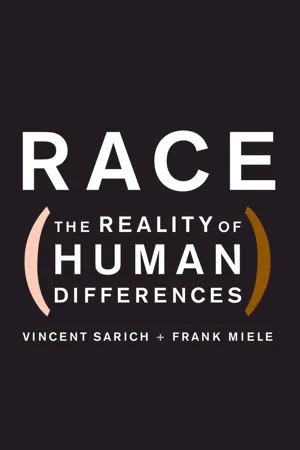
The conventional wisdom in contemporary social science claims that human races are not biologically valid categories. Many argue the very words 'race' and 'racial differences' should be abolished because they support racism. In Race, Vincent Sarich and Frank Miele challenge both these tenets. First, they cite the historical record, the art and literature of other civilizations and cultures, morphological studies, cognitive psychology, and the latest research in medical genetics, forensics, and the human genome to demonstrate that racial differences are not trivial, but very real. They conclude with the paradox that, while, scientific honesty requires forthright recognition of racial differences, public policy should not recognize racial-group membership. The evidence and issues raised in this book will be of critical interest to students of race in behavioral and political science, medicine, and law.
- 304 pages
- English
- ePUB (mobile friendly)
- Available on iOS & Android
eBook - ePub
About this book
Information
CHAPTER ONE
Race and the Law
In contrast to a recent (2003), highly acclaimed PBS documentary that termed race "an illusion," a myth constructed by Europeans in the Age of Exploration to justify colonialism and slavery, we argue that race is real.
We begin the case for race by noting how one of the most contentious facets of our society, our legal system, has no trouble in recognizing either the existence of race or the ability of the average citizen to do so. Further, DNA markers have been used to identified the race of perpetrators.
We have an inborn tendency to sort people into groups. The latest evidence shows how this tendency can mirror biological reality.
Some twenty years ago, coauthor Vincent. Sarich received a call from a San Francisco attorney who was serving as defense attorney in a racial discrimination case brought by a man who claimed he had been discriminated against because of his American Indian ancestry. As part of their discussion, the question of legal "standing" arose; that is, did the plaintiff actually have the requisite racial ancestry—was he, in fact, an Indian? Vince naively asked for the legal definition of "race" and was told there wasn't one. Still, in the spirit of scientific inquiry, he observed the proceedings until the first break, at which point he told the attorney that, in his opinion, the attorney's client had no chance of arguing successfully that the plaintiff lacked standing. To Vince's eyes, the plaintiff obviously "looked" Amerindian. End of case.
As we began working on this book, we discussed the issue of the legal definition of "race" and asked the opinion of an attorney who specializes in civil rights law, which touches on this issue. He informed us that there is still no legal definition of "race"; nor, as far as we know, does it appear that the legal system feels the need for one. Thus, it appears that the most adversarial part of our complex society, the legal system, not only continues to accept the existence of "race" but also relies on the ability of the average individual to sort people into races. Our legal system treats "racial identification" as self-evident, whereas an increasing number of anthropologists (the profession, one would think, with the pertinent expertise) have signed on to proclamations that categorically state the term has long ago ceased to have any scientific legitimacy.
Why this clash? To us the answer is simple: The courts have come to accept the commonsense definition of race, and it is this commonsense view that, as we show, best conforms to reality. A look at two recent (2000) cases is illustrative. In both Rice v. Office of Hawaiian Affairs and in Haak v. Rochester School District, neither side raised any questions about the existence of human races or the ability of the average citizen to make valid judgments as to who belongs to which race (even if the racial categories are euphemistically termed "peoples" or "populations"). No special expertise was assumed or granted in defining or recognizing race other than the everyday commonsense usage, as given in the Oxford English Dictionary, that a race is "a group of persons connected by common descent" or "a tribe, nation, or people, regarded as of common stock." The courts and the contending parties, in effect, accepted as givens the existence of race and the ability of the ordinary person to distinguish between races based on a set of physical features.
Rice V. Office of Hawaiian Affairs—Race by Any Other Name Is Still Race
In the first case, the United States Supreme Court reversed a judgment of the 9th Circuit Court of Appeals. The petitioner, H. F. Rice, had challenged the State of Hawaii for not allowing him to vote in an election for the nine trustees of the Office of Hawaiian Affairs, an agency that administers programs designed for the benefit of "Hawaiians."
Originally, "Hawaiian" was defined as "any descendant of the races inhabiting the Hawaiian Islands, prior to 1788" [the year the first European, Captain James Cook, reached the islands]. That was later changed to "any descendant of the aboriginal peoples which exercised sovereignty and subsisted in the Hawaiian Islands in 1778, and which peoples thereafter have continued to reside in Hawaii." The term "Native Hawaiian" was defined as "any descendant of not less than one-half part of the races inhabiting the Hawaiian Islands previous to 1778—provided that the definition identically refers to the descendants of such blood quantum of such aboriginal peoples which exercised sovereignty and subsisted in the Hawaiians in 1778, and which peoples thereafter continued to reside in Hawaii."
The tortuous, convoluted text in the Hawaii statutes is not just the usual legalese. Both the drafters of the amendments and the court in its decision admitted that the substitution of "peoples" for "races" was cosmetic, not substantive, and that "peoples" does indeed mean "races." The sole reason for the changes was to banish any mention of the offending word, "race," and substitute a palatable euphemism.
Rice, everyone agreed, was a Hawaiian citizen but without the requisite ancestry to be recognized as "Hawaiian" under state law. The state therefore argued that denying Rice the vote in the OH A election was justified, and the 9 th Circuit concurred when Rice challenged.
However, the U.S. Supreme Court reversed the 9th Circuit by a 7-2 margin (Stevens and Ginsburg dissenting), citing in particular the 15th Amendment: "The right of the citizens of the United States to vote shall not be denied or abridged by the United States or by any State on account of race, color, or previous condition of servitude." The Court found the Hawaiian law unconstitutional because it defined voter eligibility on the basis of race.
The 15th Amendment is explicit—race means what the average person thinks it means—and the majority of the Supreme Court read it that way. In the end, the tortuous, convoluted verbiage introduced into the Hawaiian statutes to avoid the offensive term "race" accomplished nothing.
Haak V. Rochester School District—What We See Is What You Get
In the other case, the 2nd Circuit Court of Appeals ruled that a white fourth-grade student named Jessica Haak could not transfer from her home district to an adjoining, primarily white district because the transfer program was enacted for the explicit purpose of lessening racial isolation among the six districts involved. The plaintiffs, Haak's parents, challenged on the grounds that denying the right to transfer based upon racial classification violated the clause in section 1 of the 14th Amendment, which makes it unconstitutional for any state to "deny any person within its jurisdiction the equal protection of the law." The district court ruled in Haak's favor, hut the 2nd Circuit overturned that decision, noting that although the U. S. Supreme Court had had many opportunities to rule that race could not be used as a factor in deciding who attended which school, it had never taken the opportunity to establish a precedent by doing so.
In Haak, neither side even raised the issue of who belonged to which group (race or ethnicity). A "minority pupil" was defined as "a pupil who is of Black or Hispanic origin or is a member of another minority group that historically has been the subject of discrimination." Interestingly, however, neither the application to transfer under the program, the program brochures, nor the acknowledgment letter sent to parents who apply provides any standard by which to establish a student's race or ethnicity. Parents are expected to self-screen their children. Once the applicant is met in person by a program administrator, a question may be raised as to the student's race as a result of the, student's "name, manner of speaking and phrasing, and personal appearance during an interview or orientation." Even so, it seems that Haak, who is white, was accepted into the program by the school's assistant principal and sent an official letter of acknowledgment. That acceptance was revoked after a second administrator saw Haak in person and verified her race as Caucasian/White according to the school district's records, therefore making her ineligible for the transfer program.
The critical points here are that in both Rice and Haak, neither side raised any questions about the existence of human races or the ability of the average citizen to make valid judgments as to who belongs to which race. No special expertise was assumed or granted in defining or recognizing race other than the everyday usage of the term. In Rice, the court, in effect, took judicial notice of the commonsense definition of race. In Haak, the court accepted physical appearance as a valid means by which the average citizen can recognize races and distinguish among them.
The Hawaii statutes at issue in Rice were inventively drafted to include the word "ancestry" for fear that the term "race" would be grounds to strike down the law. Notwithstanding the convoluted definition of having Hawaiian "ancestry," the definition maps quite well to the commonsense definition of "race." In short, the courts accepted the existence of race, even if the legislature was afraid to use the offending word. The Supreme Court struck down the Hawaii law because its definition of being Hawaiian based on ancestry was for all intents and purposes the equivalent of the commonsense definition of race and so was expressly prohibited by the 14th Amendment.
In Haak, the plaintiffs did not dispute that the school administrator (or anyone else, for that matter) correctly identified or was able to identify Haak's race. Rather, they contested the constitutionality of a law that discriminates on the basis of race. The ability to determine race was assumed and accepted by both parties and by the court.
Should the Criminal Justice System Recognize That Race Is Real?
A critical question is whether the courts recognize the existence of race as a mere social construct or as an underlying biological reality. In taking statements from witnesses and in courtroom testimony, the criminal justice system routinely, and with little or no complaint, accepts statements such as "The perpetrator was identified as a male, Caucasian, about twenty-five years old," or "The little girl I saw abducted in the parking lot looked like she was Hispanic or a fair-skinned African American." But consider a recent example in which accepting the existence of race as a biological reality, rather than "race" as a social construct of Western society, became a matter of life and death.
Throughout 2002 and the first half of 2003, Louisiana police were hunting for a serial killer who had murdered at least five women in the Baton Rouge area. Relying on tips and two eyewitness accounts of a white male allegedly driving a white pickup truck containing the body of a slumped, naked white female on the night of one of the murders, police focused the search on white males. A host of experimental research has demonstrated that eyewitness testimony of an unexpected event that is viewed only briefly is notoriously unreliable in far more than racial identification. Perhaps the best-known real-life example is the number of observers who report planes bursting into flames before they crash; later examination of the wreckage shows that there was no in-flight explosion. However, in the Louisiana serial-killer case, another eyewitness, a neighbor of one of the victims, frustrated that the police were restricting their search to whites, circulated a flyer with a composi te sketch of the perpetrator the neighbor thought he saw— a black male who it turned out closely resembled Derrick Todd Lee.
The state police crime lab had linked all five cases to the same perpetrator by using the minimum of thirteen DNA markers required by the FBI forensic crime lab for individual identification. (DNA markers are sequences in the complete, human genome that can identify a person's ancestry or parentage.) If the thirteen markers in samples taken either from two of the victims or, more likely, from a victim and a suspect, are the same, the probability that they come from the same individual is virtually certain, about the same probability as flipping a coin thirteen times and getting the same result or verifying a thirteen-digit credit card or bank account number. The odds of misidentification are effectively about one in a billion.
In the Baton Rouge case, samples of the perpetrator's DNA (probably from semen, though not specified in the reports we read) were taken from the victims' bodies. Holding firm in their belief that almost all serial murderers are white, the police swabbed the cheeks of more than 600 white male suspects for DNA analysis to see if they matched the samples taken from the victims.
We should note here that this method of individual DNA matching, sometimes called "DNA fingerprinting," has also cleared suspects and provided grounds for appeal. Since 1992, the Innocence Project at Yeshiva University's Cardozo School of Law, headed by Barry Scheck and Peter Neufeld (best known as defense attorneys in the O. J. Simpson criminal trial), alone has freed over thirty-five people wrongly convicted, including a number of African Americans. DNA is also used in paternity testing; evaluating kinship in inheritance disputes; and missing-persons cases, especially in identifying kidnapped children who may be unable or afraid to speak to the police on their own behalf. In 1993 a two-year-old was returned to his parents two years after being kidnapped only after police established scientifically who the child was by using genetic fingerprinting. DNA profiling is so accurate that it is highly recommended by law enforcement departments around the United States to protect individuals in the event of abduction or kidnapping.
Thirteen markers are sufficient to determine a reliable individual match, but more are needed to sort individuals by race correctly. Technically, the thirteen markers used by the FBI for individual DNA fingerprinting are termed "short tandem repeats" (STRs). They are repetitions of the same sequence of base pairs in junk (noncoding) DNA. Junk DNA is just that. It is not responsible, to the best of our knowledge, for any trait or variation within a trait. There is more junk DNA than one might think. The current estimate is somewhere over 90 percent of the total. However, it is possible that science has yet to determine the function of some so called junk DNA. The particular thirteen STRs used in the FBI Combined DNA Index System, or CODIS, were selected because they can be rapidly determined from very small amounts of DNA, using commercially available kits; more important to the discussion here, laboratories worldwide are contributing to the analysis of STR allele frequencies in different human populations.
The, seventy-three genetic markers used in the DNAPrint methodology (commercialized by DNAPrint Genomics), on the other hand, are termed "single nucleotide polymorphisms" (SNPs, pronounced "snips"). Each SNP is a specific place on the DNA molecule that can have one or more of the variant nucleotides (adenine, guanine, cytosine, or thymine [A, G, C, T]) in the population, termed "alleles." Certain alleles are more common in some races than in others, and sometimes, much more so. These have been called "ancestry informative markers" (AIMs). Just one or two or six AIMs are not enough to establish a person's race, that is, genetic ancestry. The more AIMs examined, the greater the probability of accurately determining the person's race. (The same holds true for physical racial characteristics and for blood groups— the more predictors, the greater the accuracy of the prediction— but AIMs are much more powerful). Repeatable, independent academic research has established that with 100 genetic markers, it is possible to sort people whose known ancestors are from Africa, Europe, Asia, or the Americas with almost 100 percent accuracy. DNAPrint Genomics has reduced the number of AIMs required to seventy-three and extended the methodology to determine the percentage of racial background in people of mixed ancestry.
After examining seventy-three DNA markers, Tony Frudakis of DNA Print Genomics told the Baton Rouge serial-killer task force in the first week of March 2003 that it should shift its focus from white suspects to an African American of average skin tone, because his analysis indicated the perpetrator had 85 percent sub Saharan African and 15 percent Native American ancestry The seventy-three-marker DNAPrint, which became sufficiently developed for this type of investigation only in early 2003, determines an individual's proportion of East Asian, Indo-European, Native American, and sub-Saharan African ancestry and then compares these proportions against a database of 300 to 400 people already typed to produce a comparable skin tone. A suspect fitting the racial profile, thirty-four-year-old Derrick Todd Lee of St. Francisville, whose DNA matched that found at the crime scenes and who was indeed recognizably black, was arrested and charged with first-degree murder, rape, kidnapping, and burglary.
The methods of behavioral profiling that have been highly promoted in both blockbuster movies and "real crime" TV shows misled the police in the Baton Rouge case, because their compilation of cases supposedly solved showed the vast majority of serial killers to be white males ages 25-35. The DNAPrint methodology is correct at a rate as high as that for the individual DNA fingerprinting that is accepted as legally valid. As of mid-2003, there had been no independent confirmation of the DNAPrint methodology, but Frudakis told ABC News in June 2003 that in 3,000 blind tests (in which each person's self-reported race was unknown to technicians doing the DNA analysis), there was not a single error.
The Baton Rouge case is not the first time police have used DNA samples to identify or narrow the list of potential suspects. For over a year, Britain's Forensic Science Service (FSS) has employed what the agency terms "DNA photofitting," in which the genetic markers in the suspect's DNA found at a crime site are compared against a database of DNA markers that are more common in one race than in others. FSS even tests the suspect's sample for a gene associated with red hair.
It "race" were a mere social construction based upon a few highly visible features, it would have no statistical correlation with the DNA markers that indicate genetic relatedness. The maximum degree of genetic relatedness an individual has is with himself or herself—or with an identical twin (or two identical triplets, and so on). There is also a certain amount of "family resemblance" in facial features and the like, especially in groups that tend to marry among themselves. If the commonsense recognition of races based on a relatively small set of physical features reflects an underlying biological reality, then those visible features should be correlated with genetic resemblance (as measured by DNA markers) as well as with self-reported ancestry.
Unless race is a biological reality that gives important information about an individual's degree of genetic resemblance to the various human populations and the sequence in which those populations evolved by separating from other populations, it would be inconceivable to achieve the level of accuracy obtainable through the DNAPrint methodology. Indeed, given...
Table of contents
- Cover
- Title
- Copyright
- Dedication
- Contents
- Preface: Why Another Book on Race?
- Acknowledgments
- Opening Statement: The Case for Race
- 1 Race and the Law
- 2 Race and History
- 3 Anthropology as the Science of Race
- 4 Resolving the Primate Tree
- 5 Homo sapiens and Its Races
- 6 The Two "Miracles" That Made Humankind
- 7 Race and Physical Differences
- 8 Race and Behavior
- 9 Learning to Live with Race
- Notes
- Index
Trusted by 375,005 students
Access to over 1.5 million titles for a fair monthly price.
Study more efficiently using our study tools.
Frequently asked questions
Yes, you can cancel anytime from the Subscription tab in your account settings on the Perlego website. Your subscription will stay active until the end of your current billing period. Learn how to cancel your subscription
No, books cannot be downloaded as external files, such as PDFs, for use outside of Perlego. However, you can download books within the Perlego app for offline reading on mobile or tablet. Learn how to download books offline
Perlego offers two plans: Essential and Complete
- Essential is ideal for learners and professionals who enjoy exploring a wide range of subjects. Access the Essential Library with 800,000+ trusted titles and best-sellers across business, personal growth, and the humanities. Includes unlimited reading time and Standard Read Aloud voice.
- Complete: Perfect for advanced learners and researchers needing full, unrestricted access. Unlock 1.5M+ books across hundreds of subjects, including academic and specialized titles. The Complete Plan also includes advanced features like Premium Read Aloud and Research Assistant.
We are an online textbook subscription service, where you can get access to an entire online library for less than the price of a single book per month. With over 1.5 million books across 990+ topics, we’ve got you covered! Learn about our mission
Look out for the read-aloud symbol on your next book to see if you can listen to it. The read-aloud tool reads text aloud for you, highlighting the text as it is being read. You can pause it, speed it up and slow it down. Learn more about Read Aloud
Yes! You can use the Perlego app on both iOS and Android devices to read anytime, anywhere — even offline. Perfect for commutes or when you’re on the go.
Please note we cannot support devices running on iOS 13 and Android 7 or earlier. Learn more about using the app
Please note we cannot support devices running on iOS 13 and Android 7 or earlier. Learn more about using the app
Yes, you can access Race by Vincent Sarich,Frank Miele in PDF and/or ePUB format, as well as other popular books in Social Sciences & Genetics & Genomics. We have over 1.5 million books available in our catalogue for you to explore.