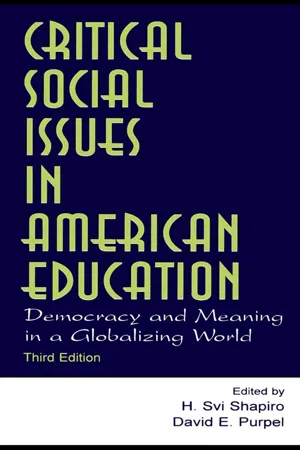
This text-reader brings together powerful readings that critically situate issues of education in the context of the major cultural, moral, political, economic, ecological, and spiritual crises that confront us as a nation and a global community. It provides a focus and a conceptual framework for thinking about education in light of these issues. Readers are exposed to the thinking of some of the best and most insightful social and educational commentators.
Critical Social Issues in American Education: Democracy and Meaning in a Globalizing World, Third Edition, is intended to work on two levels. First, it helps readers to develop an awareness of how education is connected to the wider social structures of cultural, political, and economic life. Second, it encourages not only a critical examination of our present social reality but also a serious discussion of alternatives--of what a transformed society and educational process might look like.
The editors' goal is to deliberately engage readers in connecting the work of teachers to an ethically committed, politically charged pedagogy. The assumption on which they base the text is that educators must see their work as inextricably linked to the broader conflicts, stresses, and crises of the social world--it is not otherwise possible to make sense of what is happening educationally. What happens in school, or as part of the educational experience, reflects, expresses, and mediates profound questions about the direction and nature of the society we inhabit.
The text is organized thematically into five sections, which address, respectively, social justice and democracy; consumerism, culture, and public education; marginality and difference; moral and spiritual perspectives on education; and globalization and education. Each section is preceded by a brief essay that introduces the readings.
This Third Edition includes many new readings and addresses issues that have more recently emerged as especially significant--such as concerns about the implications of globalization and the post 9/11 world, commercialism, violence, and the ever-increasing influence of high stakes testing.
This compelling text is relevant for a wide range of courses in educational foundations, educational policy, curriculum studies, and multicultural education that address the social context of education, cultural and political change, and public policy.
eBook - ePub
Critical Social Issues in American Education
Democracy and Meaning in a Globalizing World
- 520 pages
- English
- ePUB (mobile friendly)
- Available on iOS & Android
eBook - ePub
Critical Social Issues in American Education
Democracy and Meaning in a Globalizing World
About this book
Information
V
GLOBALIZATION AND EDUCATION: THE 21ST-CENTURY CHALLENGE
In the final section of this book, we look at the issue of globalization—arguably the most significant concern facing humankind in the new century. Some would note, however, that globalization is not really that new—that the process by which human beings and societies become ever more interconnected with one another has been developing for hundreds of years. Although this is clearly accurate, nothing really resembles the extraordinary explosion of links and connections that now binds societies and nations together and that has occurred in the last decades of the 20th century. Certainly there is nothing comparable to the compression of time and space that new technologies have made possible in the last few years. Such technologies have begun to radically undermine the existing borders, boundaries, and identities that marked our world, as well our definitions of who we are. To a degree previously unimaginable, a world system has emerged that has begun to eclipse the old system of autarchic nation states. Of course this process has occurred in ways that are asymmetrical in terms of power and cultural influence. As a result, globalization confronts the world with unprecedented stresses and tensions that, at least in the United States, made the events of September 11, 2001, a moment in which the new global condition burst upon a largely unaware population.
Of course this is not to say that American workers were unaware of the way that, throughout the 1980s and 1990s, a new economic order was emerging that gave unprecedented power to transnational economic interests to reshape work and employment. Workers in manufacturing especially suffered a devastating loss of jobs as the new regime of unrestricted free trade made it possible for companies to move their businesses to wherever labor was cheapest, and legislation affecting things like work conditions and the environment was the least onerous to companies. In some respects, there was a race to the bottom as big business could pursue the biggest profits through setting up shop in places where workers could be paid the least. The new regime of global flexibility was also manifest in finance, where banking and other interests could speculate in international currencies through almost instantaneous movements of vast, often unimaginable, sums of money made possible through recently developed information technologies. All of this meant a world in which there was, simultaneously, unprecedented opportunities to amass huge sums of wealth while, for many working- and middle-class people, extraordinary economic uncertainty. Massive layoffs, financial bubbles, industrial sweat shops, communal and environmental deterioration, and company mergers and buyouts are the fallout of the brave new world of the global economic system. Although there was certainly convincing evidence in some areas that globalization had provided new jobs and opportunities, it was also undeniably certain that the world witnessed horrifying levels of human exploitation and social inequality. U.N. surveys in the 1990s indicated that one half of the world’s population lived on less than $2 a day, and that one third of the world’s population had a life expectancy of under 40 years.
Alongside the problems of economic insecurity and the terrible levels of poverty in many parts of the world (women, it should be noted, bore the brunt of the latter, representing fully 70% of the world’s 1 billion poor), critics of globalization argued that the new global order represented a major threat to democracy. With corporations becoming transnational—neither restricted by nor beholden to the polity of a particular country, major economic decisions being made by international bodies like the WTO or the IMF usually behind closed doors with representatives of labor or environmental organizations largely excluded—the policies and agenda that shaped the everyday lives of citizens were now formulated outside of their influence and scrutiny. In other words, the core features of a democracy in which citizens could participate and shape the conditions that affected their lives were being seriously undermined. Indeed more than this, the very locus of civic activity—the nation state—was being sidelined as the major economic players on the international scene saw the entire planet as the potential stage for their activities. Of course it is this fact that has been central to much of the international protests against globalization. Such protests have brought together, in an unprecedented way, labor unions, environmental groups, and fair trade activists across the world who have protested the lack of democracy in the emerging global order as well as the growing inequities between the haves and have-nots resulting from neoliberal economic policies. As educators, globalization requires now that we think again about education’s responsibilities in the making of a democratic culture. We must now consider what it means to educate for a global citizenship in which questions of the rights of consumers and workers, as well environmental responsibilities, must be looked at on a planetary scale. Of course such a vision of citizenship places a new emphasis on universal human rights that cannot be separated from questions of economic and social justice. Among the latter, special attention is required concerning the misery of so many children and young people disfigured by poverty, child labor, military conscription, and sexual exploitation.
The occasional disruptions of such protests pale, of course, when compared to the horrific violence of international terrorism in this era of globalization. Yet again it is important to locate this violence in the context of the economic and cultural changes such globalization is producing. We have already alluded to the terrible levels of material deprivation and economic hopelessness that grip so many people in the world—especially among the young. Poverty in the world is, of course, not new in human history. What is new, however, is the pervasive exposure of people all over the world to the bombardment of tantalizing and seductive images that offer a view of how others live, especially in the affluent West. The relentless emphasis on buying, wealth, sex, and violence simultaneously feeds the desires, fantasies, frustrations, and resentments of many around the world. This insidious spectacle of the West, and America in particular, becomes the focal point for the pent-up fury of those who are outraged by its cultural, economic, and political influence. Of course we are not suggesting here that forms of religious fanaticism really offer a viable or humane, let alone democratic, response to the crisis of our increasingly global culture. The very opposite certainly seems to be the case, compounding the problems that beset so many people and unleashing new forms of violence, hatred, and authoritarianism.
In the affluent world, the infusion of unfamiliar cultures has also brought a new intolerance. Borders have become more permeable not just to goods and money, but also to people. Globalization has brought with it huge influxes of migrant workers looking for jobs and economic possibility. Such movements of people into hitherto settled communities have stimulated new fears and hostilities—anxieties about the presence of strange cultures and religious practices, unfamiliar faces and languages, and competition for jobs. Throughout Europe and North America, such developments have been the catalyst for extreme right-wing parties that express the angst of the local populations. The spread of fear, intolerance, bigotry, and absolutist approaches to religious belief makes new demands on the work of educators. The latter are challenged to respond to the rising culture of fear and apprehension with renewed emphasis on the value of diversity, pluralism, tolerance, and compassion toward others in our midst. Beyond this is the importance of developing a more complex understanding of the interconnected and relational nature of all culture and human identity as we seek to combat all forms of absolutism and essentialism.
Our readings focus on a number of these themes. Naomi Klein’s piece (chap. 24, this volume) from her influential book on globalization looks at the process of enforced casualization—the way that jobs are being reshaped away from full-time, secure employment into part-time, temporary, and freelance labor, which allows corporations to keep overheads down and have minimal responsibilities to their employees. David Held (chap. 27, this volume) examines a central element of the current ideology—the belief that economic growth is the key to meeting human needs and alleviating poverty. His article provides a contrary picture of the devastating effects of unrestricted growth on human communities and well-being as well as on the environment. In his chapter, Held argues that the contemporary forms of globalization necessitate new forms of democratic polity—“a community of democratic communities” that reflects the need for transnational, cross-border structures of political action. These new political communities would recognize that we now live in a complex, interconnected world that requires radically different forms of citizenship and civic cultures. Edmund O’Sullivan (chap. 25, this volume) argues that the fundamental educational task of our time is to make “the choice for a sustainable global planetary habitat of interdependent life forms over and against the global competitive market-place.” O’Sullivan asserts that educational institutions have been major apologists for industrial society and part of the hegemonic process that mediates the fantasies of consumer culture. Zygmunt Bauman (chap. 26, this volume) reflects on the explosion of politics and thought around issues of identity in recent times. There is, he argues, a paradoxical relationship between such concerns and the process of globalization; as established political institutions are sapped of their capacity to have much effect on things, so alternative modes of collective action emerge. These communities of identity offer a sense of security, confidence, and meaning in a world that seems to escape effective control and encourages privatization and individualization. Identity builders, says Bauman, seek pegs on which they can hang together their individually experienced fears and anxieties. Finally, Svi Shapiro (chap. 28, this volume) considers the lessons of September 11. Condemning the lack of serious engagement in schools with the events of this day, Shapiro suggests a number of important moral and political implications that include looking at the meaning of modernity on traditional cultures, the connection between rage and social injustice, the dangers of demonizing the other, and the need to regain our sense of value for public service. Of course only some of these articles directly relate to education. Yet it is our belief that all of them raise issues that are of immense significance in the world that will confront our children. It is surely our task as educators to find ways to address these concerns in preparing young lives for this new world. We can do no less.
24
Threats and Temps*
Naomi Klein
A sense of impermanence is blowing through the labor force, destabilizing everyone from office temps to high-tech independent contractors to restaurant and retail clerks. Factory jobs are being outsourced, garment jobs are morphing into homework, and in every industry, temporary contracts are replacing full, secure employment. In a growing number of instances, even CEOs are opting for shorter stints at one corporation after another, breezing in and out of different corner offices and purging half the employees as they come and go.
Almost every major labor battle of the decade has focused not on wage issues but on enforced casualization, from the United Parcel Service workers’ stand against “part-time America” to the unionized Australian dockworkers fighting their replacement by contract workers, to the Canadian autoworkers at Ford and Chrysler striking against the outsourcing of their jobs to nonunion factories. All these stories are about different industries doing variations on the same thing: finding ways to cut ties to their workforce and travel light. The underbelly of the shiny “brands, not products” revelation can be seen increasingly in every workplace around the globe. Every corporation wants a fluid reserve of part-timers, temps, and freelancers to help it keep overheads down and ride the twists and turns in the market. As British management consultant Charles Handy says, savvy companies prefer to see themselves as “organizers” of collections of contractors, as opposed to “employment organizations.”1 One thing is certain: offering employment—the steady kind, with benefits, holiday pay, a measure of security, and maybe even union representation—has fallen out of economic fashion.
BRANDED WORK: HOBBIES, NOT JOBS
Though an entire class of consumer-goods companies has transcended the need to produce what it sells, so far not even the most weightless multinationa...
Table of contents
- Cover Page
- Title Page
- Copyright Page
- Preface
- Introduction
- I Social Justice And Democracy: Unmet Promises
- II Schools For Sale: Consumerism, Corporate Culture, And Public Education
- III Marginality And Difference: The Fractured Community
- IV Critique And Hope: Moral And Spiritual Perspectives On Education
- V Globalization And Education: The 21ST-Century Challenge
Trusted by 375,005 students
Access to over 1.5 million titles for a fair monthly price.
Study more efficiently using our study tools.
Frequently asked questions
Yes, you can cancel anytime from the Subscription tab in your account settings on the Perlego website. Your subscription will stay active until the end of your current billing period. Learn how to cancel your subscription
No, books cannot be downloaded as external files, such as PDFs, for use outside of Perlego. However, you can download books within the Perlego app for offline reading on mobile or tablet. Learn how to download books offline
Perlego offers two plans: Essential and Complete
- Essential is ideal for learners and professionals who enjoy exploring a wide range of subjects. Access the Essential Library with 800,000+ trusted titles and best-sellers across business, personal growth, and the humanities. Includes unlimited reading time and Standard Read Aloud voice.
- Complete: Perfect for advanced learners and researchers needing full, unrestricted access. Unlock 1.5M+ books across hundreds of subjects, including academic and specialized titles. The Complete Plan also includes advanced features like Premium Read Aloud and Research Assistant.
We are an online textbook subscription service, where you can get access to an entire online library for less than the price of a single book per month. With over 1.5 million books across 990+ topics, we’ve got you covered! Learn about our mission
Look out for the read-aloud symbol on your next book to see if you can listen to it. The read-aloud tool reads text aloud for you, highlighting the text as it is being read. You can pause it, speed it up and slow it down. Learn more about Read Aloud
Yes! You can use the Perlego app on both iOS and Android devices to read anytime, anywhere — even offline. Perfect for commutes or when you’re on the go.
Please note we cannot support devices running on iOS 13 and Android 7 or earlier. Learn more about using the app
Please note we cannot support devices running on iOS 13 and Android 7 or earlier. Learn more about using the app
Yes, you can access Critical Social Issues in American Education by H. Svi Shapiro,David E. Purpel in PDF and/or ePUB format, as well as other popular books in Education & Education General. We have over 1.5 million books available in our catalogue for you to explore.