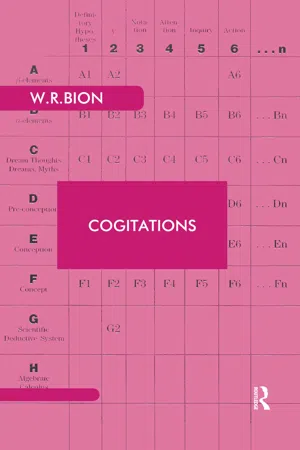
Cogitations, the last of the posthumous publications, is a collection of occasional writings representing Bion's attempts to clarify and evaluate both his own ideas and those of others by casting them in written form and frequently addressing them to an imaginary audience. Covering a period between February 1958 and April 1979, Cogitations delves into a wide range of material - psychoanalysis and science, mathematics and logic, literature and semantics. Some form a background to Bion's theoretical development, showing the doubts and arguments leading to the ideas expressed in his books, others highlighting and detailing some of the more abstract points in them, and some exploring topics destined for books that were to remain unwritten.
- 424 pages
- English
- ePUB (mobile friendly)
- Available on iOS & Android
eBook - ePub
Cogitations
About this book
Information
1 August 1959
Freud says,
It is easy to see how the remarkable preference shown by the memory in dreams for indifferent, and consequently unnoticed, elements in waking experience is bound to lead people to overlook in general the dependence of dreams upon waking life and all events to make it difficult in any particular instance to prove that dependence. [Interpretation of Dreams, 1900a, SE 4, p. 19]
My belief is that the dependence of waking life on dreams has been overlooked and is even more important. Waking life = ego activity, and in particular the play of logical thought on the synthesis of elements, i.e. particles characteristic of the paranoid-schizoid position. The function of the dream is to render these elements suitable for storage, and so to constitute the contents of what we call memory. Waking life = ego activity = logical operation. This in turn is essential for synthesis and communicability or public-ation.
‘The way in which memory behaves in dreams is undoubtedly of the greatest importance for any theory of memory in general’ [Interpretation of Dreams, 1900a, SE 4, p. 20]. In my idea above, the dream symbolization and dream-work is what makes memory possible.
2 August 1959
Vomiting and greed as most recalcitrant symptoms: the intense desire to chew and then to feel it going down; the movement of the jaws, the biting is very satisfactory. Some feeling of rebellion likewise—a kind of “Why-should-I-be-denied-the-good-things-of-life?” attitude. The good things are denied because the desire is to chew, and the object is only within visual grasp. But then the destructiveness is transferred to, and is consequently felt to impregnate, looking itself.
Much the same is true of smell as of sight, in that with neither sense must the object be in the physical contact necessary for biting and chewing. Good smells are felt to be turned into bad by the destructiveness with which they are savoured.
This frustration carries over into a relationship with the man’s anus because he is predominantly representing the cruelly destroyed breast. Or, rather, the masculine anus represents it, and is itself a cruelly destructive mouth ‘producing’ bad smells and bad food.
Stammering is also most recalcitrant. Intolerance of frustration leads to intolerance of stimulation.
* * *
Dreams
We close our most important sensory channels, our eyes, and try to protect the other senses from all stimuli or from any modification of the stimuli acting on them.
The sensory stimuli that reach us during sleep may very well become sources of dreams. [Freud, Interpretation of Dreams, 1900a, SE 4, p. 23]
Then why is it that dreams we report, or have reported to us, are so often in terms of visual images?
Is it not a ‘modification of the stimuli’ reaching us? And could this be something to do with the dream-work as an attempt to achieve ‘common sense’ as part of the synthesizing function of the dream? It may be an aspect of ‘linking’ one sense to another; the transformation of tactile stimuli into visual excretions as in hallucination. If this is so, it would fit in with Freud’s idea that sleep is to be preserved. [Interpretation of Dreams, 1900a, SE 5, p. 573 et seq.]. The hallucinated patient then would be doing what I said he was doing when I described him as taking in the interpretation and evacuating it as far as possible away from himself by ‘seeing’ it, i.e. visually evacuating it as a hallucination. If this is so, the dream proper may be an attempt at visual and flatus-like evacuation.
Calculus formation notes
There is a need for a sign for ‘contributes to’ = ‘adds to’ = ‘augments’.
Thus: greed, frustration ‘augments’ envy.
Also a sign for ‘initiates’ = ‘generates’.
Thus: greed, frustration ‘generates’ hallucination. Or, frustration, intolerance ‘generates’ hallucination.
Also a symbol or sign for ‘of’, meaning ‘associated with’, so as to express frustration ‘of’ sexual desire in the sense of the frustration being particularized as to the stimulus involved.
3 August 1959
A dream can be concerned with evacuation of an undesired thought, feeling, image, or with its storage. In either instance it must convert either an empirical external fact or an internal psychic reality into a form that renders it suitable for storage or evacuation. In this respect, too, it seems analogous to a digestive process. But is it? Or is it not that the ‘name’ of the process is similar to the ‘name’ of the digestive process? From where does this seeming similarity arise?
4 August 1959
One way of dealing with the problem of scientific evidence for dream theories would be to restrict the search for data to experience shared by analyst and patient, or at which analyst and patient are both present. Such occasions might be all those on which the patient said he had had a dream, or all those on which there appear to be events taking place, e.g. the patient sits up and looks around in a dazed way; the analyst, identifying himself with the patient, feels that the experience the patient is having would be more understandable if the patient were asleep and dreaming.
‘More understandable’ Why? Because it is more appropriate to the facts as the analyst sees them. But this means that if the analyst were feeling what the patient seems to be feeling, then he, the analyst, would be disposed to say, “I must have been dreaming”.
Just then I found I had been asleep; just before I woke I seemed to be saying to F that I was feeling I was going mad because I could not sort out the feeling I was having in the dream about having a dream and who I was. The dream seemed to be that I was trying to solve the problem I am in fact trying to solve, but with the addition of the fear of going mad—a sort of mental disintegration.
Last night, as I was trying to understand a passage in Quine’s Mathematical Logic [p. 31] in which ‘negative’ occurred, I had a dream—having fallen into a sleep or doze—in which a negro appeared. The dream, I thought as I wakened, was associated with ‘neg’ being both negro and negative. But why did I not write it down then? And now I think of negative and native: ‘natives’ is associated with memories of India, my mother, and natives as being coloured people like Indians who were ‘inferior’. Also ‘dative’ as being a present, and dates which I liked. ‘Ablative’, to lift off or take away. Negro, as he appeared in the dream, now seems to me to be not a real person but an ideogram. My theory is that this ideogram has enabled me to store all these ideas which I am now producing—maybe because I am a dreamer. Perhaps there is a class of persons, or a class of dreamers, to which it might be useful to say some people belong. If so, and if it is true that schizophrenics cannot dream, it would need to be stated that they were not members of that class. (A point to remember in the elaboration of a theoretical deductive system for the schizophrenic patient.)
What do I mean by saying that the negro in the dream was not a real person? Of course he was not. But I suppose that while I was asleep and in that part of mind, if any, in which I am still asleep, he must have been thought of as just a real person, a fact, what I have called an ‘undigested fact’. But now I regard him as an ideogram, and this means that some fact has been ‘digested’ and that the visual image of the negro, which I am now recalling, is a significant element in the process of (the mental counterpart of) digestion. Are ‘undigested facts’ then used in the process of ‘digesting’ other facts? Is their ‘indigestibility’ a quality that renders them useful for this function, as if it were some kind of container for an eroding liquid which must be able itself to resist the erosion by its contents?
On this basis there is always some ‘undigested part’ of a dream-product (‘dream-product’ is usually called the dream itself), although my point is that if the person can dream, then he can ‘digest’ facts and so learn from experience. Obviously what is needed is to consider what ‘digesting’ facts consists of in detail.
5 August 1959
α
Frustration, according to Freud, enforces the installation of the reality principle (‘Formulations on the Two Principles of Mental Functioning’ [1911b, SE 12], pp. 218–218). But the psychotic with his hatred of reality evades the installation of the reality principle. His intolerance of frustration makes for intolerance of reality and contributes to his hatred of reality. This leads to reinforcement of projective identification as a method of evacuation. This in turn leads to dreams that are evacuations, not introjectory operations—hence ‘dreams’ of the psychotic, which are really evacuations of such α as he has been unable to prevent. The dream-elements in the psychotic dream are really the discarded residue of α-elements that have survived mutilations of α.
Thus, in the psychotic we find no capacity for reverie, no α, or a very deficient α, and so none of the capacities—or extremely macilent capacities—which depend on α, namely attention, passing of judgement, memory, and dream-pictures, or pictorial imagery that is capable of yielding associations.
But this in turn means that he destroys the capacity for thought which is essential to action in reality and which makes bearable the frustration—an essential concomitant of the interval between a wish and its fulfilment. So the psychotic’s attempt to evade frustration ends in producing a personality more than ever subject to frustration without the softening or moderating mechanism that would have been available through a and thought. In consequence he is more than ever intolerant of a frustration that is more than ever intolerable. And thus a self-perpetuating situation is created in which more and more frustration is produced by more and more effort devoted to its evasion by the destruction of the capacity for dreaming which, had he retained it, might have enabled him to moderate frustration.
* * *
How does a dream evade frustration? By distortion of facts of reality, and by displacement of facts of reality. In short, by dream-work on the perception of facts—not, in this context, dream-work on the dream-thoughts except in so far as the dream-thoughts are thoughts portraying the facts. Freud attributes to dream-work the function of concealing the facts of internal mental life only—the dream-thoughts only. I attribute to it the function of evading the frustration to which the dream-thoughts, and therefore the interpretation of dream-thoughts, would give rise if allowed to function properly—that is, as mechanisms associated with the legitimate tasks involved in real modification of frustration. Consequently, since such legitimate tasks always carry an element of frustration, excessive intolerance of frustration short-sightedly leads to the attempt at evasion of the frustration intrinsic to the task of modification of the frustration.
α is concerned with, and is identical with, unconscious waking thinking designed, as a part of the reality principle, to aid in the task of real, as opposed to pathological, modification of frustration.
* * *
Freud, approaching the problem as one of interpreting the dream [Int...
Table of contents
- Cover
- Half Title
- Title
- Copyright
- CONTENTS
- FOREWORD
- February 1958: Psychotic mechanisms
- 10 January 1959: Scientific method
- 16 May 1959: Common sense
- 12 July 1959
- 14 July 1959
- 15 July 1959: (4.30 a.m. Blast it!)
- 18 July 1959
- 24 July 1959
- [Undated]: The tropisms
- 25 July 1959
- [Undated]
- [Undated]: Schematic presentation of dreaming
- 27 July 1959
- 28 July 1959: The dream
- 1 August 1959
- 2 August 1959
- 3 August 1959
- 4 August 1959
- 5 August 1959: α
- 6 August 1959: α
- 8 August 1959
- 9 August 1959: Heisenberg: Physics and Philosophy
- 10 August 1959: Dream-work-α
- 11 August 1959
- 21 August 1959: α
- 8 September 1959: α
- 12 September 1959
- 13 September 1959
- 19 September 1959: Scientific method
- 26 September 1959
- 27 September 1959
- 29 September 1959
- 2 October 1959: X
- 4 October 1959
- 6 October 1959: X
- 7 October 1959: X
- 11 October 1959: Resistance
- 16 October 1959: Various forms of dream manifestation
- 17 October 1959: The Dream
- 25 October 1959: Truth—need for, and need to keep maladjustment in repair
- 30 October 1959: X
- [Undated]
- [Undated]: No free associations
- [Undated]: The super-ego
- [Undated]: α
- January 1960: α and objects
- [Undated]
- [Undated]: Disorder of thought
- 31 January/1 February 1960: Narcissism and social-ism
- 6 February 1960
- 11 February 1960: Compassion and truth
- 12 February 1960
- 14 February 1960: Fundamental, basic, inborn character disorder
- 17 February 1960: Animism, destructive attacks and reality
- 18 February 1960: α
- 20 February 1960: Attacks on α
- February 1960: Displacement
- 22 February 1960
- 24 February 1960: α
- 27 February 1960: Mathematics
- 28 February 1960
- [Undated]: Need for a scientific method
- [Undated]: Need for study of scientific method
- [Undated]: Commentary on the scientific deductive system
- [Undated—1960]: Analytic technique
- 27 March 1960: Technique: meaning and interpretation of associations
- [Undated—1960]: Scientific deductive system
- [Undated—1960]: The painful component
- [Undated—1960]: The synthesizing function of mathematics
- [Undated]: Communication
- August 1960: α
- [Undated—1960]: α and paranoid-schizoid position
- [Undated—1960]: Dream-work-α
- [Undated]
- [Undated]: The problem of perception: common sense and group polarity of instincts
- [Undated]
- [Undated]: Mental health
- [Undated]
- [Undated]
- [Undated]: The Oedipal chain
- [Undated]: Theorem of Pythagoras—Euclid I.47
- [Undated]: The relationship of Ps and D positions to the Oedipus complex
- [Undated]: The scientific deductive system and calculus via Euclid
- [Undated]: An interpretation
- [Undated]: Probability
- [Undated]: The attack on the analyst’s α-function
- [Undated]
- [Undated]: Curiosity, and fear of socialized super-ego
- [Undated]: Tower of Babel: possibility of using a racial myth
- [Undated]
- [Undated]: Metatheory
- [Undated]
- [Undated]: Theories for use in the psycho-analysis of disorders of thought
- [Undated]: Dispositions
- [Undated]: I know X = relationship
- [Undated]: Kinds of relatedness
- [Undated]: The cause and the selected fact
- [Undated]
- [Undated]
- March 1967: Reverence and awe
- [Undated]
- [Undated—1968]: Notes on ritual and magic
- [Undated—1968]
- [Undated—1969]
- [Undated—1969]
- [Undated—1969]
- 2 March 1969
- 21 March 1969
- [Undated—1969]: Determination of direction in a group
- August 1969
- March 1970
- May 1970
- February 1971
- [1971]
- 10 July 1971
- 14 July 1971
- 15 July 1971
- July 1971: Predictive psycho-analysis and predictive psychopathology
- [Undated]
- September 1971
- 1971: Psychiatry at a time of crisis, II
- 1971
- [November/December 1973]
- [August 1975]
- [August 1975]
- [August 1975]
- August 1975
- [August 1976]
- [August 1978]
- 8 August 1978
- [April 1979]
- Notes on memory and desire
- BION’S WORKS
- GENERAL BIBLIOGRAPHY
- INDEX
Trusted by 375,005 students
Access to over 1.5 million titles for a fair monthly price.
Study more efficiently using our study tools.
Frequently asked questions
Yes, you can cancel anytime from the Subscription tab in your account settings on the Perlego website. Your subscription will stay active until the end of your current billing period. Learn how to cancel your subscription
No, books cannot be downloaded as external files, such as PDFs, for use outside of Perlego. However, you can download books within the Perlego app for offline reading on mobile or tablet. Learn how to download books offline
Perlego offers two plans: Essential and Complete
- Essential is ideal for learners and professionals who enjoy exploring a wide range of subjects. Access the Essential Library with 800,000+ trusted titles and best-sellers across business, personal growth, and the humanities. Includes unlimited reading time and Standard Read Aloud voice.
- Complete: Perfect for advanced learners and researchers needing full, unrestricted access. Unlock 1.5M+ books across hundreds of subjects, including academic and specialized titles. The Complete Plan also includes advanced features like Premium Read Aloud and Research Assistant.
We are an online textbook subscription service, where you can get access to an entire online library for less than the price of a single book per month. With over 1.5 million books across 990+ topics, we’ve got you covered! Learn about our mission
Look out for the read-aloud symbol on your next book to see if you can listen to it. The read-aloud tool reads text aloud for you, highlighting the text as it is being read. You can pause it, speed it up and slow it down. Learn more about Read Aloud
Yes! You can use the Perlego app on both iOS and Android devices to read anytime, anywhere — even offline. Perfect for commutes or when you’re on the go.
Please note we cannot support devices running on iOS 13 and Android 7 or earlier. Learn more about using the app
Please note we cannot support devices running on iOS 13 and Android 7 or earlier. Learn more about using the app
Yes, you can access Cogitations by Wilfred R. Bion in PDF and/or ePUB format, as well as other popular books in Psychology & Epistemology in Philosophy. We have over 1.5 million books available in our catalogue for you to explore.