- 258 pages
- English
- ePUB (mobile friendly)
- Available on iOS & Android
eBook - ePub
About this book
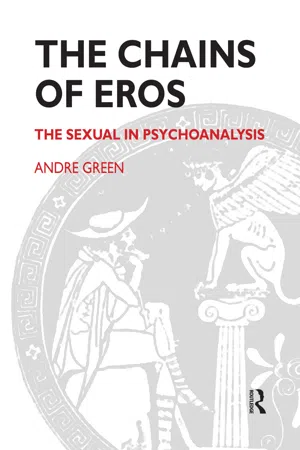
Green deplores the absence of sexuality and the erotic from current psychoanalytic theory and practice. Instead, he demonstrates how human sexuality forms an 'erotic chain'. The work of analysis, he argues, consists in following the dynamic movements of the erotic process, by ascertaining its links with other aspects of the psyche.
Information
1
Starting from the sexual
There is no doubt that, following the practical applications of discoveries in biology, in the last fifty years human sexuality has undergone a significant transformation. Unlike other advances in biology which, while improving the lot of those afflicted by diseases, are restricted in their practical usage to the alleviation of suffering, in this domain medical intervention has had far broader repercussions on the way the relations between men and women are lived, beyond any instance of pathology. This is true in the case of contraception, which has revolutionised sexual practices. One could give endless examples to show how what had appeared unchangeable for centuries from one generation to the next was transformed, in a few years, allowing the oldest patterns of living to change.
Undoubtedly, these changes affect our ideas about sex, especially if one adds to them ideas relating to the development of society in which there is no hesitation to talk of the sexual revolution—even though, later, one might feel one had perhaps been a little misled as to the extent, at the deepest level, of these breaks with the past. Psychoanalysts have paid little attention to the turbulence around them (which certainly relates to real modifications, both physical and moral, regarding the sexual), and have remained sceptical in the face of the more or less triumphalist proclamations announcing the end of restrictions, along with prejudices.
There are several reasons for this reserve. The first is that their object is above all repressed sexuality and its unconscious consequences. Furthermore, the occurrences whose effects are translated in the adults whom they analyse have their origin in an infantile sexuality and thus go back, as far as environmental factors are concerned, to conditions of at least twenty years ago. The last reason, finally, is that the place of the sexual in contemporary theory is given far less significance than it was in the psychoanalysis of about fifty years ago. From this point of view, the sexual had been set in perspective by other factors which relativised its importance (the role of destructive drives, of narcissism and unbinding affecting the ego, etc) when it was not a full-blown case of a reversal of values, in which the privileging of other notions dethroned the sexual. This even went as far as the interpretation of material in which the sexual was manifestly visible as a form of defence against anxieties or regressions, allegedly situated at a more archaic level. One looked for the true explanation of the presence of the sexual, which was understood as a surface-effect.
At the same time, the whole theory of drives was put in question, either directly, through demands for its complete abandonment or, if one desired to retain it, through its dévalorisation. It was referred to less and less, consigned to a space increasingly distant from the living spot-light of theory. We have already attempted to explain the underlying reasons which ensured that preference was given to object-relations theory, through a change of reference whose effect was to concentrate interest on clinical experience as the only source of theorisation. This was not the case with Freud, who only saw treatment as one particular application—of more importance than others, certainly, but with no claim to exclusivity (Green 1995b).
The question of the sexual should not be confined within the narrow frame of a supposed fidelity to Freudian orthodoxy. However, Freud’s teaching still retains its value on one point. The heuristic value of sexuality cannot depend on arguments based on manifest sexual behaviour—in other words, susceptible to proper observation, capable of full unfolding. That with which we deal concerning the sexual is never, from a psychoanalytic point of view, limited to that part of it which can become visible. This is not simply to invoke its repressed portion, which can be outlined on the basis of indirect, incomplete or scattered signs—largely subject, we know, to the dissolving effects of infantile amnesia—and which it would be sufficient to add, if it were possible, to the manifest portion of conscious sexual behaviour. If one adds to this what can be perceived of the part sexuality plays in phenomena apparently far removed from it, more or less codified socially and whose connection to the sexual is kept hidden, the domain of its influence is still further extended. One is sometimes even able to detect traces of it, beneath disguises struggling to conceal its effects, in something claiming to be antithetical to it—an example would be the sacred.
It can thus be understood that a theory which claims only to draw conclusions from what is visible in sexuality must seem deficient to psychoanalysis. A psychoanalytic conception of sexuality is thus distinguished from all others because it encompasses non-manifest forms—forms which are unconscious, repressed, disguised or transformed—of a sexuality which extends far beyond its observable incidences. Such a conception seeks to account for the diversity of the ordinary, socially accepted or valorised forms of the sexual, as well as of its marginal socially excluded expressions, or—conversely—of those elevated to the rank of privileged contact with the supernatural or the divine, and thus of its presence in cultural expressions which conceal it (for instance in the domains of art and religion).
Regarding those aspects of it with which psychoanalytic therapy can bring one into contact, sexual theory concerns first of all our assessment of the part played by sexuality in the structure of the clinical pictures presented to us by those who come for analysis, in the interpretation of what they offer to our observation in the analytic process and, by way of consequence, in raising questions about the hypotheses we construct relating to the constitution of the psyche.
Thus, one hopes to be able to isolate the lines along which psychical structures in general are built, and, more particularly, those structures one recognises in people who are led to expect analysis will help them; and even in those people who, although they do not allow us to penetrate so far into their psychical functioning, will nourish our reflections through the lessons we can draw from our knowledge of them—albeit partial or indirect—when we advance hypotheses of a more general kind. Our conceptions are founded, in large measure, on the representation of our analytic practice—a practice which is diverse, abundant, polysemous and yet confined by limits. Yet only one part of this is ‘shared’ with the experience of other psychoanalysts (although not always the same part); namely, our spontaneous theory bound up with our knowledge.
However, in time this knowledge is not slow to form a curious amalgam. This is not so much the formation of an eclectic composite, as the laying down of a sediment whose thickness depends on questions, deriving from observations relating to experience and from fairly solid convictions, about a set of pragmatic conceptions awaiting the re-ordering of a more attentive, articulate kind of thinking. Rigorous analysis, when it is possible, sometimes brings us up against disconcerting conclusions which ought, in strict logic, to make us recognise some incompatibility between Freud and his successors, and—moreover—between some of the latter themselves. In analytic practice, however, reading articles written by contemporary psychoanalysts leads most often to the emergence of more than one source of inspiration. The clinical imposes obligations, because it forces us to acknowledge that the complexity of what is shown there is only poorly discerned from a single point of view, even that proposed in the most advanced theories. In this respect, if the role of recourse to clinical ‘caution’ may be contested—because it can serve as a screen for the most confused thinking—then its critical function in relation to speculations grounded purely by a theoretical logic, whose only effect is often to close thought in on itself, constitutes a necessary counterpoint which points less towards the refutation of theory than to the need for an opening up, the toleration of not reaching definitive conclusions (the ‘negative capability’ of Keats and Bion).
The unfolding of debates can never cover up what we could call the ‘clinical conscience’—that is, each person’s return to the interior arena constituted by the accumulated compost of experience. This is, surely, to recognise that if sexuality is first of all a form of experience, then psychoanalytic theory should not itself be independent of the experience in which it is rooted. Whatever the result, nothing should make us dispense with the need for theoretical consistency, including confrontation of its findings with experience.
2
Freud’s coherence
A brief recapitulation might help us situate where we are today in relation to our point of departure. In his discovery of sexual aetiology, Freud brought together various currents:
1. The making-visible of something not previously known about: the role of sexuality in symptoms.
2. The discovery of the function of the dream as the realisation of a desire whose origins lie in childhood, transposed to the present. Hidden desire was also discovered in what was named the ‘formations of the unconscious’. Here, the effects of control and censorship are relaxed, desire emerges governed by the pleasure/unpleasure principle which is linked to infantile sexuality.
3. The discovery of infantile sexuality, the description of libidinal development and of the conclusion to that first flowering of sexuality: the Oedipus complex. Perversion is elevated to the rank of a paradigm: it is the positive form of which neurosis is the negative. It is traced back to infantile sexuality as the norm which accounts for its polymorphous nature, in relation to which the various perversions found in the adult are failures of evolution, fixations.
4. The (deferred) recognition of transference love.
5. The conceptualisation of sexuality as in conflict, as something always opposed by forces of equal strength, which take over from one another. This constitutes repression and the unconscious, and forms an imperfect protection for the ego (thus occasioning anxiety).
Here, let us leave aside what later happens to these theoretical foundations, to underline simply that sexuality is the basis on which the psyche is built; the sexual drive is what supports the psyche. It can only emerge from a situation of conflict. Although the sexual drives are always in an antagonistic relation with another group of drives—the identification of which will prove more laborious and will undergo several transformations along the way—there will always be a tendency to confuse drive and sexuality, the latter appearing to complete the model of drives and thus often raising a question regarding the pertinence of using the same term, ‘drive’, to nominate the group situated by Freud at the opposite pole of sexuality (thus, the case of the so-called death drive).
6. A set of factors affecting consciousness—amnesia, repression, censorship—has the continual effect of minimising the influence of the sexual to the point of denying it, or at least relativising it in relation to other factors.
7. The particularity of what is human makes it necessary to speak, in more than one sense, of psycho-sexuality. While this term has not yet been given sufficient clarification, it accounts for a group of characteristics:
‐Its role as the driving force of psychical development, which thus attributes to pleasure an importance unprecedented in any theoretical system which takes man as its object. One of the criteria differentiating man from the animals is the constant pressure of the sexual drive throughout human life, punctuated by critical moments, in contrast to the periodicity, within pre-established time limits, in higher mammals. Psycho-sexuality follows the model of pre-established development, with its characteristic diphasic evolution, and likewise is subject to physiological re-reinforcement. The biological fact of sexual difference becomes the expression of a psychical bisexuality in every individual (cf. the work of Christian David—David 1992). Infantile sexuality assumes its first definitive form with the Oedipal organisation which structures bisexuality.
‐The transformation produced by the intervention of the imaginary in man changes the nature of psycho-sexuality, opening onto the constitution of desire, which relates as much to the absence of the object as to its investment in the encounter.
‐The combination of the two previous kinds of elements may lead to veritable ‘causal’ systems, which will furnish children with intellectually-argued explanations of the ‘facts of life’; it will produce infantile sexual theories.
‐Repression (which functions to preserve things) and the unconscious (which ignores time) allow the resurgence or the re-activation of infantile conflicts, undoing temporary resolutions.
It is not hard to see that we have deliberately left aside the more problematic aspects of the Freudian architecture in order to highlight its more striking features.
Let us conclude this chapter with two remarks:
‐Right through the development of his work, Freud encountered problems linked to the theorisation of those aspects of the psyche which seemed not to be based in sexuality, aspects which were most often envisaged as in competition with it. He always established the part played by the sexualisation which affected these formations or structures before he was able to set out the antagonism which characterised their relation to sexuality (that of self-preservation, the ego, the moral conscience, aggression, sublimation, etc). One can thus, indeed, speak of a theory of sexuality generalised from its specific mode of action to its human characteristic, of its de-territorialisation—linked to the temporal de-synchronisation which is a function of its prematuration—and its potential for combination and transformation.
‐Freud’s growing preoccupation in the later stages of his work with psychosis (to which one could add narcissistic neurosis represented by melancholia), and the awakening of his interest in social phenomena (from 1921) which expands relentlessly, in no way lead him to distance himself from the sexual, although its pre-eminence seems compromised by the role of destructivity. Freud seems more concerned to find the conceptual bridges which would assure the continuity of the role of the sexual: masochism (conceived as originary) and fetishistic splitting (which obliquely illuminates psychotic fragmentation) bear witness to this.
And so we conclude: that only a theory of representation, immersed in spheres which until then had not been considered by thought (the drive as the psychical representative of endosomatic excitation) and supported by conceptual norms which are the antithesis of their link to the imaginary (’ideas and judgements which represent reality in the ego’), can allow the forms and functions of the psyche to be articulated. Moreover, the mediating structure of representation serves to separate our critique from any conception governed by a direct, mechanical carnality, resembling that given currency in the natural sciences, although recent theory in that domain is far from always conforming to such a schema. The concept of representation becomes the cross-roads at which converge the different domains that have determining effects in the psyche. Furthermore, the concept of representation opens the possibility of bringing into communication the results of the subject’s internal (intrapsychical) elaboration and effects formed in the relation to the double (the other human). The problem of subject and object is thus enriched, but it requires sufficient attention to the complexity which alone can account for it. It is often the search for solutions which do not imply a criticism of our traditional modes of thought that has tipped things over towards solutions that are less hard to accept, in the face of a clinical practice which seemed impervious to prior conceptualisations, or rather to the image—simplified by his successors—of Freud’s conceptualisation.
3
The sexual invariant and the return of Puritanism
If one had to point to a central theme in Freud’s thought, one of the first things to turn to—if not the only thing—would be the field of the sexual. I was about to say the only thing, because all others which come to mind seem to me to derive from it. Without the sexual, there would be no reason for them to exist, whereas this would not be true the other way around.
Freudian sexuality is only able to occupy this position of a theoretical constant on three conditions. The first is that it is always presented as coupled together, entangled, with something antagonistic to it (Freud 1921:69). And should it ever become completely disentangled—an exceptional circumstance, not to say impossible—a destructivity is unleashed, the manifest phenomena of which serve to obstruct the theoretical possibility of some...
Table of contents
- Cover
- Title
- Copyright
- Dedication
- A NOTE ON TEXTS
- PUBLISHER’S ACKNOWLEDGEMENT
- CONTENTS
- Preface
- 1 Starting from the sexual
- 2 Freud’s coherence
- 3 The sexual invariant and the return of Puritanism
- 4 Eros, from Vienna to London
- 5 The retreat of the sexual and its extreme forms
- 6 Maternal sexuality
- 7 And woman?
- 8 Jouissance according to Lacan and others
- 9 Towards a Metabiology
- 10 On the limit-concept: ‘a drawer is a push-button in German’
- 11 The thing and the chain
- 12 Returning to origins: translation and drives
- 13 Trieb
- 14 Eros: drives of life or love
- 15 Eros and Psyche
- 16 Representation and the erotic
- 17 Theoretical strategies: dogmatic and genetic perspectives
- 18 Traumas: yesterday and today
- 19 Sexuality in contemporary analysis
- 20 The sexualisation of non-libidinal conflicts
- 21 Bisexuality and homosexualit(ies)
- 22 A note on paedophilia
- 23 Another translation
- 24 Biosexuality
- 25 The language of sex
- 26 Cultural variations
- 27 The double alterity
- 28 Pause
- 29 The chains of Eros
- 30 Outline
- Notes
- Bibliography
- Index
Trusted by 375,005 students
Access to over 1.5 million titles for a fair monthly price.
Study more efficiently using our study tools.
Frequently asked questions
Yes, you can cancel anytime from the Subscription tab in your account settings on the Perlego website. Your subscription will stay active until the end of your current billing period. Learn how to cancel your subscription
No, books cannot be downloaded as external files, such as PDFs, for use outside of Perlego. However, you can download books within the Perlego app for offline reading on mobile or tablet. Learn how to download books offline
Perlego offers two plans: Essential and Complete
- Essential is ideal for learners and professionals who enjoy exploring a wide range of subjects. Access the Essential Library with 800,000+ trusted titles and best-sellers across business, personal growth, and the humanities. Includes unlimited reading time and Standard Read Aloud voice.
- Complete: Perfect for advanced learners and researchers needing full, unrestricted access. Unlock 1.5M+ books across hundreds of subjects, including academic and specialized titles. The Complete Plan also includes advanced features like Premium Read Aloud and Research Assistant.
We are an online textbook subscription service, where you can get access to an entire online library for less than the price of a single book per month. With over 1.5 million books across 990+ topics, we’ve got you covered! Learn about our mission
Look out for the read-aloud symbol on your next book to see if you can listen to it. The read-aloud tool reads text aloud for you, highlighting the text as it is being read. You can pause it, speed it up and slow it down. Learn more about Read Aloud
Yes! You can use the Perlego app on both iOS and Android devices to read anytime, anywhere — even offline. Perfect for commutes or when you’re on the go.
Please note we cannot support devices running on iOS 13 and Android 7 or earlier. Learn more about using the app
Please note we cannot support devices running on iOS 13 and Android 7 or earlier. Learn more about using the app
Yes, you can access The Chains of Eros by Andre Green in PDF and/or ePUB format, as well as other popular books in Psychology & History & Theory in Psychology. We have over 1.5 million books available in our catalogue for you to explore.