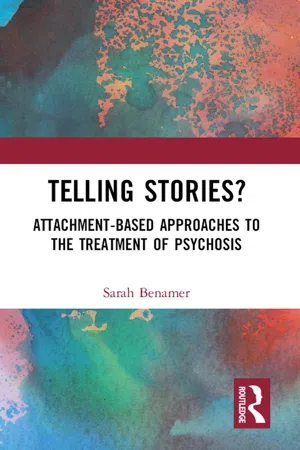
Telling Stories? explores the contemporary state of affairs in the understanding and treatment of psychosis. An inclusive approach to mental distress requires that in order to truly understand psychosis we must begin by listening to those who know this from the inside out; the voices and narrative of those who have been condemned as "unanalysable" and mad. Far from being fantastical, the complex stories that are being articulated communicate painful truths and the myriad ways in which the human psyche survives overwhelming trauma. This book is the culmination of an integrated and creative alliance between those on the cutting edge, experientially, in research, diagnosis, and treatment; this multidisciplinary dialogue proposes a new relational and attachment orientated paradigm for the 21st century. In contrast to the containment model that is currently favoured, this advocates listening and talking therapies, and the healing power of a loving relationship, offering those with psychosis the possibility of more nourishing engagement with the world.
- 154 pages
- English
- ePUB (mobile friendly)
- Available on iOS & Android
eBook - ePub
About this book
Information
CHAPTER ONE
Telling stories? Attachment-based approaches to the treatment of psychosis
Sarah Benamer
Why “Telling Stories?”? Because these are the stories denied throughout history, dismissed as fantasy or lies. These are the stories that tell us much about the nature of mental distress, and about the resourceful ways in which the human body and mind process and remember overwhelming trauma. These are the stories that mean that it is no longer possible to dehumanize “the other”. These are the stories that tell us of ourselves.
People deemed psychotic have been marginalized in society; their expression of internal terror is itself experienced as terrifying and is managed as a public health issue, historically by incarceration and restraint and more recently with medication. This defensive, fear-based reaction has left little scope for exploration and creativity in the field, with many questions remaining unanswered and the actual experiences of those with psychosis remaining, with a few notable exceptions, almost exclusively unheard.
Contextualizing psychosis in the light of real world experience enables an awareness of “madness” as an adaptive response which employs whatever means to maintain attachment to significant others and ensure that persons survival. This adaptation can echo both individual circumstance and the wider social structure, explaining trends such as the over-representation of certain groups including women, and the black and Irish communities, in the diagnostic statistics as a reflection of patriarchy or the post-colonial experience and racism. By appreciating an individual’s psychotic story within a relational attachment framework it is possible to see how they understand themselves, their developmental journey, personal experience of trauma, and how this influences current patterns of behaviour. The narrative of psychosis engages all aspects of a person’s being and as individual stories are told we come to understand how the body is employed in non-verbal psychotic communication.
This book is the culmination of an integrated and creative alliance between those on the cutting edge, experientially, in research, diagnosis, and treatment.
An inclusive approach to mental distress requires that in order to truly understand psychosis we must begin by listening to those who know this from the inside out: the voices and narrative of those who have been condemned as “unanalysable” and mad. The biographies of Julie McNamara and Jacqui Dillon take us to the heart of what this means. Their dignity and understanding of a society that has compelled them to the margins reminds us of the power of the “normative” culture and shows us ways in which we might advocate for the silenced and traumatized person as they navigate the psychotic world.
Dr Joseph Schwartz locates past understandings of psychosis in the political, historical, and socio-cultural context, illuminating the power dynamics of scientific ownership of diagnostic labels such as schizophrenia. Professors Andrew Gumley and John Read provide us with up-to-date research which challenges the very premises upon which current treatment models are founded and which empirically endorses a real world trauma and attachment-based understanding.
Professor Tony Leiba examines the impediments to interdisciplinary relating and seeks to explore ways in which collaboration may be fostered between practitioners to the benefit of those in mental distress.
Christine Blake and Mark Linington invite us into their consulting rooms, and by revealing the shared narrative of the therapeutic dyad illuminate the potential of these relationships for the client and therapist. Their material shows how, as the whole traumatic story at the origin of psychosis demands to be communicated and contained, this may be come to be encompassed in the bodies and minds of client and therapist. Thus it is not just the telling of one narrative but the weaving together of the relational experience over time that holds the possibility of understanding and transformation. Both clinicians convey the gamut of emotions traversed, and the privilege many of us feel in empowering these long silenced voices in our consulting room.
Through this multidisciplinary dialogue an integrated attachment-based approach emerges; in contrast to the containment model that is currently favoured this advocates listening and talking therapies, and the healing power of a loving relationship, offering those with psychosis the possibility of more nourishing engagement with the world.
CHAPTER TWO
A brief history of psychosis, its politics and why genetics is a cop-out
We are speaking of mental states and behaviours that seem incomprehensible. They are that way because of the unbearable mental pain endured by the sufferers of what was called madness. Telling stories? Who is there with the courage to listen? Barbro Sandin, a national hero in Sweden for her successful treatment of what is called schizophrenia, said: “With all my might I wanted to fight for the restoration and renewal of at least one of these forgotten persons”(2009).
Historically, the listeners have been few and far between. In 1811 consignment to madhouses was seen as a death sentence: “His friends judged rightly: to have him committed to a madhouse would have in all probability fixed him irremedial madness” (taken from A Report on Madhouses in England, 1811, Porter, 1987, p. 352). The 19th century reformers John Connolly and Henry Maudsley tried to de-demonize madness. The extremities of mental pain became a medical problem. By the end of the century the treatments were wide and varied. In Studies on Hysteria, Breuer and Freud reported: “Treatment of the usual kind was ordered: the electric brush, alkaline water, purges; but each time the neuralgia remained unaffected until it chose to give place to another symptom. Earlier in her life—the neuralgia was fifteen years old—her teeth were accused of being responsible for it. They were condemned to extraction, and one fine day the sentence was carried out on seven of the criminals” (1895, p. 249).
Non-listening psychiatric treatments continued throughout the 20th century. Rest, diet, exercise were ineffective but at least mild. Hydrotherapy, electrotherapy, restraint (straightjackets) less mild. The drugs—the chemical coshes—raised the stakes: cannabis, ergot (LSD), and later chlorpromazine, lithium carbonate, and the modern formulary of anti-psychotics reduced the sufferers to zombies. Finally there were the ghastly physiological invasive therapies, some of which are still alive and well: insulin shock therapy, histamine shock therapy, trans-orbital pre-frontal lobotomies, electroconvulsive shock therapy. As the psychoanalyst Edith Weigert commented in 1937, these were “a desperate manic defence of frustrated therapeutic omnipotence”. The British psychiatrist Tom Mayne observed: “[Shock treatments in the 1930s] began with giving fits chemically to people with the now famous insulin treatment. This raised the morale of staff enormously. I don’t know how much good it did the patients directly but because it improved the morale of the staff, the whole place changed and became optimistic and with a staff of high morale the patients benefited”(Schwartz, 1999, p. 158).
The listeners stood out as beacons of light for those families who could afford or were lucky enough to come under their care. As William Alanson White, medical superintendent at St Elizabeth’s Hospital, Washington, DC (formerly Government Hospital for the Insane), observed: “Through the long years that the so-called ‘insane’ have remained outside our ken, it has been sufficient to dismiss their comments, ways of thinking and conduct as simply ‘crazy’, which implied they were altogether alien to us and nothing more [need] be said” (1925, p. 32).
Like Barbro Sandin 50 years later, Harry Stack Sullivan (1925) insisted that patients needed to be heard: “The incomprehensible is to be regarded as fragments of intent which has come to light after the patient has ceased his efforts at and abandoned his hopes of communicating with the environment” (p. 72). William Alanson White (1937) at the end of his career correctly identified the aetiology of human madness: “When for any reason this feeling of belonging is interfered with or destroyed, when the individual is separated as it were from those whom he loves or upon whom he is dependent or to whom he looks for guidance, then there develops the separation anxiety which is at the bottom of neuroses and psychoses” (p. 459). White (1936) insisted: “… these patients are very like the rest of us, in fact very much more like the rest of us than different from us” (p. 22).
The physicist Max Planck long ago (1947) observed that a new theory does not triumph because it convinces its opponents but because a new generation grows up that is used to it. Planck had in mind the atomic theory of matter, highly contested in the physics of Planck’s early career when Ludwig Boltzmann committed suicide in 1900 because of the lack of acceptance of his statistical mechanics, now standard textbook fare. Yet somehow in the history of our attempts to understand and heal mental pain it is not one generation but many that seem to need to make the fight for our patients’ stories to be heard by right. In the field of mental health, the new generation does not in fact get used to the new theory. What forces are driving the continued denial of human emotional life?
Stern’s and Travarthen’s observations of the human newborn’s attachment needs are now 20 years old. Attachment theory is 60 years old. White’s and Sullivan’s work is 80 years old. Over 120 years ago Eugen Bleuler in Switzerland coined the word schizophrenia—a splintering of the psyche—in place of the then current mystified term dementia praecox. Bleuler insisted that his patients needed to be understood. Why is it taking so long to complete the transition of treatment of mental pain from demonization to medicalization to humanization? What is it in our culture that resists the fact that the human being needs human attachment to survive? Why are we so hostile to the realities of human emotional life? What is it in our culture that resists recognizing that people matter to each other?
The answer, of course, in shorthand is that structurally the intersection of patriarchy and capitalism has created a profound emotional illiteracy in the West. On the one hand the emotional work of nurturing relationships has been denigrated as women’s work leaving (male) gainful employment as the name of the game. A recent cartoon depicts a CEO at a board meeting saying: “That’s an excellent suggestion Miss Trigg. Perhaps one of the men would like to make it.”
Nearly all of us believe that so-called rational thinking is thinking without the corrupting effects of feelings, even though we now know, beyond any reasonable doubt, that thinking is impossible without feelings. In the meantime, women have been left to pick up the pieces of a culture shattered by its denial of basic human emotional needs.
At the same time, the capitalist economy requires attendance in the workplace no matter what. For men it is fix ‘em up and get ‘em back to work (or war as the case may be). Feelings get in the way. For women it has been “Here, take these pills dear”—still routine practice. The current TV series Mad Men brilliantly evokes the social climate that gave rise to Betty Friedan’s Feminine Mystique, her powerful description of how suburban house-wifery drives women mad.
In the current climate it is genetics that claims the lion’s share of explanations of psychosis. Like a hydra-headed monster it is impossible in our culture to get rid of this intellectually corrupt explanation for anything we do not (want to) understand (see appendix for a list). From the unbearable incompetence of MZ-DZ twin studies1 to the latest wheeze of epigenetics, genetics has been the belief of last resort for those who are unable to listen and hear what is being said by the sufferers of extreme mental pain. And while the old search for “a gene for schizophrenia” is now discredited in favour of more sophisticated models of how genes do or do not get expressed in the human organism, the effect is the same: somewhere, somehow there is a holy grail that will permit us to treat psychosis without ever having to engage with, in Barbro Sandin’s words, the “forgotten person” who stands before us.
We can see for ourselves how thin genetic explanations of the human condition are, by reviewing the standard molecular genetics that can be found in any GCSE textbook.
The DNA molecule is like a ladder that has been twisted. The rungs of the ladder are the legendary purine and pyrmidine bases denoted by the letters A, C, T, and G. A bacterial virus has about ten thousand bases. A mammal ten billion. Each triplet of bases is used by the cellular machinery to hold a particular amino acid in place for joining to other amino acids. The sequence of bases TTC, for example, holds the amino acid lysine in place with the help of the cellular organelle called the ribosome (likened to a read head on a tape recorder). The subsequent sequence of amino acids bound together in a chain is a protein.
In addition the DNA molecule has regions on it that can turn on or turn off the expression of the genes into proteins. For example in the classic case of the metabolism of lactose sugar by the intestinal bacteria E. coli the enzymes (protein molecules) needed to metabolize lactose are not present in the bacterial cell unless lactose is present. When lactose is added to the growth medium the bacterial cell starts to make the relevant enzymes. How does this work?
The French molecular geneticists Francois Jacob, Jacques Monod, and Andre Lwoff figured it out in the 1960s (Jacob, 1988). Like most things in science it is simple once you understand it.
In the absence of lactose the bacterial cell routinely makes a repressor protein that binds to the gene region on the DNA that codes for the needed lactose enzymes preventing their expression. However when lactose is present, the lactose molecule binds to the repressor protein freeing the DNA to produce the needed enzymes. The repressor protein is de-repressed.
And that is all that DNA does. It has the information for the cell to produce the proteins it needs, so-called structural genes. And it has switches that turn on or off the expression of the structural genes (regulatory genes). There is no gene for schizophrenia. As Max Delbruck, the father of molecular genetics (along with Salvatore Luria) famously said: “DNA is a very stupid molecule.” And it is. DNA does not do anything but lie there holding the information the cell needs to produce its proteins.
Genetics is an act of faith. As two leading researchers put it (DeLisi & Fleischhaker, 2007): “Perhaps these [genes] will prove to be true contributors to risk for schizophrenia despite researc...
Table of contents
- Cover
- Half Title
- Title Page
- Copyright Page
- Table of Contents
- ACKNOWLEDGEMENTS
- CONTRIBUTORS
- CHAPTER ONE Telling stories? Attachment-based approaches to the treatment of psychosis
- CHAPTER TWO A brief history of psychosis, its politics and why genetics is a cop-out
- CHAPTER THREE Never let the truth get in the way of a good story
- CHAPTER FOUR The personal is political
- CHAPTER FIVE Can attachment theory help explain the relationship between childhood adversity and psychosis?
- CHAPTER SIX Truth is stranger than fiction—what happens to the story when no-one wants to know
- CHAPTER SEVEN In bits: Hearing the fragmented narratives of people who experience psychosis
- CHAPTER EIGHT Interprofessional collaboration: Achieving integrated care in mental health services
- APPENDIX
- INDEX
Trusted by 375,005 students
Access to over 1.5 million titles for a fair monthly price.
Study more efficiently using our study tools.
Frequently asked questions
Yes, you can cancel anytime from the Subscription tab in your account settings on the Perlego website. Your subscription will stay active until the end of your current billing period. Learn how to cancel your subscription
No, books cannot be downloaded as external files, such as PDFs, for use outside of Perlego. However, you can download books within the Perlego app for offline reading on mobile or tablet. Learn how to download books offline
Perlego offers two plans: Essential and Complete
- Essential is ideal for learners and professionals who enjoy exploring a wide range of subjects. Access the Essential Library with 800,000+ trusted titles and best-sellers across business, personal growth, and the humanities. Includes unlimited reading time and Standard Read Aloud voice.
- Complete: Perfect for advanced learners and researchers needing full, unrestricted access. Unlock 1.5M+ books across hundreds of subjects, including academic and specialized titles. The Complete Plan also includes advanced features like Premium Read Aloud and Research Assistant.
We are an online textbook subscription service, where you can get access to an entire online library for less than the price of a single book per month. With over 1.5 million books across 990+ topics, we’ve got you covered! Learn about our mission
Look out for the read-aloud symbol on your next book to see if you can listen to it. The read-aloud tool reads text aloud for you, highlighting the text as it is being read. You can pause it, speed it up and slow it down. Learn more about Read Aloud
Yes! You can use the Perlego app on both iOS and Android devices to read anytime, anywhere — even offline. Perfect for commutes or when you’re on the go.
Please note we cannot support devices running on iOS 13 and Android 7 or earlier. Learn more about using the app
Please note we cannot support devices running on iOS 13 and Android 7 or earlier. Learn more about using the app
Yes, you can access Telling Stories? by Sarah Benamer in PDF and/or ePUB format, as well as other popular books in Psychology & History & Theory in Psychology. We have over 1.5 million books available in our catalogue for you to explore.