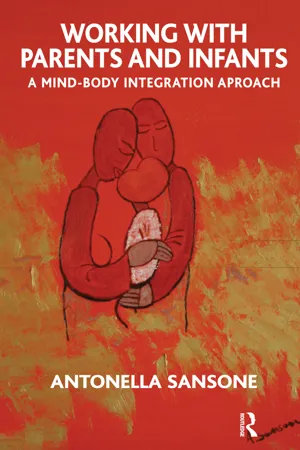
Working with Parents and Infants is aimed at understanding the process of psychosomatic illness, exploring the embodiment of psychosomatic health and illness, and the inseparability of psyche and soma. Within this book, the author highlights the beneficial function of psychosomatic symptoms, such as mastitis, in signalling to the counsellor or therapist as well as the patient the need for change and the path through which it may occur. Research and clinical literature have often overlooked the relationship between the woman's attitude to her bodyself, thus her mind-body integration, breastfeeding and the quality of interactions with her baby. A psychosomatic disturbance is in this book conceived as an impaired sense of bodyself, or in other words, a lack of psycho-soma integration. The author presents a new approach to health and the healing relationship emerging from a meeting between Eastern meditative disciplines and Western psychological practise.
- 172 pages
- English
- ePUB (mobile friendly)
- Available on iOS & Android
eBook - ePub
About this book
Information
Chapter 1
A historical examination of the psyche-soma
In this Chapter I explore some theoretical gaps and imbalances in the psychoanalysis of the psyche-soma. The philosophy of dualism owes much to Christian theology. Descartes (1644) regarded mind and body as two separate entities, composed of different substances and governed by different laws. He deemed that the body, being a material object, could be explored via scientific investigation but that the mind could only be investigated via introspection. Since then, Western philosophers have struggled with the mind/body dilemma for over 300 years. This has profoundly affected the evolution of thinking in the field of psychoanalysis about the psyche-soma.
Psychoanalysis has been involved with the psyche-soma from the very beginning, when Freud began to treat patients with the physical symptoms of conversion hysteria via a “talking cure” (Freud and Breuer, 1893). For Freud a difficult task for the individual resided in controlling physically-based sexual drives seeking immediate gratification, and adapting them to the “reality principle” of social expectations (1911b). Although Freud described the ego as a “body ego’, he substantially deemed mental and bodily functions to be opposed rather than complementary.
The complexity of mind/body entanglement as described in Freud’s cases shows how a simple cause/effect relationship between mind and body is not appropriate. This is clearly confirmed in his notion of over-determination of symptoms (1901), which is widely accepted within psychoanalysis. Psychoanalysis does acknowledge that a delineation drawn by medicine between the psychological or somatic nature of certain illnesses is not possible and that it represents an oversimplification.
McDougall has described the “early pre-speech” infant’s state; the infant depends upon the body for self-expression. In her book Theatres of the Body (McDougall, 1989, p. 87), she considers an adult patient’s psychosomatic disorder to be “an attempt to take flight from intolerable affective states of anger and abandonment that she could neither contain nor elaborate.” McDougall has explained that because emotions are psychosomatic, the incapacity to be in touch with a child’s emotional needs may lead a child to develop the symptoms as a defence against emotional suffering.
McDougall’s work has made substantial contributions to the understanding of psychosomatic processes through psychoanalysis. Her valuable ideas allowed many psychotherapists to reach an understanding of somatic manifestations. Yet, in spite of the major contributions it has made to our understanding, McDougall’s work remains essentially dualistic. She has stated (1974, p. 441): “At this point we come back to the fact that the mental and the physical are indissolubly linked yet at the same time essentially different.” McDougall struggled with the same dilemma that has concerned philosophers for hundreds of years. She acknowledged that the psyche-soma “functions as an entity’, yet she also wrote (1974, p. 443): “Nevertheless, theoretical confusion will result if we overlook the fact that somatic processes and psychic processes are governed by different laws of functioning.’
Dualism has created, rather than resolved theoretical confusion. In the area of psychoanalytic infant observation, for example, the psyche-soma is conceived as one indivisible entity:
The physical sensations and experiences of a baby are seen as part of a unified continuum of physical and mental states. The significance for observers of a baby’s sense of physical togetherness, or panic, or attachment through sucking (or biting) to the mother, is that it is expressive of a baby's whole state of mind/body, not a physical action alone. [Rustin 1989: p. 62].
Klein (1935, 1946, 1948) retained the Freudian notions of instincts and physical drives but propounded that these drives emerged only in a context of relationship to another object, whether real or a phantasy. She was interested in observing and listening to small children while playing. Whilst Kleinian theory did not address the mind/body dilemma, their implicit continuity emerges in Klein’s clinical work on disturbed children, where she saw the emotional and physical aspects of an idea’s elaboration and expression. For example, with regard to phantasies, Isaacs (1948, p. 112) wrote that: “The earliest phantasies are experienced in sensations; later they take the form of plastic images and dramatic representations. Phantasies have both psychic and bodily effects, e.g. in conversion symptoms, bodily qualities, character and personality, neurotic symptoms, inhibitions and sublimations.’
Winnicott was originally a Kleinian but later he developed his own ideas. Winnicott’s view of the psyche-soma and its effects on other key concerns has attracted my attention. His focus on health, on normal development, and on the positive function of a symptom illuminates my therapeutic work.
While psychoanalysis operated within a dualistic framework of mind and body as “composed of different substances” (Descartes 1644), Winnicott adopted a phenomenological framework based on Heidegger’s (1927) idea of physical “in-dwelling’, described by Winnicott (1962b, p. 68) as: “The achievement of a close and easy relationship between the psyche and the body, and body functioning.”
Initiated by Hegel (1807) and elaborated by Heidegger (1927), phenomenology emphasised description and observation, which is what was central to Winnicott’s experience. For Winnicott any separation between psyche and soma resided in the onlooker, in the choice of perspective rather than within the subject himself. This idea is conveyed in the following passage:
Here is a body, and the psyche and the soma are not to be distinguished except according to the direction from which one is looking. One can look at the developing body or the developing psyche. I suppose the word psyche here means the imaginative elaboration of somatic parts, feelings and functions, that is, of physical aliveness. [Winnicott 1949, p. 244]
Phenomenological perspectives have recently influenced psychoanalytic thinking. These have made important contributions to the mind/body dilemma. In her paper on Sandor Ferenczi and his influence on Melanie Klein, Likierman argued for the impossibility of separating mental and physical aspects of functioning, even within the “talking cure” of psychoanalysis:
By implication, psychoanalytic interpretation, like all verbal expressions, cannot escape intimate links with the body. It is inseparable from sounds that are emitted physically, and thus from intonation, volume, rhythm and other forms of primitive enactment. Such an "active" element is not necessarily a disadvantage, for it gives transference interpretations an unconscious vitality that constitutes their communicable value. [Likierman 1993: 446]
With hermeneutics (Rustin, 1991) the emphasis shifted from the cause and aetiology to the meaning. Attention was now drawn to the meaning of a psychosomatic symptom, on what it is communicating, and to the individual’s subjective experience.
Winnicott argued that verbal self-expression stands alongside, rather than replaces, self-expression via the body. On a similar line of thought, Turp has written:
In many instances "showings" may healthily take up a place alongside "telling', offering alternative paths for self-expression with a particular eloquence of their own. From this perspective, we can perhaps view sport or dance, or yoga with less suspicion, regarding the body, rather in the way we regard dreams, as a potentially creative site of symbolisation, elaboration and self-expression. [Turp 1998, p. 12]
In my book Mothers, Babies and their Body Language, I argue for the inseparability of body and mental functions:
Our body is involved in our relationships as much as our mind. The two levels of our being are inseparable and a circular relation exists between them. They are split only by language and concepts. While thinking, speaking, dreaming, and interacting, there are changes in our breathing, muscle tone, posture, and facial expression–throughout our body language. They are powerful forms of non-verbal communication. [Sansone, 2004, p. 51]
In Winnicott’s 1949 paper, “The mind and its relation to the psyche soma’, he used the term “psyche” to refers to “that part of the body capable of mental functioning” (1949, p. 95). The term “mind” refers to what we would describe as thinking. For Winnicott health in the individual’s early development entailed “continuity of being’. For the healthy development of the early psyche-soma there is a need for a perfect environment, which actively adapts to the needs of the early psyche-soma. The mind/thinking splits off from the psyche-soma when a severe environmental failure “disturbs the continuity of being’. Then “excessive mental functioning” substitutes the function of the maternal care.
Winnicott wrote (1949, p. 243): “I venture to predict that the antithesis which has baffled all the philosophers will be found to be based on an illusion. In other words, I do not think that the mind exists as an entity–possibly a startling thing for a psychologist to say.” In the following quote he condensed his own ideas on the mind/body (1949, p. 244): “The mind does not exist as an entity in the individual’s scheme of things provided the individual psyche-soma or body schemes have come satisfactorily through the very early developmental states; mind is then no more than a special case of the functioning of the psyche-soma.”
A central idea in Winnicott’s thinking was that any separation of psyche and soma is a sign of disturbance. Over the course of his work, he increasingly put forward the importance of experienced “in-dwelling” (1962b) as a basis for continuity of being–a basis for feeling real. The foundations of this experience reside in maternal handling and holding, which is later accompanied by thinking and language.
On the same line of thought about mind/body, an observational study of mother-baby interaction (Sansone, 2002) suggested to me that an infant’s posture, breathing, and body language in general begin to organize in relation to the primary caregiver’s body language. An entire world of emotional/physical vibrations condition the baby’s muscular tone and internal world, as well as those of the caregiver, and sow the seeds of health. There is no boundary between the emotional and the muscular, or general physical, levels.
At first, the baby responds to the physical stimulation of the mother's hands: as the mother touches her, the baby adjusts her position and the mother then accommodates her gestures to the child's position. Bodily signals are transmitted from one to another. The quality of touch induces a feeling and modulates the child's postural response. The child thus has a complete experience. An interchange of muscular tone information gives rise to mutual postural adjustments. Physical or emotional tension weakens the capacities of mother and infant to rhythmic adjustments, making mutual understanding difficult. [Sansone, 2004, p. 202]
In his 1949 paper, Winnicott deemed that in its beginning a good (psychological) environment is a physical one, with the child in the womb, being held and generally tended to; only in the course of time does the environment develop emotional, psychological, or social characteristics.
The value of Winnicott’s observations about the importance of the early environment in shaping the psychological functioning has increasingly been acknowledged by new developments in the neurosciences. The functioning of the brain is conceived of in a new way and bridges between disciplines seem to being built. For example, with regard to neuroscience and its relevance to psychoanalytic thinking Olds and Cooper wrote (1997, p. 221): “Where once we were concerned about the reductionism of some forms of biology, today’s biological forefront is based on hierarchical systems theory, recognising emergent properties, and is unconcerned with trying to reduce poetic understanding to neuronal activity.”
Major neuroscientific researchers such as Damasio (1999) and LeDoux (1996) have contributed to integrating neuroscience with psychology and psychotherapy. Emotion cannot be reduced to a few simple elements, but involves facial and other motor system changes, physical and autonomic changes, cognitive processes, and subjective feelings.
In my book Mothers, Babies and their Body Language, I argued that emotion is a subjective process involving different levels–cellular, hormonal, nervous, muscular, and behavioural–holding the whole system together and reflecting fundamental adaptive integration (Sansone 2004). The psychological level is the most complex, as it is the result of an intricate interrelationship between all levels. For example, fear involves a neural circuit in the brain and a hormonal process such as adrenaline release, with its effect on pupil size, heart rate, breathing, body temperature, hairs, muscle tone, posture, and facial muscles (Ruggieri, 1987). The subjective feeling of fear is the result of all these changes.
Finally, I refer to the illuminating work of Turp (1998), who considers the contribution of bodily experience to emotional wellbeing. I share her adoption of the term “beneficial psychosomatic processes” and I apply it to baby massage, conceived here as an integral part of psychotherapy. I am suggesting that the contribution of baby massage to the mother-infant relationship is that of feeling whole, within a skin, and of opening windows to bodily “indwelled” experiences of early life. In particular, I refer to the significance of the containing function of the infant massage teacher. The activation of sensory channels of communication fostered by the practice of baby massage–touch, eye contact, movement, vocalization, and smell, accompanied by a space for projections and verbal self-expression–involves a coming together of action, thinking, and feeling that leads to psychosomatic integration.
A central idea in Mothers, Babies and their Body Language is that:
Any activity, whether it is lifting an arm, or walking, talking, going to sleep, learning something, thinking out a problem, or making a decision, involves an interrelationship between "mental" and "physical" processes and it is impossible to separate activities into either purely mental or purely physical. The distinction between "mental" and "physical" is merely a construct based on a particular observational perspective. [Sansone 2004, p. 7]
I call this unity of mind and body “psychophysical integration’, which is the foundation of health. Disharmony between mind and body is a sign of disturbance. An example is when excessive emotional tension manifests itself through the mother’s tightened gesture while breastfeeding, in muscular tension while holding her baby, in her sharp tone of voice, or her inability to verbalize her feelings and internal world.
Babies are particularly sensitive to the close relationship between the mental and physical states of their caregivers. They sense their emotional state through their muscular tension and movements. They will sense if they are being held confidently, nervously, lovingly, or rejectingly. By sensing the congruence between emotional states, muscular tone, and body language, babies can build psychosomatic integration. When the mother’s mind and body live in harmony, she will be able to convey congruent messages through her body language, and through mirroring, so that her child will build an integrated and harmonious bodyself image.
Chapter 2
The psyche-soma within an object-relations framework
Winnicott put at the centre of his developmental model not a mythic conflict between incompatible forces but the localisation of self in one’s body. For Winnicott, there was the body at the root of development out of which a “psychosomatic partnership” evolved. The self was first and foremost a body self and the “psyche” of the partnership meant the imaginative elaboration of somatic parts, feelings and functions, that is, of physical aliveness.
(Phillips 1988, p. 78)
What I find particularly relevant was Winnicott’s interest in distressing psychosomatic symptoms that he encountered in his psychoanalytic practice. Nevertheless, he was also interested in the relationship of psyche and soma in health and in normal development as well as in illness. Phillips (1988, p. 5) drew attention to Winnicott’s questions: “What do we depend on to make us feel alive, or real? Where does our sense come from, when we have it, that our lives are worth living? Winnicott approached these issues through the observation–one of his favoured words–of mothers and infants, and what became in time the “transitional space” between them.”
The blossoming of infant observation within psychoanalysis (e.g. Miller, Rustin, Rustin, & Shuttleworth, 1989) has provided new accounts of a “normal” infancy.
In his book Clinical Note...
Table of contents
- Cover
- Half Title
- Title
- Copyright
- Contents
- Dedication
- ABOUT THE AUTHOR
- ACKNOWLEDGEMENTS
- INTRODUCTION
- CHAPTER 1 A historical examination of the psyche-soma
- CHAPTER 2 The psyche-soma within an object relations framework
- CHAPTER 3 The "bodyself" in early relationship
- CHAPTER 4 Touch, movement, and integration of the psyche-soma
- CHAPTER 5 Case illustration
- CHAPTER 6 An east/west approach to working with parents and infants and the healing relationship
- CHAPTER 7 Emotions and the primal brain
- CHAPTER 8 The effectiveness of early support
- CHAPTER 9 Infant observation
- CHAPTER 10 Conclusions
- REFERENCES
- INDEX
Trusted by 375,005 students
Access to over 1.5 million titles for a fair monthly price.
Study more efficiently using our study tools.
Frequently asked questions
Yes, you can cancel anytime from the Subscription tab in your account settings on the Perlego website. Your subscription will stay active until the end of your current billing period. Learn how to cancel your subscription
No, books cannot be downloaded as external files, such as PDFs, for use outside of Perlego. However, you can download books within the Perlego app for offline reading on mobile or tablet. Learn how to download books offline
Perlego offers two plans: Essential and Complete
- Essential is ideal for learners and professionals who enjoy exploring a wide range of subjects. Access the Essential Library with 800,000+ trusted titles and best-sellers across business, personal growth, and the humanities. Includes unlimited reading time and Standard Read Aloud voice.
- Complete: Perfect for advanced learners and researchers needing full, unrestricted access. Unlock 1.5M+ books across hundreds of subjects, including academic and specialized titles. The Complete Plan also includes advanced features like Premium Read Aloud and Research Assistant.
We are an online textbook subscription service, where you can get access to an entire online library for less than the price of a single book per month. With over 1.5 million books across 990+ topics, we’ve got you covered! Learn about our mission
Look out for the read-aloud symbol on your next book to see if you can listen to it. The read-aloud tool reads text aloud for you, highlighting the text as it is being read. You can pause it, speed it up and slow it down. Learn more about Read Aloud
Yes! You can use the Perlego app on both iOS and Android devices to read anytime, anywhere — even offline. Perfect for commutes or when you’re on the go.
Please note we cannot support devices running on iOS 13 and Android 7 or earlier. Learn more about using the app
Please note we cannot support devices running on iOS 13 and Android 7 or earlier. Learn more about using the app
Yes, you can access Working with Parents and Infants by Antonella Sansone in PDF and/or ePUB format, as well as other popular books in Psychology & Mental Health in Psychology. We have over 1.5 million books available in our catalogue for you to explore.