eBook - ePub
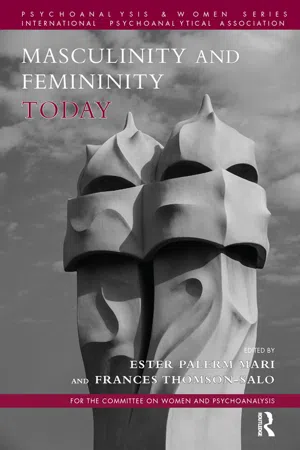
Masculinity and Femininity Today
- 186 pages
- English
- ePUB (mobile friendly)
- Available on iOS & Android
eBook - ePub
Masculinity and Femininity Today
About this book
This book presents a wide range of psychoanalytic writing on masculinity and femininity from British, European, and North and South American perspectives, exploring how masculine and feminine aspects are structured and evolve in the child, adolescent and adult. The authors address from a background of considerable clinical experience how masculinity and femininity manifest in the body, gender, sex, sexuality and the life-cycle, and cover aspects both productive and generative, constricted and defended. The importance of the parenting couple and their bond with the child in the forming of masculine and feminine idenitities is emphasized. Beginning with an overview of the development of masculinity, the developmental perspective is explored in how adolescents discover their sexuality and come to 'own' their sexual bodies. Different types of disturbance are explored including the early defence mechanism of disavowal of difference.
Information
CHAPTER ONE
Evolving perspectives on masculinity and its discontents: reworking the internal phallic and genital positions
This chapter presents an overview of my psychoanalytic understanding of masculinity and male development. I clarify what I mean by phallic and genital masculinity, and briefly address the roles played by both biology and culture in influencing how boys establish their earliest sense of masculinity. I then focus on the internalisation processes impacting masculine gender identity prior to reflecting upon the interplay between the male’s initial sense of masculinity, his uniquely gendered ego ideal, and the central developmental challenges that ensue in reworking the phallic and genital positions. To set us on course, I begin by offering a contemporary perspective on gender.
A contemporary perspective on gender
Where Freud did not use the terms gender or gender identity nor explore such areas, several generations of psychoanalytic theorists have grappled with gender related issues as well as gender questions raised by Freud’s (1925) original ideas on psychosexual development. As you recall, Freud (1925) tackled these issues originally through his account of how the young child’s discovery of the anatomical differences between the sexes, with the resulting castration anxiety or penis envy, influences male and female development, conflicts, and personality. As Kulish (2010) suggested, contemporary thinking about gender can be organised into five major, interrelated areas: (1) the social construction of gender; (2) the complexity and fluidity of gender; (3) the separation of gender and object choice; (4) normality versus marginality; and (5) embodiment. I primarily consider the first two areas.
Though probably obvious, the landscape of psychoanalysis and gender abounds with conceptual, terminological, technical, and socio-political difficulties. Not surprisingly, gender, with its basis in differentiation and an accompanying history of gender-based suffering and oppression, is a minefield where disturbance is to be expected (see Benjamin, 1996; Harris, 1991). Yet today, much as when Freud started his psychosexual prospecting, there continues to be something about the terrain that draws us close to the heart of the mind-body-spirit interface. And happily, we now have an assortment of canvassing tools that Freud did not.
Nowadays we are more likely to understand that gender identity development is not a linear, continuous trajectory, and that a boy’s (and later, a man’s) experience of the ambiguities of his gender are continually being reworked across differing developmental junctions (see Diamond, 1997, 1998, 2004a, 2004b, 2006, 2007, 2009). Moreover, in bridging the polarities between social constructionism and biological essentialism, a more complicated, and ambiguous, understanding of gender identity ensues that is constructed largely out of early, preoedipal identifications with each parent (in addition to being influenced by biological variables). A healthy sense of masculinity requires incorporating the multitude of these early identifications (as well as subsequent ones) and inevitably demands a psychic achievement in the integrativesynthetic sphere. Hence, the analyst’s clinical understanding of male patients’ unconscious conflicts around gender-related issues, as well as personal gender-related biases and countertransferences, can lead to more effective interpretive interventions.
Masculinity and psychoanalysis
Until three or four decades ago, the psychoanalytic study of male development was essentially organised around Freud’s oedipal theory and the idea that the boy wants to have his mother (Freud, 1923, 1924, 1925). To overcome the castration anxieties aroused in competing with his father, the boy identifies with him and, in turn, constructs the sense of his own masculine identity. Moreover, by equating masculinity with activity and femininity with passivity, as Freud (1937) exemplified in referring to the male’s bedrock struggle “against his passive or feminine attitude toward another male” (p. 250), he furthered “the rejection of femininity” (De Simone Gaburri, 1985, p. 466). Indeed, Freud (ibid., pp. 252–253) argues that the repudiation of femininity, the so-called “masculine protest” (which is “nothing else than castration anxiety”), reflects a “biological fact”. This confusion between both receptivity and passivity, and between psychodynamics and biology, continues to collude with cultural assumptions and hinders psychoanalytic theorising about masculinity.
Nonetheless, by the latter third of the twentieth century, attention had been redirected to the fact that before the boy wants to have his mother, he wants to be his mother, or at least be with what his mother provides, that is, her maternal nurturance. Hence, the boy’s preoedipal relationship with his mother, and the actual involvement of the father in the early triadic environment, is now seen as crucial to understanding male gender identity.
Analysts influenced by Margaret Mahler (cf. Mahler, Pine, & Bergman, 1975) began to formulate a new way of understanding male psychology. Most significant were Ralph Greenson and Robert Stoller, who formulated what has become known as the disidentification hypothesis (Greenson, 1966, 1968; Stoller, 1964, 1965, 1968, 1976), claiming that in order to establish a normal, healthy sense of masculinity, the small boy must dis-identify from his mother and counter-identify with his father. This idea has been taken as the benchmark to explain the male’s struggle to experience his gendered identity as “masculine”.
The theory happens to be congruent with a dubious, widely held view in patriarchal cultures that masculinity is defined by its not being feminine. In other words, the most significant thing about being a man is not being a woman. This reductive and monolithic view has been unfortunate for both sexes but perhaps especially so for men, since gender identity, as long as it is based on the disavowal of whatever is construed as feminine (and that persists in being equated with passivity), remains an unstable psychological achievement.
More recent work by psychoanalytic gender theorists, however, has furthered our understanding of boys’ earliest and subsequent sense of masculinity (e.g., Axelrod, 1997; Benjamin, 1988, 1991; Fast, 1984, 1990, 1999; Hansell, 1998; Lax, 1997; Pollack, 1995, 1998; ). Furthermore, Freud’s famous dictum that “anatomy is destiny” is no longer the lynchpin of psychoanalytic gender theorising. Research on the masculinisation of the brain demonstrates that several biological variables are related to male specific gender-related traits, challenges, and intrapsychic conflicts (Baron-Cohen, 2003; Panksepp, 1998). Nonetheless, on the basis of clinical evidence, the biological givens in gender identity formation are significantly counterbalanced by what psychoanalysis emphasises: the early imprinting of the boy’s actual interactions with his primary attachment figures; his internalised object relations; the prevailing socio-cultural determinants; and most important, his unique psychodynamically determined reactions to each of these influences, particularly as they interact with his basic biological development (cf. Blos, 1984; Stoller, 1976). We might say therefore that with respect to biology, the destiny of a boy’s masculinity is based on what he makes of his anatomy!
Contemporary psychoanalytic theory must be able to sustain the necessary dialectical tension between biological givens, such as hormonally influenced brain and bodily masculinisation, and the psychosocially created—that is, between traditional essentialist (either-or thinking) and a postmodern, constructivist (both-and) perspective. Thus, it is important to maintain the dialectical tension between the dichotomous (or fixed) aspects of gender experience and the more integrated experience of gender, between gender rigidity and fluidity, and between (core) gender identity and the gender multiplicity of the multigendered self.
However, as cultural beings we cannot so easily contain this tension. Anthropologists write about a ubiquitous socio-cultural process that renders a splitting of gender traits so that aspects of human personality are distributed unequally between the sexes (see Young-Eisendrath, 1997; also Labouvie-Vief, 1994). In every culture, gender polarity is internalised, and each child is directed to develop qualities attributed to their own sex and, in some measure, to suppress or disavow qualities of the other—to keep the other gender’s characteristics less developed within (see Young-Eisendrath, 1997). This occurs even though hormonal influences on the foetal brain and genitalia demonstrate differences between the two genders. Regardless of how we define the concepts of masculine and feminine from a constitutional perspective, what is most serviceable in psychoanalysis stems from clinical observation that demonstrates that “… in human beings pure masculinity or femininity is not to be found in either a psychological or a biological sense. Every individual on the contrary displays a mixture of the character-traits belonging to his own and to the opposite sex; and he shows a combination of activity and passivity whether or not these last character-traits tally with his biological ones” (Freud, 1905, p. 220n).
Culture indeed plays a pivotal role in interfacing with the psychodynamics of gender identity—there are a wide variety of masculinities across cultures—and masculinity is not the exclusive province of heterosexual men (cf. Person, 2006). In Western societies, despite efforts to reduce this gender splitting, the underlying cultural images for masculinity generally continue to mean being rational, protective, aggressive, and dominating, while those for femininity mean being emotional, nurturing, receptive, and submissive (Benjamin, 1988).
Fogel (2006), in underscoring our inherent psychological bisexuality, suggests, like our Jungian colleagues, that dialectical balance between the masculine principle, characterised by boundaries, definitions, penetration, differentiation, and doing, and the contrasting feminine, represented by fluidity, receptivity, creativity, containment, integration, space, and being, is required for healthy maturation. Thus, psychoanalysis must comprehend the implications of the “lost feminine half”, recognizing the “dark hole” in a man’s inner genital position (Fogel, 2006, p. 1143–1144; see also Elise, 2001 in her discussion of “phallic supremacy”).
An evolving perspective on masculinity
In my own work, I revise the disidentification model, emphasise how masculinity is forged from the boy’s earliest wishes to be both his mother and father, and suggest how the male’s earliest identifications require adaptations and accommodations throughout the life span (Diamond, 1998, 2004a, 2004b, 2006, 2009). Likewise, a male’s gendered ego ideals and his sense of masculinity, as well as the ambiguities of his gender, are continually being reworked throughout his life. The phallic and genital features of a man’s internal experience are best understood as coexisting positions in varying, discontinuous balances that shift as a man matures (much like the Kleinian notion of paranoid-schizoid and depressive positions), rather than representing different developmental phases that supersede one another linearly.
Terminology: phallic and genital masculinity
A brief word on terminology is needed. In using the terms phallic and genital, I am referring to a specific orientation, typically manifest in a cluster of traits, which psychoanalysis views as originating from early psychosexual, libidinal development. From the classical standpoint, the phallic phase refers to that pre-genital period beginning at about two years of age and extending into the oedipal phase, during which the phallus is the primary erogenous zone. Freud (1923) describes this “infantile” organisation as reflecting “a primacy of the phallus” rather than of the genitals (original italics, p. 142). The phase comprises two subphases: phallic narcissism (or, phallic exhibitionism), characterised by a self-satisfaction based on an overestimation of the penis, exhibitionistic desires to gain attention, and the primacy of dyadic relations, and the later phallic-oedipal phase proper with its triangular configuration, idealisation of oedipal objects promoting phallic omnipotence, and heightened castration anxieties (see Edgcumbe & Burgner, 1975; Greenspan, 1982; Jones, 1933; Schalin, 1989).
Throughout the entire phallic phase, the high valuation of the penis is manifest in phallic pride with its associated desires and anxieties. Figuratively speaking, extending, thrusting, and penetrating become paramount along with the associated personality traits of asser...
Table of contents
- Cover
- Half Title
- Title Page
- Copyright Page
- Table of Contents
- About the Editors and Contributors
- Acknowledgements
- Introduction
- Chapter One Evolving perspectives on masculinity and its discontents: reworking the internal phallic and genital positions
- Chapter Two Discussion of “Evolving perspectives on masculinity and its discontents: reworking the internal phallic and genital positions”
- Chapter Three The hour of the stranger
- Chapter Four Discussion of “The hour of the stranger”
- Chapter Five The abyss of intimacy
- Chapter Six Lack of discrimination as a defence mechanism
- Chapter Seven Listening to psychical bisexuality in analysis
- Chapter Eight Masculinity and the analytic relationship—transforming masculinity in the course of the analysis
- Chapter Nine Intersubjective context of gender and sexuality
- Chapter Ten Identity: a constellation of emotional experience and metaphors in childhood
- Chapter Eleven Furious with love—some reflections on the sexuality of a little girl
- Index
Trusted by 375,005 students
Access to over 1.5 million titles for a fair monthly price.
Study more efficiently using our study tools.
Frequently asked questions
Yes, you can cancel anytime from the Subscription tab in your account settings on the Perlego website. Your subscription will stay active until the end of your current billing period. Learn how to cancel your subscription
No, books cannot be downloaded as external files, such as PDFs, for use outside of Perlego. However, you can download books within the Perlego app for offline reading on mobile or tablet. Learn how to download books offline
Perlego offers two plans: Essential and Complete
- Essential is ideal for learners and professionals who enjoy exploring a wide range of subjects. Access the Essential Library with 800,000+ trusted titles and best-sellers across business, personal growth, and the humanities. Includes unlimited reading time and Standard Read Aloud voice.
- Complete: Perfect for advanced learners and researchers needing full, unrestricted access. Unlock 1.5M+ books across hundreds of subjects, including academic and specialized titles. The Complete Plan also includes advanced features like Premium Read Aloud and Research Assistant.
We are an online textbook subscription service, where you can get access to an entire online library for less than the price of a single book per month. With over 1.5 million books across 990+ topics, we’ve got you covered! Learn about our mission
Look out for the read-aloud symbol on your next book to see if you can listen to it. The read-aloud tool reads text aloud for you, highlighting the text as it is being read. You can pause it, speed it up and slow it down. Learn more about Read Aloud
Yes! You can use the Perlego app on both iOS and Android devices to read anytime, anywhere — even offline. Perfect for commutes or when you’re on the go.
Please note we cannot support devices running on iOS 13 and Android 7 or earlier. Learn more about using the app
Please note we cannot support devices running on iOS 13 and Android 7 or earlier. Learn more about using the app
Yes, you can access Masculinity and Femininity Today by Ester Palerm Mari, Frances Thomson-Salo, Ester Palerm Mari,Frances Thomson-Salo in PDF and/or ePUB format, as well as other popular books in Psychology & Developmental Psychology. We have over 1.5 million books available in our catalogue for you to explore.