- 192 pages
- English
- ePUB (mobile friendly)
- Available on iOS & Android
eBook - ePub
About this book
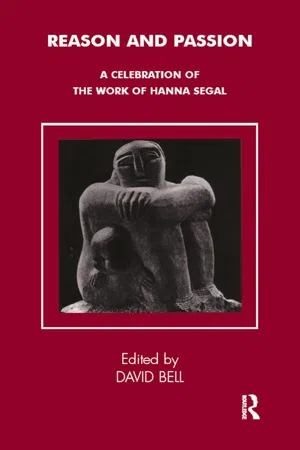
This book provides an account of Hanna Segal's contributions to psychoanalytic theory and practice and gives a picture of her as a person. It covers mainly on clinical and theoretical aspects of psychoanalysis.
Information
1
Symbol Formation and Creativity
Hanna Segal’s Theoretical Contributions
Symbol Formation and ‘Optimal Anxiety’
Melanie Klein’s paper on ‘The Importance of Symbol Formation in the Development of the Ego’, published in 1930, was a milestone in two respects: first, it opened up the study of symbolisation as a creative and developmental process, and second, it showed how abnormalities in the ability to form symbols could cripple the development of the ego.
Klein suggested that the ego’s attachment to its first, few primal objects grows to encompass the wider world only through the development of symbolic links: our interest in the world develops only if new objects can be made to represent our. old ones symbolically. Her paper was also of great importance in a third way: it provided the basis for Hanna Segal’s work on symbol formation.
It therefore seems appropriate to begin my review of Segal’s work with a summary of Klein’s paper, which contains an account of her analysis of a four-year-old autistic boy, Dick, whose arrested ego development was connected to an almost complete inability to form symbols. Klein’s theoretical understanding of this disability was as follows: the young infant is not able to repress sadism, as he is later on, but expels it into a good object — the mother’s body – which it then feels it has destroyed. It experiences this sadism not as a fantasy or wish, but concretely as biting, tearing, stamping, burning, drowning and shooting of the object. At the same time, ‘the weapons used to destroy the object are felt by the [infant] to be levelled at his own self as well’.1
Klein believed that the anxiety that one felt with regard to the original object (the mother’s body) as a result of this projected sadism was an important developmental force, since it propelled the ego away from its exclusive relationship with the original objects toward new objects, which it would then use to represent the older ones symbolically. She placed great emphasis on the importance of symbolic links for normal development because she believed that all contact with internal and external reality was a symbolic displacement of the contact with one’s primal objects. In this vein, she wrote that, ‘not only does symbolism come to be the foundation of all phantasy and all sublimation, but, more than that, it is the basis of the subject’s relation to the outside world and to reality in general’ (Klein, 1930, pp. 220–1).
If the child’s relationship to reality is to develop in an optimal way, this ‘beneficial’ anxiety about the original object must be present. But if it is too great, as in Dick’s case, rather than propelling one away from the primal object into symbolic relations with new objects, it will paralyse his capacity to form a symbolic relationship with anything. In her discussion of Dick’s autism, Klein wrote that
… what brought symbol-formation to a standstill was the dread of what would be done to him … after he had penetrated into his mother’s body [in his primitive oedipal phantasies] … the defence against the sadistic impulse directed against the mother’s body and its contents – impulses connected with phantasies of coitus – had resulted in the cessation of phantasies and the standstill of symbol-formation. Dick’s further development came to grief because he could not bring into phantasy the sadistic relationship to the mother’s body. (Klein, 1930, p. 224)
Symbolic Equation and Confusion of Self and Object
When Klein says that ‘Dick’s further development came to grief because he could not bring into phantasy the sadistic relationship to the mother’s body’, she seems to mean that Dick was so frightened of his aggressive impulses that he turned off his phantasising (or at least his aggressive phantasising and impulses) altogether, as a defensive manoeuvre. This left him lacking in the aggression necessary to make his way in the world. But the idea that Dick ‘could not bring into phantasy’ his sadistic impulses also has other implications: Dick’s sadistic impulses, if not brought into fantasy, were left as concrete experiences.
Hanna Segal takes up this point in her first paper on symbol formation, written in 1957. She pointed out that if one’s relationship to the external world – one’s objects – is extremely concrete (as Dick’s was), one will not experience one’s thoughts and fantasies about one’s objects as thoughts and fantasies, but as concrete actions that one is performing on the actual objects. Segal agreed with Klein that Dick’s ability to form symbolic relationships was crippled by overwhelming anxiety about his object (or rather, about his phantasies about it), but added that part of the reason Dick’s phantasies were frightening was that Dick did not know that his phantasies were just phantasies; he felt that they were real, concrete acts.
This situation was the product of a state of mind in which Dick had almost completely obliterated the distinction between himself and his object, and this state of mind was in turn produced by the fantasy that he and his objects had concretely entered each other, and lived inside each other. The distinction between himself and his objects having been eliminated in this way, he was unable to distinguish between something that was himself (his fantasies about his objects) and what was in fact not himself (his actual objects).
Segal points out that true symbolisation is a three-part relationship between the thing symbolised, the thing functioning as a symbol, and the person for whom the latter represents the former.
There was something about the quality of Dick’s projections into his objects – his ‘concrete evacuations of sadism’ – that abolished the distinction between himself (or his sadism) and his object. Segal says that the psychotic’s projections have this quality because they are not true projections, but projective identifications instead. The ‘identification’ in projective identification means that the self and object are literally experienced as the same thing. Loss of the self/object distinction leads in turn to loss of his capacity to phantasise and symbolise: if the distinction between two of the three terms (self/object) of the triangular relationship (self/object/symbol) necessary for phantasy and symbol-formation to occur is lost, so is the ability to form true symbols.
This perspective on the psychotic’s inability to have an ordinary phantasy life seems to me to be much more interesting and psychological than the one that Klein proposed. Klein, we recall, seems to say that Dick was so terrified of the sadism that he had projected into his mother that he stopped phantasising. But there is something unsatisfactory about this formulation. How does one stop phantasising? Just try it.
Segal proposed that the psychotic does not stop phantasising, but rather develops a phantasy about his phantasies: he believes that his phantasies about his object are literally and concretely true of the object. This is equivalent to confusion between one’s phantasies about the object and the object itself. This type of phantasy is no longer a phantasy in the proper sense, but something else instead; Dick could not bring his impulses into phantasy because he was bringing them into this concrete form that is very different from a phantasy in the ordinary sense of the word.2 Since one’s symbols are phantasies, confusion between one’s phantasies about one’s object and the object itself implies confusion between one’s symbols and what they stand for.
Segal proposed that this confused, concrete type of relationship between the symbol and what is symbolised be called a ‘symbolic equation’. According to Segal, while symbolic equations are a kind of substitute for the original objects, ‘they are hardly different from the original object. These substitutes are treated as though they were identical with it … The symbolic equation between the original object and the symbol in the internal and external world is, I think, the basis of the schizophrenic’s concrete thinking’.
The distinction between a symbol and a symbolic equation, like that between the depressive and paranoid-schizoid positions, is schematic. In fact, during normal development there is a gradual transition from a state of mind dominated by symbolic equations and one dominated by symbolisation proper. This transition stems from the growing ability to acknowledge that the good object is not oneself. This is sometimes referred to as the loss (or renunciation) of the object; this does not refer to an actual external loss, but rather to an inner acknowledgement that the object is not the self.
This acknowledgement permits the use of symbols in a less concrete way. Segal (1957) points out that this in turn has two important psychological consequences. First,
The capacity to experience loss and the wish to re-create the object within oneself gives the individual the unconscious freedom in the use of symbols. And as the symbol is acknowledged as a creation of the subject, unlike the symbolic equation, it can be used freely by the subject.
This means that one has acquired the capacity to use one’s symbols and phantasies in a free, imaginative way.
The second point has to do with the ego’s ever-widening use of new objects as symbolic representations of old ones:
When a substitute in the external world is used as a symbol, it may be used more freely than the original object, since it is not fully identified with it. But inasmuch as it is distinguished from the original object, the symbol is also recognised as an object in itself. Its own properties are recognised, respected and used because no confusion with the original object blurs the characteristics of the new object used as a symbol.
This means that one has also acquired the capacity to see new objects and new experiences as they really are – distinct from one’s phantasies about them or symbolic use of them. For example, the Earth may be a symbol for the mother, but only by being able to see how the earth differs from a mother can one acquire geological knowledge – knowledge of the earth as it really is. By the same token, if we recognise that the Earth is not really mother, but only a symbol for her (as, indeed, the word ‘mother’ is), we can be free to use it for our creative purposes in ways that we could never use our actual mothers.
Segal’s work indicates that imaginativeness, on the one hand, and a realistic outlook – the ability to see the world as it actually is – on the other, far from being opposed to each other (as in the false antithesis between the creative artist and the scientist), are both products of the same psychological accomplishment.
A third important contribution contained in this paper is Segal’s insight into the role that symbol formation plays in normal repression (which differs from splitting or projection in that one has greater contact with what has been repressed than with what has been split off):
Symbols are needed not only in communication with the external world, but also in internal communication. Indeed, it could be asked what is meant when we speak of people being in touch with the unconscious. It is not that they have consciously primitive phantasies, like those which become evident in their analyses, but merely that they have some awareness of their own impulses and feelings. However, I think that we mean more than this; we mean they have an actual communication with their unconscious phantasies. And this, like any other form of communication can be done only with the help of symbols. So that in people who are ‘in touch with themselves’ there is a constant free symbol formation, whereby they can be consciously aware and in control of symbolic expressions of the underlying primitive phantasies. The difficulty in dealing with schizophrenic and schizoid patients lies not only in their failure to communicate with us but even more in their failure to communicate with themselves.
The availability of lines of symbolic communication between the conscious and the unconscious in normal subjects, and the lack of it in schizophrenic and schizoid states of mind, is one of the crucial differences between normal repression and splitting.
At this point, Segal’s work on symbolisation makes contact with Bion’s theory of thinking. We may compare the idea of ‘being in touch with oneself as symbolic communication with the unconscious with Bion’s notion of the contact-barrier that separates the normal conscious mind from the normal unconscious mind in normal repression.
Bion pictured this barrier as a kind of network or mesh work composed of what he called alpha-elements. These elements are like true symbols in the sense that they represent some aspect of reality, but are still recognised as being separate from what they represent. Alphaelements may be contrasted with beta-elements in Bion’s model, since beta-elements are experienced as identical with what they represent (as ‘things-in-themselves’). In this regard, the difference between an alpha and a beta-element is the same as the difference between a symbol and a symbolic equation.
In Bion’s model, a barrier composed of alpha-elements allows contact between our conscious and unconscious minds. This contact is symbolic: the alpha-elements are symbols of what is unconscious or repressed. But the contact-barrier also keeps the conscious and unconscious separate, because there is still the recognition that these symbols are just symbols and not the contents of the unconscious itself.
Symbolism and Projective Identification
Segal’s next important contribution to the theory of symbol formation, On symbolism’ (Segal, 1978), appeared as part of a colloquium on symbol formation at the International Psychoanalytic Congress in Jerusalem in 1977. It begins with a summary of some of the points of her 1957 paper, followed by a revision of her 1957 view that projective identification per se leads to concretisation and symbolic equations. She now says that this is an oversimplification: the nature of the projective identification and its fate in the object also have to be taken into account. This modification of her views seems to be in response to Bion’s extension of the concept of projective identification to include ‘normal projective identification’ alongside the type described originally by Klein, which is now qualified as excessive or pathological projective identification.
Projective Identification into Reality
Segal illustrates what she means by the fate of the projective identification with a clinical example of a man who had an extremely vivid and frightening dream, almost indistinguishable from a hallucination, of a motorcyclist riding into his forehead. Now, the patient was prone to fantasies of intruding on and invading the analyst (representing his mother), and the details of the dream and his associations to it showed that such fantasies of intrusive projective identification into the mother/analyst played a part in its formation. That is, his phantasies of intruding upon or invading the analyst made him experience the analyst as invading him in the form of a motorcycle.
But the dream was also connected to the previous session which had in fact been intruded upon by the noise from motorcycles just outside the consulting room window. The patient connected motorcycles with the analyst’s son. This actual intrusion repeated a childhood situation in which a very intrusive older brother interfered with the patient’s relationship to his mother even when he was a tiny baby. So the ‘fate’ of this particular projective identification was to encounter a reality, both in the patient’s past and in the present, which was congruent with it, and this contributed to making the experience and the dream so concrete.
The point here is that the reality into which one is projecting must also be taken into account, since if the reality is too similar to that which is projected into it, one may experience one’s phantasies in a concrete way that will interfere with symbol formation and abstract thought.3
Destructive Projective Identification
Segal’s next point is that the nature of the projective identification itself must be taken into account:
A great deal of work has been done on projective identification since Melanie Klein formulated it, particularly by Bion in his work on the relation between the containing and the contained and Herbert Rosenfeld in his work on narcissism. The fate of development in the depressive position is largely determined by the vicissitudes of projective identification. Bion’s (1957) model, which I find the most helpful, is as follows. The child projects into the breast unbearable feelings. The mother elaborates them, and if she gives an appropriate response, the child can introject the breast as a container capable of dealing with feelings. The introjection of such a container is the necessary precondition for the elaboration of the depressive position. But a great deal can go wrong with the projection. The relationship between the container and contained may be felt as mutually destructive or mutually emptying, as well as being mutually creative. If the relationship between the container and contained is of a positive nature, the depressive elaboration and the depressive symbol formation can proceed. If the relationship is disturbed, it immediately affects the nature of the symbol formation (p. 317).
She then presents material from a second patient, illustrating how the nature of the projective identification itself may lead to a bad relationship between the container and the contained, producing ‘extreme difficulty in communicating’.
At times, this patient responded to interpretation with physical sensations; she felt that the analyst’s words were concrete things. These were times when she felt that her projections had totally and concretely identifi...
Table of contents
- Cover
- Half Title
- Title Page
- Copyright Page
- Dedication
- Table of Contents
- Preface
- Foreword
- Introductory Essay. Hanna Segal, the Work and the Person
- 1. Symbol Formation and Creativity: Hanna Segal’s Theoretical Contributions
- 2. Unprovoked Assaults: Making Sense of Apparently Random Violence
- 3. Putting the Boot In: Violent Defences Against Depressive Anxiety
- 4. Meaning and Meaningfulness: Touching the Untouchable
- 5. Expiation as a Defence
- 6. On Remembering, Repeating and Working Through
- 7. Blocked Introjection/Blocked Incorporation
- 8. Enclaves and Excursions
- 9. ‘Where There Is No Vision’: From Sexualisation to Sexuality
- Acknowledgements
- Select Bibliography of the Work of Hanna Segal
Trusted by 375,005 students
Access to over 1.5 million titles for a fair monthly price.
Study more efficiently using our study tools.
Frequently asked questions
Yes, you can cancel anytime from the Subscription tab in your account settings on the Perlego website. Your subscription will stay active until the end of your current billing period. Learn how to cancel your subscription
No, books cannot be downloaded as external files, such as PDFs, for use outside of Perlego. However, you can download books within the Perlego app for offline reading on mobile or tablet. Learn how to download books offline
Perlego offers two plans: Essential and Complete
- Essential is ideal for learners and professionals who enjoy exploring a wide range of subjects. Access the Essential Library with 800,000+ trusted titles and best-sellers across business, personal growth, and the humanities. Includes unlimited reading time and Standard Read Aloud voice.
- Complete: Perfect for advanced learners and researchers needing full, unrestricted access. Unlock 1.5M+ books across hundreds of subjects, including academic and specialized titles. The Complete Plan also includes advanced features like Premium Read Aloud and Research Assistant.
We are an online textbook subscription service, where you can get access to an entire online library for less than the price of a single book per month. With over 1.5 million books across 990+ topics, we’ve got you covered! Learn about our mission
Look out for the read-aloud symbol on your next book to see if you can listen to it. The read-aloud tool reads text aloud for you, highlighting the text as it is being read. You can pause it, speed it up and slow it down. Learn more about Read Aloud
Yes! You can use the Perlego app on both iOS and Android devices to read anytime, anywhere — even offline. Perfect for commutes or when you’re on the go.
Please note we cannot support devices running on iOS 13 and Android 7 or earlier. Learn more about using the app
Please note we cannot support devices running on iOS 13 and Android 7 or earlier. Learn more about using the app
Yes, you can access Reason and Passion by David Bell in PDF and/or ePUB format, as well as other popular books in Psychology & History & Theory in Psychology. We have over 1.5 million books available in our catalogue for you to explore.