- 366 pages
- English
- ePUB (mobile friendly)
- Available on iOS & Android
eBook - ePub
Project Management of Large Software-Intensive Systems
About this book
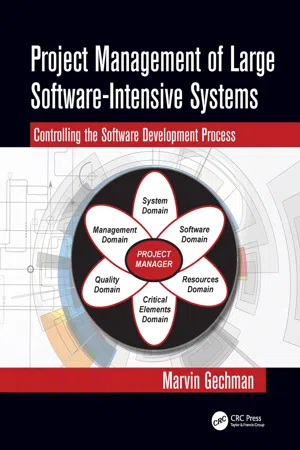
The book describes how to manage and successfully deliver large, complex, and expensive systems that can be composed of millions of line of software code, being developed by numerous groups throughout the globe, that interface with many hardware items being developed by geographically dispersed companies, where the system also includes people, policies, constraints, regulations, and a myriad of other factors. It focuses on how to seamlessly integrate systems, satisfy the customer's requirements, and deliver within the budget and on time. The guide is essentially a "shopping list" of all the activities that could be conducted with tailoring guidelines to meet the needs of each project.
Information

SOFTWARE PROJECT MANAGEMENT FUNDAMENTALS | 1 |
1 Software Project Management Introduction
2 Software Project Management Activities
3 System and Software Life Cycle Processes
4 Software Development Methodologies
Chapter 1
Software Project Management Introduction
The beginning of wisdom is the definition of terms.
—Socrates (470–399 BC)
The essence of this introduction is indeed the beginning, or basic foundation, of what you need to know in order to better understand the rest of this Guidebook. Chapter 1 briefly covers the key Software Project Management fundamentals in the following ten sections:
■ Why You Should Read This Chapter First: To understand the terminology and acronyms (1.1).
■ Business Operations, Programs and Projects: Definition of a project and its relationship to programs and business operations (1.2).
■ What Is Project Management: Why projects must be planned, executed and managed (1.3).
■ A System Perspective: Why it is imperative that Software Project Managers have a system perspective, plus definitions of Systems Engineering, software-intensive systems, system boundaries, System of Systems, an overview of the System Life Cycle (SLC), and the value of a one-page big picture overview (1.4).
■ Software Project Planning: An introduction to the importance of the two key software planning documents: the Software Development Plan (SDP) and Work Breakdown Structure (WBS) (1.5).
■ The Software Project Team: Discussions of project organization, software roles, team organization, and the importance of the Chief Software Engineer (CSwE) and the Software Integrated Product Team (SwIPT) (1.6).
■ A Customer Focus: Why you must figure out how to please your customer (1.7).
■ Software Classes and Categories: Describes why having a mechanism to assign proper designations to each software entity will result in major cost savings by eliminating unnecessary documents, reviews, measurements and testing (1.8).
■ Software Development Standards: Needed to produce consistent software work products (1.9).
■ Why Software-Intensive Systems Fail or Overrun: The core success factors needed for successful development and delivery of software-intensive projects (1.10).
1.1 Why You Should Read This Chapter First
All users of this Guidebook should read this introductory chapter first as it establishes a basic understanding of the terminology used and it briefly describes the Guidebook infrastructure that constitutes a foundation for understanding the principles of Software Project Management.
Lessons Learned. This Guidebook is not a standard! Therefore, there are no mandatory “shalls” as you will find in a typical technical standard. There are many variables involved with managing software projects. This Guidebook does not contain prescriptive directions as to precisely how to manage software-intensive system development. What it does provide is approaches, techniques and recommendations for managing software-intensive systems based on many years of proven practices and successful developments. Use new approaches where they fit, but please don’t abandon the wisdom gained from experience.
Acronyms. Acronyms are used extensively in this Guidebook. Appendix A contains a list of all acronyms used in this Guidebook. Table 1.1 is a list of the most common acronyms used throughout the Guidebook; memorizing this set of acronyms will speed up and facilitate reading the Guidebook.
Table 1.1 Common Acronyms
| CSwE | Chief Software Engineer | SDP | Software Development Plan |
| CCB | Configuration Control Board | SDR | Software Discrepancy Report |
| COTS | Commercial Off-the-Shelf | SEIT | Systems Engineering, Integration & Test |
| C/R | COTS/Reuse (a software class) | SEPG | Software Engineering Process Group |
| CUT | Coding and Unit Testing | SI-SU | Software Item–Software Unit |
| IT&V | Integration, Testing and Verification | SIP | Software Implementation Process |
| IMP | Integrated Master Plan | SLC | System Life Cycle |
| IMS | Integrated Master Schedule | SPM | Software Project Manager |
| JMR | Joint Management Review | SPR | Software Peer Review |
| JTR | Joint Technical Review | SQA | Software Quality Assurance |
| MSDL | Master SDL | SE | Systems Engineering |
| SCS | System Critical Software (a Sw class) | SS | Support Software (a software class) |
| SCM | Software Configuration Management | SwIPT | Software Integrated Product Team |
| SCR | Software Change Request (or Report) | SwE | Software Engineering |
| SDF | Software Development File (or Folder) | TIM | Technical Interchange Meeting |
| SDL | Software Development Library | UI&T | Unit Integration and Test |
| SDLC | Software Development Life Cycle | WBS | Work Breakdown Structure |
It is expected that, when this Guidebook is used a reference, readers will revisit individual sections for reminders when needed. Consequently, acronyms are typically redefined when first encountered in each chapter. Definitions of key terms used in this Guidebook are included in Appendix B.
Learning acronyms is almost like learning another language. Those who balk at learning a lot of acronyms must realize that, if they want to work in the Software Engineering profession, acronyms are an inherent part of the daily life of a software engineer. The pinnacle of acronym usage is in government and military work because, for example, it is much easier to say “DIACAP” than it is to say, “Department of Defense Information Assurance Certification and Accreditation Process.”
Terminology. The Guidebook is focused on large software system developments with the intention that smaller sized systems will tailor out what does not apply to them. Essentially, the Guidebook is a “shopping list” of what must be done, what should be done, what can be done, and what may be done (if applicable to your project). In that context, the following terms—and what they mean—are used throughout this Guidebook:
■ Must: Highly recommended for compliance with most software standards and as a best practice.
■ Should: Recommended for accuracy and completeness.
■ Can: Discretionary but should be seriously considered for inclusion.
■ May: Discretionary or used to show examples; Using the term “may” implies that other good options exist—choosing between them is left up to the Project Manager.
1.2 Business Operations, Programs and Projects
Business Operations. A project should not be confused with general business operations that are ongoing, repetitive, or essentially permanent functional activities of your organization that produces products or services. A simplistic example: If a boat company has a speedboat division that manufactures and sells speedboats, the daily activities of that division is an ongoing business operation. When that division decides to design and build a new model speedboat, that effort is a project.
Programs. Likewise, projects should not be confused with programs since programs typically consist of multiple projects. In your company, there may be only a subtle difference between programs ...
Table of contents
- Cover
- Half-Title
- Title
- Copyright
- Contents
- Foreword
- Preface
- Acknowledgements
- Author
- SECTION 1 SOFTWARE PROJECT MANAGEMENT FUNDAMENTALS
- SECTION 2 SOFTWARE MANAGEMENT AND QUALITY DOMAINS
- SECTION 3 SOFTWARE RESOURCES DOMAIN
- SECTION 4 SYSTEMS AND SOFTWARE ENGINEERING DOMAINS
- SECTION 5 CRITICAL SOFTWARE ELEMENTS DOMAIN
- Appendix A: Software Acronyms
- Appendix B: Software Definitions
- Appendix C: Software Roles and Responsibilities for Skill Groups
- Appendix D: Criteria for Evaluating Commercial Off-the-Shelf (COTS) and Reusable Software Products
- Appendix E: Pre-Milestone A Plans and Strategies
- Appendix F: Annotated Outline of the Software Development Plan (SDP)
- Appendix G: Exit Criteria for Software Reviews
- Appendix H: Chapter Highlights
- Appendix I: References by Category
- Index
Trusted by 375,005 students
Access to over 1.5 million titles for a fair monthly price.
Study more efficiently using our study tools.
Frequently asked questions
Yes, you can cancel anytime from the Subscription tab in your account settings on the Perlego website. Your subscription will stay active until the end of your current billing period. Learn how to cancel your subscription
No, books cannot be downloaded as external files, such as PDFs, for use outside of Perlego. However, you can download books within the Perlego app for offline reading on mobile or tablet. Learn how to download books offline
Perlego offers two plans: Essential and Complete
- Essential is ideal for learners and professionals who enjoy exploring a wide range of subjects. Access the Essential Library with 800,000+ trusted titles and best-sellers across business, personal growth, and the humanities. Includes unlimited reading time and Standard Read Aloud voice.
- Complete: Perfect for advanced learners and researchers needing full, unrestricted access. Unlock 1.5M+ books across hundreds of subjects, including academic and specialized titles. The Complete Plan also includes advanced features like Premium Read Aloud and Research Assistant.
We are an online textbook subscription service, where you can get access to an entire online library for less than the price of a single book per month. With over 1.5 million books across 990+ topics, we’ve got you covered! Learn about our mission
Look out for the read-aloud symbol on your next book to see if you can listen to it. The read-aloud tool reads text aloud for you, highlighting the text as it is being read. You can pause it, speed it up and slow it down. Learn more about Read Aloud
Yes! You can use the Perlego app on both iOS and Android devices to read anytime, anywhere — even offline. Perfect for commutes or when you’re on the go.
Please note we cannot support devices running on iOS 13 and Android 7 or earlier. Learn more about using the app
Please note we cannot support devices running on iOS 13 and Android 7 or earlier. Learn more about using the app
Yes, you can access Project Management of Large Software-Intensive Systems by Marvin Gechman in PDF and/or ePUB format, as well as other popular books in Computer Science & Project Management. We have over 1.5 million books available in our catalogue for you to explore.