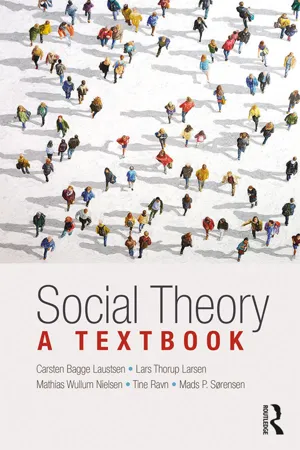
This textbook offers a new approach to understanding social theory. Framed around paired theoretical perspectives on a series of sociological problems, the book shows how distinctive viewpoints shed light on different facets of social phenomena. The book includes sociology's "founding fathers", major 20th-century thinkers and recent voices such as Butler and Zizek. Philosophically grounded and focused on interpretation and analysis, the book provides a clear understanding of theory's scope while developing students' skills in evaluating, applying and comparing theories.
eBook - ePub
Social Theory
A Textbook
- 270 pages
- English
- ePUB (mobile friendly)
- Available on iOS & Android
eBook - ePub
About this book
Information
chapter 1
What is sociology?
As with any other discipline, the subject and methods of sociology are disputed. What is sociology? What is it not? The typical answer is that the subject of sociology is “the social”; or, somewhat less tautologically, “society” and that its method consists of reducing phenomena to a societal root. Saying it in this manner might leave a bit of a bad taste in your mouth, but as sociologists we actually do believe that it is “society’s fault”. We will qualify this statement later; until then, allow this to serve as the point of departure for our identification of the social and sociology.
Whatever sociology does, it represents a departure from the notion of the autonomous and solipsistic individual. Basically, the social is that which exists between people, between individuals; that is, their interaction, communication and (moving up a level) the rules, roles, norms and values tying them together in communities of different types and sizes. In everyday speech, when we refer to humans as “social”, we are saying something about how they are able to create relations to other human beings. And when we criticise others for being asocial, we are saying something about how they do not contribute to or participate in the community.
Humans are social individuals: not just homo sapiens, but also homo socius. If we do not have others with whom to speak or act in relation to, we go insane. It is natural for us to engage in interpersonal relations, communicate with one another and act together with others. When the communist regimes in Eastern Europe collapsed after the fall of the Berlin Wall in 1989, the world witnessed the horrific images of the understimulated children in Romanian orphanages who had spent most of their lives in a crib without intimacy and proper contact with others. Many of these children were ultimately given up for adoption, and a large number of them proved to have suffered serious injury. Or to draw on an example from the world of film, think of the Robinson Crusoe-like Cast Away, where Chuck Noland (played by Tom Hanks) is stranded on a deserted island together with a number of FedEx packages. One of the packages contains a Wilson volleyball. Chuck puts his dirty hand on it, creating a palm print that resembles a face. He gives the ball some hair, and suddenly Chuck has his “Friday” – unsurprisingly, he named him Wilson. Like Chuck, we all need a “Friday”. This is so obvious that we practically need a trip to a deserted island to discover this to be so.
Often, our sociality is so ingrained and implicit that we do not even notice that the social is at stake. We are born into communities and in everything that thus follows; and we are therefore hardly able to imagine living in a different manner. Even when we try to imagine the zero point of our culture, as is the case with Robinson Crusoe-like tales such as the aforementioned Cast Away, the sociological sequence of numbers starts with the number 2. The story – at least the sociological – only begins when at minimum a twosome has been established. If we momentarily try to disregard the Romanian orphans, we might say that we are weaned on the social. Just as we hardly think about grammar on a daily basis and yet speak in grammatically correct sentences, “the social” becomes second nature. The social is something we draw upon but not necessarily something we reflect upon.
Sociology does not necessarily contradict our intuitive notions of community life; rather, it sharpens and enriches the knowledge we already possess. Sociology is therefore occasionally accused of producing platitudes. If only it was possible to juggle advanced formulae that demand years of education to understand! The knowledge produced by sociology may occasionally appear somewhat banal, but this only occurs when we become fully aware of that which we already “know”. That said, as the professional observer of the social, sociology obviously also contributes with new insights; often in competition with lay knowledge.
In other words, we have an inclination to not think sociologically. For example, a central insight in the sociology of religions is that religion is socialised. The religious convictions of children usually follow those of their parents, the explanation being that they are raised in a certain religious tradition. But reducing religion to something learned means disregarding any talk of actual faith and revelation. It gets worse yet, of course, if you insist, like Karl Marx, that religion is the “opium of the people”. This unmasking ambition necessarily means that sociology finds itself in conflict with a number of authorities and therefore occasionally in a bad light.
When we claim that the subject of sociology is “society”, reference is being made to the existence of a supra-individual level. In the early years of sociology, reference was made to communities, but that concept quickly became too narrow. The term society is considerably more capacious, as it also makes it possible to conceive of the social as conflict. The aggregated level can then be fleshed out so as to be made up of institutions, organisations, groups, masses or even states – and of course, the relations between these entities. The series can almost be continued indefinitely, and considerable creativity has also been exercised in the attempts at conceptualising that which is “above” the individuals.
Especially in the early years of sociology, there has been a tendency to understand the social as something “soft” and therefore difficult to define, in contrast to more tangible phenomena. Sociology has therefore been more interested in informal control than formalised rules; in culturally given values rather than laws; in masses rather than associations; and in “gossip” rather than official “truths” or formal self-presentations. Sociology is constantly on the hunt after that which is neither said nor written anywhere but nevertheless is absolutely essential to making common life work.
But the societal is also “over” the individual in another sense. As mentioned, we are born into the social, which means that considerable limitations are placed on our actions. As French author Bernard Le Bovier de Fontenelle (1657–1757) wrote, the power of the dead is often greater than that of the living. When we as teachers step into the lecture hall, our behaviour is not only conditioned by the spatial framework but also by the expectations sticking to the conceptions about a university, ideas which are based on centuries of academic practice. When they meet in the courtroom, judges and lawyers are obligated to respect a lengthy number of institutional norms that they can hardly even budge. And finally, examples of less formalised institutions include something as simple as how you are supposed to act on a bus; you don’t burp, you wear clothing, you don’t stare at the other passengers, and you avoid physical contact. The social might well be some kind of “soft entity”, but should you violate the codex for correct behaviour, you will experience sanctions. Just try getting naked on a bus and learn this the hard way.
Further along these lines, the contribution of sociology is to analyse or even construct this level “above” the individuals. In the field of sociology, there is talk of how the social has emerging properties; that is, properties that cannot be reduced to a lower or more fundamental level, usually to the level of the actions of individuals. Sociology distinguishes itself from many other disciplines by constructing its own object of study. The social is not readily observable in the same manner as literary works are for a student of literature or verdicts are for a lawyer. In Durkheim’s work with the rules for social methods, he argues that sociology ought to analyse social facts (1938). In addition to emphasising how the social is something undeniable and solid, the intention behind this use of terms was that the social is something that cannot be reduced to the level of the individual and which sociology must therefore determine the existence of.
And finally, the third element – how sociology reduces individual behaviour to a societal or social root: Sociology is seeking that which lies behind a given phenomenon. What does it mean? As we will see in the following pages, it can mean very different things. At minimum, it means viewing the social or the societal as something that conditions the behaviour of the individual. To borrow a couple of terms from statistics, the individual is our dependent variable (that which is to be explained) and the independent variable (that which explains) is the social or society. One can focus on the conditions for individual action as being conditioned or perhaps actually something that unequivocally forces us to act in specific ways. Sociologists have attempted to establish regularities and laws, but many – in fact more – prefer to talk about probabilities or a complex network of conditioning factors.
This can be placed in the perspective of the so-called contract argument, which often serves as the basis of liberalism and which sociology fiercely opposes (see e.g. Mead 1977: 242). In the writings of political philosopher Thomas Hobbes, the contract argument is interpreted, when read from a liberal perspective, as the story of how individuals come together in a community. Weary of war, they realise that it would be better to surrender the use of weaponry to a state power which, in exchange, guarantees their security. The point of departure for this liberalistic reading is that the individuals and their interests are primary and that it is therefore necessary to understand the aggregated level – here, the state – as a product of a deliberate action; that is, an epiphenomenon.
Sociology turns this on its head. We cannot start with the individuals and then construct the relations, as in the form of a contract. It is the reverse. The relations, such as the role as citizen, come before the individual. The individual is not the basis of society but rather its product. Society is something into which we are born. Sociologists therefore start with society and analyse the extent to which society makes it possible for individuals to enter into relationships with one another – for example, as citizens.
We have now introduced three central metaphors. Sociology is occupied with what is “between”, “over” and “behind” the individuals – with relations, social facts and that which can explain the individuals and their behaviour. Before we continue, let us mention the most renowned example in the history of ideas of a sociological explanation: Durkheim’s analysis of suicide (1951). To begin with, one might believe that suicide is the most individual action of all – as it is about an existential choice. Durkheim does not contest that suicide is often understood as such by the unhappy souls who resort to it. His point is, however, that from a sociological perspective, suicide must be understood and analysed as a “social fact”. Suicide is conditioned by a social framework and it is as such a patterned phenomenon that opens itself towards a sociological explanation. One can thus consider suicide both from the perspective of the individual and from an aggregated and supra-individual perspective, which is that of sociology. Sociology often understands our behaviour in an entirely different manner than we do; and it is not necessarily because we are mistaken but because it raises a number of entirely different questions than we (i.e. laymen) normally do.
Durkheim, in his study of suicide, found a number of differences that called for a sociological explanation. First, he found that Catholic countries had lower suicide rates than Protestant countries. The explanation was not religious dogma as Catholicism and Protestantism alike prohibit suicide. An obvious explanation was that Protestantism places the individual before God, whereas in Catholicism this relationship is mediated to a higher degree by a number of authorities, the priest being the most important. The key issue here was individualism versus collectivism in the form of the individual’s degree of integration in a given community. Other results would appear to support this assumption. For example, unmarried persons have higher suicide rates than married persons; and suicide rates are inversely proportionate to the number of children a person has. Finally, Durkheim found that suicide rates decline in times of crisis, which could be explained by how communities are strengthened in such periods.
Durkheim used the degree of individualism and collectivism to explain what he referred to as egoistic suicide. Another form of suicide, anomic suicide, peaks in periods with weak moral regulation where individuals struggle to stay oriented. Finally, altruistic suicide is primarily observed in so-called traditional societies in which honour and prestige are central and where death is sometimes preferable to a life in shame or dishonour.
In Durkheim’s analysis, we see our three metaphors in use. First, the social is about relations between individuals. Strong relations (as in Catholicism) mean fewer suicides than weak relations (as in Protestantism). If the social glue is strong, as in periods with strong moral values, there should be fewer suicides than in transition periods in which established societal values are under pressure. We also see clearly that Durkheim understands the social as an aggregate level. He made use of suicide statistics and knowledge about culture, religion and other macrophenomena. The social is thus above the individuals. Finally, Durkheim is not interested in people’s own explanations but rather in the conditions in play behind the backs of the actors. That which is central is the culture (i.e. morals, religion) that they are born into and which conditions their actions.
Sociology as discipline
If we begin with the aforementioned description of what sociology is, one hardly finds a discipline within the social sciences that does not make use of a sociological method. In that sense, political science can be understood as a subgroup within the sociological field of investigation: as political sociology. Anthropology also makes widespread use of a sociological approach. And why not also the historical sciences? In our attempt to define sociology, we must emphasise that sociology is not merely defined by a subject and a method – our three metaphors only take us so far – but it is also shaped by theoreticians and debates. There is a “royal line” of theoreticians, the fathers of the discipline and everyone who relates to them and discusses the questions they raised can be said to practice sociology.
The easiest way to recognise a sociologist is, thus, that he or she makes frequent references to Marx, Weber or Durkheim; or to Bourdieu, Habermas or Foucault, to name some more recent sociologists. This fondness for the sociological classics can find release in journals and book series. As the Polish-British sociologist Zygmunt Bauman writes, it is simply possible to understand sociology as the books that are categorised in the library under the term “sociology” (Bauman and May 2014). In other words, sociology is a specific academic tradition, and that statement alone actually says a lot. Naturally, sociology can be conceptualised sociologically. The discipline is to be understood as a field in which battles are fought over what constitutes sociology. And the result – well, you can see that when you look at the sociology shelf. Some works and authors are categorised as sociology, others not.
Perhaps the most tangible definition of sociology is to identify the sociological as that which at any given point in time is carried out by those who are educated at a sociological department. A lawyer has studied the law; a doctor has studied medicine; and so on. However, the title “sociologist” is not restricted or protected (unlike the titles “doctor and “lawyer”). Moreover – and just as important – a considerable number of the great sociologists were not actually educated within the discipline. Philosophy, among other disciplines, has had a great impact on the development of sociological thinking. Again, we can attempt to forward a sociological explanation: Those employed at sociological departments and institutes attempt to take a patent on all things sociological. Like all others, they are fighting for their legitimacy and to show that they are able to do something that others can only achieve with great difficulty or not at all. Fortunately, they do not win every time.
A further difficulty is that sociology thrives among other academic traditions; for example, the sociology of religions is studied at faculties of theology, political sociologists can be found at departments of political science, and the sociology of law is studied at faculties of law. Finally, many researchers practice the sociological perspective as one among many.
The fourth definition is the most open and inclusive (and a trifle naïve): A sociologist is someone who wishes to contribute to a sociological milieu and to an academic discussion about issues pertaining to sociology. When we call it naïve, it is because those who are already established decide who is granted admission and who is kept out. Ideally, sociology will become a more open discipline over time and the establishment within the field more tolerant in their academic demarcations.
In the 1970s, sociology was practically the dominant discipline in some countries due to the status of Marxism, and sociologists delivered the hard-hitting arguments and enjoyed political attention. Later, it found itself in a somewhat more humble position in the social sciences, as economists took the spotlight. Throughout the 1990s, however, sociology again established itself in departments of sociology, among researchers and students, in textbooks and attracted renewed media attention.
As far as international differences, American sociology is often more empirical, whereas continental sociology is more theoretical. The great, canonised sociological theoreticians are thus almost all from the European continent. The postwar generation of sociologists is heavily influenced by the experiences with Nazism and the Holocaust, whereas the American-dominated consumer society and its consequences have a more central position among more recent theoreticians.
It makes sense to draw a distinction between what is often referred to as general social theory and so-called hyphenated sociology (Bindestrich-Soziologie). As the term indicates, social theory offers a more theoretical approach to the social, often characterised by general soundings with respect to the society in which we find ourselves. Many have surely heard terms such as risk society, knowledge society, the society of control and reflexive modernity. An important task for social theory is to critically discuss contemporary diagnoses such as these and attempt to provide a holistic characterisation of contemporary society and contrast this with social formations of the past. German sociologist and philosopher Theodor W. Adorno (1903–1969) claims that sociology is the only discipline with an eye for society as a whole – in its totality (2000: 110). Not everyone goes that far, but it is correct that social theory is very inclusive.
In order to be so inclusive, social theory must be relatively abstract and general, meaning that it often leans on other disciplines, such as philosophy. However, social theory is marked by far stronger empirical foundations. Philosophy is typically interested in whether or not arguments are good and logically rigorous; social theory is more about the applicability of concepts in a diagnosis of specific societies and social forms. Social theory is empirically grounded, although the empirical matter can vary, including examples, paradigmatic illustrations and the like. Hyphenated sociology is the term for all specialised disciplines ending with sociology. Here, sociological method is associated with a demarcated field, such as sociology...
Table of contents
- Cover
- Title
- Copyright
- Contents
- Preface
- 1 What is sociology?
- 2 Capitalism and alienation: Marx and Weber
- 3 Recognition and anomie: Durkheim and Honneth
- 4 Social interaction and marginalisation: Simmel and the Chicago School
- 5 Power and stratification: Foucault and Bourdieu
- 6 System and differentiation: Luhmann and Habermas
- 7 State and market: Althusser and Boltanski & Chiapello
- 8 Uncertainty and risk: Bauman and Beck
- 9 The reflective self: Goffman and Giddens
- 10 Family and work: Sennett and Hochschild
- 11 Gender, body and identity: Butler and Haraway
- 12 Factish and fetish: Latour and Žižek
- 13 Sociology as an analytic praxis
- References
- Index
Trusted by 375,005 students
Access to over 1.5 million titles for a fair monthly price.
Study more efficiently using our study tools.
Frequently asked questions
Yes, you can cancel anytime from the Subscription tab in your account settings on the Perlego website. Your subscription will stay active until the end of your current billing period. Learn how to cancel your subscription
No, books cannot be downloaded as external files, such as PDFs, for use outside of Perlego. However, you can download books within the Perlego app for offline reading on mobile or tablet. Learn how to download books offline
Perlego offers two plans: Essential and Complete
- Essential is ideal for learners and professionals who enjoy exploring a wide range of subjects. Access the Essential Library with 800,000+ trusted titles and best-sellers across business, personal growth, and the humanities. Includes unlimited reading time and Standard Read Aloud voice.
- Complete: Perfect for advanced learners and researchers needing full, unrestricted access. Unlock 1.5M+ books across hundreds of subjects, including academic and specialized titles. The Complete Plan also includes advanced features like Premium Read Aloud and Research Assistant.
We are an online textbook subscription service, where you can get access to an entire online library for less than the price of a single book per month. With over 1.5 million books across 990+ topics, we’ve got you covered! Learn about our mission
Look out for the read-aloud symbol on your next book to see if you can listen to it. The read-aloud tool reads text aloud for you, highlighting the text as it is being read. You can pause it, speed it up and slow it down. Learn more about Read Aloud
Yes! You can use the Perlego app on both iOS and Android devices to read anytime, anywhere — even offline. Perfect for commutes or when you’re on the go.
Please note we cannot support devices running on iOS 13 and Android 7 or earlier. Learn more about using the app
Please note we cannot support devices running on iOS 13 and Android 7 or earlier. Learn more about using the app
Yes, you can access Social Theory by Carsten Bagge Laustsen,Lars Thorup Larsen,Mathias Wullum Nielsen,Tine Ravn,Mads P. Sørensen,Lars Larsen,Mathias Nielsen,Mads Sørensen in PDF and/or ePUB format, as well as other popular books in Social Sciences & Social Theory. We have over 1.5 million books available in our catalogue for you to explore.