eBook - ePub
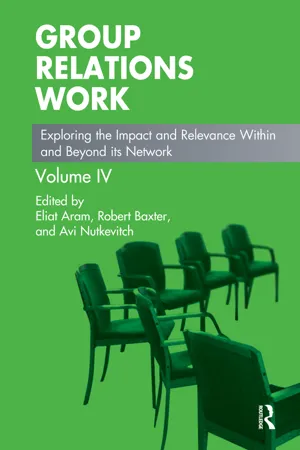
Group Relations Work
Exploring the Impact and Relevance Within and Beyond its Network
- 304 pages
- English
- ePUB (mobile friendly)
- Available on iOS & Android
eBook - ePub
Group Relations Work
Exploring the Impact and Relevance Within and Beyond its Network
About this book
This book presents a sort of angsty identity crisis and offers many clear illustrations of the multiple useful and relevant applications of group relations in different parts of the world, reflecting on the theory of group relations and its relevance to contemporary phenomena.
Information
PART I
REFLECTING ON THE THEORY OF GROUP RELATIONS AND ITS RELEVANCE TO CONTEMPORARY PHENOMENA
CHAPTER ONE
The Oedipus complex, creativity, and the legacies of group relations’ intellectual parents
Summary
This chapter highlights two key conceptual elements that are core to our understanding of group relations conference dynamics and which are often ignored—Oedipus and Sphinx. It is argued that focusing on these two concepts should help distinguish between resolutions of conflict with authority based on the paranoid–schizoid position and those based on the depressive position. In the paranoid–schizoid position, resolution is based on victory of one party over another; in the depressive position, resolution is based on the acceptance of difference that includes tolerating weakness without withdrawing from the group process. This is especially relevant where the group’s purpose is learning (Sphinx) and not a struggle over power and dominance (Oedipus). This paper also links understanding of these two concepts in group relations work to its application to social thought and social behaviour outside the group relations network.
Group relations has been at the centre of my professional life for over forty years, helping me address the challenges of organisational work and social and political process. I offer a few perspectives here on how I think group relations serves as an instrument beyond its network for understanding how individuals, groups, communities, and society conduct their affairs and, where possible, helping them to do so in better ways.
I am grateful to the organisers of the conference—Eliat, Bob and Avi—for the honour they have extended to me by inviting me to give the keynote address, thereby providing the opportunity to reflect on what group relations means for me and to offer a few thoughts on its development.
First, a brief personal history: as a young man in South Africa, I was an active member of a Jewish youth movement that later led me to live for a year on a kibbutz in Israel where ideas of the collective and the role of the individual in it were the topics of discussion and argument into the early hours. We were imbued with ideological imperatives that we believed were destined to change society and the national character. Our endeavours, centring on developing awareness, new knowledge, and integration, would be loyal to both South African and Jewish history and heritage, yet we would be revolutionary in breaking the mould of historical identities. The group, the community, the nation, the people were the focus of our youthful intellectual and political ideologies. Our daily thoughts, discussions, and actions were hugely influenced by them.
Writing about psychoanalysis, Rustin (1981) argues that seeking connections between the individual and the social are major reasons for the distance and latent hostility between psychoanalysis and general political and social modes of thought. He considers these two “systems of ideas” in tension with one another. I am positing a similar tension in “systems of thought” between group relations and organisational and leadership theory. Rustin implies that by emphasising processes involving individual minds and feelings, and an insistence on individual responsibility for them, certain forms of political commitment and social action can be undermined. I wonder if that is one reason why we are concerned about the relevance of group relations beyond its network. Rustin writes (p. 72),
Political commitment and social action attribute agency and responsibility in a collective way; they generate responses to perceived wrongs; they are activities that are external in their objectives, and are open to other interpretations of inner motivation. Such externalisation of feelings can become frenetic and one’s experience be deeply structured by a split between the idealisation of the product of change and denunciation of the evils of the present.
In this chapter, I take the view that connections between the personal and the political are significant features of group relations and are also consistent with applications of group relations theory to economic, cultural, and social behaviour. I think we share a belief that group relations and political movements outside our network will develop future directions of society through political action that depends also on understanding the capacity to live by meanings and values that are more civilised, sociable, and altruistic and more equal to the difficulties of life. Group relations can and ought to assist in this process; without this capacity to live by meanings and values, the experience of political commitment could become a very paranoid–schizoid one. In our group relations view, the “freedom of constraints” would be greater awareness and knowledge of unconscious defences that prevent us facing what we know. That was the challenge I felt as a young socialist in South Africa as we experienced the dismantling of democracy. We had reached a crossroads where we had to face the challenges of a redistribution of power and wealth. In short, we believed the nation needed to undergo a process of redemocratisation. In this process, for me, group relations later became powerfully instrumental in learning about resistance to the changes that were widely recognised as necessary and inevitable.
In group relations, we believe that cognitive ideas of social behaviour cannot be separated from the pains inflicted by our biological natures. Political and organisational theory must take account of these facts and construct a frame of meanings that can be faced—matters of pain, death, our sexual natures, the needs of infancy and nurture, and inborn individual differences in natures and capacities. Kleinian object-relations theory (Guntrip, 1961) is relevant here to the understanding of natural needs and capacities of people. In the wider field of cultural and organisational meanings, Kleinian theory offers a view of human nature as being fundamentally moral. It also assumes human beings to be constituted as social beings interdependent with others. Kleinian theory is suffused with moral categories in its developmental concepts, especially those of the paranoid–schizoid and depressive positions, notably the concern for the well-being of others. Guilt in the Kleinian “depressive position” is understood to arise from the recognition of pain suffered by, or inflicted on, others and is an essential part of relatedness. Capacity for moral feeling, therefore, is the definable attribute which links human beings, not an unfortunate external constraint upon them. The attribution of moral capacity derives from the Kleinian view of the infant’s early relationship with its mother. Individuality is shown to be not the starting point, but, rather, the result of a prolonged and delicate process of dependency. Innate concern for the well-being of the other, at a very deep level, appears to arise from the earliest lack of differentiation between self and other and from the process whereby this lack comes about. While committed to the development of individuality, object-relations theory starts from the assumption that social relationships are always primary. Bowlby and his colleagues provided experimental proof for the assertion that social relationships form the precondition for human cognition, as did Rosenfeld, in Psychotic States (1965), Bion, in Experiences in Groups (1961) and Meltzer, in Explorations in Autism (1975).
The theme of this conference was: “Exploring the impact and relevance of group relations work within and beyond its network”.
I shall now describe the impact of ideas about the Oedipus complex and ideas of Sphinx on group relations within and beyond its network because I have been intrigued by the ubiquitous force of these two concepts. They are central to our thinking about group relations and are often poorly acknowledged. This follows developments in psychoanalytic thinking about the Oedipus complex, the metaphor used by Freud to describe the son–father psychosexual competition for possession of the mother, and the daughter–father competition, also for possession of the mother. Otto Rank, in developing object-relations theory, proposed that a boy’s mother was the source of the superego. Rank’s ideas of the centrality of the mother in the Oedipus complex were developed by Klein, who concentrated on the early maternal relationship, proposing that underlying the Oedipus complex there is an earlier layer of more primitive relationships with the oedipal couple. Klein’s work lessened the role of the Oedipus complex with the concept of the “depressive position”, in which the infant is able to experience others as whole and which radically alters relationships with others, bringing the good and bad aspects of the feeding mother and the withholding mother and leads to a corresponding integration of the ego. For the post-Kleinian Bion, the myth of Oedipus concerns investigatory curiosity—the quest for knowledge. Bion regarded the central crime of Oedipus as his insistence on knowing the truth at all costs (Parsons, 2000, p. 45). The achievement of the Oedipus complex is the child coming to understand something about the oddity of possessing its own mind and discovering a multiplicity of points of view (Bollas, 1987, pp. 86–89); Phillips, 1994, p. 159). For Britton, “the link between the parents perceived in love and hate can be tolerated in the child’s mind and provides it with a capacity for seeing itself in interaction with others and for reflecting on ourselves, whilst being ourselves” (Britton, 1989, p. 86). Parsons (2000) proposes that the Oedipus complex is a life-long developmental challenge with new kinds of oedipal configurations that belong to later life. I hope that you can see these links with the development of psychoanalytic theory and how they bring me to our theme of group relations.
Lawrence (1997, p. 2) reminds us that Bion believed that the self-study of groups is a methodology that allows for the exploration of the group mind through observations that tend to fall into two categories: those that tend to centre on the oedipal situation, when related to the pairing group, and Sphinx situations when related to problems of the desire for knowledge, the function of learning, and scientific method (Bion, 1961, p. 8). The group relations method is directed at the study of the group mind that is based on the nature of psychic reality in the inner worlds of the individuals in a group and as the individual believes it is construed in the minds of others in the group. In psychoanalytic thinking, the study of the two-person relationship centres on Oedipus. Using psychoanalysis as a means of understanding the nature of thinking in groups, Bion talks about Sphinx. Lawrence (1997) argues that transferring insights from the psychoanalytic dyadic relationship to groups risks the danger that groups come to be understood in terms of the psychopathology of the role-holders constituting them rather than as potential “properties” of the group or system as a whole. This would be an over-simplification of the qualities of groups that try to bring thinking into being that transcends the individual.
A vignette from a large study group (LSG)
I am working with a white South African female consultant. A South African member links our roles to his own South African background and culture which was characterised, he said, by white authoritarian rule that spied on the people to see they did not get up to sexual mischief. Other members of the LSG continue with a theme of the consultants having other agendas—in particular, controlling the membership and the abduction and sale of children. Two Irish women take up the theme of the abuse of children in Irish children’s homes. A man volunteers that he was in a children’s home as a child where his main objective was to not attract the attentions of the male staff.
This vignette describes the feelings of helplessness and the phantasies of tragedy formed in infancy: for members of the LSG it has taken the form of fearing that their survival is at stake because the consultants appear engaged in a power-play with the weakest elements of the group.
In our group relations work, we know that a good interpretation does more than make the unconscious conscious. It offers the opportunity to integrate a newly found understanding into one’s overall organisational structure. It is a corollary of the Oedipus complex that creativity requires that one comes to grips with the legacies of one’s intellectual parents. Within the broad domains of group relations, there have been embarrassingly many attempts to kill off the line of heritage from Freud, Klein, and Bion to Rice, Miller, and Lawrence. The proliferation of schisms in group relations has often hidden a wish to murder the father (Lear, 1999, p. 125). Our work must continue to be a unique blend of creativity and faithfulness, bringing together in group relations understandings, on the one hand, of the Oedipus situation that involves a relationship with our “intellectual parents”, and creativity on the other, of the Sphinx situation of acknowledging a need to learn and co-operating with others to assist in that learning.
A usual group relations conference structure reflects the different roles that members and consultants play. These are related to organisational structures, and sometimes individual mental structures, which are represented in the members’ and the staff’s internal worlds. A m...
Table of contents
- Cover
- Half Title
- Title Page
- Copyright Page
- Table of Contents
- About the Editors and Contributors
- Foreword
- Introduction
- Part I Reflecting on the Theory of Group Relations and its Relevance to Contemporary Phenomena
- Part II Studying the Relationship Between Group Relations Work and its Impact in its Cultural and Geographical Setting
- Part III Exploring Variations in Theme and/or Design of Group Relations Conferences
- Part IV Post-Conference Reflections
- Index
Trusted by 375,005 students
Access to over 1.5 million titles for a fair monthly price.
Study more efficiently using our study tools.
Frequently asked questions
Yes, you can cancel anytime from the Subscription tab in your account settings on the Perlego website. Your subscription will stay active until the end of your current billing period. Learn how to cancel your subscription
No, books cannot be downloaded as external files, such as PDFs, for use outside of Perlego. However, you can download books within the Perlego app for offline reading on mobile or tablet. Learn how to download books offline
Perlego offers two plans: Essential and Complete
- Essential is ideal for learners and professionals who enjoy exploring a wide range of subjects. Access the Essential Library with 800,000+ trusted titles and best-sellers across business, personal growth, and the humanities. Includes unlimited reading time and Standard Read Aloud voice.
- Complete: Perfect for advanced learners and researchers needing full, unrestricted access. Unlock 1.5M+ books across hundreds of subjects, including academic and specialized titles. The Complete Plan also includes advanced features like Premium Read Aloud and Research Assistant.
We are an online textbook subscription service, where you can get access to an entire online library for less than the price of a single book per month. With over 1.5 million books across 990+ topics, we’ve got you covered! Learn about our mission
Look out for the read-aloud symbol on your next book to see if you can listen to it. The read-aloud tool reads text aloud for you, highlighting the text as it is being read. You can pause it, speed it up and slow it down. Learn more about Read Aloud
Yes! You can use the Perlego app on both iOS and Android devices to read anytime, anywhere — even offline. Perfect for commutes or when you’re on the go.
Please note we cannot support devices running on iOS 13 and Android 7 or earlier. Learn more about using the app
Please note we cannot support devices running on iOS 13 and Android 7 or earlier. Learn more about using the app
Yes, you can access Group Relations Work by Eliat Aram, Robert Baxter, Avi Nutkevitch, Eliat Aram,Robert Baxter,Avi Nutkevitch in PDF and/or ePUB format, as well as other popular books in Psychology & History & Theory in Psychology. We have over 1.5 million books available in our catalogue for you to explore.