eBook - ePub
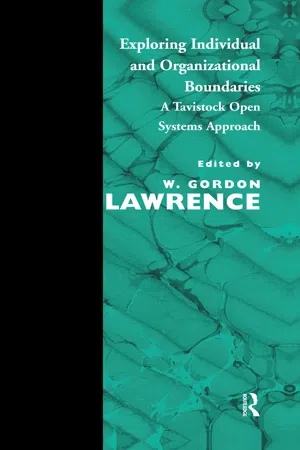
Exploring Individual and Organizational Boundaries
A Tavistock Open Systems Approach
- 256 pages
- English
- ePUB (mobile friendly)
- Available on iOS & Android
eBook - ePub
Exploring Individual and Organizational Boundaries
A Tavistock Open Systems Approach
About this book
One way of conceptualizing the relationship of individuals, through their roles, to their various groupings (such as families, communities, and business and industrial enterprises) is to consider their political relatedness. This includes an exploration of organizational structures, management, and issues of responsibility, leadership, and authority. Beyond this, the Tavistock open systems approach has always held that unconscious social processes are of central importance in such explorations. The methodology of the approach, therefore, is one that encourages people to consider the unconscious in relation to the political dimensions of institutions, This involves people in examine a range of boundaries, such as those between the inner and outer worlds of the individual, between person and role, and between enterprise and environment. Also involved are less obvious boundaries - or limits, or distinctions - such as those between certainty and uncertainty, order and chaos, innovation and destructiveness, reality and fantasy, and relationship and relatedness.
Information
Chapter 1
Introductory Essay: Exploring Boundaries
A Tavistock Model of group relations training
This collection of papers has been brought together to convey some of the current thinking of those involved in the kind of group relations training which was developed within the Tavistock Institute of Human Relations and is now conducted by its Group Relations Training Programme. Since the beginnings in 1957 when the first conference was held in conjunction with Leicester University, and which is described by E. L. Trist and C. Sofer in Exploration in Group Relations (1959), there have been a number of institutional developments. Within the Tavistock Institute a group of people led by the late Dr A. K. Rice, and principally supported by Mrs I. E. P. Menzies Lyth together with Drs P. M. Turquet, R. H. Gosling, and E. J. Miller, pressed forward the particular version of group relations training with which this volume is concerned.
Between the first conference and those under the directorship of A. K. Rice there occurred a critical division among those scientific workers of the Tavistock involved in group relations training. At the first conference the events were Study Groups and Application Groups. The former were designed to give participants experiences of the dynamics of small groups and the latter to explore how the learning could be applied in real-life situations. It was realized that while this design gave participants opportunities to become intensely aware of the destructive and creative processes of the unconscious in Study Groups there was a gap between such experiences and the world of work. Hence, H. Bridger introduced the Inter-Group Exercise at the second conference which was held at Buxton in 1959 (Higgin and Bridger, 1965). Bridger’s version of the Inter-Group Exercise provide participants with opportunities to form their own groups for the purpose of deciding on a programme of special interest sessions which would occupy the second half of the timetable for the conference. This event had a double task: the study of group processes in relation to a particular project. A. K. Rice and his colleagues, however, believed that the educational objectives of conference would be better realized if events had a single task, i.e. if the task of the event was framed in such a way that the existential nature of the event was preeminently available for study by all the participants. To have a double task for an event would mean that the exploration of the ‘here and now’ processes, which undoubtedly raise anxieties, could be defended against by participants. Thus the phenomenal stuff of unconscious group phenomena would be lost.
Since the time of Rice’s directorship (from 1962 till his death in 1969) of this programme in the Tavistock, the conferences have had the title ‘Authority, Leadership, and Organization’, or some variation on that. The focus of these conferences is on the exercise of responsibility and authority, and therefore of leadership and followership, in interpersonal and intergroup settings. This is a minimal statement because these concepts relate to others such as management and organization. Because the word ‘authority’ occurs in the title, there is often the fantasy that they are ‘authoritarian’. Be that as it may, what needs to be stated at the outset is that the concern of these Tavistock conferences is about the political relatedness of the individual through his roles to his groups, institutions, and the larger society.
Other institutions have been founded to develop not only this version of group relations training but also related consultancy and action research activities. Because of the institutional seeding it has been convenient to refer to this version of group relations training as the Tavistock Model. It has, however, been taken on and developed by people who have founded institutions and is now, therefore, not just located in the Tavistock. In America there is the A. K. Rice Institute in Washington, DC, with six regional centres and affiliated institutions such as GREX in San Francisco and the Institute of Applied Study of Social Systems in New York. In Canada, the Rosehill Institute of Human Relations also mounts working conferences and continues to develop as an institution for consultancy. In Britain there are the Grubb Institute; the Scottish Institute of Human Relations; the Chelmsford Cathedral Centre for Research and Training; and the Centre for the Study of Group and Institutional Relations based in Bristol University. In addition, there have been a number of individuals who have introduced this version of group relations training into business and educational institutions.
The term ‘Tavistock Model’ refers to a heuristic framework for identifying and understanding what conscious and unconscious processes take place within and between groups of people. Its use, however, is both accurate and misleading. It is accurate in the sense that it has its beginnings in the Tavistock Institute and is still being developed there. It is misleading in two senses. First, the tradition is now located in a number of institutions and so ‘Tavistock’ becomes a common identifying tag. Second, the tradition is a living one and is continually being reinterpreted by institutions in the light of changing circumstances in the environment; so the term ‘model’ needs to be explored. The notion of a ‘model’ can imply some ‘thing’—a reification—which is fixed and stable. Here the usage of the word ‘model’ implies a tradition with identifiable, experiential, and intellectual roots that is being reinterpreted and reworked by representatives of different institutions. These differences are not to be obliterated but celebrated; one institution’s thinking can inform other institutions. Predictably, technical leadership will move among the different institutions depending on how well their representatives are experiencing and interpreting across the boundary of their institutions. Somewhat ambivalently, therefore, I propose to refer to the version of group relations training which this book explores as the Tavistock Model. The reluctance, I hope, is understandable. Nevertheless I believe that the heuristic concepts used by the institutions to which I have referred above are identifiable and their shared usage ought to be acknowledged.
All these institutions are not founded merely for the task of providing group relations training. As in the Tavistock, the training has to be seen as complementary to other action research and consultancy projects. Hence, there is a good deal of interpenetration of ideas, values, and concepts from the research field to conferences and vice versa. Working conferences use such concepts as open-systems thinking about the organization of enterprises. The first text in this area was Rice’s Productivity and Social Organization (1958). Other books have taken this idea, among others, about organizations further. There is Systems of Organization by Miller and Rice (1967) and, as a companion volume in this series of John Wiley & Sons, Miller’s Task and Organization (1976). Action research studies which have taken such thinking further, and which rely on the heuristic concepts of the model, have been Richardson’s (1973) The Teacher, the School and the task of Management; Miller and Gwynne’s (1972) A Life Apart and an earlier text by Rice (1970), The Modern University.
The editorial policy for this volume has been to try to open up thinking about the Tavistock Model rather than to see it as a closed system of ideas which need only to be elaborated. Although it is a somewhat extravagant notion, the volume with its papers can be seen as a metaphor of the working conferences it explores. The papers, which are interpretive, are akin to the contribution of a staff in a working conference. The role of the editor, like a director of a conference, has been to set these alongside each other holding in mind their relevance for environmental issues and problems.
This volume also has to be situated in relation to other books and pamphlets which have set out this Tavistock Model of group relations training. Of these W. R. Bion’s Experiences in Groups (1961) stands preeminent because it elaborates the working hypotheses and methodology on which this model is founded. To radically alter this method would be to establish a different model. Subsequently, in 1965, A. K. Rice published his Learning for Leadership in which he meticulously described the working conferences in interpersonal and intergroup relations that had developed from Bion’s ideas. Having set out the basic concepts and described the structure, culture, and activities of the conferences by using an open-systems analysis, Rice pulled together much of the key thinking about working conferences. There have been no major radical shifts since then. The most recent text is the Group Relations Reader (1975) edited by Arthur D. Colman and W. Harold Bexton. The merit of this last text is that it makes available the best of the published material up to that date on the theory, method, and application of the Tavistock Model of group relations training. The important point, in respect of this volume, is that because others have done the basic work of explicating the conceptual, methodological, and central values of the model as exemplified through working conferences, writers for this volume have been freed to be associative and to take thinking further. Nevertheless, I want to describe aspects of this training in order to provide a context for the contributions that follow.
Aspects of working conferences
Working conferences for group relations training are usually residential and can last from a weekend to a fortnight. They are temporary education institutions and can be seen as open systems taking in members who have an interest in understanding issues of authority. The staff of a conference have two subroles: that of collective management and that of consultants. As management they provide conditions for members to learn, and in their consultant role they interpret what is taking place from this role perspective. Essentially, they manage a process which is to study group behaviour. This process is the transforming of feelings and ideas about authority into new ones. Hopefully, members will export themselves back into their institutions with fresh insights. The conference process is open-ended in the sense that the staff do not determine what members and they will learn. Experiences are provided through activities and consultants attempt to interpret the experiences of these events as they occur. Hence, it does happen that some insight will emerge in a conference of which neither staff nor members were aware before.
Working conferences have a primary task. Among the most recent statements of task for these has been the following: ‘To provide members with opportunities to find sanction within themselves to experience and interpret the nature of authority and the interpersonal, intergroup and institutional problems encountered in its exercise within the Conference Institution.’ The primary task is determined by the dominant import-transformation-export process which is to study group behaviour. It is upon this task that the design of the conference and the role of staff is based. What members choose to do is on their authority.
‘Living methodology’
The more I think about conferences the more I am inclined to say that they are designed to provide opportunities for members to internalize and make for themselves a ‘living methodology’ for inspecting the conscious and unconscious realities of groups and institutions and the political relatedness (authority, management, and organization) of individuals in roles within these configurations. ‘Living methodology’ is a cumbersome term but it carries the idea of the individual using his subjectivity and sensibility to explore realities, forming working hypotheses about the realities as he construes them, and testing the hypotheses with others as a way of arriving at some externalized, objective statement about the truth of the social situation as it is perceived from the role of member.
If we accept that what Kant called the noumenon, the thing in itself, is only known through phenomena and that we are only in a position to guess ‘that corresponding to these phenomena, which are something that we know about because they are us, is the thing itself, the noumenon’ (Bion, 1974), notions about an education in a living methodology may become somewhat clearer. It is living in the sense that it is based on the individual testing his changing constructions and perceptions of his social world as an ongoing process. The method uses subjectivity but in the process takes into account the state of the person as an instrument. So it is just not a matter of perceiving but also of personally inquiring into how one arrived at a particular perception. Something of what is involved has been captured by one writer:
In a paradoxical way, then, objectivity requires the cultivation of specific subjective states, the disciplining of attention and selected habits of thought, the screening out of other sources of consciousness, control over emotions, and a commitment to private and public honesty, to care and precision, to technical statement and social cooperation. Objectivity is a highly selective, highly developed subjective state. (Novak, 1971)
What all this points to is that reality is not something exclusively ‘out there’, that there is not a domain of order outside of the individual which merely has to be discovered, but that the individual is a bearer of that reality. Reality is both inside and outside of him. Furthermore, it is his construction of the phenomena of reality that is to be investigated. Ultimate reality, which can be referred to by such terms as ‘absolute truth, the god-head, the infinite, the thing in itself (Bion, 1974), does not fall into the domain of knowledge. Ultimate reality can only be in a state of ‘becoming’; it cannot be known. And it is this idea of ‘becoming’ that is to be held on to when thinking about modes of inquiring into social processes in groups and institutions. The ‘becoming’ enables us not to fall into the traps of either solipsism or positivism but to engage with the creative tensions among what people believe to be realities and fantasies.
The role of the consultant
The pressing forward of this methodology is initially in the hands of the consultants. What follows is certainly not a prescription but my thoughts around this role. First, the relatedness between the consultant and a group is one focus of study. The consultant interprets from his role perspective. Whether that is perceived and experienced as having more power than that of the members is open to examination. He interprets and formulates working hypotheses about the social processes, conscious and otherwise, that he understands to be present in the group. Transference phenomena are part of the data. But he is part of that configuration in the room even though he is not in the group and is not in the role of a member. If he becomes a member, his function is lost which is sedulously to pursue the primary task. Yet the data from which the interpretation is derived are his experience of being pulled into membership on the one hand and extruded into limbo on the other.
Second, I sometimes explain to myself that the task of a consultant is a maieutic one in that he is helping members to realize their interpretations of the situation; in short, to exercise their authority to test realities. Clearly, the role is not didactic in the conventional sense but is to puzzle out from a role perspective what social phenomena are present in the situation, to form hypotheses, and to further learning. It is fashionable in educational settings to talk about raising the level of consciousness. This educational context includes just that, but it also provides a model, through behaviour, of how one gets in touch with unconsciousness. This is part of the conditions that the consultant provides to enable members to undertake these tasks for themselves. Just as for the work group leader who is in touch with the primary task, there will be continual attempts to seduce the consultant into a membership role and preferably one which satisfies the primitive wishes of the members. But if this happens transference and countertransference feelings will be removed from the situation and the aim of understanding the nature of authority will disappear.
There is, third, a necessity that the consultant leads the group in a work fashion into problem areas for himself in his role in relation to the members with whom he is working. At the same time he needs to understand for himself the experience of containment, the ability to allow the members to ‘be’ in their terms. The boundary between these two is always puzzling, just as are the limits of certainty and uncertainty, chaos and order, which are all personally defined.
Fourth, the consultant is working with his subjectivity and attempting to use himself as an instrument in the situation. The internal disentangling of what is being projected into the consultant and what is already there, having been introjected from his own past experiences, is a continual private task for the consultant. He needs to be able to work out, for example, how much uncertainty he owns and how much he is projecting on to the group when he leads into new areas of exploration by offering hypotheses. It is for this reason among others that those who have directed the Group Relations Training Programme in the Tav...
Table of contents
- Cover
- Half Title
- Title
- Copyright
- Acknowledgements
- Contributors
- Contents
- EDITORIAL FOREWORD TO THE SERIES
- PREFACE
- NEW FOREWORD TO THIS EDITION
- 1 Introductory Essay: Exploring Boundaries
- 2 Boundary Management in Psychological Work with Groups
- 3 The A. K. Rice Group Relations Conferences as a Reflection of Society
- 4 The Pseudomutual Small Group or Institution
- 5 Another Source of Conservatism in Groups
- 6 Manifestations of Transference in Small Training Groups
- 7 A Manager’s View of the Institutional Event
- 8 Men and Women at Work: A Group Relations Conference on Person and Role
- 9 By Women, for Women: A Group Relations Conference
- 10 A Model for Distinguishing Supportive from Insight-oriented Psychotherapy Groups
- 11 The Adolescent, the Family, and the Group: Boundary Considerations
- 12 Learning and the Group Experience
- 13 Darkness
- 14 The Psychology of Innovation in an Industrial Setting
- 15 Open Systems Revisited: A Proposition about Development and Change
- 16 A Concept for Today: The Management of Oneself in Role
- INDEX
Trusted by 375,005 students
Access to over 1.5 million titles for a fair monthly price.
Study more efficiently using our study tools.
Frequently asked questions
Yes, you can cancel anytime from the Subscription tab in your account settings on the Perlego website. Your subscription will stay active until the end of your current billing period. Learn how to cancel your subscription
No, books cannot be downloaded as external files, such as PDFs, for use outside of Perlego. However, you can download books within the Perlego app for offline reading on mobile or tablet. Learn how to download books offline
Perlego offers two plans: Essential and Complete
- Essential is ideal for learners and professionals who enjoy exploring a wide range of subjects. Access the Essential Library with 800,000+ trusted titles and best-sellers across business, personal growth, and the humanities. Includes unlimited reading time and Standard Read Aloud voice.
- Complete: Perfect for advanced learners and researchers needing full, unrestricted access. Unlock 1.5M+ books across hundreds of subjects, including academic and specialized titles. The Complete Plan also includes advanced features like Premium Read Aloud and Research Assistant.
We are an online textbook subscription service, where you can get access to an entire online library for less than the price of a single book per month. With over 1.5 million books across 990+ topics, we’ve got you covered! Learn about our mission
Look out for the read-aloud symbol on your next book to see if you can listen to it. The read-aloud tool reads text aloud for you, highlighting the text as it is being read. You can pause it, speed it up and slow it down. Learn more about Read Aloud
Yes! You can use the Perlego app on both iOS and Android devices to read anytime, anywhere — even offline. Perfect for commutes or when you’re on the go.
Please note we cannot support devices running on iOS 13 and Android 7 or earlier. Learn more about using the app
Please note we cannot support devices running on iOS 13 and Android 7 or earlier. Learn more about using the app
Yes, you can access Exploring Individual and Organizational Boundaries by W. Gordon Lawrence in PDF and/or ePUB format, as well as other popular books in Psychology & Organisational Behaviour. We have over 1.5 million books available in our catalogue for you to explore.