- 200 pages
- English
- ePUB (mobile friendly)
- Available on iOS & Android
eBook - ePub
About this book
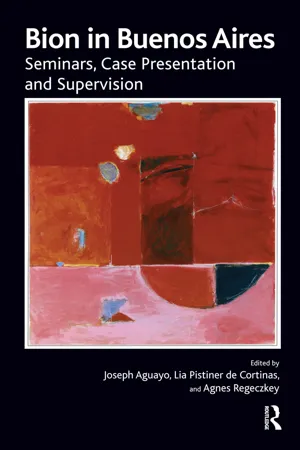
These newly discovered clinical seminars of Wilfred Bion, which include supervisions, personal case presentations, and lectures on psychoanalytic theory, represent his initial foray into many years of work that have inspired South American analysts for nearly a half a century.The clinical and theoretical work of Bion arguably ranks rather high in the current psychoanalytic firmament-as national and international conferences convene regularly to continue discussing the contemporary relevance of his work. His work has served as a source of inspiration to contemporary psychoanalysts in all three regions of the International Psychoanalytical Assocation-Ronald Britton, Antonino Ferro, Giuseppe Civitarese, Thomas Ogden, James Grotstein, and Paolo Sandler, just to name a few. These newly discovered clinical seminars from work Bion conducted in Buenos Aires in 1968 help us to further fill out the picture of his versatile gifts. In these seminars, we find lectures on Bion's elaborations on his epistemological research-still on-going in the 1960s when he went to Buenos Aires; a lecture on the Grid and its clinical relevance.
Information
Introduction
Bion in the New World—from Los Angeles to Buenos Aires
Joseph Aguayo
This brief introduction opens with two short pieces, the first of which begins with Bion in Los Angeles in 1967. He would henceforth continue a decade-long odyssey of clinical seminars in all three regions of the International Psychoanalytic Association. Bion’s Los Angeles Clinical Seminars (2013) in turn set the context for his work in Buenos Aires, and there, some of their analysts, such as León Grinberg, had some familiarity with Bion’s ideas when he arrived there in late July 1968.
By the time Wilfred Bion had lived and worked in Los Angeles for a few months in 1968, he re-routed himself from a family holiday in England, stopped off at the recently rededicated John F. Kennedy Airport in New York to change planes quickly, and then made his way to Buenos Aires. There, he was to teach and supervise for the next two weeks in late July/early August (Bion, CW 2, pp. 172–173). He was greeted by León Grinberg, who, having heard Bion at International Psychoanalytic Association Congresses, had already formed a small study group of Argentinian analysts interested in furthering their understanding of his ideas. The larger number of South American analysts who came to hear Bion in 1968 arrived with some familiarity with Kleinian ideas, while fewer directly knew Bion’s published work (Grinberg, in Talamo-Bion, Borgogno, & Merciai, 2000, p. xx).
This situation in Buenos Aires was somewhat dissimilar from the experience Bion had had in April 1967 at the Los Angeles Psychoanalytic Society and Institute, where he had come to teach and supervise—before he decided to live and work there. The visitor now became a resident of Los Angeles. Making the assumption that American-trained ego analysts would not be very familiar with his ideas about the Kleinian understanding and treatment of near psychotic and psychotic cases, Bion emphasised this aspect as he also informed American analysts about the latest Kleinian ideas on technique, namely working in the “here and now”. On the other hand, since Melanie Klein’s ideas had been in vogue for some time after the Second World War in Argentina, there was more familiarity with her work, more with child than psychotic patients (Etchegoyen & Zysman, 2005).
On the American front, Bion’s recent ideas about technique were also the source of bewilderment and criticism among American analysts, especially those who were asked to comment on his brief sketch, “Notes on memory and desire” (Bion, 1967, pp. 272–280; 2013, pp. 133–149). In urging these American analysts to “abandon memory and desire”, I have maintained that Bion startled many of his listeners in Los Angeles, who were long accustomed to the rigours of the classical definition of the transference as a displacement from past to present. Such an understanding fit in quite well with the idea of slow and gradual reconstruction of infantile neurotic conflicts and traumas. However well that might have worked in the treatment of analysable neurotics in the United States, Bion maintained that severely disturbed patients required a different kind of understanding and technical approach (Aguayo, 2014).
In also expanding the Kleinian paradigm to include the subjective processing capacities of the analyst, now becoming more popularly known as “container/contained”, Bion also introduced notions about how the subtle complexity of the analyst’s own subjective processes had to be factored into the treatment of disturbed and disturbing patients. While these factors of the analyst’s own subjective impact on his or her analytic work had been discussed and debated at the British Psychoanalytical Society since the post-Second World War era in such papers as D. W. Winnicott’s “Hate in the countertransference” (1949), Paula Heimann’s “Countertransference” (1950), and Bion’s revised version of “Group dynamics” (1955), these ideas were still new in the United States, where the ego psychological ideas of analysts like Annie Reich (1960) still held sway. In this view of countertransference, overly subjective reactions on the analyst’s part were more likely to be seen as revealing gaps or inadequately analysed lacunae in the analyst—and thus required either further supervision or remedial analysis. In the British Kleinian view of Reich’s work on countertransference, they would have regarded her definition as too restrictive, something that left out the impact on the analyst of the psychotic patient’s jumbled and disorganising communications.
When Bion came to the Americas and relayed these newer views on the analyst’s subjectivity—after all, the analyst now had to consider how he or she oscillated to and fro from the chaotic realm of the “paranoid/schizoid” to the “depressive” position, there was a clash of analytic cultures. It appeared that British Kleinians like Bion understood Freud’s structural theory in a different way from American-trained ego-psychological analysts. This point was humorously brought home when one Los Angeles analyst asked Bion if he ever made “structural considerations”. Bion replied that he considered “container/contained” such a structural consideration! (Bion, 2013, p. 92). This mix of analytic cultures made for a Kleinian/Freudian slight confusion of tongues, but it seemed that Bion ultimately found his reception in Los Angeles to his liking because a few short months later, at the age of seventy, he left the British Psychoanalytical Society and moved himself and his wife Francesca to Los Angeles. Lionised though he was in London, as both the President of the British Society from 1962 through 1965, and thereafter Chair of the Melanie Klein Trust, he resigned these posts to live the last decade of his life in Los Angeles.
By moving to America, Bion managed to become an important conveyor of the Kleinian diaspora, bringing his version of Kleinian ideas to analysts little familiar with Melanie Klein’s 1946 project to conceptualise and psychoanalytically treat near psychotic and psychotic states of mind. Since the great majority of American-trained analysts at that time were medical psychiatrists, most of them had psychiatric patients whose treatment did not fit into an American ego psychology paradigm most suited for the walking well. So, for the most part, Los Angeles psychiatrists gave Bion an attentive hearing when he spoke on the subject of psychosis. The Freudian group in Los Angeles had also maintained a bit of a maverick identity in so far as it was the only American institute that had welcomed Kleinian analysts like Hanna Segal, Herbert Rosenfeld, and now Wilfred Bion as regular visitors since the early 1960s (Kirsner, 2000).
The initially receptive atmosphere turned against their work within a few short years after Bion decided to now stay as a permanent resident in Los Angeles. In short, while welcomed as a visitor, his ongoing presence for all but a few was regarded with suspicion and weariness. By the 1970s, the chasm between the American Freudians such as Ralph Greenson and the few British Kleinians in Los Angeles became known as the “Time of Troubles” (Kirsner, 2000).
But that is another story. Let me end this part of my introduction by pointing out some of the textual continuities and discontinuities between the Los Angeles and Buenos Aires Seminars. To start with the obvious: after years of writing dense and opaque epistemological monographs, Bion (1962, 1963, 1965) decided to distil his clinical thinking in the form of clinical supervisions and case presentations. Very few in attendance at the Los Angeles and Buenos Aires Seminars would have realised that Bion had been long disinclined to discuss extensive clinical case material in his writings, especially during the 1960s. There was scarcely any clinical material to be found in three theory-laden monographs, so it would been hard except for a few close colleagues in London to have much of an idea of how exactly Bion analysed his patients (Bion, 1962, 1963, 1965).
But in the Los Angeles Seminars, Bion reversed himself by spending most of the Third and Fourth Seminars giving detailed clinical accounts of his distillation of the Kleinian method. This outstanding organising feature of the Los Angeles Seminars, along with a long supervision of an analytic case presented to him (Bion, 2013, pp. 107–131), certainly demonstrated Bion’s readiness to convey how he worked with especially disturbed patients to a group of soon-to-be colleagues on whom he would also depend for referrals once he relocated to Los Angeles just a few months later.1
This emphasis on the presentation and supervision of clinical material now became a signature of the clinical seminars for the next decade.2 Of particular interest here is Bion’s presentation in his Third Los Angeles Seminar of a borderline case of a screaming, quite reproachful patient who made such an emotional cacophony of his consulting room that he concluded in exasperation, “I couldn’t even hear myself think”. It seems that a case can be made that this patient was so difficult to treat that Bion made a decision to keep presenting material from this case the next year in Buenos Aires (cf. Bion’s Fifth Seminar). It is either that or there is simply an uncanny resemblance between these two patients. In electing for the former view, I think that this case in effect forms one of the longest case presentations by Bion we have gathered thus far, one that helps us understand something of what, in effect, was his implicit method of clinical inquiry. We also see how vulnerable a presenter Bion could be, in so far as he was exasperated to the point that he himself broached the issue with the patient of terminating the analysis. We are appreciative of having this long clinical example which gives us an opportunity to understand the various elements of his unique clinical approach, one whose careful study repays the analyst ten-fold in analysing his own difficult-to-treat patients.
An introduction to Bion's Seminars in Buenos Aires
Lia Pistiner de Cortinas
In July/August 1968, Bion was invited by the Argentinian Psychoanalytic Association (APA) to lecture, give seminars and supervisions in Buenos Aires. Since the 1960s, and even long before, in Buenos Aires there was a great interest and enthusiasm for psychoanalysis, most of all Kleinian psychoanalysis. This interest resulted in many analysts studying and learning Kleinian ideas, but also in the fact that some Argentinian psychoanalysts went to London to be supervised by Melanie Klein. Dr Horacio Etchegoyen, who presented clinical material for the supervision with Bion, lived for some time in London and had his analysis with Donald Meltzer there in 1966.
The APA was created in 1942 and some of its members, such as Heinrich Racker, Marie Langer, and Angel Garma, came from Europe, taking refuge in Argentina because of Nazism or the Civil War in Spain. We can understand why these psychoanalysts left Europe, and we must keep in mind that the condition for developing a psychoanalytic movement is the existence of a state that respects the law and guarantees the freedom to teach psychoanalysis. This kind of state has a power over its citizens limited by the law, and without freedom it is not possible or it is very difficult to work as a psychoanalyst or teach psychoanalysis in specific institutions. To challenge all kinds of authoritarian manifestations is a contribution of psychoanalysis to society. The Faculty of Psychology was created in Buenos Aires in 1958, a few years after the government of Perón was overthrown by what seemed to be a liberal movement, called “La Revolución Libertadora”—and soon it had as professors well-known psychoanalysts, such as José Bleger, David Liberman, Rafael Paz, who in several books approached psychoanalytic subjects with very original hypotheses.
Unfortunately, I could not participate in the seminars and supervisions that Bion gave in Buenos Aires, because in the 1960s psychologists could not have access to the Argentinian Psychoanalytic Association, which was the only International Psychoanalytical Association in Argentina and which had invited Bion to come to Buenos Aires. The Military Government of the dictator General Onganía forbade psychologists to work as psychoanalysts. On the other hand, there were private study groups where psychoanalysts taught Freud, Melanie Klein, and Bion. I was in one of these groups where we studied Bion with Elizabeth Tabak de Bianchedi, and also I was analysed by Darío Sor, supervised by Elizabeth Bianchedi, and later on, I was also supervised by Darío Sor. In those study groups and supervisions, I learned how Bion’s ideas transformed our clinical practice.
In 1999, along with Elizabeth Bianchedi, Darío Sor, and other colleagues, I organised the Second International Bion Conference, which was held in Buenos Aires. James Grotstein and Gerard Bléandonu were the main speakers. The First International Bion Conference had been organised by Parthenope Bion-Talamo in Turin, two years earlier. In 1973, León Grinberg, Elizabeth Bianchedi, and Darío Sor wrote Introducción a las Ideas de Bion (Introduction to the Work of Bion), the first such book that gave an overview of his ideas and for which Bion himself wrote the foreword (Grinberg et al., 1973, 1975). Bion used as a model the emotional experience of seeing Vermeer’s picture The Little House in Delft, comparing it with the impact of the emotional experience of reading this book.
With Elizabeth Bianchedi, Darío Sor, and a group of colleagues, we co-authored another book, Bion/conocido-desconcido (Bion, known/unknown), which was presented at the Bion Conference in Buenos Aires in 1999. That is how I began my work with Bion’s ideas, his hypotheses about psychoanalytic theory and clinfical practice that later on resulted in my two books: The Aesthetic Dimension of the Mind: Variations on a Theme of Bion (Pistiner, 2009) and Autismo: una perspectiva psicoanalitica (Pistiner, 2016).
Buenos Aires, 1968: the psychoanalytic atmosphere
The professors of the Faculty of Psychology were almost all well-known psychoanalysts and psychologists, and several of them also worked in many of the hospitals of Buenos Aires. In the seminars and supervisions that Bion gave in Buenos Aires we can see an enthusiastic atmosphere towards psychoanalysis. Through the questions posed by many analysts, and Bion’s spirited response, we realise the impact that his ideas had in Buenos Aires. The most significant subjects that Bion introduced in these seminars are placing psychoanalytic theory and clinical practice in a new dimension, one that nevertheless retained and refined most of the values of Freud’s and Klein’s contributions, while dealing with them from another perspective. Bion’s originality stimulated a new attitude in the analyst.
Once again, Bion spoke about putting aside rigid schemas and clichés, and said that our work takes us down a lonely road. Psychoanalysts are alone in their work; their only companion is the patient, who is not reliable because of his defences. The depth of Bion’s hypotheses, the flexibility of his models, and his recommendation to the analysts to work “without memory, desire, and understanding” attracted great attention in Buenos Aires, along with some uneasiness, which is reflected in the kinds of questions he received. In his published work, Bion’s intention was to stimulate the creative capacity of the analyst, as if to say: “dare to think by yourself”. At the same time, his interventions pointed towards the use of common sense, the development of psychoanalytic intuition, and an open state of mind towards “discovering”.
Bion spoke about the difficulties of expressing new ideas with familiar, known words and explained that this led him to introduce terms without meaning, or to use known terms but with a very precise meaning. He insisted that in our work as psychoanalysts, we have to leave the meaning open-ended, so it can continue to evolve.
Approaching these seminars, one becomes aware not only of the emotional experience of reading them but also of the emotional experience for the analysts who were there in Buenos Aires, listening to Bion and asking him questions. For example, just to show some part of this vivid dialogue between Bion and his public: someone asked about external reality and Bion says that analysts meet a very peculiar reality in their work, and that this reality is almost impossible to communicate to anybody but the patient. The lateral communication, where one attempts to communicate what happens in analysis to one’s colleagues, is not good. One can communicate this shared reality to the patient in the session, but the communication to the colleagues can be very difficult, if not impossible, because the experience of the analyst with his patient cannot be repeated with those who were not present in the session; it is a unique emotional experience.
Bion also spoke about the difficulties analysts have to face when their training is over; he stressed the difference between speaking about analysis and analysing patients. He referred to what cannot be learned through theory, and he spoke not only of psychoanalytic training but of the personal experience of the analyst developing his own technique. This implies knowing very few theories that have to become part of one’s equipment. Memories and desire interfere between the analyst and reality: they interfere between the emotional experience that is taking place in the session with the patient: while the analyst is trying to resort to “what did the patient say yesterday?” or thinking “what will I do this weekend?”, he is not present in the session. Analysts need to avoid bad habits, and Bion stressed that his perspective on psychoanalysis implied throwing a penetrating dark beam that illuminated a dark zone. He spoke of the need to develop a mental state of “patience” while not understanding and of “security” when the selected fact comes up and gives coherence to what was dispersed before.
In Transformations (1965), Bion uses a model for this aspect of his theory: the model is the reflection of a tree in a lake: the reflection will depend on the state of the lak...
Table of contents
- Cover
- Half Title
- Title
- Copyright
- Contents
- ACKNOWLEDGEMENTS
- ABOUT THE EDITORS
- FOREWORD
- INTRODUCTION
- INDEX
Trusted by 375,005 students
Access to over 1.5 million titles for a fair monthly price.
Study more efficiently using our study tools.
Frequently asked questions
Yes, you can cancel anytime from the Subscription tab in your account settings on the Perlego website. Your subscription will stay active until the end of your current billing period. Learn how to cancel your subscription
No, books cannot be downloaded as external files, such as PDFs, for use outside of Perlego. However, you can download books within the Perlego app for offline reading on mobile or tablet. Learn how to download books offline
Perlego offers two plans: Essential and Complete
- Essential is ideal for learners and professionals who enjoy exploring a wide range of subjects. Access the Essential Library with 800,000+ trusted titles and best-sellers across business, personal growth, and the humanities. Includes unlimited reading time and Standard Read Aloud voice.
- Complete: Perfect for advanced learners and researchers needing full, unrestricted access. Unlock 1.5M+ books across hundreds of subjects, including academic and specialized titles. The Complete Plan also includes advanced features like Premium Read Aloud and Research Assistant.
We are an online textbook subscription service, where you can get access to an entire online library for less than the price of a single book per month. With over 1.5 million books across 990+ topics, we’ve got you covered! Learn about our mission
Look out for the read-aloud symbol on your next book to see if you can listen to it. The read-aloud tool reads text aloud for you, highlighting the text as it is being read. You can pause it, speed it up and slow it down. Learn more about Read Aloud
Yes! You can use the Perlego app on both iOS and Android devices to read anytime, anywhere — even offline. Perfect for commutes or when you’re on the go.
Please note we cannot support devices running on iOS 13 and Android 7 or earlier. Learn more about using the app
Please note we cannot support devices running on iOS 13 and Android 7 or earlier. Learn more about using the app
Yes, you can access Bion in Buenos Aires by Wilfred R. Bion in PDF and/or ePUB format, as well as other popular books in Psychology & Education in Psychology. We have over 1.5 million books available in our catalogue for you to explore.