![]()
1
Introduction
Characteristics of Asian financial systems in comparative perspective
Peter J. Morgan, Ulrich Volz, and Naoyuki Yoshino
Asia has become the most dynamic economic area in the world economy, and this dynamism is reflected in the developments that are taking place in the banking and financial systems of Asian economies. The chapters in this handbook aim to provide an overview of the developments and trends that have taken place in Asian banking and finance, and of the challenges ahead.
The financial sector in Asia has generally performed well in supporting the growth process, as shown by Asia’s unmatched growth record. Nonetheless, maintaining a strong growth path and meeting the needs of savers and investors in the coming decades will provide many new challenges to Asia’s financial sector. These include the need to fund investments in infrastructure and human capital, support the development of innovation and the emergence of new enterprises, promote financial inclusion, accommodate the aging of Asian populations, and support green growth. Maintaining economic and financial stability in a world subject to external shocks and volatile capital flows provides another set of major challenges. This chapter aims to provide comparative perspectives on the previous and current situation of financial market development in the Asian economies covered in this book, including aspects such as financial inclusion and capital market openness.
Current situation of financial development, capital market openness, and financial inclusion
This section provides broad measures of financial development in Asia, including market size, capital market openness, and financial inclusion. Of course, there are many other dimensions that are covered in more detail in the individual chapters.
Overall financial size
Table 1.1 provides a snapshot of the overall level of financial development in many Asian economies in 2015, as measured by the share of bank credit, bonds, and stocks in gross domestic product (GDP).1 Clearly there is a huge range of development, from low-income economies with relatively rudimentary financial systems to sophisticated financial centers such as Hong Kong, China; Japan; and Singapore. The mix of funding by source also varies significantly, as the share of funding from bonds and stocks tends to rise with the level of per capita income and financial sophistication. Highly financially developed economies tend to show overall financing ratios of over 300% of GDP, including Hong Kong, China; Japan; the Republic of Korea; and Singapore. Total financing in economies with intermediate level of financial development range from 100% to 300% of GDP, including the People’s Republic of China (PRC), India, Indonesia, Malaysia, the Philippines, Thailand, and Viet Nam. The other economies have overall financing levels less than 100% of GDP.
Table 1.1 Total finance as percentage of GDP, 2015 | Economy | Bank Credit | Bonds | Stocks | Total |
| Bangladesh | 41.0 | NA | 24.9 | 65.9 |
| Brunei Darussalam | 40.1 | NA | 0.0 | 40.1 |
| Cambodia | 56.5 | NA | NA | 56.5 |
| People’s Republic of China | 140.4 | 62.6 | 64.1 | 267.2 |
| Hong Kong, China | 212.2 | NA | 1,029.1 | 1,241.3 |
| India | 50.2 | 32.4 | 42.0 | 124.7 |
| Indonesia | 31.5 | 24.6 | 71.5 | 127.6 |
| Japan | 102.6 | 208.1 | 85.9 | 396.6 |
| Republic of Korea | 136.6 | 140.3 | 99.8 | 376.7 |
| Lao PDR | 18.9 | NA | NA | 18.9 |
| Malaysia | 119.6 | 108.7 | 26.3 | 254.6 |
| Mongolia | 55.2 | NA | 24.9 | 80.0 |
| Myanmar | 16.0 | NA | 4.0 | 20.0 |
| Nepal | 56.7 | NA | 26.5 | 83.1 |
| Pakistan | 14.9 | 35.8 | 27.1 | 77.8 |
| Philippines | 39.5 | 50.5 | 25.2 | 115.2 |
| Singapore | 127.9 | 97.5 | 88.4 | 313.9 |
| Sri Lanka | 27.5 | 11.5 | 29.3 | 68.3 |
| Thailand | 114.6 | 77.7 | 97.7 | 290.1 |
| Viet Nam | 102.8 | 24.2 | 53.6 | 180.5 |
Notes: Bank credit calculated from bank deposit to GDP and bank credit to bank deposit ratio. Lao PDR data for 2010. GDP = gross domestic product. Lao PDR = Lao People’s Democratic Republic. NA = not available.
Source: World Bank Financial Development Index Database.
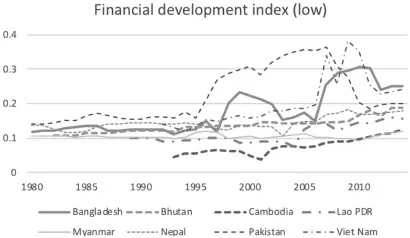
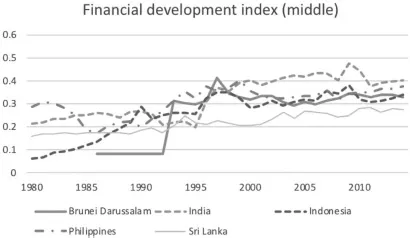
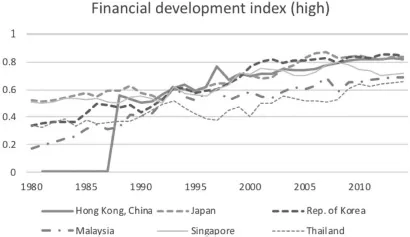
To be sure, total financing is only a crude measure of financial development and may be biased by factors such as excessive lending by the banking sector. To address this issue, Svirydzenka (2016) developed a composite measure of financial development which aggregates scores for six measures of how deep, accessible, and efficient are financial institutions and financial markets, respectively. The scores range from zero to one. Figures 1.1a, 1.1b, and 1.1c show the movements of the index from 1980 to 2014 for countries with latest scores in the range of 0–0.25 (low), 0.25–0.5 (medium), and 0.5–1.0 (high), respectively.
Overall, the results in Figures 1.1a–c match up fairly well with the crude measures of financial development in Table 1.1. All of the economies with gross financing over 300% of GDP also have composite financial development scores over 0.5. So do Malaysia and Thailand, which is not too surprising given that their gross financing levels were only slightly below 300%. Similarly, aside from Malaysia, Thailand, and Viet Nam, all of the economies with gross financing between 100% and 300% of GDP scored in the medium range of 0.25–0.5 for the composite financial development indicator, including the PRC, India, Indonesia, and the Philippines, and Viet Nam’s score was only a shade below the cutoff level.2
Figure 1.1a Composite measure of financial development: economies with current score of 0–0.25 (low development)
Figure 1.1b Composite measure of financial development: economies with current score of 0.25–0.5 (medium development)
Figure 1.1c Composite measure of financial development: economies with current score of 0.5–1.0 (high development)
Banking sector development
Within the financial sector as a whole, the banking sector tends to develop first, and the importance of the banking sector in Asian finance is well known. Table 1.1 shows that the banking sector has the largest share of aggregate finance in all economies, except Hong Kong, China; Indonesia; Japan; the Republic of Korea; Pakistan; the Philippines; and Sri Lanka. Table 1.2 shows the development of the banking sector over time in Asian economies. The shar...