"This paper is based on research into European economics and politics on the basis of ten months travelling in ten countries, as well as on four workshops run in Europe. Two hypotheses will be explored:
It is possible to discern psychodynamic evidence that unresolved humiliation trauma is being re-evoked and recycled by attempts to find solutions and cures through the tyranny of austerity measures. But the question will be asked whether these are "chosen trauma" (Volkan, 2010) which may be at the heart of the foundation matrix (Foulkes, 1973) of the European Community. The exploration of political and economic leadership in the crisis in the European Union builds on the notion of society as a large group proliferating crises of identity. From a systemic perspective it is possible to analyse the nation states of Europe protesting with regressive nationalism, refusing collaboration by engaging in economic warfare while at the same time attempting rescue packages. The protest could be seen as defensive denial of their humbling at the hands of the over-ambitious aspects of the European single currency project and the demise of the potency of the nation state.
The concluding section reflects on these issues and tries to distinguish the recycling of humiliation trauma from defence against the experience of being humbled."
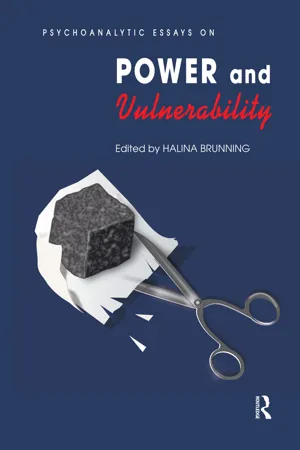
- 304 pages
- English
- ePUB (mobile friendly)
- Available on iOS & Android
eBook - ePub
Psychoanalytic Essays on Power and Vulnerability
About this book
Information
Part I
Power and Vulnerability in Leadership and Organisations

Chapter One
The relevance of early development to the psychodynamics of power and vulnerability
Introduction
According to the heroic ideal, and certainly since the figure of Achilles appeared, heroism has always been associated with invulnerability. But it was that very same Greek hero whose “Achilles heel” gave us the most powerful metaphor for the inevitable vulnerability of the apparently invulnerable. Thus the myth of invulnerability, of invincibility, of unconquerability, that is, of omnipotent indefatigability, carried with it its own contradiction, its own renunciation right from the start. Whether we think of the Greek Gods, the Greek heroes, the Samurai, the German mythological figure Siegfried, or comic book figures such as Superman, the Hulk, Batman, or Spiderman—or even real, existing persons (such as the Navy SEALs, for instance, see Chapter Eight)—the fantasy that there should exist such a creature, whether human or superhuman, is a topos which exists in every culture, and which in Jungian terms belongs to the realm of the archetype.
Equally, the ideas, fantasies, and myths surrounding power and powerfulness also partake of this yearning for omnipotence. Growing up as a young boy in the USA, one of my favourite American myths was the folktale of Paul Bunyan and Babe the Blue Ox. Paul, who was portrayed as a giant, stood somewhere between eight and twenty-nine meters tall (twenty-nine axe-handles high) and weighed at least 300 pounds. At birth it took five storks to carry him, and he was renowned for digging the Grand Canyon by dragging his axe behind him, creating Mount Hood by piling up rocks to put his campfire out, and creating the Great Lakes as a watering hole so that his huge companion, Babe the Blue Ox, could get enough to drink. But heroes, their heroic feats and their heroic powerfulness, whether mythical or real, also must be seen to be vulnerable, must have an “Achilles heel” so that we mere mortals have at least a slight chance of identifying ourselves with them. Being aware as we are, at least subconsciously, of our own mortality and vulnerability, we need our all-powerful heroes to have at least one weak spot where they prove to be vulnerable, imperfect, incomplete, and non-omnipotent. So, with these pictures in mind, let us now turn to the developmental issues involved in dealing with one’s own vulnerability and handling one’s own powerfulness.
Baby’s vulnerability/baby’s power—adult vulnerability/adult power?
Vulnerability is a characteristic easily and accurately applied to babies. Babies are so helpless, so dependent on their caretakers for food, shelter, warmth, attention, admiration, and love. As many different types of experiments have proven, babies cannot do without the presence of what Donald Winnicott referred to as the “environment mother” in order to grow and to thrive, and through whom they learn and develop in order to evolve into ever more mature, more independent but also more dependable persons. Does it not therefore stand to reason that people in responsible positions in their organisations, as well as in their families, are equally vulnerable, equally dependent upon “significant others” in order to sustain themselves adequately, and thus better withstand the stresses and strains of organisational life without succumbing to its “toxicity”?
But not to forget … babies are strong! Babies are powerful! Babies exert enormous influence on their environment from early on … starting indeed before they are even born! By the time they are only a few prenatal months old, they are insistent in making themselves felt, and in that sense making themselves known. They kick, they disturb mother’s digestion, her ability to sleep, her ability to move about. They dictate her diet, her need for sleep, for fresh air, for exercise and rest, and, moreover, her emotional and mental states. Our knowledge of what babies experience in utero is, of course, still very limited, although continually growing. But without falling into the trap of anthropomorphic thinking, it is safe to say that babies do begin to have experiences of life in the womb from early on (tactile, kinesthetic, auditory, etc.) and that these experiences influence who they are and who they become, probably in ways far more profound that we yet know about or perhaps even can imagine.
Thus it follows that baby’s vulnerability is in itself the most powerful survival mechanism, as the evidence of its vulnerability, the smallness, the sweetness, the big eyes in the round face, all reflect the utter dependency and immaturity vis-à vis the world can and, for the most part, do evoke the necessary care-giving responses from the baby’s environment which serves as its guarantee of life.
Furthermore, as our infantile vulnerability has a profound influence on our vulnerability as adults, it must also follow that our initial experiences of strength, of power and influence on our environment, also colour the way we relate to those dimensions of life later on. Although this statement may sound banal and self-evident, its consequences are not to be underestimated, even recognising the fact that many further, equally important, phases of development follow, which, in turn, shape who we are and who we become throughout our entire life cycle.
A newborn baby, merely through the very act of coming into the family, has the power to immediately influence and change the environment in many significant ways. Indeed, one could argue that they “manage” the situation from day one and are “in command” of a myriad of roles and behaviours. For not only do they determine sleeping and waking patterns, times and content of meals, who goes where and when, etc.—they are even capable of changing everyone’s name! No longer George or Fred, but Dad; no longer Sally or Mary, but Mum; no longer Daniel, but brother; no longer Kathy, but sister!
Nature and/or nurture? Becoming who one is!
But let us return to our earliest days, weeks, and months as an infant, and to the formation of the inbuilt equipment which we all bring with us and with which we form our very first relationships. Much has been studied and written about this early period of our lives and, as in all scientific endeavours, there are many different points of view and much dissent. What by now is clear to all, however, is that the old theories of babies being a kind of tabula rasa, a clean slate upon which anything and everything could be projected, is simply not true. Already at conception, and certainly after nine months gestation, we arrive at birth not only equipped with an elaborate and ancient phylogenetic heritage, but a wealth of individual experience gleaned from our time in the womb—for no two wombs and no two babies are alike.
We emerge from that fully protected, 100 per cent caring environment equipped not only with a panoply of reflexive responses, but also “preprogrammed” to breathe, eat, sleep, defecate, make ourselves noticed, heard, paid attention to, and related to as a lively, communicative individual. Through every one of our individual genetic codes, we are pre-formed to a certain extent, bodily, but also mentally, to become the person we are. For, according to Wilfred Bion, we possess a “character” or “personality” right from birth, indeed, most likely, even before. And, not only do we possess this personality but, again according to Bion, it is that aspect of ourselves which confronts us with the fact that … “the earliest problems demanding solution are related to a link between two personalities” (Bion, 1965, p. 66).
It is this fact, the ultimate centrality of relationships and relatedness to others of our species, which at one and the same time makes us human and causes us as human beings the most “problems demanding solution”. The relevance of this basic fact of existence to our double theme of vulnerability and power is self-evident. Only through our relationships with one another are we confronted both with the fact of our vulnerability and our needs and with possibilities for exercising power over our environment. So let us now go on to consider the vicissitudes of human relations in regard to these two dynamic dimensions, both in their inception and as they apply to the different roles in which we find ourselves throughout life.
Relationships: Adam and Eve—Cain and Abel
The relationship of one human being to another has occupied us literally since Adam and Eve. Their relationship, we are told, was characterised by a certain fundamental disagreement and caused them the very first marital strife of all time. But there was more to it than that. After all, they did have two sons, Cain and Abel, even though we have no further information about their relationship as a couple, or their parenting skills, that is, about how they related to their children and how the children then learned to relate to one another.
Since the outcome of the brothers’ relationship unfortunately ended in the one murdering the other, there was presumably something essentially lacking in the parents’ ability to bring up their children in a “civilised” way and to teach them to manage both their vulnerability and their quest for power more humanely. As Adam and Eve experienced no parenting whatsoever, where “on earth” were they supposed to have gathered the experience and the knowledge necessary to be able to have done so? Evidently, that knowledge doesn’t just “grow on trees!” So, how then do we learn to relate to one another so that we manage at the very least to survive, and at best even learn to thrive together and prosper, rather than doing one another in?
Again, science as well as religion and philosophy have attempted to answer these questions for a very long time and again have come up with a myriad of answers. Even within the disciplines of psychodynamic psychology and psychoanalysis there are many and varied approaches to the problem. Those that, to my mind, seem most convincing and useful are Bion’s “container–contained” approach, and that of “attachment theory” as developed by John Bowlby, Mary Ainsworth, and others, with important additions and contributions by Erik Erikson and D. W. Winnicott. Let me sketch the main points of each with particular reference to our central theme.
W. R. Bion’s theory of thinking: “container–contained”
Although originally derived from his work with psychotic patients, whose inability to think properly, or even to think at all, gave Bion the impetus for these ideas, the result turned out to be a generalised theory of the development of thought—emotionally influenced thought—from its original inception in the relationship between mother and baby to maturity in the adult mind. That is to say, its assertions reach far beyond the parameters of developmental pathology, providing us instead with a universal model of mental/emotional development based on that primary mother–child relationship.
Put simply, the model states that a baby who is in need, in distress, or even panic, has an inbuilt propensity to project that need, distress, or panic into its caretaker, or anyone else for that matter who might be in range, that is, might be capable of receiving such projections. This propensity, discovered by Melanie Klein (1946) and dubbed “projective identification” is meant to provide the baby (patient, client, colleague, etc.) with some immediate, yet in the end only temporary, relief from the emotional burden under which it is suffering at the moment. Needing to give a name to “that which gets projected”, Bion dubbed them “beta-elements” and defined them as “things-in-themselves” which are “only suitable for expulsion” (Bion, 1992, p. 181). However, this is only step one of the process.
Step two, Bion tells us, requires the receptivity of the “object” (mother or other caretaker, partner, therapist, coach, colleague, or superior, for instance) to be in a mental emotional state which he called “reverie”. This dreamlike state allows the emotional message of whatever it is that is being projected to impact upon that “Other”, ultimately enabling it to be thought about emotionally until the receptor of the projections can begin to make some sense of it. This process, to which Bion gave the name “alpha-function”, results in a kind of “dream work” which then produces what he called “alpha-elements”. These he then defined as dreamable dreams, thinkable thoughts, the “furniture”, the “building blocks”, so to speak, of what our dreams and ultimately our thoughts are made of.
In step three, these alpha elements are returned to the projecting subject in a “detoxified” form which the baby, client, colleague, or partner can hopefully then begin to use to “think for him- or herself”, not only benefitting from the relief and detoxification of its “poisonous” expulsions, but even more so, so the model claims, from the process itself. According to Bion, the projector can, through having experienced the thinking, feeling mind of the Other, now begin to introject this emotional thought process, to identify with it, and thus over time become more and more able to utilise it for oneself. (Bion, 1984; Lazar, 2000)
The implications of this model for leadership and management functions cannot be overemphasised. Indeed, for many, it has now become a paradigm of the mental attitude and psychic process in which leaders and managers need to engage, at least in part, if they are to communicate well with, listen to, understand, and thereby gain cooperation and true “followership” from their subordinates (Lazar, 2007).
Furthermore, its implications for issues of vulnerability and power are also of major significance. Without being able to be open enough, to allow oneself to be appropriately vulnerable for the reception of unpleasant, unwanted projections, one cannot be in touch with them enough to receive and work on their needs. Without this knowledge and experience of the Other, one is powerless to influence his behaviour, his thinking, and his attitudes in a deep and convincing way. Conversely, using one’s vulnerability to this end will add power and conviction to one’s own attitudes, reactions, statements, and behaviour in role, therefore maximising one’s interpersonal influence, putting one more in command of the situation and thus in a position to achieve better results.
This can, however, be understood to be a radical, and, for many, extremely risky, if not unacceptable, departure from current, established attitudes towards one’s vulnerability as well as towards one’s exercise of power. As it turns out, only the truly strong are really able and willing to admit and demonstrate their weakness and vulnerability, therefore putting them in the position to gain the added power and strength that comes from that admission. Those leaders and managers who are too afraid of their own vulnerability tend to mask it through demonstrations of “power” which don’t ring true and are easily seen and felt by their colleagues to be what they are, that is, more a “whistling in the dark” than a true demonstration of strength.
Attachment theory
In addition to being able to “think emotionally” in order to be able to reflect about what transpires in oneself and others, another major developmental hurdle to be mastered deals with the complex realm of interpersonal relationships. Again, much has been thought and written about this key area of human life and again there are many different approaches to it. One particularly fruitful approach began in the 1930s, undertaken then, for the most part by Dr. John Bowlby and his American colleague Dr. Mary Ainsworth. Since then the study of human attachment patterns has been taken up by the field of human relations and related fields all over the world. Attachment t...
Table of contents
- Cover
- Half Title
- Title
- Copyright
- CONTENTS
- ACKNOWLEDGEMENTS
- ABOUT THE EDITOR AND CONTRIBUTORS
- NOTE FROM THE EDITOR
- INTRODUCTION
- Dedication
- PART I: POWER AND VULNERABILITY IN LEADERSHIP AND ORGANISATIONS
- PART II: POWER AND VULNERABILITY IN THE POLITICAL ARENA
- PART III: THE POWER AND VULNERABILITY OF GLOBAL FINANCE
- CONCLUDING REMARKS Reflective space and the exercise of power
- INDEX
Trusted by 375,005 students
Access to over 1.5 million titles for a fair monthly price.
Study more efficiently using our study tools.
Frequently asked questions
Yes, you can cancel anytime from the Subscription tab in your account settings on the Perlego website. Your subscription will stay active until the end of your current billing period. Learn how to cancel your subscription
No, books cannot be downloaded as external files, such as PDFs, for use outside of Perlego. However, you can download books within the Perlego app for offline reading on mobile or tablet. Learn how to download books offline
Perlego offers two plans: Essential and Complete
- Essential is ideal for learners and professionals who enjoy exploring a wide range of subjects. Access the Essential Library with 800,000+ trusted titles and best-sellers across business, personal growth, and the humanities. Includes unlimited reading time and Standard Read Aloud voice.
- Complete: Perfect for advanced learners and researchers needing full, unrestricted access. Unlock 1.5M+ books across hundreds of subjects, including academic and specialized titles. The Complete Plan also includes advanced features like Premium Read Aloud and Research Assistant.
We are an online textbook subscription service, where you can get access to an entire online library for less than the price of a single book per month. With over 1.5 million books across 990+ topics, we’ve got you covered! Learn about our mission
Look out for the read-aloud symbol on your next book to see if you can listen to it. The read-aloud tool reads text aloud for you, highlighting the text as it is being read. You can pause it, speed it up and slow it down. Learn more about Read Aloud
Yes! You can use the Perlego app on both iOS and Android devices to read anytime, anywhere — even offline. Perfect for commutes or when you’re on the go.
Please note we cannot support devices running on iOS 13 and Android 7 or earlier. Learn more about using the app
Please note we cannot support devices running on iOS 13 and Android 7 or earlier. Learn more about using the app
Yes, you can access Psychoanalytic Essays on Power and Vulnerability by Halina Brunning in PDF and/or ePUB format, as well as other popular books in Psychology & Finance. We have over 1.5 million books available in our catalogue for you to explore.