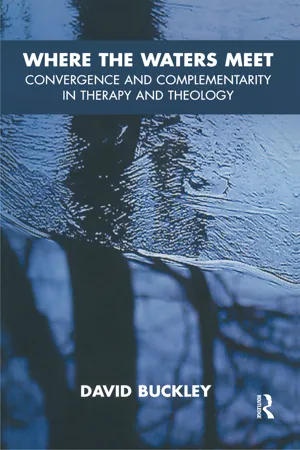
Where the Waters Meet offers the reader a new way of viewing an old subject. So often psychology and counselling therapies have been, and still are, seen as competitors, or even enemies, vying for supremacy as the true religion. This book invites us to take a fresh look at these two fields, each with their own experience and dogma, and view them in a different light. We are introduced to complementarity, an approach through which vital common factors begin to break through the barriers of convention and jargon. This book is written from deeply held convictions about faith and about therapy and emerges from several decades of experience in ordained ministry, and of working as a psychodynamic counsellor. David Buckley is passionate about both the healing process of therapy and the life-giving inspiration of faith. He sees the two not as enemies but as intrinsically linked.
eBook - ePub
Where the Waters Meet
Convergence and Complementarity in Therapy and Theology
- 166 pages
- English
- ePUB (mobile friendly)
- Available on iOS & Android
eBook - ePub
About this book
Information
PART I
Psychology and Religion
CHAPTER ONE
Differing approaches
There is a wealth of literature on the subject of psychology and religion and it is not my aim to offer anything approaching a review of this enormous field of study; to do so would require a book in itself. However, it will be helpful to indicate how this subject falls into several differing but overlapping categories.
Within this literature there are those who openly set out to demonstrate that religious belief is a colossal self-deception and who use psychology or psychoanalytical concepts and insights in an attempt to expose the fallacy of religion. Sigmund Freud, the commonly recognized father of psychoanalysis, is frequently quoted as the touchstone for this confrontation (sometimes referred to as the "warfare" model, reflecting the battle royal between science and religion). If Freud and his views are to be cast as the arch-enemy of religion we should at least recognise the nature of his opposition, especially since it is often misunderstood and misrepresented.
Although Freud is quoted - not least by many ardent adherents of religion - as the prime example of those who question the credibility of religion and find no usefulness for it in the lives of individuals or in society, he did in fact acknowledge the value of religion. By that I mean he recognized that it performed a function within society. Freud saw religion as an unconscious resistance to the intrusive and prohibitive presence of a human father, who unwittingly threatens to destroy the idyllic relationship of mother and child. Religion and particularly the concept of a heavenly father is, for Freud, our creation of a father-god, on whom we can be totally dependent. Although Freud regards this "projection" as a neurotic symptom, he argues that it has a usefulness in defending us against the realities of what he sees as our harsh existence. The following quotation demonstrates both Freud's attempt to expose religion as an "illusion", in the sense of a fallacy, and at the same time his understanding of religion as an illusion which has a usefulness for human beings facing the harsh realities of life. The italics are mine:
Religions are remarkable compromise formations: they allow the human being to admit its extraordinary vulnerability and at the same time, to retain a sense of superiority in relation to the surrounding reality. The price for the compromise is the submission to an "illusion". Religious dogmas are not the results of experience or thinking, but they are refined fantasies, wish-fulfillments in response to the most basic needs of humankind. The strength of the illusion is therefore reciprocal to the strength of the need. The central religious fantasy, a Father-God, draws its material from the childhood experience of the human being: the child's helplessness creates the need for protection; this need motivates its love and expectations towards the father and forces it to suppress the hostility towards him insofar as he is also a rival in relation to the mother. But since the real father cannot remedy the fragility of human life, and since it does not end with childhood, a stronger and more powerful father is needed. In this way the father becomes idealized and projected into the image of God. The wish for protection, powered by the actually felt need, explains the strength of the religious belief. Although this is an inadequate response because it hides from the believer her or his real loneliness and the extent of the vulnerability, Freud can come to understand religion in general as a useful neurotic and even psychotic symptom...It is a fantasy that makes life tolerable despite the hardships, and it even negates death as the final end of human life
(Braungardt, 1999).
All of this gives no comfort to the religious believer but it does give us an example of various ways in which psychology, or in Freud's case, psychoanalysis, is used as a critique of religion. There is a further point which makes it inappropriate to class Freud's confrontation with religion as "warfare". Freud enters into a dialogue with religion and several of his writings specifically address the subject. Towards the end of his life, he seemingly accepted that religion, neurotic symptom or not, was here to stay: "Life, as we find it, is too hard for us; it brings us too many pains, disappointments and impossible tasks. In order to bear it we cannot dispense with palliative measures" (Freud, 1930, p. 75).
The sting in the tale here, of course, is that by "palliative measures" Freud is indicating his view that religion is a form of drug. Nevertheless, dialogue is challenging and makes enlightenment possible. Believers who are prepared to listen may conclude that Freud's critique does reflect the way in which we can abuse religion to escape from reality. The religious person may wish to strongly challenge Freud's view by arguing that the purpose of religion is in fact to enable one to be utterly real by facing reality but which person of faith can deny the pitfall of using religion as an escape from reality? Where there is dialogue there are lessons to be learned; a point which keeps us anchored to the main purpose of this essay.
There are others who, unlike Freud, have a more favourable view of religion; who pursue a dialogue between religion and psychology which is informed and motivated by involvement and commitment to both faith and therapy. Brian Thorne, a leading "Person-Centred" therapist, has a short but powerful book subtitled A Therapist's Meditations on the Passion of Jesus Christ (Thorne, 1991), in which he brings psychological insight to stories of Jesus' last days. Thorne's book is offered as devotional reading but it is an outstanding example of how religious stories can be enhanced and given credibility through an imaginative, therapeutic interpretation. "Person-Centred" theory is a form of counselling pioneered by Carl Rogers (1902-1987), who developed his theory by placing emphasis on the efficacy of the counselling relationship and the client's right and ability to discover healing for themselves. These emphases are readily embraced within psychodynamic therapy models. I will return to Thorne's book later.
Jack Dominian, a well-known and widely-read Catholic author of pastoral and devotional books, who is also a psychiatrist, has attempted something similar to Thorne but not I think with the same success. His book, One Like Us (Dominian, 1998), is, as we might except from such an eminent figure, packed with valuable information and insights into the relationship between psychology and faith. Despite this, I do not find Dominian's approach helpful. His methodology for arriving at a psychological interpretation of Jesus is based on a direct comparison with the way he regards and responds to the stories of his patients. This methodology has the feeling of a circular argument.
As a psychiatrist I take the stories of the Christ of faith with utter seriousness. And this extends to their details. I accept them at face value and analyse them as I would any revelation made to me by my patients. I do so even if I am aware that certain details may owe their origin or their form to the catechetical concerns of the early Christian communities.
[p. 11]
An example of Dominian's approach is his interpretation of the incident of the twelve year old Jesus' conversation with his parents in the temple (Luke 2,41-43):
"Every year his parents used to go to Jerusalem for the feast of the Passover. When he was twelve years old, they went up for the feast as usual. When the days of the feast were over and they set off home, the boy Jesus stayed behind in Jerusalem without his parents knowing it."
[p. 68]
Dominian comments on this incident by imposing scarcely disguised psychodynamic concepts in order to create an apparently obvious, plausible link between the boy Jesus, the adult Jesus and the Christian Church of today. The most prominent of these concepts, that of a secure base, originates with John Bowlby (1907—1990) whose distinctive contribution to psychodynamic therapy I shall refer to later in Chapter 10. For the present it will suffice to say that the concept of a secure base emphasises how enormously important it is for a child to have an experience of security with a mother who keeps the child safe but also allows and encourages her child to venture, or to come and go. The following passage demonstrates how transparently Dominian uses the concept in the Biblical passage:
"This passage shows the secure self assurance of the boy Jesus, enabling him to stay behind and explore his environment, as well as showing his autonomy and his gentle rebuke to his mother: "Why were you looking for me? Did you not know that I must be in my Father's house?" But they did not understand what he meant" (Luke 2,49). Jesus' secure basis was internal, he carried it within himself. He in turn became the secure basis for his apostles and those who turned to him. In due course, he was to become the secure basis for his Church, which has survived to this very day."
[ibid., p. 63]
This "psychological interpretation" may well be interesting to and inspirational for a committed religious reader but I doubt whether it would commend itself to the non-believer.
Psychological models, concepts and insight can be used to explain religious experience, including the stories and miracles of sacred texts. Jung, for example, describes Paul's experience of blindness, on the Damascus Road, as "psychogenetic":
Fanaticism is only found in individuals who are compensating secret doubts. The incident on the way to Damascus marks the moment when the unconscious complex of Christianity broke through into consciousness. Unable to conceive of himself as a Christian on account of his resistance to Christ, he became blind, and could only regain his sight through complete submission to Christianity. Psychogenetic blindness is, according to my experience, always due to unwillingness to see; that is, to understand and to realize something that is incompatible with the conscious attitude. Raul's unwillingness to see corresponds with his fanatical resistance to Christianity.
[Jung, 1928, p. 257]
It is important to recognise that however unpalatable such an interpretation may be to some religious people, or whether Jung is anywhere near correct in his assessment, he is not wanting to dismiss or denigrate religious experience but to describe the unconscious, psychological processes that underlie such experiences. Jung's views on the psychology of religion are of particular interest to the religious person because of his own spiritual convictions. It is not my purpose to attempt a summary of Jung's views on the subject of psychology and religion but it is important to remember the colossal contribution he has made to the subject, especially in our understanding of the symbolic nature of Christian dogma. It is also the case that some of Jung's ideas have become household phrases and concepts; his work on "psychological types", particularly the definitions of introvert and extrovert, have been developed and used in various forms of personality-type testing. The most widely known of these is the "Type Indicator" developed by Isabel Briggs Myers and commonly referred to as "Myers-Briggs". (For those who wish to understand Myers-Briggs first hand, the clearest and most authoritative book to consult is Gifts Differing (Briggs Myers, 1980). I mention Myers-Briggs and its Jungian roots, in the context of my own agenda, because it is often used to understand the relationship between personality and spirituality; a typical contribution is Charles Keating's book Who we are is how we pray (Keating, 1987). Jung, therefore and the development and uses of his psychology, represents a further, differing approach to the relationship between psychology and religion.
There is another way in which the dialogue between religion and psychology has been pursued and presented which can be justifiably recognised as a tradition itself, within this field of study. It seeks to draw comparisons between various forms of developmental psychology - particularly those, like Freud's, which chart distinctive "stages" of human development. These stages are then likened and intrinsically linked to complementary stages of development in spiritual, religious and faith experiences. For those who have even a passing interest in the relationship of psychology and religion, probably the best known of these is J.W. Fowler's Seven Stages of Faith model (Fowler, 1981). The Stages, which are listed from 0 to 6, indicate a growth process which develops from a primal faith, through intuitive-projective faith, mythic-literal faith, synthetic-conventional faith, individualise-reflective faith, conjunctive faith, to its most refined and mature expression in universalizing faith. I have deliberately listed Fowler's terminology so that it can be clearly appreciated that the terminology which precedes the word "faith", represents the psychological dimensions of his theory. The psychological aspects of his psychology of belief model are informed by Piaget's work on the cognitive development of children, E. Erikson's Freudian-based model of the Eight Ages of Man, and the moral development model of the psychologist, L. Kohlberg.
For an overview and critical appraisal of the above models, Michael Jacob's Living Illusions - A Psychology of Belief (Jacobs, 1993), is outstanding. Not only does Jacobs offer a detailed description of Fowler's model, and acknowledge his indebtedness to it but he offers us a model which is broader and more flexible. Two of the critical features of Jacob's version are that, first, unlike Fowler's model, he uses the language of "faith" in a wider sense than "religion" and second, he releases the Stages from being age-specific, as in Fowler. This latter point is one of the great strengths of Jacob's approach. His appreciation of Fowler's stages model (and those of others) is tempered by awareness of its limitations, though I sense that any criticism is directed at how such models are interpreted and used, rather than the model itself:
Although none of the models I have so far described insists on a rigidly linear scheme, there is nevertheless a temptation to link stages to ages, and to see each stage as being complete in itself. Fowler indicates that the ages spanned by most of his Stages of faith have blurred edges. Transitional periods apart, it is important to remember that all these models involve dynamic movement, and that they are not to be understood as static. They have all been developed from the perspective of psychodynamic psychology. If stages have some value as signposts of human growth, when it comes to real psychological development, people pass into and out of (and back to as well as staying in) these various stages, depending upon external circumstances and upon their own internal responses to such eventualities.
[p. 50]
and later, again speaking of the misuse of developmental models, Jacobs writes:
"There is also a temptation to use any of the categories or stages outlined in this chapter to caricature, stereotype or label others, whether as individuals or en masse, belonging to groups of which for one reason or another we are suspicious or critical."
[p. 52]
Jacob's describes his own model as:
"...a possible psychology of belief, based on four themes: the first three of which I take from the stages of childhood which Freud identifies. I take the three terms "oral", "anal" and "genital" as being themselves metaphors: each one forms the matrix for a cluster of ideas, which helps make a collage of modes of belief. These modes may in some sense also be stages, although I have already expressed my caution about adopting too strict a linear model of "development". The technical terms and the symbols I collate point towards ways of understanding systems of belief."
[p. 59]
Jacobs calls his fourth theme, Letting Go, which unlike the three, does not obviously stem from Freudian psychology.
I acknowledge here my own appreciation of Jacobs, not only for his amplified stages model and his caution in treating any model too rigidly or in a hierarchical fashion but for the whole scope of his book which deals admirably, and in an imaginative and positive way, with an understanding of faith as an illusion. I will freely draw upon Jacob's particular use of illusion later.
The developmental comparison models, as we might term them, have antecedents in the pioneering work of the study of religion and psychology. William James' The Varieties of Religious Experience (James, 1902), is the classic example of this approach. James was a pioneering psychologist, theologian and philosopher, often described as belonging to the "school" of pragmatism This philosophical framework of pragmatism assumes a particular importance because James' approach to the psychology of religion became, either consciously or unconsciously, the touchstone for others. From a personal perspective it has been important to reacquaint myself with pragmatism and to discover to my surprise that it feels like home ground - a natural place to be. Pragmatism therefore, from an objective-historical point of view as well as a subjective-personal one has an important place in the philosophical texture of this book.
Pragmatism is a philosophical methodology which begins with, and focuses on, practical consequences, rather than theoretical, or metaphysical propositions, in the search for understanding. James in no way discounts the need for ventures of faith. Indeed these ventures are absolutely necessary if faith is to be existentially realized, for we cannot discover whether something is true unless we experience it working in practice. James' own way of describing pragmatism is best heard first-hand. In his lecture What Pragmatism Means (in which "she" is James' circumlocution for "pragmatism") he concludes:
In short, she widens the field of search for God. Rationalism sticks to logic and the empyrean. Empiricism sticks to the external senses. Pragmatism is willing to take anything, to follow either logic or the senses and to count the humblest and most personal experiences. She will count mystical experiences if they have practical consequences. She will take a God who lives in the very dirt of private fact - if that should seem a likely place to find him.
Her only test of probable truth is what works best in the way of leading us, what fits every part of life best and combines with the collectivity of experience's demands, not...
Table of contents
- Cover
- Half Title
- Title
- Copyright
- Contents
- ACKNOWLEDGEMENTS
- ABOUT THE AUTHOR
- INTRODUCTION
- PART I: PSYCHOLOGY AND RELIGION
- PART II: THEOLOGICAL AND THERAPEUTIC PERSPECTIVES
- PART III: EXAMPLES OF COMPLEMENTARITY
- CONCLUSION
- BIBLIOGRAPHY
- INDEX
Trusted by 375,005 students
Access to over 1.5 million titles for a fair monthly price.
Study more efficiently using our study tools.
Frequently asked questions
Yes, you can cancel anytime from the Subscription tab in your account settings on the Perlego website. Your subscription will stay active until the end of your current billing period. Learn how to cancel your subscription
No, books cannot be downloaded as external files, such as PDFs, for use outside of Perlego. However, you can download books within the Perlego app for offline reading on mobile or tablet. Learn how to download books offline
Perlego offers two plans: Essential and Complete
- Essential is ideal for learners and professionals who enjoy exploring a wide range of subjects. Access the Essential Library with 800,000+ trusted titles and best-sellers across business, personal growth, and the humanities. Includes unlimited reading time and Standard Read Aloud voice.
- Complete: Perfect for advanced learners and researchers needing full, unrestricted access. Unlock 1.5M+ books across hundreds of subjects, including academic and specialized titles. The Complete Plan also includes advanced features like Premium Read Aloud and Research Assistant.
We are an online textbook subscription service, where you can get access to an entire online library for less than the price of a single book per month. With over 1.5 million books across 990+ topics, we’ve got you covered! Learn about our mission
Look out for the read-aloud symbol on your next book to see if you can listen to it. The read-aloud tool reads text aloud for you, highlighting the text as it is being read. You can pause it, speed it up and slow it down. Learn more about Read Aloud
Yes! You can use the Perlego app on both iOS and Android devices to read anytime, anywhere — even offline. Perfect for commutes or when you’re on the go.
Please note we cannot support devices running on iOS 13 and Android 7 or earlier. Learn more about using the app
Please note we cannot support devices running on iOS 13 and Android 7 or earlier. Learn more about using the app
Yes, you can access Where the Waters Meet by David Buckley in PDF and/or ePUB format, as well as other popular books in Psychology & Mental Health in Psychology. We have over 1.5 million books available in our catalogue for you to explore.