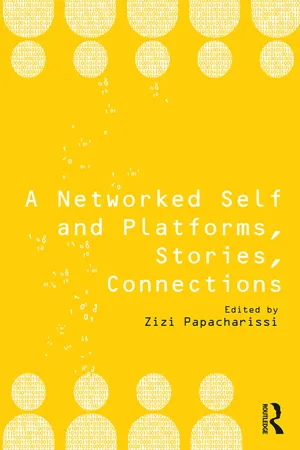
We tell stories about who we are. Through telling these stories, we connect with others and affirm our own sense of self. Spaces, be they online or offline; private or public; physical, augmented or virtual; or of a hybrid nature, present the performative realms upon which our stories unfold. This volume focuses on how digital platforms support, enhance, or confine the networked self. Contributors examine a range of issues relating to storytelling, platforms, and the self, including the live-reporting of events, the curation of information, emerging modalities of journalism, collaboratively formed memories, and the instant historification of the present.
- 214 pages
- English
- ePUB (mobile friendly)
- Available on iOS & Android
eBook - ePub
A Networked Self and Platforms, Stories, Connections
About this book
Information
1
Introduction
Zizi Papacharissi
We tell stories about who we are, and through telling these stories, we connect with others and affirm our own sense of self. For human beings, this is our modus operandi. It is how we survive—through expression and social connection. We vary in those behaviors, as some people may be more outgoing in certain situations and others more introverted in different contexts. Still, we adjust, we reconsider, and we evolve. So more than a mode of daily survival, storytelling for human beings is a way of understanding who we are and imagining who we would like to be. Media have always helped along with this process. From the ancient days of carving our daily experiences in caves, to drawings, to developing languages so as to communicate, to then developing many platforms for telling, printing, publishing, broadcasting, podcasting, and sharing our stories, it has all been about expression and connection. Sometimes we succeed in telling great stories that inspire and other times we fail in telling stories that disconnect us. Still, most often, we tell stories that are always in the making: always being revised, always soluble. The technologies are there to help us along and to network us, but it is our stories that identify us, connect us, or further tear us apart.
This is a volume about how we tell stories in the contemporary networked digital environment. We tell a variety of stories in our everyday lives, but I focus on storytelling that enables us to sustain our sense of self: to help us make sense of the world surrounding us and find our place(s) in it. This volume is part of a series of books that build on the concept of the Networked Self. In earlier work, serving as the prequel to this volume, I drew inspiration from this quote: “Attention shapes the self, and is in turn shaped by it” (Csikszentmihalyi, 1990, p. 13). I wanted to focus the volume on the self, and the sense of self attained (and imagined) via social media. Csikszentmihalyi (1990) was writing about flow at the time. He explains that happiness is not a constant state, but rather a fleeting emotion we experience when we find ourselves at our most creative. That is typically attained when we are immersed in activities optimally, in ways that afford us great mental and emotional satisfaction. He is careful to locate this in the realm of creativity, which extends beyond the work realm to include a number of creative pursuits. I was very interested at the time in how social media can help connect us to our lifeworlds in ways that optimize flow, and I relied on the knowledge of gifted researchers, leaders in work on social media, to help me respond to questions revolving around identity, community, and culture, as those took form online and offline.
I thus made the argument that the self, in late modern societies, is expressed as a fluid abstraction, always in solution,1 reified through the individual’s association with a reality that may be equally flexible. The process of self-presentation and representation becomes an ever-evolving cycle through which individual identity is presented, compared, adjusted, or defended against a constellation of social, cultural, economic, or political realities. Goffman (1959) had described this as an information game: “a potentially infinite cycle of concealment, discovery, false revelation, and rediscovery” (p. 13). This made me think of playful uses of social media. I imagined (and still do) expression on social media (and in everyday life) as a fun game, through which we leave traces of our stories in the places we inhabit and derive pleasure when others discover them, relate to them, and thus connect with us, all the while playing the same game themselves. This is a somewhat ego-centered approach and playful, I will admit. There are important consequences for communication being ego-driven in late modernity. Play also possesses an infrastructure that reflects, reproduces, and sometimes, albeit not often enough, reinvents geopolitical, sociocultural, and economic hierarchies. Play always has been that way: a wanted distraction that pays off in ways public and private, personal and commercial, from the days of agoras in Ancient Greece, arenas of the Roman Empire, medieval theater, and all types of playgrounds, material and imagined, adult and non-adult that have emerged and are yet to come.
Several scholars connect the cultural tendencies, which render the self more liquid (Bauman, 2000, 2004), reflexive (Giddens, 1991) and self-identity a process, to historical developments. A sense of self has always been developed across public and private, or hybrid terrain. These conventional boundaries are challenged through amplified networks of connections and overlapping or distinct milieus of interaction we traverse in late modernity, or, broadly speaking, in the anthropocene (e.g. Gergen, 1991; Latour, 2017). Technology is the playing ground of the anthropocene. It provides the stage for hybrid modalities of expression and connection, linking the individual, separately or simultaneously, with multiple audiences. Online social networks present recent sites of self-presentation and identity negotiation. The Networked Self five-volume anthology presents a collection of discussions on what it means to present the self while striving toward a sense of self in contemporary societies and cultures.
Stories and Platforms of a Networked Self
Technologies advance at a pace that invites us to reconsider and adjust the locus of our social habits. This is a distinction to be emphasized. Technology does not render us more or less social. But it does reorganize our social activities, and thus offers up new places for us to tell stories about who we are, who we would like to be, and how we might connect with others. It is true that over the past several years, the web has become increasingly platformized (Helmond, 2015) and accessible through interfaces that suggest an order for the experiences it affords (Galloway, 2012). A sense of community is thus frequently not organically developed, but suggested through the affordances and algorithmic architecture of platforms. Still, the advent of constantly re-developed technologies, technologies that are in permanently beta form (Neff & Stark, 2004), or always already new (Gitelman, 2006), introduces a modality of accelerated reflexivity, leading us to feel that our habitus, our social environment of comfort that is, is incessantly changing. Bourdieu (1987) understands the habitus as always already changing fluid environment, generated through the “durably instilled generative principle of regulated improvisations” (p. 78). It is a malleable collection of our social habits, practices, and norms that serves as a constant reference point: an ever-evolving social backdrop that helps us adapt to the new while also sustaining the familiar.
Easton and I (Papacharissi & Easton, 2014) originally used the term habitus of the new to talk about how the affordances of specific platforms interact with our habituated predispositions for sociality to insert an affect, that is, a mood or an atmosphere that evokes a feeling of ongoing, and sometimes relentless change. In the habitus of the new, our repertoire of storytelling practices is constantly reinvented. So, with Easton, we described the following expressive and connective modalities that become prominent as sociality emerges (and evolves) within the habitus of the new: (authorship as) disclosure, listening, and redaction. And so, as I articulate the meaning of this multipart anthology, I find myself moving away from language that focuses on presentations and representations of the self online. Instead, I see the scholarship presented in this anthology as work focused on the storytelling project of the self: using technology to help us make sense of who we are, who we have been, and who we can become.
In doing so, I understand storytelling as a process that involves disclosure, as much as it involves listening and redaction. Here, John Hartley’s articulation of the homo nuntius, or the “messaging human,” comes to mind. Hartley (2010) understands the homo nuntius as a contemporary species that expresses identity via and as message, and “produces individual identity out of social network interaction” (p. 305). In Hartley’s words, “Individuals in the species homo nuntius don’t just ‘send’ messages as an action (‘message’ as verb), they are a system of messages (‘message’ as noun); they are both constituted by and productive through messages, which are the process by means of which reason emerges (it is the product of a process, not an input)” (p. 19). In the habitus of the new, agency is claimed storytelling. Individuals attempt to reconcile the distance between structure and agency through authoring (disclosure), listening, and redacting messages about the self and others.
Spaces—be they online or offline; private or public; physical, augmented or virtual; or of a hybrid nature—present the performative realms through which one’s sense of self is articulated, actualized, presented, and represented. In line with the central theme of this multivolume anthology, people tell stories about who they are in order to affirm their sense of self and become who they are and want to be. People tell these stories on spaces that function as platforms for performativity. This volume focuses on how these platforms support, enhance, or confine the networked self. In so doing, it focuses on three areas of interest:
- Platforms and the politics of platforms.
- Stories people tell about themselves on these platforms.
- Stories people tell about themselves, others, and events they experience on these platforms.
The first area considers how the web has become increasingly platformized, moving from an architecture that supported organically formed communities to a structure comprising distinct or interconnected platforms. While these platforms support self-expression, connection, and communities, they do so within spaces prescribed and defined by algorithms. This first area of interest concerns the architecture of platforms as performative space for the networked self. The second area focuses on how the stories people share, in performing the networked self, are restricted, enhanced, and adorned by the affordances of these platforms. The third area of interest explores how stories we tell about ourselves, others, and events we experience on networked platforms. As such, the focus is on storytelling as it connects to live-reporting of events, curation of information, emerging modalities of journalism, collaboratively formed memories, and the instant historification of the present.
Kreiss sets the stage by synthesizing diverse literature on the long storytelling project of the self to draw attention away from the broad story of “disembedding,” and reflexivity, and back to core existential constructs that define how we understand ourselves, and then tell stories that help advance this form of self-understanding. Relying on Castells’s (2011) work on identity, he calls for scholars to focus on the “persistence of structuring identities” of what Castells calls “God, nation, family, and community” that “provide unbreakable, eternal codes” to stand against the global flows of power and information and “the individualization of identity.” This call is timely, especially as globalization flows have only partially networked some publics, while mostly disconnecting others through fragmented narratives that negate agency and reproduce insecurity.
Human identity, as Carlson and Lewis reiterate, in exploring new storytelling, journalistic epistemologies, and platforms, is performed and networked. Most accounts of performance and identity focus on identity and connection, and skim over engagement with news as a performative representation of the self. Still, involvement with news and news storytelling suggest an important way of socioculturally orienting oneself within the world. The two draw from Carey’s (2009) work to illustrate how news storytelling provides ways of connecting with others and thus suggesting modalities of collective identity. Platform design, however, enables, identifies, and restricts ways in which individual and collective identity may be performed. This is not new. Performative spaces by nature suggest ways in which identity may be presented or represented. And they support performativity through multiple forms of sharing (John, 2017; Lingel, 2017), although, unmistakably, there is a certain digitality to the form sharing takes on: algorithmically enabled, yes, but also editable, remixable, and exploitable (Gunkel, 2016; Scholz, 2017).
There is a different texture to the publicness that users experience, as they perform the self online. The materiality of these performances is different. Poell, Rajagopalan, and Kavada engage this question directly, by examining what publicness truly means in the age of datafication. In the circular process through which user data are both systematically collected and simultaneously redirected back to users in the form of metrics, trending topics, and personalized content, publicness becomes both an act and a form of being. It becomes the performative imaginary against which independent or coordinated acts of expression and connection are developed, experienced, and reified. The feedback loop rendered as users are interpellated by algorithmic processes that have been set into motion by users’ own performances of public acts sets the stage for potential performances.
Datafication is borne out of public and networked forms of participation in a digitally enabled public sphere. As Barney and colleagues (2016) remind us:
Participation has become a tremendously valuable social, political, and economic resource . . . [naming] a particular instance of what Louis Althusser described as interpellation, the process whereby we become the subjects we are by responding to the hail of ideological formation that structure our social environments . . . Participation is one of the most prominent means by which individuals and publics (at least in the contemporary West) become subjects and inscribe themselves in the social order.
(pp. ix–x)
Datafication is, therefore, the prevalent mode of algorithmically generated interpellation or interpolation [sic], as Cheney-Lippold (2017) argues in the recent We Are Data. And we have always been data, I would argue, in further extending this line of thinking. It is not my intention to gloss over the relevance of these processes, but rather, to place them in a historical continuum. The participatory condition has always empowered and enforced a sense of order; enabled independent forms of expression but also organized them within a social habitus; facilitated autonomous reactions and interpellated them at the same time. Data, digital and non-digital, make up the social fabric of collaboratively enabled interaction. Datafication, that is, the order of data, is set into motion by mechanisms that both reproduce and remediate those described by Foucault (1970) in the Order of Things.
From this premise, we can better appreciate the nuances of performative modalities that emerge through storytelling practices online. Woolley, Shorey, and Howard’s foray into bots, that is, automated programs built in the style of real users, reveals how these software-driven social actors are both imbued with the intentions of their creators and capable of functioning as distinct entities. Bot proxies capture the tendencies and tensions of the participatory condition. They reflect the paradox of interactivity that has long puzzled their creators, something Andrejevic (2016) refers to as the pacification of interactivity, that is, the tendency for “active forms of participation online [to be] redoubled by increasingly passive ones, amounting to automated participation in data-driven control systems” (p. 204). As byproducts of datafication, bot proxies are, in the words of Woolley, Shorey, and Howard, “more than a mask for a user, but less than a fully independent sentient entity.” Bots present a supporting cast for both the networked self and its aftermath. They are part of the infrastructure of the storytelling project of the networked self and the story itself. They are the product of the stories we tell about ourselves, and yet are also capable of reflexively producing their own stories.
What is the place of sentiment, then, within the algorithmically generated performative stage for the self? Wahl-Jorgensen examines how the emotional architecture of platforms is intentionally designed to facilitate certain forms of pro-social sentiment in some cases, while in others it unexpectedly and coincidentally produces emotive modalities of expression. She traces the ongoing negotiation of affective aspects of online media that lead to further commodification of emotional labor (see also Scholz, 2017) and introduces a commodified affect control structure that is ripe for...
Table of contents
- Cover
- Title
- Copyright
- Dedication
- Contents
- List of Figures
- List of Contributors
- Acknowledgments
- 1 Introduction
- 2 The Networked Self in the Age of Identity Fundamentalism
- 3 News and the Networked Self: Performativity, Platforms, and Journalistic Epistemologies
- 4 Publicness on Platforms: Tracing the Mutual Articulation of Platform Architectures and User Practices
- 5 The Bot Proxy: Designing Automated Self Expression
- 6 The Emotional Architecture of Social Media
- 7 "The More I Look Like Justin Bieber in the Pictures, the Better": Queer Women's Self-Representation on Instagram
- 8 Affective Mobile Spectres: Understanding the Lives of Mobile Media Images of the Dead
- 9 Cleavage-Control: Stories of Algorithmic Culture and Power in the Case of the YouTube "Reply Girls"
- 10 From Networked to Quantified Self: Self-Tracking and the Moral Economy of Data Sharing
- 11 "Doing" Local: Place-Based Travel Apps and the Globally Networked Self
- 12 The Networked Self and Defense of Privacy: Reading Surveillance Fiction in the Wake of the Snowden Revelations
- 13 Mobile Media Stories and the Process of Designing Contested Landscapes
- Index
Trusted by 375,005 students
Access to over 1.5 million titles for a fair monthly price.
Study more efficiently using our study tools.
Frequently asked questions
Yes, you can cancel anytime from the Subscription tab in your account settings on the Perlego website. Your subscription will stay active until the end of your current billing period. Learn how to cancel your subscription
No, books cannot be downloaded as external files, such as PDFs, for use outside of Perlego. However, you can download books within the Perlego app for offline reading on mobile or tablet. Learn how to download books offline
Perlego offers two plans: Essential and Complete
- Essential is ideal for learners and professionals who enjoy exploring a wide range of subjects. Access the Essential Library with 800,000+ trusted titles and best-sellers across business, personal growth, and the humanities. Includes unlimited reading time and Standard Read Aloud voice.
- Complete: Perfect for advanced learners and researchers needing full, unrestricted access. Unlock 1.5M+ books across hundreds of subjects, including academic and specialized titles. The Complete Plan also includes advanced features like Premium Read Aloud and Research Assistant.
We are an online textbook subscription service, where you can get access to an entire online library for less than the price of a single book per month. With over 1.5 million books across 990+ topics, we’ve got you covered! Learn about our mission
Look out for the read-aloud symbol on your next book to see if you can listen to it. The read-aloud tool reads text aloud for you, highlighting the text as it is being read. You can pause it, speed it up and slow it down. Learn more about Read Aloud
Yes! You can use the Perlego app on both iOS and Android devices to read anytime, anywhere — even offline. Perfect for commutes or when you’re on the go.
Please note we cannot support devices running on iOS 13 and Android 7 or earlier. Learn more about using the app
Please note we cannot support devices running on iOS 13 and Android 7 or earlier. Learn more about using the app
Yes, you can access A Networked Self and Platforms, Stories, Connections by Zizi Papacharissi in PDF and/or ePUB format, as well as other popular books in Social Sciences & Media Studies. We have over 1.5 million books available in our catalogue for you to explore.