eBook - ePub
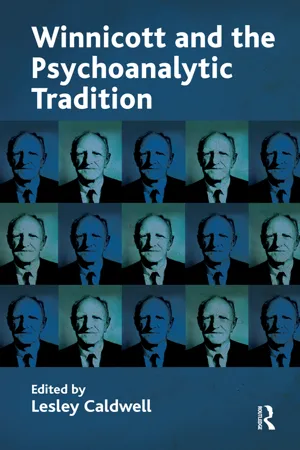
Winnicott and the Psychoanalytic Tradition
Interpretation and Other Psychoanalytic Issues
- 192 pages
- English
- ePUB (mobile friendly)
- Available on iOS & Android
eBook - ePub
Winnicott and the Psychoanalytic Tradition
Interpretation and Other Psychoanalytic Issues
About this book
This book focuses on two themes: the first theme is the true self and the resonance of Winnicott's thinking with the contributions of other major psychoanalysts of the past half century; the second theme emerges from the first: the pursuit of authenticity, whether by patient or analyst.
Information
Chapter One
A theory for the true self
Christopher Bollas
It is next to impossible to account for what transpires in a psychoanalysis. Although clinicians collect vignettes, remember interpretations that make sense, and isolate important psychic themes, the sheer unconsciousness of a patient-analyst relationship makes it a difficult occasion to describe. How do I talk about the qualities of silence in an hour? How can I describe the mix of tonal stress and narrative content that constitutes the analysand’s unconscious emphasis of the emotional reality of a session? How shall I ever be able to narrate my inner dialogue with myself as I silently shadow the analysand, agreeing, disagreeing, querying, wondering, co-imagining? If it is possible for me to state precisely why I choose a particular interpretation, why in that moment? Why do I allow clear themes to pass without comment, only to pick up something else the patient says?
Some people find themselves incapacitated by the question “What did you get out of your analysis?” Pressed to be specific, often by a friend who is on the verge of seeking an analyst but still needing some clear evidence of accomplishment for the considerable investment of time and money, the friend may want to know details of what was found out that was previously not known. The reply of the analysand will often be most unhelpful. “It changed my life.” “I was very confused and it helped me out.” The unanalysed cannot be blamed for considering this a mystifying reply.
What does happen in an analysis? How can we discuss the unknown benefits of our intervention?
In some respects the history of the psychoanalytic movement can be read as a progressive effort to understand the unique situation that Freud invented and psychoanalysts inherit. Michael Balint’s (1968) works on the nature of the analytic setting and the ordinary regressive features of the process, Milner’s book (1969) on the role of illusion in the transference, and Winnicott’s (1954) ingenious discoveries of the infant-mother memories latent to the analytic relation typify the spirit of continuing inquiry into the nature of clinical psychoanalysis within, for example, the Independent Group of the British Psychoanalytical Society. Each of these authors believes that the success of an analysis rests not simply on the transformation of unconscious conflicts into conscious awareness, but also on fundamentally new psychic experiences generated by the analytic situation, in particular those sponsored by transference states. Naturally, some transference experiences are interpreted and cease to be unconscious, but certain uses the analysand makes of the analyst are of a different category of meaning from that represented by the concept of repressed unconscious conflict. When Winnicott introduced the term “true self” to stand for an inherited potential that found its expression in spontaneous action, I think he conceptualized a feature of the analytical relationship (and of life) that had heretofore been untheorized.
If we explore the theory of the true self further, I think we may position ourselves to discuss previously unrepresentable features of our clinical work. I refer to that psychic movement that takes place when the analysand is free to use the psychoanalyst as an object through whom to articulate and elaborate his personality idiom. This use of an analyst is difficult to describe, but because I think it is an important part of analytical work, we must try to find a conceptual category to represent this type of psychic movement. Winnicott’s theory of the true self is, in my view, just such a concept through which we may describe something we know about analysis, but have until now been unable to think.
Winnicott defined the true self as “the inherited potential which is experiencing a continuity of being, and acquiring in its own way and at its own speed a personal psychic reality and a personal body scheme” (1960, p. 46). The spontaneous gesture was evidence of true self, and Winnicott found its earliest manifestations in the muscle erotism of the foetus. The true self was aliveness itself, and although he saw it as an inherited potential, he did little to extend this understanding of the concept. If we are to provide a theory for the true self, I think it is important to stress how this core self is the unique presence of being that each of us is; the idiom of our personality. We are singular complexities of human being—as different in the make-up of our characters as in our physiognomies; our person design finds its expression in the discrete living villages (composed of all those objects we select to cultivate our needs, wishes and interests) that we create during our lifetime. A genetically biased set of dispositions, the true self exists before object relating. It is only a potential, however, because it depends upon maternal care for its evolution. As its gestural expressions and intersubjective claims are never free of the other’s interpretation, its evolution depends upon the mother’s and father’s facilitations. No human being, however, is only true self. Each inherited disposition meets up with the actual world and one of the outcomes of this dialectic between personality idiom and human culture is psychic life.
The psyche is that part of us which represents through self and object representations the dialectics of true-self negotiation with the actual world. Conflict is essential to the usefulness of the psyche which depends, in part, on the healthy balance of forces between the true self and the actual world. If a mother, for example, forecloses her infant’s true self, impairing the dialectic of self and other, her infant will have a diminished psychic capability, as psychic representations owe much to the freedom of expression guaranteed by the mother and the father.
To some extent the inherited potential is objectified through self and object representations in the subject’s internal world although this is always only a derivative of the true self, much as we know the unconscious through its derivatives. The idiom of the person is not, however, a hidden script tucked away in the library of the unconscious waiting for revelation through the word. It is more a set of unique person possibilities specific to this individual and subject in its articulation to the nature of lived experience in the actual world. The life of the true self is to be found in the person’s experiencing of the world. The idiom that we are finds its expression through the choices and uses of objects that are available to it in the environment. If the mother knows her infant, if she senses his figural intentions, his gestures expressive of need and desire, she will provide objects (including herself) to serve as experiential elaborators of his personality potential. In this way she assists the struggle to establish self.
The unthought known
That inherited set of dispositions that constitutes the true self is a form of knowledge which has obviously not been thought, even though it is “there” already at work in the life of the neonate who brings this knowledge with him as he perceives, organises, remembers and uses his object world. I have termed this form of knowledge the unthought known (1987) to specify, amongst other things, the dispositional knowledge of the true self. More complex than an animal’s instinct, which is another manifestation of an unthought knowledge, how much of this knowledge is ever to be employed and brought into the subject’s being depends entirely on the nature of this child’s experience of the mother and the father. If the mother and father have a good intuitive sense of their infant, so that their perception of his needs, presentation of objects for his “use” and representation of the infant (in the face, body gestures and language) are sensitive to his personality idiom, then he will experience the object world as facilitating. When this happens, we have children who take joy in re-presenting themselves, celebrating the arts of transformation because they have experienced transformative mothering and fathering and know from the authority of inner experiencing that latent knowledge can be given its life.
The primary repressed unconscious
Perhaps the theory of the true self—as an inherited personality potential—is compatible with Freud’s concept of the primary repressed unconscious. In “The Unconscious”, Freud wrote: “The content of the unconscious may be compared with an aboriginal population in the mind. If inherited mental formations exist in the human being—something analogous to instinct in animals—these constitute the nucleus of the unconscious” (1915, p. 195). These “inherited mental formations” that “constitute the nucleus of the unconscious”—the primary repressed unconscious—may be equivalent to the idiom of the true self. Laplanche and Pontalis (1973) understand Freud’s effort to conceptualize inherited schemata: “The typical phantasies uncovered by the psychoanalysis led Freud to postulate the existence of unconscious schemata transcending individual lived experience and supposedly transmitted by heredity; these he called ‘primal phantasies’” (p. 315).
To be sure, Freud’s view of mental preformation expressed his adoption of Lamarck’s theory of the genetic transmission of acquired characteristics, an argument I do not support. Human idiom is the derivative of a genetically biased disposition, but I do not know what factors suggest this determination. The experience of each foetus, inside the womb, will also contribute to the infant’s personality idiom, as will birth itself. Still, if I see, as do most parents, not only psychological but personality resemblances between my child and myself, his wife and members of our families, it is clear to me—in a most unscientific way—that my child has inherited features of his ancestral family idiom. But such a transmission need hardly be the inheritance of acquired traits, as I presume the ancestral idioms are not acquired but are derivatives of their own genetic history. This does not speak to the question of the genetic origins of idiom, but such a consideration is far beyond my capability. For me it is enough to say that infants, at birth, are in possession of a personality potential that is in part genetically sponsored and that this true self, over the course of a lifetime, seeks to express and elaborate this potential through formations in being and relating.
Freud did not develop his theory of primary repression, and used it mostly to mark the baseline in the journey of mental contents from the unconscious, through the preconscious, to consciousness. His theory of the unconscious was devoted to repression proper: to the banishment of an idea to the system unconscious. When mentioning the primary repressed unconscious, he characterized it as the domain of primary instincts that have a nucleus to them (by virtue of the repression, not as an intrinsic organization) that attracts conscious ideas, pulling them into the system unconscious and thus cooperating with the anti-cathexis exerted by the system preconscious to sustain repression.
If we substitute the idiom of personality (or true self) for the instincts1 as the nucleus of the primary repressed unconscious, then we can argue that the core of unconscious life is a dynamic form that seeks its being through experience. Winnicott erred, in my view, when he linked the true self to the id and the ego to the false self. He intended to emphasize the true self’s representation of instinctual life, but in so doing failed to convey the organization of person that is the character of the true self. If the true self is the idiom of personality, it is therefore the origin of the ego, which is concerned with the processing of life. Naturally instincts are a part of the ego, and without delving into psychoanalytic metapsychology, I will only add that there is no reason in Freudian theory why we cannot hold that the energy of the instincts is intrinsic to and inseparable from the economics of ego life. But the drives are always organized by the ego, because this true self that bears us is a deep structure which initially processes instincts and subjects according to its idiom.
If the ego is synonymous with the true self at birth, then the infant’s negotiation with the mother and father establishes mental and organizational structures that subsequently become part of the ego, but are not equivalent to the true self. The unthought dispositional knowledge of the true self inaugurates the ego, but increasingly the ego becomes an intermediary between the urges of the true self (to use objects in order to elaborate) and the counter-claims of the actual world. (This distinction is very similar to that made in classical psychoanalysis where the ego is seen as a derivative of the id, increasingly differentiated from the id as it manages the child’s relation to the outside world.) We are still addressing the issue of process and not of mental representation. A part of the ego processes the demands of environmental reality, and its structure changes according to the nature of the interaction with the object world. When this dialectic is thought about, the thinking occurs in the psyche, where that which is thinkable from true self experiencing is represented in the internal world.
Perhaps the primary repressed unconscious consists originally of the inherited potential and then those rules for being and relating that are negotiated between the child’s true self and the idiom of maternal care. These rules become ego processes and these procedures are not thought through, even though they become part of the child’s way of being and relating. They are therefore part of the unthought known and join the dispositional knowledge of the true self as essential factors of this form of knowledge. Freud’s letter to Fliess of 6 December 1896 suggests that he knew there were unconscious registrations of experience not unlike theories of being and relating, and he termed them conceptual memories. “Ub [Unbewusstsein, unconsciousness] is the second registration, arranged according to other, perhaps causal relations. Ub traces would perhaps correspond to conceptual memories, equally inaccessible to consciousness” (1896, p. 208).
Rules stored in the primary repressed unconscious differ from the mental contents that are repressed to the system unconscious. The secondary repressed unconscious stores thoughts which give rise to other derived ideas as they seek disguised representation in consciousness. The primary repressed unconscious stores processes (of self experiencing and self-other relating) that are operationally determined in the infant’s, then child’s, negotiation with the mother’s mothering. In The Shadow of the Object (1967), I argued that through a receptive frame of mind, a patient evokes news from within the self whereby new internal objects are created.
Perhaps this is so because the process of knowledge of the unconscious ego is thought through. That is, that which has never been thought about but is a useful bit of working knowledge is mentally processed. Topographically speaking this means that through a kind of active reception to internal information the preconscious indicated interest in the unthought ideas that process both self and other-relating. Perhaps Freud gives us a clue as to how this can happen through his theory of endopsychic perception—that mental awareness of “the structural conditions of [our] own mind” (1913, p. 91). Certain mental representations depict the working of the ego itself, rather like a cinema projector casting the imagery of its own internal operations on the screen. It is possible that some internalized paradigms that are part of the working structure of the ego find representation in the internal world, a projection of the workings of the ego.
In my view there are differing moments in analysis when the patient transforms process knowledge into ideation, through the representation of dream, daydream or phantasy. This may occur in a period of self-experiencing during an ordinary regression to dependence, when through a particular kind of attentiveness and due to deepening emotional reality, the analysand transforms a scrap of unthought knowledge into its thinking. Most frequently, however, it is through the interlocking logics of the patient’s transference, when both persons psychologically enact a process, that this knowledge is first thought about by the patient. In some respects, then, it is the paradigm potential of the transference-countertransference category that elicits unconscious rules for being and relating, and transforms these lived processes into mental representations. Indeed, the analyst’s countertransference is often just such a journey of transformation from the object of the patient’s process to the affective and ideational representation of the process.
In-formative object relating
If unthought knowledge begins with inherited dispositions, the infant will soon know about the laws of interrelating through the relation to the mother, and this then will also become a feature of the unthought known. Such knowledge is composed of all those “rules” for being and relating conveyed by the mother and father to the infant (then to the child) through operational paradigms rather than primarily through speech or representational thought. In other words, the child learns theories for the management of self and other through the mother’s mothering. As the mother’s transformational idiom alters the infant’s and child’s internal and external world, each transformation becomes a logical paradigm replete with complex assumptions which no infant or child can think out. These are meant to be the rules of this infant-child’s existence, and they are determined by the mother’s presentation of them to her infant, in interaction, of course, with his unique idiom.
As infant and mother are mutually in-formative, they act upon each other to establish operational principles derived from interrelating. Of course, the mother forms an internal object representation of her infant. But she is also in-formed by the infant’s true self, so that her unconscious ego is continuously adapting to her infant. And to a far greater extent the infant is given form(s) by the mother’s logic of caretaking. Object relations during the first years of life are always in-formative, so much so that such conveying of information could be termed in-formative object relating, to identify object relations that sponsor ego structures. In-formative object relating can refer either to the alteration of ego structure or to the contents of psychic life or to both. As the mother transforms the child’s self states, she may induce significant ego alterations, a change in the child’s processing of self and other, that may yield only minimal mental representation in the psyche. In-formative object relating at a later period of psychic development may result in the child mentally representing attitudes, actions, and other communications from the parent. This is less fateful than early in-formative object relating wh...
Table of contents
- Cover
- Half Title
- Title
- Copyright
- Dedication
- Contents
- ACKNOWLEDGEMENTS
- ABOUT THE EDITOR AND CONTRIBUTORS
- Introduction
- 1 A theory for the true self
- 2 Destructiveness and play: Klein, Winnicott, Milner
- 3 On humming: reflections on Marion Milner's contribution to psychoanalysis
- 4 Being and sexuality: contribution or confusion?
- 5 Clinical experience with psychotic mothers and their babies
- 6 On holding and containing, being and dreaming
- 7 The virtues of Anna Freud
- 8 Donald Winnicott and Melanie Klein: compatible outlooks?
- 9 Michael Balint and Donald Winnicott: contributions to the treatment of severely disturbed patients in the Independent Tradition
- 10 Therapeutic relations: Sándor Ferenczi and the British Independents
- 11 The suppressed madness of sane analysts
- INDEX
Trusted by 375,005 students
Access to over 1.5 million titles for a fair monthly price.
Study more efficiently using our study tools.
Frequently asked questions
Yes, you can cancel anytime from the Subscription tab in your account settings on the Perlego website. Your subscription will stay active until the end of your current billing period. Learn how to cancel your subscription
No, books cannot be downloaded as external files, such as PDFs, for use outside of Perlego. However, you can download books within the Perlego app for offline reading on mobile or tablet. Learn how to download books offline
Perlego offers two plans: Essential and Complete
- Essential is ideal for learners and professionals who enjoy exploring a wide range of subjects. Access the Essential Library with 800,000+ trusted titles and best-sellers across business, personal growth, and the humanities. Includes unlimited reading time and Standard Read Aloud voice.
- Complete: Perfect for advanced learners and researchers needing full, unrestricted access. Unlock 1.5M+ books across hundreds of subjects, including academic and specialized titles. The Complete Plan also includes advanced features like Premium Read Aloud and Research Assistant.
We are an online textbook subscription service, where you can get access to an entire online library for less than the price of a single book per month. With over 1.5 million books across 990+ topics, we’ve got you covered! Learn about our mission
Look out for the read-aloud symbol on your next book to see if you can listen to it. The read-aloud tool reads text aloud for you, highlighting the text as it is being read. You can pause it, speed it up and slow it down. Learn more about Read Aloud
Yes! You can use the Perlego app on both iOS and Android devices to read anytime, anywhere — even offline. Perfect for commutes or when you’re on the go.
Please note we cannot support devices running on iOS 13 and Android 7 or earlier. Learn more about using the app
Please note we cannot support devices running on iOS 13 and Android 7 or earlier. Learn more about using the app
Yes, you can access Winnicott and the Psychoanalytic Tradition by Lesley Caldwell in PDF and/or ePUB format, as well as other popular books in Psychology & History & Theory in Psychology. We have over 1.5 million books available in our catalogue for you to explore.