- 410 pages
- English
- ePUB (mobile friendly)
- Available on iOS & Android
eBook - ePub
About this book
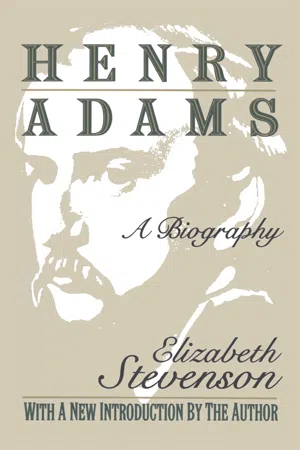
His great grandfather and his grandfather had been presidents of the United States, and to a small boy this seemed a matter of course in his family. But Henry Adams, belonging to a later generation, coming to maturity at the time of the Civil War, found himself in an age uncongenial to the leadership of such men as his ancestors. In the changing world of the late nineteenth century and early twentieth century, Adams found his rightful place as an observer and critic rather than a participant in public life. But no time and no country ever had a keener mind to take note of the comic and tragic qualities embedded in the political, economic, and human drama upon which he gazed. And his writings appeal timelessly in their incisive wit, their warm charm, and in the way they speak to us of a very individual personality. When Stevenson's book first appeared, the New York Times called it 'One of the noteable biographies of recent years,' and it won the Bancroft Prize that year. It remains an engrossing portrait of a remarkable man.It is good to take note of the sage he became in his late, great books: Mont-St. Michel and Chartres and The Education of Henry Adams. This biography explains how Henry Adams became the man both admired and feared in his later years. He was first a bright, unformed young man who was a diplomatic assistant to his father; then an ambitious journalist, a writer of several 'sensational' newspaper and magazine articles. Next he became a provocative and innovative teacher, and a historian unequalled in his presentation of the Jeffersonian period. Until his wife's tragic death, he was a willing actor on the social scene of his beloved Washington, D.C. Throughout, he remained a friend and instigator of the careers of friends in artistic and scientific fields. His writings speak to us still and seem contemporary in their tone as well as their view of cycles of culture and their warnings of decline and achievement.
Information
Chapter 1
Starting Place
THERE WAS a child once who sat upon a kitchen floor and stared at sunlight filtering through a window and making that floor warm with the color yellow.1 The house was a New England house, and the surrounding world—of family, emotions, ideas, the very air—was a New England world. It was a New England of a secure time long before the Civil War. Exactly, it was the year 1841. The child lived to be an old man who pondered his past and identified this earliest memory.
He was born on February 16, 1838. His family name was Adams, his own, Henry Brooks. He was the fourth child of Charles Francis Adams and Abigail Brooks Adams. We can look ahead to the end and see him come full circle to color once more after veering away from it through the rationality of line and the logic of determinism. He came back at the end to staring once more at pure color, finding it as important then, in certain church windows, as it was on the kitchen floor of a New England house on Boston Bay.
Color the child loved, and color meant summer and Quincy. It was a small place then, a town down the South Shore a little way from Boston, but a separate place, not a suburb. Here, every summer, Charles Francis Adams brought his family to live near his father, the former President, John Quincy Adams, who was Representative to Congress from the Plymouth District of Massachusetts during the growing up of his grandchildren.
Henry’s own family—father, mother, and children—lived in what they thought of as the “house on the hill.” The fierce-seeming, bald-headed grandfather and his exotic, sweet-tempered wife, Louisa, lived in the house they thought of as the “real” house, the “old house,” the “house down the hill.”2
“Summer was drunken,”3 Henry said lovingly, looking back to those seasons. Summer was freedom, and the center of that grateful summer freedom was the Old House, an un-pretentious, clapboarded dwelling house, gaining an addition in width nearly every generation, or pushing out behind in the direction of the sloping orchard. This growing house, topped by its chimneys, sunk in the shade of its elms and silver-green beeches, marked the center of existence for all the generations of the family.
The center of this center was John Quincy Adams, an old man remembered by the grandchildren as seated in the study forever writing, or as strolling, stick in hand, down some rutted country road nearby, his head bent in thought. His study was a room with window seats where Henry could sit and read as the old man worked. The grandfather was both important and familiar.
The old man’s tenderness to privileged children could gather into decisiveness. He could take by the hand one child, unwilling one day to go to school, and lead him, in understanding silence, out of the house, down the street, and into the school: demonstration rather than expostulation. Henry Adams remembered that act, and the superiority of act to word, all the rest of his life.
The grandfather’s larger activities were only guessed at by the grandchildren. He was a daily, taken-for-granted figure while the enthrallment of Quincy was the world outdoors: the sea down below the town, the hills and woods and streams back of and above the town, the village center with its meetinghouse and tavern where stagecoaches on the way to Plymouth stopped to pick up or set down passengers, and where the Quincy topers sat and judged their neighbors’ doings.4
It was a town settled in comfort, offering to remembrance the greatest possible contrast to the New England and America which were to surround and swallow it. People worked in Quincy, but not in a competitive way. It was a shoemaking town, but there was no factory as yet.5 Each shoemaker had a small annex attached to his house. There he did his work, with family help, and the summer sound of shoes being made was a lazy sound, as natural as the insect noises of the fields not very far away.
If Quincy was summer, then Boston was winter. Just as the grandfather dominated the summer scene, so Henry’s father dominated the winter scene in Boston. Boston, as memory was to reconstruct it, meant constriction and constraint, dull hours in the house on Mount Vernon Street, or dull hours at school, in David B. Tower’s private school in the basement of the Park Street Church, or in Mr. Dixwell’s private Latin school, which seemed a time of competent routine rather than stimulation.
Very probably Henry, looking back, exaggerated the dullness of his Boston childhood. But his principal memory was no doubt true: that there was in those days, in the forties and fifties of the nineteenth century, an unnecessary stoppage put upon spontaneity and play. Too often children were treated as small adults. The fault was not Charles Francis Adams’s alone, although his temperament added weight to the heaviness of his own household; it was the fault of the generation.
“In my boyhood,” said Charles, Henry’s next oldest brother, “nothing whatever was done to amuse children.”6 The youngest brother, Brooks, reacting in his memories of that time against Charles’s strictures, conveys the idea that their father was a man of passionate feelings, but of passions strongly controlled.
Certainly it was control that was advocated for the younger generation. Perhaps this movement of will in Charles Francis was a distaste for the excesses of feeling that his father and grandfather had often betrayed. Yet it was their emotional excesses which had made them lovable. Charles Francis had brought the roughness of love and hate under control and wished his children not to be betrayed by the family tendency toward strong passions. It was his success that betrayed him. He had no endearing faults. His very virtues were ice-bound. There was something pitiful in his inarticulateness. His second son, Charles Francis, came almost to hate him, and expressed his crudity of reaction publicly in his own memoirs. The youngest son, Brooks, in reaction, was sharply defensive of his father, defensive in a manner that showed he felt some need for the attitude. Only Henry, late in life, seemed to have arrived at a balanced admiration, yet it was an admiration expressed in terms of justice rather than love.
Charles Francis was a good and just father, but not an easy one. His family of opinionated, sensitive, and self-conscious children could not confide in him. They were thrown upon one another in their inexperience, and upon their mother. She was a woman of a positive character, dominating, not always tactful, but sympathetic, and interested—entertained by her children. Henry’s easygoing letters to her in his first youthful absence from home at the age of twenty show that he relied upon her quick understanding and upon her sympathy. She seems to have submerged her separate interests in her family’s and to have lived altogether for her husband and her rather difficult children.
The children of the family turned to one another in their growing pains. They wrestled with one another, occasionally physically, but more often with all the expanding mental powers of which they were capable. They were strong and bright. Louisa, the oldest, was the leader; John, the second child, was the gayest mannered, the quickest to make friends; Charles had a sort of bulldog tenacity and frankness; Henry was smaller, quieter, with a quick sense of humor. To these older ones, Mary and Brooks were as yet negligible, children to dominate and patronize. Arthur the last child, died at five.
If the father was not much good for children as such, he was rather exciting for children turned into premature politicians. And this they were. Political theory and action blotted out interest in anything else. Where other generations of New England children might have been morbid over religion or precocious in literary expression, this one, or the Adams part of it, concentrated its young mind on desperate hopes concerning a national cause.
Henry said of himself that he was “a ten-year-old priest and politician.”7 Sitting in a corner listening to his elders, he could hear experts expound political theory and practice. Or leaving the hill he lived on and going down into the crowded lower squares of the city, he could see practical demonstrations of what was talked of at home: mob action flaring up with an irregular regularity during these years.
His father represented good society in political radicalism. He and his friends—Dana, Palfrey, Sumner, and a few others—worked quietly, good-manneredly for an end condemned by their next-door neighbors. Other little boys’ fathers were for Daniel Webster and harmony. Henry’s father and grandfather embarrassed these gentry. They pointed out keenly the real split that existed between the two sections: the unblinkable fact of slavery. The fact that Henry’s family discussed slavery at all, instead of leaving it alone as good taste demanded, isolated it to a real extent. Good men of North and South were anxious for compromise.
Sharing the Adams family’s isolation in politics was their remote and nobly talking friend Charles Sumner. He was a bleakly upright person, without warmth, not dealing in humor, or even recognizing it, but all the same, exhilarating and refreshing in his candor and courage. His political heroism affected Henry’s imagination. He was the boy’s first hero.
For Henry, as for his brothers and sisters, the fight that filtered into his mind was simplified and no doubt distorted. But, little as he might understand its complexity, he could grasp the emotion of his famous grandfather’s fight. He might even have recognized the family’s household mood in his grandfather’s diary of a time before he himself was born.
As early as 1820, John Quincy Adams wrote in connection with the struggle in Congress over Missouri’s entry into the Union, and the question of its being slave or free: “I take it for granted that the present question is a mere preamble—a title page to a great tragic volume.… The President thinks this question will be winked away by a compromise. But so do not I. Much am I mistaken if it is not destined to survive his political and individual life and mine.”8
Monroe was the President mentioned. He himself was to be the next President, from 1824 to 1828. Then, beaten painfully by Jackson, he was to be sent home, whipped, as it seemed, ill and in debt, with the old house at Quincy mortgaged.
But John Quincy made a surprising return to politics. Against the advice of his own son Charles Francis, he ran for office as congressional Representative from the Plymouth District, and was elected. Once in, he found his true place. The unhappy constraint of the Presidency was gone. He could hit as hard as he wished, and did so with a zest unknown to him before.
But John Quincy Adams had the hard lot of the forerunner. His was almost the first respectable voice to cry out against slavery. He fought against great odds enumerated with whimsical bitterness in the following passage from the diary:
One hundred members of the House represent slaves; four-fifths of whom would crucify me if their votes could erect the cross; forty members, representatives of the free, in the league of slavery and mock Democracy, would break me on the wheel, if their votes or wishes could turn it round; and four-fifths of the other hundred and twenty are either so cold or so lukewarm that they are ready to desert me at the very first scintillation of indiscretion on my part. The only formidable danger with which I am beset is that of my own temper….9
Such strenuousness could have its rewards in a thankfulness as extreme as the fearfulness. When Henry was six, he might have had some inkling of the stir made in the family by the repeal of the hated Gag Rule, a rule of procedure which had been in force in Congress since May 26, 1836, and which had, from that date until its repeal in 1844, tabled every bill, every petition, even every mention of slavery, and prevented its discussion. Repealed at last, principally through his own efforts, John Quincy rejoiced in his depths. In prostrations of thankfulness he wrote at that time, “Blessed, forever blessed, be the name of God!”10
This high temperature of feeling must to some extent have burned through to the child’s consciousness. There was not a time in his backward-glancing memory when members of his own immediate family had not been involved in political struggles of first importance. The national self was a second skin for an Adams; what wounded the nation wounded him.
By the time Henry was seven, not only his grandfather, but his father, too, was taking an active part in the national issue of slavery and free soil. Charles Francis had already, in Henry’s younger days, given his father support in the legislature of Massachusetts. Now, in 1845, he and a few other gentlemen of Boston purchased and began to publish a political newspaper, the Boston Whig. In it, Charles Francis, supplementing the fight John Quincy was carrying on in Washington, gave a voice to the anti-slave Whigs of New England and tried to wean them away from Webster.
The year 1845 was also the year in which Charles Sumner, impressive in the clear, honest beauty of his look and manner, discovered his voice. When in November he addressed an audience of anti-slave Whigs, in Faneuil Hall, to protest the entrance of the new state of Texas into the Union as a slave state, he amazed his audience and himself. From this time forward, Sumner lived in public. He was the prophet of the movement while Henry’s father, with his unquestioned integrity, was its skillful, practical persuader.
The Whig party soon crumbled in a political heat it could not stand. Then Charles Francis Adams, Charles Sumner, Richard Henry Dana, and a few others in Massachusetts instigated a new party, one to be called the Free-Soil party. Its reason for being was to work for the prevention or extermination of slavery in every piece of territory controlled by Federal rather than state law. During the first year of the party’s life, these men bravely named a slate of candidates for the national election: Martin Van Buren for President, Charles Francis Adams for Vice President. They lost, but the effort was not a waste. They kept their issue before the public; they made the Democrats uncomfortable; they prepared the way for a new, stronger party not yet born.
That Henry’s father should flout financial and commercial Boston, should go against the advice of his influential father-in-law, Peter Chardon Brooks, was remarkable in him. Family tradition was behind him, but he had also the encumbrance of money, which John and John Quincy Adams had never had. From the time of his marriage to Abigail Brooks, the daughter of the wealthiest man of his generation in Boston, Charles Francis was thus burdened and thus helped. Choosing to follow his own family tradition rather than class tradition proved him to have some of that family’s iron in him. His very mildness made him more formidable.
His father died in 1848, struck down, as he might have wished, in the heat of battle, under the Capitol roof. He died there two days later. Peter Brooks died the next year. Thus, with father and father-in-law gone, Charles Francis Adams saw the way cleared for him, both politically and financially. He was the heir of a political tradition and the heir of a share of the Brooks money. Family energy could now be concentrated and centered entirely on politics, no matter what the outcome might be.
In former decades some of that energy might have gone into other vital interests, religion being the principal passion alternating with politics in earlier generations. Perhaps the cushioning effect of money had something to do with a falling off of a living interest in matters of faith. J...
Table of contents
- Cover
- Half Title
- Title Page
- Copyright Page
- Dedication Page
- Contents
- Introduction to the Transaction Edition
- Preface
- Acknowledgments
- 1 Starting Place
- 2 Negative Happiness
- 3 Maiden Voyage
- 4 The Winter Before the War
- 5 Outpost
- 6 A London Bachelor
- 7 Washington Reporter
- 8 Professor Adams
- 9 Mr. and Mrs. Adams
- 10 Marlborough Street
- 11 Lafayette Square
- 12 Disaster
- 13 The Growth of a Mind
- 14 A Toy Land
- 15 The Breakfast Table
- 16 Time and the Sliding Rock
- 17 The History
- 18 DosBocas
- 19 The Cathedrals
- 20 Twelfth Century—and Twentieth
- 21 Mont-Saint-Michel and Chartres
- 22 Multiplicity
- 23 The Education of Henry Adams
- 24 Science, History, and Imagination
- 25 Satanic Gentleman
- 26 “Remember My Music”
- Notes
- Selective Bibliography
- Index
Trusted by 375,005 students
Access to over 1.5 million titles for a fair monthly price.
Study more efficiently using our study tools.
Frequently asked questions
Yes, you can cancel anytime from the Subscription tab in your account settings on the Perlego website. Your subscription will stay active until the end of your current billing period. Learn how to cancel your subscription
No, books cannot be downloaded as external files, such as PDFs, for use outside of Perlego. However, you can download books within the Perlego app for offline reading on mobile or tablet. Learn how to download books offline
Perlego offers two plans: Essential and Complete
- Essential is ideal for learners and professionals who enjoy exploring a wide range of subjects. Access the Essential Library with 800,000+ trusted titles and best-sellers across business, personal growth, and the humanities. Includes unlimited reading time and Standard Read Aloud voice.
- Complete: Perfect for advanced learners and researchers needing full, unrestricted access. Unlock 1.5M+ books across hundreds of subjects, including academic and specialized titles. The Complete Plan also includes advanced features like Premium Read Aloud and Research Assistant.
We are an online textbook subscription service, where you can get access to an entire online library for less than the price of a single book per month. With over 1.5 million books across 990+ topics, we’ve got you covered! Learn about our mission
Look out for the read-aloud symbol on your next book to see if you can listen to it. The read-aloud tool reads text aloud for you, highlighting the text as it is being read. You can pause it, speed it up and slow it down. Learn more about Read Aloud
Yes! You can use the Perlego app on both iOS and Android devices to read anytime, anywhere — even offline. Perfect for commutes or when you’re on the go.
Please note we cannot support devices running on iOS 13 and Android 7 or earlier. Learn more about using the app
Please note we cannot support devices running on iOS 13 and Android 7 or earlier. Learn more about using the app
Yes, you can access Henry Adams by Elizabeth Stevenson in PDF and/or ePUB format, as well as other popular books in Literature & Historical Biographies. We have over 1.5 million books available in our catalogue for you to explore.