- 400 pages
- English
- ePUB (mobile friendly)
- Available on iOS & Android
eBook - ePub
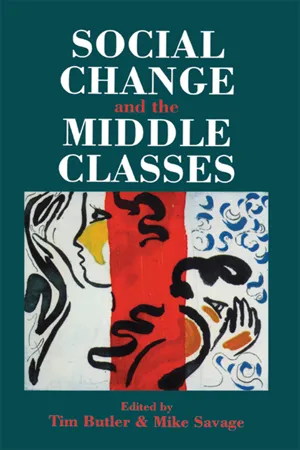
Social Change And The Middle Classes
About this book
First Published in 1995. The study of the middle classes actually poses a variety of interesting challenges. Traditionally, the social scientific gaze has been directed either downwards, to the working classes, the poor and the dispossessed, or upwards, to the wealthy and powerful. For all these reasons, a collection of original papers on various aspects of the British middle classes seems an important venture that will cast valuable light on the course of social change in Britain more generally. This book is designed to bring together a series of accessible, high-quality research papers on various aspects of the British middle classes.
Information
Part One
Orientations
Chapter One
Class analysis and social research
Mike Savage
. . . in the traditional models, people were socialised into worlds of home and work in which they “knew their place”. They joined a class, learned its values, developed its attitudes and behaved accordingly – again throughout their lifetimes. Those fairly rigid boundaries have now gone. (Thrift & Johnston 1993: 84)
As this rather apocalyptic comment implies, the status of class analysis is in doubt as we approach the twenty-first century. There is a feeling amongst social scientists that the pace and scope of contemporary social change is making the concept of social class redundant. What value does the idea of class, fashioned by Marx and Weber to explore the tensions of industrial capitalism, have for investigating the putatively postmodern, post-industrial, information societies that some observers currently detect?
Indeed, it might even be argued that the supposed “death of class” is one of the very few themes shared by the varied writers arguing that major social change is occurring, because there is certainly no broader consensus on how they interpret current developments. Accounts range from “economy-centred” analyses such as those associated with neo-Marxist writers discussing post-Fordism (Aglietta 1979 and Harvey 1987; see Amin 1994 for an overview) to more “cultural” accounts, such as the arguments of Giddens, Beck and Bauman concerning the development of “reflexive modernity” (Giddens 1990, Beck 1992, Lash & Urry 1994) or “post-modernity” (Bauman 1991). It is not the purpose of this paper to discuss and evaluate these different views (see Smart 1992). Rather, it is interesting to note their common objection to the contemporary relevance of class. For Beck (1992: 100), “class society will pale into insignificance”; for Bauman (1985: 112), “it is increasingly difficult to maintain that class membership remains a major key to the mechanism of reproduction of societally-inflicted deprivations (and more generally, social differentiation as such)”, and similar ideas are echoed by Giddens, Lash & Urry, and others.
And yet, despite this tide of negative opinion, social class is an obstinate concept that refuses to make a dignified exit from the social scientific agenda. Some sociologists, such as the English sociologists John Goldthorpe, Anthony Heath and Gordon Marshall, the American Erik Wright, or – in a rather different tradition – the Frenchman Pierre Bourdieu, have insisted on the continued centrality of social class divisions to the analysis of social relations. Indeed some would argue that class analysis has only recently attained unprecedented conceptual clarity and achieved major research breakthroughs. Thus it would be possible to trace an evolutionary history from the early days when social enquirers such as Booth and Rowntree documented the nature and extent of poverty at the turn of the century to the sophistication evident in current analyses, such as that of Erikson and Goldthorpe’s The constant flux (1992b). The argument might run that, with the introduction of Weberian theory from the 1950s and Marxist theory from the 1960s, the study of class took a more analytical focus, and landmark studies such as Glass’s Social mobility in Britain (1954), Lockwood’s The blackcoated worker (1958), and Goldthorpe, Lockwood et al.’s The affluent worker in the class structure (1968/69) appeared to give class analysis a new theoretical clarity and empirical rigour that placed it at the centre of British social science. The promise of class analysis lay in its ability to offer a viable theoretical alternative to functionalism while opening up whole new areas of empirical research. The field of social mobility was especially affected by the development of the “class structural” approach, which marked a major break from the individualistic assumptions of previously dominant status attainment models common in the USA (see Goldthorpe 1980a, Erikson & Goldthorpe 1992b), but there were other examples. Studies of the relationship between class and politics (Heath et al. 1985) and between social class and popular attitudes (Marshall et al. 1988) seemed to confirm such promise. For researchers within this “class analysis programme” (to adopt the terminology of Goldthorpe & Marshall 1992), the growing scepticism towards class appeared at the very same moment that its importance was being demonstrated through substantive research.
In recent years something of a debate between critics and supporters of the value of the class concept has spluttered along (Pahl 1989, Mullins 1990, Goldthorpe & Marshall 1992, and see the overview in Crompton 1993). However, it has succeeded only in revealing that various writers have such different conceptions of what social science is all about that they find it difficult to understand each other’s arguments. One of the principal objectives of this book is to allow the debate about the merits of class analysis to continue in a more profitable and stimulating vein through the collection of a range of empirically focused papers on various aspects of the British middle classes. The aim is partly to use the middle classes as a “frame” on which to hang observations about the nature of contemporary British society. But underlying this we also have a deeper conceptual interest in the value of class analysis itself. A question raised in every paper, in different ways, is the extent to which some concept of social class can be used to shed light on current dynamics of change and persistence.
This first chapter is an attempt to clear the ground so that the terms of the debate are clear. The intention is less to advance a particular view of the status of class analysis, than to try and provide a guide round a contested terrain, though some of my own prejudices will inevitably be displayed in the process. I begin by showing that the debate about class has, in Britain, been conducted in the shadow of a particular view of the “traditional working class”. Views about the changing character of the working class are all too readily transported into claims about the status of class analysis and there has been a persistent tendency to assume that class analysis as a whole is brought into question because of the alleged decline of the “traditional working class” (indeed echoes of this can be found in the quote from Thrift and Johnston that began this paper). In the second section I propose that it is necessary to examine the merits of class analysis on its own terms, and I indicate some of the conceptual choices and options facing social scientists. I suggest that the concept of class occupies a “force field” between structural and cultural analyses and between views that see class as the central as opposed to one possible axis of social division. Finally, I discuss how the recent rise of attention to the processes of gender and ethnicity affects the “class analysis programme”.
1.1 The political context
In order to understand the contours of the current debate on social class it is essential to comprehend the peculiarly British obsession with class. The most important point to make here is that in Britain, since at least the early twentieth century and arguably for much longer, there has been a strong tendency to conflate class in general with the working class in particular. The working class has traditionally been the crucial reference point that people have used to identify themselves in class terms. This partly reflects the cohesiveness, strength and visibility of the working class and its organizations in the first half of the twentieth century, especially as manifested through the labour movement. But it is important to recognize that this “traditional working class”, as it has later been termed (Stedman-Jones 1973), was actually a particular social construction. As McKibbin (1990) has shown, Conservative politicians after the First World War tried to define a particular notion of a “middle-class public” by counterposing it to a version of the “working class” that they defined as being trade union based, disloyal, unpatriotic and so forth. By this means the construction of middle-class identities was primarily related to a claim that you were not working class.
The result of this was twofold. First, it led to a particular preoccupation with a highly stereotyped “traditional working class”, when in reality manual workers were much more divided and heterogeneous than that image of them. Secondly, and more important for us, people’s views of the general value of class analysis tended to be coloured by views about the significance of this stereotype of the traditional working class. Even if one is prepared to accept some of the pertinence of the traditional view of the working class in the early years of the twentieth century (see the overview in Savage & Miles 1994), there can be little doubt that there have been significant changes to the working class since the mid-twentieth century. Even the most cautious on this point, for example John Goldthorpe, are prepared to admit that the working class has shrunk in size as a result of the decline of manufacturing industry, while others point to much more far-reaching economic, social and cultural changes, related to such issues as the rise of working-class affluence, consumerism and home-ownership, the development of distinct working-class youth cultures, the proliferation of ethnic cultures and so forth. Whatever one’s view about such developments, the important point is that they should not be assumed a priori to be indications that “class is not important”. The general merits or otherwise of class analysis should not be confused with the fortunes of a particular view of working class.
But, in fact, confusion is legion. Perhaps the best example of this is the debate over “class dealignment” (see Crewe & Sarlvik 1981, Heath et al. 1985, 1991, Marshall et al. 1988). Strictly speaking, class dealignment refers to the declining propensity for members of given social classes to vote for their allegedly “natural” class party: Labour in the case of the working class and Conservative for the middle class. There do seem to be important shifts here: in the 1960s, 63% of manual workers voted Labour, compared with only 43% in the 1980s (Dunleavy 1989: 173). In a period such as the early and mid-1980s, however, when the Labour Party is generally less popular amongst the electorate, one would expect a smaller proportion of the working class – as of any other class – to vote for it. What needs to be shown if the class dealignment thesis is to be upheld is that workers are proportionately less likely to vote Labour than other social classes are, and research suggests that the trends here are by no means unilinear (Heath et al. 1991, Dunleavy 1989). In the ensuing debate over this issue, however, it has become clear that some writers regard the idea of class dealignment as virtually synonymous with the decline of the Labour Party. Kavanagh’s (1990: 178) observation that, “in all the rarefied debate over whether we should measure absolute or relative class dealignment . . . we are in danger of throwing out the baby with the bathwater, overlooking the dramatic decline in Labour support”, is a remarkable admission of this fact.
The same point can be made concerning the recent debate about the “underclass”, which has been the subject of considerable speculation and research both in America and more recently in Britain. Proponents of the underclass theory argue that a significant sector of the population is deprived of access to regular (or even irregular) employment and is ghettoized into “redundant” social spaces, frequently slums and council estates, and is becoming increasingly marginalized from the rest of society (see Saunders 1990, Westergaard 1992, Lash & Urry 1994). The evidence concerning the underclass issue is hotly debated, and a number of writers contest the idea that it can be clearly distinguished from the working class, pointing to a relatively high degree of mobility into and away from “underclass” positions (Gallie 1989, Morris 1994). But what is revealing about the importation of the underclass idea to Britain is the way that it is seized upon by some writers to show that the working class is now no longer homogeneous and therefore to cast doubt on the value of class analysis per se (Saunders 1990). There is no reason to suppose, however, that the existence of the underclass really has fundamental implications for class analysis (as opposed to implications for our understanding of the working class). It is interesting, in fact, to point out that in the American context the idea of the underclass has been used to explore the declining significance of race rather than of class. For Wilson (1986) it is the ability of affluent middle-class blacks to leave ghetto locations which allows those left behind to form a distinct underclass, and in this respect appears to indicate the growing importance of class.
A final example of this issue is evident if the question of new forms of politics is broached. Today there are numerous claims that “class politics” is giving or has given way to other types of political movements. The sorts of movements mentioned here are various. They include new forms of politics arising out of consumption divisions, especially in relation to housing tenure (Saunders 1990); concerns with environmental risks that are common to members of all classes (Beck 1992); people’s growing concerns with expressive issues as evidenced through ideas of “post-materialism” (Inglehart 1971), and with “self-identity” and lifestyle (Giddens 1991). Related to these developments, it is sometimes claimed that solidaristic class-based political organizations are giving way to new social movements that tend to be organized around specific issues and have a more diffuse constituency (Scott 1991).
What is again interesting about these sorts of arguments is how they suggest a contrast not with class politics per se but with a specific form of political organization based on the labour movement. Indeed this contrast is directly drawn by Giddens (1990: 159), for instance, when he seeks to distinguish labour movements, democratic movements, peace movements and ecological movements. It is all too easy for a typology such as this to drift into the quite erroneous assumption that class is most important in relation to labour movements. But just as it is vital to register that labour movements are not “pure” class movements, because they also rest upon gendered, ethnic and nationalist bases, it is equally important to recognize that class may be pertinent to other political forms.
In general I have suggested that we need to liberate contemporary discussions about class analysis from specific concerns with the “traditional working class” and Labour politics. The working class organized through the labour movement is not the litmus test against which the virtues (or otherwise) of class analysis should be judged. It is this that gives particular general interest to this collection of papers on the middle classes.
1.2 Issues in class analysis
The papers in this book use a variety of means for understanding and analyzing the middle classes. Some of the specific issues in the way they understand the middle classes are examined in the next chapter. Here, I focus on some of the broad tensions evident in their handling of the class concept. Let me begin by noting that it has always been difficult to find ways of carrying out theoretical “closure” round the concept of class. This is indeed one of its strengths, since it serves as a point of intersection between different frameworks of analysis and between social scientific and lay terms of reference. Indeed, it is one of the few terms that appears both to be widely used by people in their “everyday life” (at least in contemporary Britain (see Marshall et al. 1988), for we obviously need to be wary about assuming it has any pertinence in other societies, (see Reddy 1987, Joyce 1990)), and to be the subject of systematic social scientific enquiry. However, the inevitable concomitant of this is that the term lacks precision. In this section I seek not to delineate what class is “really” about, but to indicate some of the possible ways of handling it within social scientific analyses.
Let me begin by noting that most perspectives on class tend to adopt some sort of structural approach that focuses on the way that social classes are rooted in the division of labour and, in particular, employment relations. This perspective can be traced back to the theoretical framework laid down by Marx and Weber and in current usage has led to the focus on social class as defined by employment and occupational location (Edgell 1993, Crompton 1993). In the course of the 1980s, however, many social theorists became critical of structural approaches to social explanation that rooted social causation in disembodied and abstract social structures. Within sociology, the work of Giddens (e.g. 1984) was especially influential in redirecting attention to the need to overcome the duality between structure and agency through a recognition that structures exist only insofar as they are drawn upon by human agents in their everyday lives. But Giddens’ theoretical objectives have been overshadowed by an even more radical critique influenced by post-structuralist and postmodernist currents in which any attempt to delineate “objective” social structures is regarded as illegitimate. The arguments of Derrida (1976) pointing to the way that “reality” can become an object only through language have had wide repercussions here (e.g. Laclau & Mouffe 1985). From a more sociological perspective, the writings of Bauman (1987) alert US to some of the political stakes involved in attempting to define “truth” and “reality”. He sees this as part of the general tendency of modern thought to reject ambivalence and establish certainty. For Bauman, the attempt to specify objective social structures is related to the traditional role of the intellectual as “legislator”, able to decree what is right or wrong by intellectual pronouncement.
From these points of view it is easy to see how social class appears as a problematic concept, tied to a modernist, “objectivist” perspective. Hindess (1987) raises two particular criticisms. First, class analysis sees classes as actors, wrongly imputing agency to otherwise heterogeneous groups of people. Although Hindess agrees that organizations can be seen as agents, he regards it as illegitimate for researchers to define a social class by theoretical fiat and then to suggest that the resulting group of people are collective actors. Secondly, Hindess argues that class analysis rests upon a notion of “objective interests”, that is to say, the interests that govern social classes are defined by virtue of objective social structures, with the result that human agents have only a minimal role in defining their interests.
The sorts of problems I have outlined have been dealt with in three different ways, which I want to explore below. First, it can be denied that social class is a structuralist, “objective” concept in the way Hindess suggests. There is in fact a distinguished tradition, whose best-known exponent is E. P. Thompson, that argues that social classes can be recognized only in the cultural activities and beliefs of social agents. Thompson’s best-known statement of this position is ...
Table of contents
- Cover Page
- Half Title page
- Title Page
- Copyright Page
- Contents
- Preface
- Acknowledgements
- Notes on contributors
- Introduction Marking out the middle class(es)
- Part One Orientations
- Part Two Class, gender and ethnicity
- Part Three Restructuring, employment and middle-class formation
- Part Four Place, space and class
- Part Five Consumption and the middle classes
- Part Six Politics and the middle classes
- Part Seven Conclusions
- Bibliography
- Index
Trusted by 375,005 students
Access to over 1.5 million titles for a fair monthly price.
Study more efficiently using our study tools.
Frequently asked questions
Yes, you can cancel anytime from the Subscription tab in your account settings on the Perlego website. Your subscription will stay active until the end of your current billing period. Learn how to cancel your subscription
No, books cannot be downloaded as external files, such as PDFs, for use outside of Perlego. However, you can download books within the Perlego app for offline reading on mobile or tablet. Learn how to download books offline
Perlego offers two plans: Essential and Complete
- Essential is ideal for learners and professionals who enjoy exploring a wide range of subjects. Access the Essential Library with 800,000+ trusted titles and best-sellers across business, personal growth, and the humanities. Includes unlimited reading time and Standard Read Aloud voice.
- Complete: Perfect for advanced learners and researchers needing full, unrestricted access. Unlock 1.5M+ books across hundreds of subjects, including academic and specialized titles. The Complete Plan also includes advanced features like Premium Read Aloud and Research Assistant.
We are an online textbook subscription service, where you can get access to an entire online library for less than the price of a single book per month. With over 1.5 million books across 990+ topics, we’ve got you covered! Learn about our mission
Look out for the read-aloud symbol on your next book to see if you can listen to it. The read-aloud tool reads text aloud for you, highlighting the text as it is being read. You can pause it, speed it up and slow it down. Learn more about Read Aloud
Yes! You can use the Perlego app on both iOS and Android devices to read anytime, anywhere — even offline. Perfect for commutes or when you’re on the go.
Please note we cannot support devices running on iOS 13 and Android 7 or earlier. Learn more about using the app
Please note we cannot support devices running on iOS 13 and Android 7 or earlier. Learn more about using the app
Yes, you can access Social Change And The Middle Classes by Tim Butler,Mike Savage in PDF and/or ePUB format, as well as other popular books in Social Sciences & Gender Studies. We have over 1.5 million books available in our catalogue for you to explore.