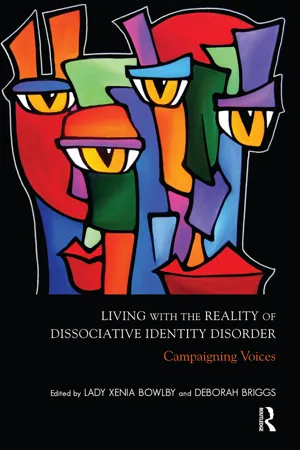
eBook - ePub
Living with the Reality of Dissociative Identity Disorder
Campaigning Voices
- 160 pages
- English
- ePUB (mobile friendly)
- Available on iOS & Android
eBook - ePub
About this book
This book brings together the threads that make up the campaign for people with Dissociative Identity Disorder (DID). It is based on a Campaign Day for survivors organised by the Paracelsus Trust to raise awareness of DID.
Information
CHAPTER ONE
Introduction
This book aims to bring together the threads that make up the campaign for people with Dissociative Identity Disorder (DID). The many threads reflect the multiplicity of the condition and this will become apparent as you read on. Weaving the threads together should be healing and that is one of the aims of the campaign. The multiplicity is both rich and confusing. Supporting people with DID can be exhausting. Living with it is both confusing and exhausting. DID is a survival mechanism and reflects the strength of the basic psyche to survive experiences that would drive some to psychosis.
The Clinic for Dissociative Studies (CDS) has taken a lead in the diagnosis and treatment of people with DID. Valerie Sinason has been a major contributor to the sharing of knowledge and raising the profile of this disabling condition. She has also been influential in highlighting ritual abuse as one of the main causes. This situation has led to many attacks from people who try to conceal their identity and role in the horrific abuse that people with DID report. Valerie, in particular, who has been willing to be named and to speak out, has been attacked in the press and on the internet. She continues to be brave and withstand these attacks, and is well supported by her colleagues to do this. The Bowlby Centre, looking at attachment and how this has been damaged in people with DID, offers further interventions. These two organisations have pioneered the therapeutic work with people with DID. Many people with DID, including some of the contributors to this book, have endured life without the benefit of formal therapy directed at the condition. They have found their way through the maze and survived. Their work is testament to their courage and strength.
A recent article in the Observer (December 2011) paints a distorted picture of the condition and the causes, leaving ordinary readers confused and perhaps thinking we are all mentally deranged. It is hard to believe that people will harm their own children the way they do, but that is not sufficient reason to fail to believe the real-life experience of some very brave and distressed people. It is inevitable that this book will involve many references to ritual abuse, but it is primarily about survival and living with the consequences of life experiences that attempt to destroy the self. Of course, it is the core identity that is attacked in ritual abuse, as this ensures that the person on the receiving end can often be discredited as an unreliable witness.
My own role has been in the development, registration, and running of the Paracelsus Trust. This is a registered charity, with the objective of supporting the people who attend the clinic for things that are not funded from their care package. The initial benefactors were Pearl King and Tina Carlile. Sadly Tina is no longer with us but she left a bequest in her will to support the charity. The trust has engaged in some fund-raising but relies primarily on legacies. It has been, and is, within the remit of the trust to support the campaign and we were pleased to be able to provide some financial support for the campaign meetings in March 2010 as well as for people attending, to ensure that the days were a success.
The original Paracelsus was an early advocate of medical interventions, with a wide approach to what might work. He was often rejected for his ideas and spent much of his time wandering around the world looking for acceptance. He was a brilliant man already very capable by the age of sixteen. He died in 1541 after a short illness, with some admirers of his skill and knowledge of alchemy, and others who rejected him outright. There are so many similarities for people with DID and those who work for them that it seemed a good name for the trust. He was a leader in his field and he persevered even after rejection. No doubt this sounds familiar to many people reading this book. Paracelsus is another thread in the weave.
Amelia Roberts was funded by the clinic and the trust to carry out the administration of the campaign days, and we thank her for this. The first day was for survivors and their therapists. The second day was for parliamentarians and commissioners of services. Attendance at both was significant and a considerable amount of information was shared. We are optimistic that more developments will follow and that, in time, people with DID will receive the services they need, and ritual abuse will be brought into the open and stopped.
The Paracelsus Trust is independent of any of the organisations that are represented in the campaign, and this independence allows the trustees to help without creating schisms in, or between, the activist groups. Everyone who contributes is valued and necessary, but it is interesting to note that there are so many different organisations, making it look like a replica of DID. It would be good to see everyone come together in an integrated way and perhaps Paracelsus can help with this. I have retired from the chair of the trust but continue as a trustee and it would be a delight for me to hear that the separate groups were able to combine their energies for the benefit of all.
My studies over the years have taken me into systems and what makes organisations function in the way they do. Individuals in organisations sometimes can’t recognise what happens when it is far removed from their own position. Systems reflect the pressures that come from inside as has been well documented by Obholzer et al. (1994). There is a system within the person and a system that the person lives within. The total system is the whole of society, but people exist within microsystems, sometimes family, sometimes support services and, of course, for people with DID, often within a cult. The power of systems should not be underestimated. Ritualised abuse can produce systems with internal destructive systems as well as the fractured personality that enables power to be retained by the abusers. The systems within systems are confusing and exhausting for the individual affected and for those who support them. It is common for people with DID to refer to their body and their internal system as separate entities, making statements like “the body’s age is …” and “within my system there are many alters, all with their own role”. It is a joy to meet people with DID who have found a way to live a good life and some of them have written chapters in this book.
The internal system of someone with DID is fragmented and only has some communication lines on the inside. A communication book, where each member of the system can write, enables them to find out who is there, but no one has a picture of everyone who is there, their individual roles, or a shared history. It falls to the therapist or other supporters to help to establish a full history, from the information provided by each of the alters, and to try to enable the present host or group to accept this and live with it. There is grief over the loss of alters who disappear, although it must be at least possible, and maybe likely, that the ones who disappear have served their purpose in keeping the body alive and the mind stable. Kim Noble, in her book All of Me (2011) and her chapter here, shows us how the different people who share her body can communicate with each other and the world through art. Each of her personalities has an individual painting style, making them identifiable and distinct from each other.
People with DID are survivors. They have endured horrific experiences. The way that their psyche has fractured has allowed them to survive physically and not be killed or kill themselves. The horror of their childhood has been managed through the process of splitting off so that most have no memory of what happened. Those who do suffer begin to be able to talk about it, but this can be restricted to the times that they are aware of being “out”. Coping strategies become very complex and intricate, with switching happening to ensure the safety of the whole body. These themes are developed in this book.
The chapters are all written by survivors until the last one where Orit Badouk Epstein offers a brief summary and some closing thoughts on the processes involved in the campaign meeting and the writing of the book, which in itself has been a process of bringing together diverse information. Each chapter has an internal coherence, recognising that the authors have reached a level of integration in their survival journey. We hope that together they provide a link to the book and the campaign, enabling all of us to continue in the endeavour to bring these very real issues into a wider consciousness in the public arena.
References
Noble, K. (2011). All of Me. London: Piatkus.
Obholzer, A., & Roberts, V. Z. (2005). The Unconscious at Work: Individual and Organizational Stress in the Human Services (2nd edn). Abingdon: Routledge.
CHAPTER TWO
The art of Kim Noble
From the age of fourteen we had been in and out of hospital with several different diagnoses like anorexia, bulimia, psychosis, depression, post-traumatic stress, alcoholism, and schizophrenia. No one understood about DID then. Now I understand that twenty main alters and many fragments share my body. Many of them have trouble accepting the idea that they share a body even though they have been told. I do understand how hard it is for them and for the rest of the population to make sense of DID as I had the same problem when I was diagnosed in 1995. I blamed my memory problems on too much drinking. I was only drinking one or two glasses of wine but I seemed to always have a glass in my hand. I thought I must be an alcoholic. If you are sharing a body with other alters then you also share time so my time can be very much limited.
I am often asked, “What does it feel like to have DID?” The strange thing is that each of us is a person in our own right, no different from anyone else, so it is normal for us. It is how we have always been.
The main problem for me now is the lost time or lack of memory as we are not co-conscious when another personality is in control of the body. To explain this to someone who has not experienced DID is hard but I think it is a similar experience to sleep walking. You can be told that you walked downstairs, ate some cake, and went back to bed. Yet you have no memory of it, just the evidence of the missing cake. I can get up in the morning, find a new painting in the studio, and I have no memory of doing it. The important point is that another personality painted it so I wouldn’t have their memory.
I started painting seven years ago. It began because a support worker came round who was training to be an art therapist. She said while we were chatting we could do some painting. I said I could not paint and we had no paints. She found some wallpaper and some of my daughter’s paints and we were able to paint on the back of it. Seven of us took part in the next few months. This took place in my dining room on the table. But the paint went everywhere so we turned the small bedroom into a studio.
Since then, another seven have found enjoyment and a way of communicating and expressing themselves through their art. We all have our own distinctive style and many of them are unaware they share a body. However, all are informed about our exhibitions. Judy does ask why she has to share her exhibitions with Kim Noble and not have a solo exhibition under her own name. She knows about DID but does not think she has it. That way, the personalities who do not understand they have DID are still prepared.
I remember our first exhibition in London and the feeling of closeness, warmth, and pride I felt as I looked around the gallery. It helped me realise for the first time that this was the nearest I was ever going to get to meeting my alters. Being untrained artists our work comes from our heart and not our head. Every painting exhibited was part of us on the wall, communicating a message, expressing an emotion, and telling a story. I could see for once at least fourteen of us were on the same page, heading down the same road, having an activity that we enjoyed.
After seeing the huge amount of space our paintings take up in exhibitions we feel the contrast with our space at home. Our studio is a small room and has trouble housing fourteen artists. However, we manage to share the space and respect one another’s work. Quite often I see unfinished canvasses lined up in the hall. In order to have room to paint, whoever is there has to take others’ work out of the studio as there isn’t the room for them to paint otherwise. The paintings are lined up like people waiting in a queue.
I have no memory at all between the personalities and scientific research has confirmed this. When I come back, by which I mean take control of the body, I don’t always know who’s been around. The best way to tell is to look at what painting is out at the time. Since we started the artwork, there’s actually been a lot more control in my life. If they’re painting, they’re achieving something, and when they don’t, they get very restless.
I can tell you a little about the fourteen artists and their paintings but my words haven’t come from them, it is my interpretation of their works and what they have told family, friends, and our therapist.
The artist personalities
Abi likes to paints lone figures—her paintings portray loneliness and emptiness; she often leaves a lot of blank canvas with just a lone figure in the corner.

Anon is called Anon as we don’t know her name. She usually paints in the early hours of the morning so nobody is there to ask her name. Her work is of a mystic nature. Her technique is extremely unusual with the paint poured directly onto the canvas and limited use of a pal...
Table of contents
- Cover
- Half Title
- Title Page
- Copyright Page
- Table of Contents
- Acknowledgements
- About the Editors and Contributors
- Foreword
- Chapter One Introduction
- Chapter Two The art of Kim Noble
- Chapter Three Spiritual aspects of DID
- Chapter Four Reading, writing, and reeling
- Chapter Five The role of friends in recovery
- Chapter Six Satanic Ritual Abuse (the painful truth)
- Chapter Seven Personal and societal denial
- Chapter Eight Living with DID
- Chapter Nine Back to normal? Surviving life with dissociation
- Chapter Ten Living well is the best revenge
- Chapter Eleven Medical aspects of recognising complex dissociative disorders
- Chapter Twelve How far have we come?
- Index
Trusted by 375,005 students
Access to over 1.5 million titles for a fair monthly price.
Study more efficiently using our study tools.
Frequently asked questions
Yes, you can cancel anytime from the Subscription tab in your account settings on the Perlego website. Your subscription will stay active until the end of your current billing period. Learn how to cancel your subscription
No, books cannot be downloaded as external files, such as PDFs, for use outside of Perlego. However, you can download books within the Perlego app for offline reading on mobile or tablet. Learn how to download books offline
Perlego offers two plans: Essential and Complete
- Essential is ideal for learners and professionals who enjoy exploring a wide range of subjects. Access the Essential Library with 800,000+ trusted titles and best-sellers across business, personal growth, and the humanities. Includes unlimited reading time and Standard Read Aloud voice.
- Complete: Perfect for advanced learners and researchers needing full, unrestricted access. Unlock 1.5M+ books across hundreds of subjects, including academic and specialized titles. The Complete Plan also includes advanced features like Premium Read Aloud and Research Assistant.
We are an online textbook subscription service, where you can get access to an entire online library for less than the price of a single book per month. With over 1.5 million books across 990+ topics, we’ve got you covered! Learn about our mission
Look out for the read-aloud symbol on your next book to see if you can listen to it. The read-aloud tool reads text aloud for you, highlighting the text as it is being read. You can pause it, speed it up and slow it down. Learn more about Read Aloud
Yes! You can use the Perlego app on both iOS and Android devices to read anytime, anywhere — even offline. Perfect for commutes or when you’re on the go.
Please note we cannot support devices running on iOS 13 and Android 7 or earlier. Learn more about using the app
Please note we cannot support devices running on iOS 13 and Android 7 or earlier. Learn more about using the app
Yes, you can access Living with the Reality of Dissociative Identity Disorder by Xenia Bowlby in PDF and/or ePUB format, as well as other popular books in Psychology & Abnormal Psychology. We have over 1.5 million books available in our catalogue for you to explore.