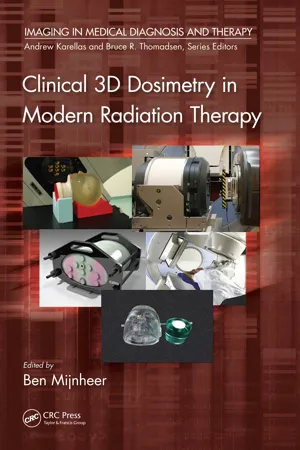
This book provides a first comprehensive summary of the basic principles, instrumentation, methods, and clinical applications of three-dimensional dosimetry in modern radiation therapy treatment. The presentation reflects the major growth in the field as a result of the widespread use of more sophisticated radiotherapy approaches such as intensity-modulated radiation therapy and proton therapy, which require new 3D dosimetric techniques to determine very accurately the dose distribution. It is intended as an essential guide for those involved in the design and implementation of new treatment technology and its application in advanced radiation therapy, and will enable these readers to select the most suitable equipment and methods for their application. Chapters include numerical data, examples, and case studies.
- 674 pages
- English
- ePUB (mobile friendly)
- Available on iOS & Android
eBook - ePub
Clinical 3D Dosimetry in Modern Radiation Therapy
SECTION IV
Clinical Applications
15
Acceptance Testing, Commissioning, and Quality Assurance of Linear Accelerators
15.1Introduction
15.2Equipment and Setup
15.3Acceptance Testing
15.4Commissioning
15.5Verification and Documentation
15.6Conclusions
15.1Introduction
Linear accelerators (linacs) are one of the most common machines in the delivery of radiation therapy. Following installation, proper preparation of these machines for clinical use is pivotal, as this will ensure the ability to treat patients with the utmost safety, accuracy, and precision. Furthermore, establishing well-known values of accelerator and beam characteristics, including depth dose and profile information, is imperative to delivering a planned dose distribution accurately. This process of evaluation and beam characterization is composed of two parts: acceptance testing and commissioning. After this is completed, linacs are regularly evaluated to establish that the machine is correctly functioning and that it, among other things, is still delivering dose within some tolerance level of the characterization determined during acceptance testing and commissioning. This regular quality assurance (QA) process comprises of different tests and/or levels of rigor depending on several factors including the frequency with which a given test is performed: annually, monthly, daily, and so on.
There are a number of different approaches and techniques for acceptance testing, commissioning, and regular linac QA. For example, some groups espouse the benchmarking of their beam and dosimetric data against manufacturer provided “idealized” machine data, sometimes called “golden beam” data (Murray et al., 2006; Stern et al., 2011). This process can include adjusting the machine’s beam and dosimetric characteristics to match the golden beam data. Others caution against the reliance on these datasets (Das et al., 2008). In terms of regular QA, many of the current techniques and protocols for the QA of linacs are driven by the assigning of a fixed set of tests and tolerances along with specified frequencies to achieve a specific outcome, such as 5% overall dosimetric error in treatment (Kutcher et al., 1994; IAEA, 2008). However, an increasing number of groups and studies espouse a risk assessment approach in which the treatment and dosimetric processes are analyzed to alter the QA techniques, tolerances, and frequencies to address the determined failure points (Fraass, 2008; Huq et al., 2008; Ford et al., 2015). As these debates continue, and there are differences even within those that fall on either side, this chapter is not intending to act as a complete review of all equipment available, methodologies, test tolerances, and so on for linac acceptance testing, commissioning, and routine QA. Rather, the intent here is to review a basic framework of resources, equipment, and techniques central to dosimetric acceptance testing and commissioning, as well as how a protocol for regular dosimetric linac QA could be constructed.
As mentioned above, a number of protocols abound for each of these techniques. Frequently, clinics will choose to follow the recommendations of international organizations, national organizations, and/or professional societies, many of which have made specific recommendations as to the content, frequency, and tolerances for acceptance, commissioning, and QA tests for linacs used in the delivery of radiation therapy. For example, the International Atomic Energy Agency (IAEA) has published works such as TECDOC-989, among others, guidelines for setting up radiation therapy programs, including descriptions of linac commissioning aspects, recommended QA regiments and tolerances, and equipment (IAEA, 1997, 2008). Similar documents have been produced by other groups, including, but not limited to, Report 94 of the Institute of Physics and Engineering in Medicine (IPEM) (Kirby et al., 2006) and Reports 60976 and 60977 of the International Electrotechnical Commission (IEC) (IEC, 2007, 2008). In the United States, the American Association of Physicists in Medicine (AAPM) has published a number of task group (TG) reports, which include the report of TG 106 addressing the recommended equipment and techniques involved in linac beam data acceptance testing and commissioning (Das et al., 2008), and the reports of TGs 40 and 142 discussing recommended linac QA frequencies and tolerances (Kutcher et al., 1994; Klein et al., 2009). Ultimately, it is up to the end user to select which of the various protocols makes the greatest sense to apply in his or her own clinic, or to follow one of the espoused risk assessment-based techniques (Fraass, 2008; Huq et al., 2008; Williamson et al., 2008).
Acceptance testing and commissioning are intrinsically linked, but are different concepts. When a linac is purchased, the buyer and the vendor agree that the machine installed will have certain capabilities and precision. The acceptance testing is then a set of tests the vendor performs along with the physicist to demonstrate the machine installed has the abilities advertised during purchase. Commissioning is the set of tests performed by the end user, the “buyer” as defined above, to prepare the linac for its full use in the clinic, including the collection of data which is needed as input into a treatment planning system (TPS).
15.1.1Effort and Personnel
Before beginning the acceptance testing and commissioning process, it is important to allocate the proper resources in terms of personnel and time to complete the tests. Some of the publications provide guidance for this: the IAEA, for example, includes a table outlining the times necessary for an individual to complete each aspect of the acceptance and commissioning processes (IAEA, 2008). Instead of providing an explicit breakdown by personnel required, the AAPM details a formula to estimate the total time required for commissioning based on the number of energies/modalities and scanning datasets required (Das et al., 2008). Guidance is then given about the blocks of time needed to inform data analysis and point measurements, with an ultimate conclusion that “the typical time allotted for commissioning is 4–6 weeks.”
The differences in these approaches illustrate there is no definitive methodology for determining how many people and how much time is needed to perform a given acceptance and commissioning project. As the acceptance testing and commissioning of linacs dictates the accuracy, efficacy, and safety of radiation therapy treatments and treatment planning, it is imperative to not shortchange the process in terms of time or personnel available. It is also important to note that new accessory devices or treatment modes which require commissioning will add additional time to this process. Furthermore, as technology develops and/or the complexity of linacs increase, the guidance provided by published sources may not be sufficient to estimate the time/personnel needed to properly address those items.
15.2Equipment and Setup
An array of equipment is needed for acceptance testing and commissioning of a linac. Equipment for acceptance testing is typically very similar compared to commissioning. The difference tends to be that acceptance testing equipment is owned and provided by the vendor, while commissioning equipment is provided by the team performing the work and should include devices (or similar devices) that will be on hand for the periodic QA: annually, monthly, daily, and so on. Commissioning equipment need not be the same specific devices as that used for acceptance testing but must be capable of acquiring the data with sufficient accuracy and precision necessary for creating beam models of interest in the TPS, as well as setting baselines for periodic QA.
15.2.1Scanning Water Tanks
For beam scanning, a three-dimensional (3D) scanning water tank is typically the instrument of choice (Figure 15.1). These devices have a stage upon which a radiation measurement instrument, ionization chamber, diode detector, and so on, can be mounted and moved throughout an incident radiation field in all three dimensions. These tanks can have different geometries, for example: cubic, rectangular cubic, or cylindrical. Some scanning water tanks, including those used by certain vendors for acceptance testing, may only have stages that can move in two directions, along one axis perpendicular and one axis parallel to the radiation field. Those who use these “two-dimensional (2D)” scanning tanks may assume the radiation field is cylindrically symmetric, thus only one profile of the beam is needed to characterize the field. Typically for most types of scanning water tanks, the tank itself and/or the scanning stage must be leveled in each direction.
Different sizes of scanning water tanks are available commercially. Recommendations are made in the literature (Das et al., 2008) to have a tank large enough to include all of the fields of interest. This is generally limited by the size of field data the end user will need to fully commission the TPS. Bear in mind that, for most linacs, field size is defined at the isocenter, typically 100 cm source-to-axis distance (SAD). Scanning data needed for TPSs generally require profile data for setups with source-to-detector distance (SDD) greater than the SAD, resulting in effective field sizes at those SDDs that are greater than the nominal SAD field size. For example, if a 20 cm × 20 cm field is required to be scanned at 100 cm source-to-surface distance (SSD) and 30 cm depth, the field size at that depth is 26 cm × 26 cm. Furthermore, nominal field size is typically defined for flattened fields at the 50% falloff of the penumbra. In order to capture data encompassing the full edge of the penumbra, which is generally good practice to generate high-quality field models in TPSs, an even greater distance is required. Typically, 5 cm added to the nominal at-depth field size on either side can frequently give more than sufficient data. TPSs are notoriously limited in their ability to model the peripheral dose from radiation field, as discussed in detail in Chapter 21, thus measuring further outside the radiation field is generally unnecessary. Measurements outside of the field may be performed during the acceptance testing; however, alternative detector systems would generally be employed. In the example above, this would require a tank of at least 36 cm wide to accommodate the desired field.

Figure 15.1
Scanning water systems: (a) rectangular cubic (Blue Phantom2, IBA, Schwarzenbruck, Germany); (b) cylindrical (3D SCANNER, Sun Nuclear, Melbourne, FL).
With that said, tanks which can accommodate scanning 40 cm × 40 cm fields at appropriate SDDs are prohibitively large and heavy to be widely produced and/or used. If large fields are required, one solution is to offset the water tank from being centered with the beam and scan one or more half-beam profiles; i.e., scanning from central axis (CAX) past the penumbra. Most commercially available scanning water tanks also come with a platform which allows them t...
Table of contents
- Cover
- Half Title
- Series Page
- Title Page
- Copyright Page
- Contents
- Series Preface
- Preface
- Acknowledgments
- Editor
- Contributors
- Section I Introduction
- Section II Instrumentation
- Section III Measurement and Computation
- Section IV Clinical Applications
- Section V Emerging Technological Developments
- Index
Trusted by 375,005 students
Access to over 1.5 million titles for a fair monthly price.
Study more efficiently using our study tools.
Frequently asked questions
Yes, you can cancel anytime from the Subscription tab in your account settings on the Perlego website. Your subscription will stay active until the end of your current billing period. Learn how to cancel your subscription
No, books cannot be downloaded as external files, such as PDFs, for use outside of Perlego. However, you can download books within the Perlego app for offline reading on mobile or tablet. Learn how to download books offline
Perlego offers two plans: Essential and Complete
- Essential is ideal for learners and professionals who enjoy exploring a wide range of subjects. Access the Essential Library with 800,000+ trusted titles and best-sellers across business, personal growth, and the humanities. Includes unlimited reading time and Standard Read Aloud voice.
- Complete: Perfect for advanced learners and researchers needing full, unrestricted access. Unlock 1.5M+ books across hundreds of subjects, including academic and specialized titles. The Complete Plan also includes advanced features like Premium Read Aloud and Research Assistant.
We are an online textbook subscription service, where you can get access to an entire online library for less than the price of a single book per month. With over 1.5 million books across 990+ topics, we’ve got you covered! Learn about our mission
Look out for the read-aloud symbol on your next book to see if you can listen to it. The read-aloud tool reads text aloud for you, highlighting the text as it is being read. You can pause it, speed it up and slow it down. Learn more about Read Aloud
Yes! You can use the Perlego app on both iOS and Android devices to read anytime, anywhere — even offline. Perfect for commutes or when you’re on the go.
Please note we cannot support devices running on iOS 13 and Android 7 or earlier. Learn more about using the app
Please note we cannot support devices running on iOS 13 and Android 7 or earlier. Learn more about using the app
Yes, you can access Clinical 3D Dosimetry in Modern Radiation Therapy by Ben Mijnheer in PDF and/or ePUB format, as well as other popular books in Medicine & Oncology. We have over 1.5 million books available in our catalogue for you to explore.