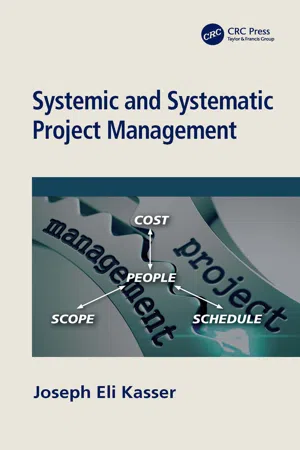
This book applies systems thinking to treat project management in a systemic and systematic manner from a problem-solving perspective. Considering the project as a system, the book discusses traditional project planning and organizing, as well as some neglected aspects of the project, namely how to prevent cost and schedule escalation, how to deal with change, recognize problems in time to prevent project failure and what to do when things go wrong during the implementation states of a project.
This book provides you with a better understanding of the systems approach to problem-solving and project management that will enable you to be more successful at managing projects.
Features
Treats projects as systems
Presents project management as a problem-solving paradigm
Discusses how to incorporate prevention into planning and how to show the value
Describes what to do and how to cope with unanticipated problems that arise during the project implementation state
The best book on the current process-based management paradigm that I’ve read is one that I purchased for $0.50 about 20 years ago in the Montgomery County, Maryland, library used book sale. The book was published in 1917 and reprinted in 1920 and it was Volume 6 of a factory management course. The title of the book does not contain the word management; the title is Executive Statistical Control (Farnham 1920) and it deals with management from the following perspectives:
Financial.
Making decisions based on facts instead of hunches or opinions.
Treating employees fairly and decently.
The efficient use of labour.
About the only major change to management that came after the book was published was the Gantt chart that showed project timelines and how the timelines changed during the reporting period on a single chart (Clark 1922).
The current project management paradigm does not seem to work too well because in spite of all the textbooks1 and courses, projects still tend to fail. The reasons for these failures are well known, yet continue to manifest themselves; an instance of Cobb’s Paradox (VOYAGES 1996). Cobb’s Paradox states, ‘We know why projects fail, we know how to prevent their failure; so why do they still fail?’ Now a paradox is a symptom of a flaw in understanding the underlying paradigm. Perhaps Juran and Deming provided the remedy:
80%–85% of all organizational problems (Juran quoted by Harrington (1995)).
94% of the problems belong to the system, i.e. were the responsibility of management (Deming 1993).
Peter Drucker wrote that management in the 21st century would be different (Drucker 2011). This book discusses a different project management paradigm; project management as a problem-solving methodology using the systems approach.
The systems approach is a technique for the application of a scientific approach to complex problems. It concentrates on the analysis and design of the whole, as distinct from the components or the parts. It insists upon looking at a problem in its entirety, taking into account all the facets and all the variables, and relating the social to the technological aspects
Ramo (1973)
This book:
Provides you with a better understanding of the systems approach to problem-solving and project management, which will enable you to be more successful at managing projects.
Treats project management as a problem-solving paradigm.
Shows how to incorporate prevention into planning and show the value of prevention.
Shows how the tools described in The Systems Thinker’s Toolbox (Kasser 2018) can be applied to project management.2
Shows how to cope with unanticipated problems that arise during the project implementation state.
Is based on more than 40 years of research and experience.
Integrates many published and invented tools and techniques into a practical methodology.
Applies systems thinking to treat project management in a systemic and systematic manner from a problem-solving perspective.
Considers a project as a system.
Divides project management into pure project management, applied project management and domain project management which identifies the reasons for the opinion that a project manager can manage any type of project, and identifies the situational fallacy in that opinion.
Picks up where the Systems Thinker’s Toolbox (Kasser 2018) ended for project managers.
Incorporates new project monitoring tools including categorized requirements in process (CRIP) charts and enhanced traffic light (ETL) charts from the book The Systems Thinker’s Toolbox (Kasser 2018).
Provides examples of how the tools are used.
Provides examples of good and bad resumes in the section on staffing a project to show what to look for when considering candidates for staffing a project.
Provides a list of acronyms in Table 1.1 to help you read the book.
1.1 The Contents of This Book
This book discusses systemic and systematic project management. The systemic aspects in Chapters 2, 3, 4, 12 and 13 help you conceptualize and understand project management. The systematic aspects in the middle chapters help you to become a better project manager.
Chapter 2 explains the seven P’s of project management: people, politics, prevention, problems, processes and products which must be managed (or juggled) to achieve the objectives of a project.
TABLE 1.1 Acronyms Used in the Book
Chapter 3 deals with problems and problem-solving. If a problem didn’t need solving there wouldn’t be any need for management. The chapter discusses perceptions of problem-solving process from a number of perspectives, explains the structure of problems and the levels of difficulty posed by problems and the need to evolve solutions using an iterative approach. After showing that problem-solving is really an iterative causal loop rather than a linear process, the chapter then explains complexity, and how to use the systems approach to manage complexity. The chapter then shows how to remedy well-structured problems and how to deal with ill-structured, wicked and complex problems using iterations of a sequential two-stage problem-solving process. Reflecting on this chapter, it seems that iteration is a common element in remedying any kind of problem other than easy well-structured problems irrespective of their structure.
The purpose of management is to accomplish a goal by getting other people to do the work. Chapter 4 discusses management, general management and project management, and how to accomplish that goal. After a brief discussion on general management, the chapter focuses on the attributes of projects and project management as a problem-solving activity.
Successful projects are planned. Chapter 5 focuses on product-based planning, the project and system lifecycles and planning methodologies. The chapter discusses plans, the difference between generic and project-specific planning, explains how to incorporate prevention into the planning process to lower the completion risk and shows how to apply work packages (WPs) instead of work breakdown structures (WBS). The chapter also explains why planning should iterate from project start to finish at the conceptual level and project finish back to start at the detailed level.
Because projects are staffed by people, Chapter 6 discusses aspects of staffing projects, teams and distributing assignments to members of the project team. The chapter explains:
The need for high-performance teams.
That people are not interchangeable; namely, one engineer does not necessarily equal another.
How to staff a project.
Chapter 7 explains planning and adhering to schedules, an important function of project management since exceeding schedule is one of the characteristics of failed projects. Consequently, it is important to get the right schedule for the project. Accordingly, Chapter 7 explains:
How to create the project network.
How to create a project schedule.
The critical path and its importance.
The fallacy in slack time in fixed resource situations.
Chapter 8 explains that project managers need to estimate ...
Table of contents
Cover
Halftitle Page
Title Page
Copyright Page
Dedication Page
Contents
List of Figures
List of Tables
Preface
Acknowledgements
Author
Chapter 1 Introduction
Chapter 2 The Seven Interdependent P’s of a Project
Chapter 3 Perceptions of Problem-Solving
Chapter 4 Management: General and Project Management
Chapter 5 Project Planning
Chapter 6 Successful Project Staffing
Chapter 7 Successful Project Scheduling
Chapter 8 Successful Project Cost Estimating
Chapter 9 Successfully Adjusting Project Schedules and Costs
Chapter 10 An Introduction to Managing Risk and Uncertainty over the Project Lifecyle
Chapter 11 Successful Performance Monitoring and Controlling
Chapter 12 The Human Element
Chapter 13 Ethics
Appendix 1: The Engaporian Multi-satellite Operations Control Centre Communications Switching System Replacement Project
Appendix 2: Change Management Events
Appendix 3: Presentation Guidelines and Requirements
Appendix 4: Staffing Information
Appendix 5: Resumes for the Session 6 Exercise
Author Index
Subject Index
Trusted by 375,005 students
Access to over 1.5 million titles for a fair monthly price.
Study more efficiently using our study tools.
Frequently asked questions
Yes, you can cancel anytime from the Subscription tab in your account settings on the Perlego website. Your subscription will stay active until the end of your current billing period. Learn how to cancel your subscription
No, books cannot be downloaded as external files, such as PDFs, for use outside of Perlego. However, you can download books within the Perlego app for offline reading on mobile or tablet. Learn how to download books offline
Perlego offers two plans: Essential and Complete
Essential is ideal for learners and professionals who enjoy exploring a wide range of subjects. Access the Essential Library with 800,000+ trusted titles and best-sellers across business, personal growth, and the humanities. Includes unlimited reading time and Standard Read Aloud voice.
Complete: Perfect for advanced learners and researchers needing full, unrestricted access. Unlock 1.5M+ books across hundreds of subjects, including academic and specialized titles. The Complete Plan also includes advanced features like Premium Read Aloud and Research Assistant.
Both plans are available with monthly, semester, or annual billing cycles.
We are an online textbook subscription service, where you can get access to an entire online library for less than the price of a single book per month. With over 1.5 million books across 990+ topics, we’ve got you covered! Learn about our mission
Look out for the read-aloud symbol on your next book to see if you can listen to it. The read-aloud tool reads text aloud for you, highlighting the text as it is being read. You can pause it, speed it up and slow it down. Learn more about Read Aloud
Yes! You can use the Perlego app on both iOS and Android devices to read anytime, anywhere — even offline. Perfect for commutes or when you’re on the go. Please note we cannot support devices running on iOS 13 and Android 7 or earlier. Learn more about using the app
Yes, you can access Systemic and Systematic Project Management by Joseph Eli Kasser in PDF and/or ePUB format, as well as other popular books in Business & Project Management. We have over 1.5 million books available in our catalogue for you to explore.