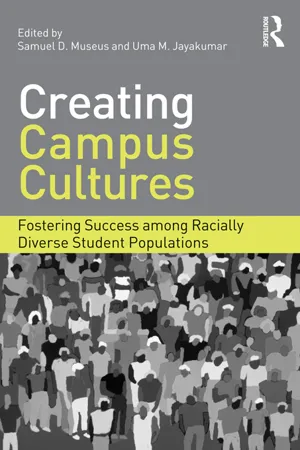
Many colleges and universities have not engaged in the critical self-examination of their campuses necessary for effectively serving racially diverse student populations. This timely edited collection provides insights into how campus cultures can and do shape the experiences and outcomes of their increasingly diverse college student populations. By cultivating values, beliefs, and assumptions that focus on including, validating, and creating equitable outcomes among diverse undergraduate students, an institution can foster their success.While attention to campus climate is critical for gauging the nature of an institution's culture and how students are experiencing the campus environment, changes in climate alone will not lead to holistic and deep rooted institutional transformation. Moving beyond previous explorations of campus racial climates, Creating Campus Cultures addresses the considerable institutionally embedded obstacles practitioners face as they attempt to transform entrenched institutional cultures to meet the needs of diverse student bodies. A broad range of chapters include voices of students, new research, practical experiences, and application of frameworks that are conducive to success. This book will help student affairs and higher education administrators navigate this increasingly difficult terrain by providing practical advice on how to foster success among racial minority students and enact long-term, holistic change at any institution.
eBook - ePub
Creating Campus Cultures
Fostering Success among Racially Diverse Student Populations
- 240 pages
- English
- ePUB (mobile friendly)
- Available on iOS & Android
eBook - ePub
Creating Campus Cultures
Fostering Success among Racially Diverse Student Populations
About this book
Information
1
Mapping the Intersection of Campus Cultures and Equitable Outcomes Among Racially Diverse Student Populations
Although higher education researchers, policymakers, and practitioners across the nation have acknowledged the importance of increasing rates of success among racial and ethnic minority students, several scholars have pointed to a superficial commitment to diversity and multiculturalism on college campuses that falls short of genuine inclusion of students of color (Bell, 2004; Bensimon, 2005; Ladson-Billings & Tate, 1995; Maldonado, Rhoads & Buenavista, 2005; McLaren, 1995; Sleeter & Grant, 2009). The absence of an authentic commitment to diversity and multiculturalism manifests in several ways. For example, some institutions are replacing efforts to actively recruit underrepresented and disenfranchised domestic students, whom predominantly White institutions (PWIs) have a history of excluding, with initiatives to increase enrollment of high-income students from China, India, and other foreign nations. Such efforts function to increase the numbers of students of color on campus, enhance diversity in the student body, and generate exponentially higher revenues – but they also serve to neglect domestic students of color. Another example of the absence of an authentic commitment to diversity and multiculturalism is the fact that several colleges across the country are currently consolidating and dismantling ethnic studies programs, despite evidence of the profound positive impact that such programs can have on validating the experiences of students of color and promoting their success in college (e.g., Kiang, 2002, 2009). Indeed, as colleges and universities progress toward diversification and face rising costs, there is an increasing trend toward eliminating or diminishing the very practices and efforts originally designed to increase the representation and success of historically excluded and currently under-represented and marginalized racial and ethnic minority student populations.
Perhaps the most obvious manifestation of a failure of colleges and universities to truly commit to diversity and multiculturalism is the fact that many postsecondary institutions fail to adapt adequately to the increasing racial diversity of their student bodies and instead rely on offering token initiatives dedicated to diversity and multiculturalism. Put another way, many colleges and universities have not engaged in a critical self-examination and transformation of the cultures of their campuses that can lead to most effectively serving diverse student populations. This overreliance on tokenized diversity and multicultural efforts, as well as the failure to cultivate institutional cultures that engage, support, and facilitate success among diverse student populations, hinders institutions’ abilities to foster environments where underrepresented students of color can thrive. As a result, institutions continue to perpetuate problematic disparities in persistence and degree attainment among college students of color.
In the following section, we highlight persisting racial and ethnic disparities in degree attainment. Next, we discuss the role of campus cultures in hindering and promoting college success among racially diverse student populations. Then, we offer a typology of campus cultures that can help postsecondary educators conceptualize the status of their institutions and how they can work to transform the cultures on their campuses to maximize success among racially diverse student bodies. In the final section, we discuss the importance of cultural assumptions in hindering such cultural transformation. Finally, we offer these assumptions as a starting point – prompting readers to (re)think the cultures of their own campuses and setting the stage for the remaining chapters, which delve into strategies that college and university leaders can employ to engage in deep and broad institutional transformation.
Racial and Ethnic Disparities in College Degree Attainment
Racial and ethnic disparities in persistence and bachelor’s degree attainment have received much attention in higher education over the past two decades, and those inequities are substantial and have proven to be resilient. Indeed, recent nationally representative data suggest that 63% of White students who begin college at a 4-year institution will attain a baccalaureate degree within 6 years, whereas fewer than 43% of their Black, Latino, and Native American peers will attain a 4-year degree in the same timeframe (Figure 1.1). Although Asian Americans and Pacific Islanders (AAPIs) have the highest rates of degree attainment when racial statistics are examined, several ethnic subgroups within this racial category suffer from disparities as well. Although data from nationally representative studies of college students are not sufficient for disaggregating attainment rates among AAPI ethnic subgroups (Museus, 2009), Census data indicate that, among those 25 years of age and older, Southeast Asian American (i.e., Cambodian, Hmong, Lao, and Vietnamese), Native Hawaiian, and other Pacific Islander (e.g., Chamorro Islander, Fijian, Guamanian, Micronesian, Samoan, Tongan) groups all hold bachelor’s degrees at rates noticeably lower than the national population (Figure 1.2).

Figure 1.1 Six-Year Baccalaureate Degree Completion Rates at 4-year Institutions by Race. Data source: Beginning Postsecondary Students Survey (BPS: 03/09).

Figure 1.2 Baccalaureate Degree Attainment among Asian Americans and Pacific Islanders by Ethnicity. Data source: Public Use Microdata Sample (PUMS: 2007–09). N = 14,847,168.
Given that racial and ethnic minority students comprise a growing proportion of the student populations entering college campuses, these disparities in success also constitute an ongoing concern and urgent problem that requires the attention of higher education researchers, policymakers, and practitioners (Allen, Jayakumar, & Franke, 2009; Kelly, 2005; Museus, Palmer, Davis, & Maramba, 2011). These racial and ethnic disparities demand attention for multiple reasons. From an equity perspective, higher education has a responsibility to provide its increasingly racially diverse student bodies with equal opportunities to enter and succeed in higher education. Furthermore, it has been noted that persisting racial and ethnic disparities, coupled with a rapidly diversifying population, could lead to an overall decline in levels of educational attainment across the nation and have devastating social and economic consequences for society (Kelly, 2005). Thus, from an economic perspective, higher education also has a responsibility to produce a sufficient number of qualified graduates who can function effectively in the increasingly diverse workforce to secure an economically stable future for generations.
This volume emerged, in part, as a result of our belief that providing access to underrepresented students of color and isolated programmatic efforts to support racially diverse student populations are not enough to move toward equitable outcomes. Rather, we argue that institutional transformation is required to achieve such ends. Institutional transformation is both deep and pervasive, affecting the cultural fabric of college and university campuses (Eckel, Hill, & Green, 1998). This volume is aimed at better understanding how institutions can cultivate such transformation to better serve their increasingly diverse student bodies.
Campus Culture and the Promise of Holistic Institutional Transformation
Two concepts that have received considerable attention in the higher education literature are campus climate and culture. Although campus climate and culture are often used interchangeably, there are important distinctions between the two phenomena (Bauer, 1998; Museus & Harris, 2010; Peterson & Spencer, 1990). Such distinctions must be clarified because they are critical to understanding and maximizing the effectiveness of colleges and universities.
Campus climate can be defined as “the current perceptions, attitudes, and expectations that define the institution and its members” (Bauer, 1998, p. 2). Much of the research on the intersection between institutional environments and racially diverse student populations has examined campus climates as they pertain to race (for review, see Harper & Hurtado, 2007). By and large, analyses of campus racial climates are focused on measuring students’ attitudes, perceptions, observations, or interactions within the racial environment of their institutions at a particular point in time (e.g., Cabrera, Nora, Pascarella, Terenzini, & Hagedorn, 1999; Hurtado & Carter, 1997; Museus, Nichols, & Lambert, 2008; Nora & Cabrera, 1996). This campus racial climate research has clarified important realities: it has generated substantial evidence that different racial groups perceive campus environments in disparate ways, students of color encounter prejudice and discrimination at PWIs, and benefits accrue because of cross-racial interactions in college (Ancis, Sedlacek, and Mohr, 2000; Chang, 1999, 2001; Chang, Astin, & Kim, 2004; Chang, Denson, Sáenz, & Misa, 2006; D’Augelli & Hershberger, 1993; Fries-Britt, 1998; Fries-Britt & Turner, 2001; Hurtado & Carter, 1997; Hurtado, Carter, & Spuler, 1996; Jayakumar, 2008; Museus, Nichols, & Lambert, 2008; Museus & Truong, 2009; Rankin & Reason, 2005; Sáenz, Ngai, & Hurtado, 2007; Smedley, Myers, and Harrell, 1993). Aligned with the emphasis on campus racial climates in research, educators at campuses across the nation regularly engage in efforts to address “chilly” climates to improve the college experience for racially diverse student populations. Although the focus on campus racial climates in both research and practice has been invaluable in helping better understand the experiences and outcomes of racially diverse college student populations, we argue that this focus on campus racial climates has at least two important limitations.
First, with few exceptions (e.g., Hurtado, Milem, Clayton-Pederson, & Allen, 1998), the focus on campus climate has failed to generate holistic perspectives regarding how institutions of higher education can and should adapt to increasingly racially diverse student populations. As a result, efforts to positively influence the experiences of students of color often consist of isolated programs and activities designed to make students feel more welcome or feel as if they have a voice on campus. However, the impact of such isolated efforts is often fleeting and fails to stimulate deep, pervasive, and long-lasting systemic institutional transformation. In contrast to campus climate research and discourse, examinations of campus culture seek to understand institutions from a more holistic perspective (Bauer, 1998). The latter takes into account the historical context, rituals and traditions, and other symbolic components of a campus’s identity, as well as both the observed and unobserved values and assumptions that shape perspectives, behaviors, and the way education is approached and delivered. In doing so, campus culture research and discourse can help lead to more holistic understandings of the intersection between the deeply embedded and complex elements of institutions and their diverse student bodies.
Second, campus racial climate research has failed to develop an empirical basis for understanding how those deeply embedded elements within the fabric of postsecondary institutions constitute barriers to institutional transformation that is aimed at better serving racially diverse student populations. This is a salient point because, even when college educators enthusiastically advocate for institutional change to address the needs of racially diverse student populations, they encounter systemic cultural and structural barriers. In contrast to the body of knowledge on campus climate in higher education research and discourse, understanding campus cultures can help institutional leaders better comprehend how values and taken-for-granted assumptions that shape behavior and the delivery of education on campuses can inhibit positive institutional transformation. Comprehending campus cultures can also provide institutional leaders with greater flexibility in facilitating institutional transformation (Tierney, 1992, 1993). Such understandings can aid institutional agents in overcoming cultural barriers and leveraging various elements of their campus cultures to make such transformation happen. In sum, our position is that understanding and considering institutional culture is essential for transforming institutions to maximize success among increasingly racially diverse student populations.
Frameworks for Understanding the Impact of Campus Cultures on Racially Diverse Student Populations
Higher education scholars have studied and written about campus culture for decades (e.g., Bauer, 1998; Kuh & Hall, 1993; Kuh & Whitt, 1988; Peterson & Spencer, 1990; Tierney, 1988, 1992, 1993; Whitt, 1996). Although campus culture can be defined in many ways, Kuh and Hall (1993) have offered one of the most useful definitions of organizational culture as it pertains to institutions of higher education. They defined campus culture as:
the collective, mutually shaping patterns of institutional history, mission, physical settings, norms, traditions, values, practices, beliefs, and assumptions that guide the behavior of individuals and groups in an institution of higher education which provide a frame of reference for interpreting the meanings of events and actions on and off campus. (p. 2)
Their definition is particularly valuable because it underscores both the complexity of institutional cultures and value of cultural perspectives in understanding the experiences of individuals and groups on college campuses (Museus, 2007).
Schein (1992) provided a useful framework for understanding the different levels of organizational culture, which can be applied to institutions of higher education and consists of three levels that range from the most to least visible levels of culture: artifacts, values, and assumptions. Artifacts are the most visible aspect of an organization’s culture, including its history, traditions, stories, and interactions (Schein, 1992). Values constitute the next level of organizational culture in Schein’s model, and they can both be espoused and enacted. Espoused values refer to the shared beliefs about what members of an organization consider important (Whitt, 1996), whereas enacted values are those that manifest in the actions of members of that organization (Museus, 2007). Finally, cultural assumptions are the most tacit aspects of an organizational culture and constitute the underlying system of beliefs “that influences what people in the culture think about, how they behave, and what they value” (Whitt, 1996, p. 191). The fact that assumptions are the most tacit aspects of a campus’s culture means that they can be especially problematic barriers to institutional transformation efforts – a point that we discuss later in this chapter. It should be noted that Kuh and Hall (1993) delineated perspectives as a fourth level of culture to this framework. Cultural perspectives are “socially shared rules and norms applicable to a given context,” constituting “the way we do things here,” and “acceptable behavior” among institutional members in a given setting (p. 6).
In using any cultural framework, it is important to avoid oversimplifying the complexity of campus cultures (Museus, 2007). Indeed, parsing the various elements of a campus’s culture for purposes of analysis can hinder one’s ability to see that culture in all of its entirety and complexity, and maintaining a holistic perspective of campus culture is important because the many elements of an institution’s culture interact in both palpable and implicit ways (Whitt, 1996). For example, the norms, values, practices, beliefs, and assumptions that comprise a campus’s culture manifest symbolically in various institutional missions, traditions,...
Table of contents
- Cover
- Half Title
- Title Page
- Copyright
- Dedication
- Contents
- Foreword
- Acknowledgments
- 1. Mapping the Intersection of Campus Cultures and Equitable Outcomes among Racially Diverse Student Populations
- 2. The Campus Racial Culture: A Critical Race Counterstory
- 3. Creating a Culture of Inquiry around Equity and Student Success
- 4. Moving from Cultures of Individualism to Cultures of Collectivism in Support of Students of Color
- 5. Fostering Cultures of Inclusion in the Classroom: From Marginality to Mattering
- 6. Cultural Integration in Campus Subcultures: Where the Cultural, Academic, and Social Spheres of College Life Collide
- 7. The Role of Student Agency, Student Empowerment, and Social Praxis in Shaping Supportive Cultures at Traditionally White Institutions
- 8. Shared Leadership for Creating Campus Cultures that Support Students of Color
- 9. Engaging Faculty in the Process of Cultural Change in Support of Diverse Student Populations
- 10. Cultivating Campus Cultures that Support Racially Diverse and Other Underserved Students: A Model for Multi-Institutional Transformation
- Contributor Biographies
- Index
Trusted by 375,005 students
Access to over 1.5 million titles for a fair monthly price.
Study more efficiently using our study tools.
Frequently asked questions
Yes, you can cancel anytime from the Subscription tab in your account settings on the Perlego website. Your subscription will stay active until the end of your current billing period. Learn how to cancel your subscription
No, books cannot be downloaded as external files, such as PDFs, for use outside of Perlego. However, you can download books within the Perlego app for offline reading on mobile or tablet. Learn how to download books offline
Perlego offers two plans: Essential and Complete
- Essential is ideal for learners and professionals who enjoy exploring a wide range of subjects. Access the Essential Library with 800,000+ trusted titles and best-sellers across business, personal growth, and the humanities. Includes unlimited reading time and Standard Read Aloud voice.
- Complete: Perfect for advanced learners and researchers needing full, unrestricted access. Unlock 1.5M+ books across hundreds of subjects, including academic and specialized titles. The Complete Plan also includes advanced features like Premium Read Aloud and Research Assistant.
We are an online textbook subscription service, where you can get access to an entire online library for less than the price of a single book per month. With over 1.5 million books across 990+ topics, we’ve got you covered! Learn about our mission
Look out for the read-aloud symbol on your next book to see if you can listen to it. The read-aloud tool reads text aloud for you, highlighting the text as it is being read. You can pause it, speed it up and slow it down. Learn more about Read Aloud
Yes! You can use the Perlego app on both iOS and Android devices to read anytime, anywhere — even offline. Perfect for commutes or when you’re on the go.
Please note we cannot support devices running on iOS 13 and Android 7 or earlier. Learn more about using the app
Please note we cannot support devices running on iOS 13 and Android 7 or earlier. Learn more about using the app
Yes, you can access Creating Campus Cultures by Samuel D. Museus, Uma M. Jayakumar, Samuel D. Museus,Uma M. Jayakumar in PDF and/or ePUB format, as well as other popular books in Bildung & Bildung Allgemein. We have over 1.5 million books available in our catalogue for you to explore.