eBook - ePub
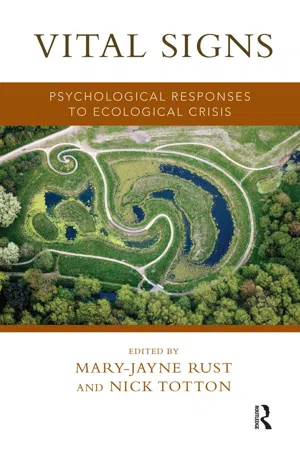
Vital Signs
Psychological Responses to Ecological Crisis
- 336 pages
- English
- ePUB (mobile friendly)
- Available on iOS & Android
eBook - ePub
Vital Signs
Psychological Responses to Ecological Crisis
About this book
This anthology illustrates the range and diversity of responses from the psychological world to the multiple ecological crises with which our society is faced. "Vital signs" are the basic physiological measures of functioning which health practitioners use to assess how ill a patient is. This book focuses not on our physical predicament, with so many of the earth's systems severely stressed and beginning to fail, but on our psychological predicament. As news of this very serious situation slowly penetrates our defences, we struggle as individuals and as a society to find an adequate response.
Information
PART 1
CONTEXTS
CHAPTER ONE
The darkening quarter: an embodied exploration of a changing global climate
Viola Sampson
Home
I live on a hilltop who tips me out into the fresher winds and broader horizons to the north of the city. This hill shoulders old villages swallowed many years ago in London’s urban gobble. Its paths through ancient woodlands, of oak and hornbeam, jay and blue tit, will soon be softened by fallen leaves—the dank wind in my nostrils tells me it is autumn now.
Autumn. I share my days with yellow plums squashed underfoot near the bus stop, and rain-swollen blackberries cloaked in mildew. Ripe, green figs hang far out of reach in my neighbour’s tree. Heavy with fragrant sweetness, they empty ooze onto the roof of the shed, hanging slack before sliding to the ground and completing a year-long gesture of fruition and nourishment. Each year a flock of starlings descend in noisy feasting and leave in one quick swoosh. I am waiting for them. To me, they mark the season in this increasingly uncertain time, when the chemistry of the climate is stirred by humanity’s hand.
What of this home? This house on a hill in London. This city, a historical centre from where the great British set out to colonize lands, creatures, and cultures. A city perched at the base of a small, green island. This island, laid out on the northern face of this blue-green planet swooping through the heavens, and spinning on a midline pointing to the distant North Star. This face of the planet now tilted towards the winter skies in the outer reaches of the sun’s rays.
Our industrial growth society is rushing headlong into a darkening age, clamouring to keep the lights on and the accelerator pressed down: a moth mistaking the hot streetlight for the moon. This is a time when the wildness of life on earth as we know it, is dependent on industrial civilization for survival. In its linear hero’s quest for progress and growth, industrial civilization has acted as if we could cut loose from the web of life and ignore the cyclical nature of earthly systems. Climate change is on of many pressing symptoms of this disorientation.
This is a time of emergency: new models of enquiry and knowing are emerging and informing our decisions and priorities, systems theories of feedback and balance are generating new stories of earthly intelligence, and there are other vital signs of our evolving consciousness.
As an ecopsychologist, I am interested to explore what earth, as an intelligent system, may be calling into our awareness through climate change. This question reverberates through my days, through my work and my ponderings.
As a craniosacral therapist, I am interested in how the airy, intellectual exchange of facts and figures, that feature in climate change discussions, can be brought back down to earth and explored through embodiment. I search for a collaboration between our high-flying eagle intellect and the earth-bound snake of our gut feelings and passions (Peters, 1987).
As a climate activist, I find myself asking people to become interested in air. We speak in tonnes of CO2, using the language of science to give us gravitas. But how can such a measurement describe this apparently weightless and invisible sea pervading every cell of our bodies? How can it portray these hurricanes in our nostrils we co-created with the green grasses and all life on earth? We are immersed in a common field, sharing breath with this living planet—with soil microbes and elephants, forests and seaweed. Air? We are now called into conscious relationship with the earth’s changing atmosphere—a word rooted in the ancient Sanskrit, atman, meaning soul (Abram, 2010a) and atma, intelligence, mind, and heart. Through the evolution of languages from both Latin and Greek, air is linked to the words psyche, spirit, and soul (Abram, 1996). Perhaps these words speak more deeply than metrics to the challenges we are facing, and can inspire the task in our hands.
Alongside the cycling currents of ocean and air, the great carbon and water cycles are central to global climate stability. As they move through us, the air and the global landscape, these cycles show us to be small in relation to the life-sustaining capacity of this planet. Perhaps as we build our homes higher and cut deeper into wild spaces, we struggle with our smallness and dependence on these vast cycles beyond our control. Yet they are highly sensitive and, as the climate shows signs of disruption, we are realizing our awesome destructive power over them.
Over the past five years in the UK, we have lived through the hottest summer since records began (two centuries ago), the driest spring and one of the coldest winters. In this part of the world, the seasons are where we can have a bodily understanding of a changing climate (Knebusch, 2008, pp. 242–262). Through attending to the seasons, I have deepened into my embodied understanding of the cycles our planet maps through the heavens, in relationship to the source of life energy—the sun.
Equinox: balance
It is Equinox. The days have been receding to equal night, as the sun dips lower in its ancient circle dance. The relationship between earth and sun is the basis of myths and stories that fed the imagination of older cultures, but no longer fills us with awe.
For us the changing seasons simply mean comments on the unwelcome chill rain, and our changing wardrobe. But the beech tree in the nearby woodland still bends to this dance; the flourishing of spring and fullness of summer is already giving way to winter’s crackle of empty branches, and the metallic grey of her bark is cold against my cheek.
The transition between night and day is also overlooked. Humanity’s collective brilliance lights the night sky with orange streetlights, and the hum of cars holds at bay the deep stillness suspending the stars. In the daytime, we like to forget the night’s skinny fox, police cars, and creeping wind, as we busy ourselves with our daily lives.
This Equinox, the Harvest Moon is waning, and I feel grateful for this soft beacon shining with the same light now gracing the far side of the earth. Night—the great shadow of this planet body—draws us into the intimacy of the earth’s celestial relationships (Abram, 2010) with whom our own bodies stretch and swell, ebb and flow.
School physics taught me that the force binding these celestial bodies together in their dance of intergalactic yearning, is the same force gifting us with weight, embedding us in the airy, watery surface of earth. Without gravity and their earthly ground, we learned, astronauts float clumsily, their muscles degenerating and their toothpaste squirling upwards. Gravity pulls us and the earth together at a speed of 9.81 metres per second. Yet we, continuously landing on planet earth, feel a quiet meeting of foot and ground, hoof and turf, rump and chair, head and pillow; a resting place.
We now understand gravity pulls the earth to orbit the sun, and the moon to orbit earth. But tales of chariots and night sea journeys depict something of humanity’s earlier relationships with the burning sun and the gentle moon.
It was only around five hundred years ago that the astronomer Copernicus calculated that the earth orbits the sun, and a Spanish ship sailed across uncharted seas to complete the first circumnavigation of the globe. While the whales and birds, oceans and winds have long known the planet to be round, this was a radical change in human consciousness: within just one generation, the earth was no longer flat, nor the solid, heavy, fixed centre of the universe it once had been. The cosmos, once the realm of gods and dark mysteries, had succumbed to human reason in a mathematical aesthetic.
To understand the heliocentric theory, the human mind must be projected into the heavens, to look down at the earth, while the sun must be chosen as a central, commanding stillpoint. Objective reasoning overrules a subjective, embodied sense of a solid, still earth and moving sun. This worldview is now so close to our perception that we barely notice how it shapes our relationship with the wider than human world.
Copernicus’s heliocentric theory sparked the scientific revolution. Objective reasoning generates an experience of fundamental separation between the experiencing human self (subject) and the objective facts that make up the world. For modern scientific reasoning, the factual world must be purely objective, that is, it must not contain subjectivity and therefore inherent meaning or conscious intelligence (Tarnas, 2006, pp. 1–26).
In this way of thinking, no pattern or meaning exists except as constructed by the human mind. The world is passive, inanimate, inarticulate, and non-participatory. This worldview underpins the dominant culture today, where consciousness and intelligence are created by the circuitry of the brain, rather than received by it as a fundamental, pervasive force of the universe. There is no continuity of subjectivity from the interior world of the human to the surrounding (and permeating) world. Responsive, creative intelligence, as well as consciousness, spirit or soul, are believed to be qualities only of the human world. Any recognition of human-attributed qualities in the encompassing world is dismissed as projection and anthropomorphic.
As the world is objectified and disenchanted, forests can be considered resources and natural limits ignored. Humanity’s uniqueness in subjectivity becomes magnified, giving us a greater sense of freedom and power over the rest of the world. In today’s society, quantity (an objective measurement) supersedes quality—a function of subjectivity, essential to an embodied, relational understanding of the world. As objectivity is over-privileged, the value of subjective experience can be easily dismissed and, with that, our empowerment to act on our experience of ecological crisis.
The story of how the waters of Copernicus’s theory broke over civilization intrigues me. While many writers have charted defining moments in history, before and since the scientific revolution, that contributed to the emergence of today’s dominant ecopsychological disposition, this story describes one step in a dramatic change in humanity’s experience of place within the cosmic order. It gave us the powerful, reasoning intellect suited to solving many puzzles and technological challenges, but it also gave us an illusion of freedom from the marshy web of life and death, it undermined the value of our embodied, relational experience, and disenchanted the cosmos.
Within a tale that has breathed through much of western civilization, I see the heliocentric theory as one bite of the fruit from the Tree of Knowledge that changed our self-consciousness. When, in the Garden of Eden, Eve bites the fruit, the state of wholeness and unity falls into apparent opposites—good and evil, man and woman, life and death, subject and object, sickness and health, mind and body.
These dualisms are alive in our culture today, and I ponder this black and white thinking, as the Equinox days and nights occupy this greying of autumn into winter. This transitional time of cool dusk and gloaming holds light and dark in balance.
* * *
I began adult life as a scientist, studying molecular biology and genetic engineering, feasting on the fruits of objective enquiry and scientific reason, deeply fascinated by the invisible magic of living processes. I later applied my knowledge to environmental campaigning and grassroots activism. But it was seven years ago, at this time of year, when I found a practice uniting objective and subjective ways of knowing, as I embarked on a training in craniosacral therapy.
I was drawn to the training by a force I could not argue with. I wanted to learn a new language—the language of the body, form, and health. I learned, through experiencing, how life moves in deep breaths through the body, and the body’s fluids are drawn in the undertow of tides. Deeper still, I found a wind glittering like the Aurora Australis sweeping through the body in a long, slow waft. I learned that this was an intelligence that pervaded the human body, and that of other living beings, constantly seeking health and wholeness. I learned how the muscle and sinew of each joint makes intelligent decisions more quickly than my intellect can grasp. And I learned how to sit, still, with the body’s moment-to-moment coming into form.
Core to my craniosacral skills, I learned to listen from a state of balanced awareness—balancing my internal sensations with awareness of my external world, including the client’s body (Sumner & Haines, 2010, pp. 19–22). This kind of listening, through a spacious, relational touch, is deeply synaesthetic; images, textures, smells, feeling tones, and even sound, all inform the practitioner of the process of health in the client’s system. It is based on equanimity and presence. Craniosacral therapy is a perceptual practice that requires a balanced attention to objective awareness and subjective experience; to oneness and separation; to relationship.
A perceptual practice like this can nurture our sense of self that is of the world. As we deepen into our senses, the separation between us as an experiencing subject and the perceived as an object, diminishes (Sewall, 1999). The perceiver is interdependent with the perceived, different aspects of the same living field. Craniosacral practitioners recognize that deep listening is healing for the deeply heard, and we recognize that healing has reciprocity; both client and practitioner emerge changed from the shared therapeutic journey.
Samhain: darkness
Darkness causes us to sense differently. It banishes our vision and invites us to drop deep into our sensing bodies, listening for the edge of the coffee table that surprises us as we bruise our shin.
The earth’s shadow looms over our hour of waking, darkness seeping into the daytime. But with a quick flick of a switch, electric light blasts the shadows, crudely announcing humans’ power over darkness. In this city, it feels as though the pace of life is increasing and there is little time for twilight, liminal space, or not knowing.
One of the greatest difficulties with facing climate change seems to be not knowing. The emphasis on models, facts, targets and parts per million, feels to me like a desperate way to regain some sense of control, as if, in quantifying, we can reduce this enormous issue enough to fit inside boxes in our minds and bend to human reason. We demand ever more accurate predictions, but no model can compute all the variables, and scientists’ understanding of vital intricacies in the global cycles— such as the oceans and Arctic tundra—is still in its infancy. Is it too late? Are we just in time to avert the worst with an array of glittering technologies and green jobs? Are we shuffling deckchairs on the Titanic? Should we just party while Rome burns? Maybe. We don’t know. We cannot know.
Climate change faces us with darkness, a great uncertainty, and a fear of losing the electric excitement of our fossil-fuelled lifestyle. In the discomfort of not knowing, it can feel easier to pretend nothing is wrong, but also easier to pretend we know catastrophic climate change is inevitable and we humans, like a cancer, have no part to play in the earth’s healing. Can we stay present to the stretch of possibility that either could be true—and perhaps somewhere in between, or even completely different? We cannot predict how an intelligent system, as we now know this planet to be, might respond, or what interventions it might make—for better or worse.
The objective, scientific analysis of earth’s climatic systems has been vital in alerting us to climate change. However, perhaps a different kind of knowing might emerge, that can provide a path to navigate the climate crisis. Objective knowing is a cool unfettered thinking that permeates a singular truth from all angles. Subjective knowing is based in our embodied experience. It recognizes that we can see just one part of the truth, one side of the argument and one side of a rock. The rock keeps a side hidden from us. If w...
Table of contents
- Cover
- Half Title
- Title Page
- Copyright Page
- Contents
- About The Editors And Contributors
- Introduction
- Part I: contexts
- Part II: Other-Than-Human And More-Than-Human
- Part III: The View From Postmodernism
- Part IV: What To Do—Possible Futures
- Part V: What To Do—Influencing Attitudes
- Part VI: What To Do—Clinical Practice
Trusted by 375,005 students
Access to over 1.5 million titles for a fair monthly price.
Study more efficiently using our study tools.
Frequently asked questions
Yes, you can cancel anytime from the Subscription tab in your account settings on the Perlego website. Your subscription will stay active until the end of your current billing period. Learn how to cancel your subscription
No, books cannot be downloaded as external files, such as PDFs, for use outside of Perlego. However, you can download books within the Perlego app for offline reading on mobile or tablet. Learn how to download books offline
Perlego offers two plans: Essential and Complete
- Essential is ideal for learners and professionals who enjoy exploring a wide range of subjects. Access the Essential Library with 800,000+ trusted titles and best-sellers across business, personal growth, and the humanities. Includes unlimited reading time and Standard Read Aloud voice.
- Complete: Perfect for advanced learners and researchers needing full, unrestricted access. Unlock 1.5M+ books across hundreds of subjects, including academic and specialized titles. The Complete Plan also includes advanced features like Premium Read Aloud and Research Assistant.
We are an online textbook subscription service, where you can get access to an entire online library for less than the price of a single book per month. With over 1.5 million books across 990+ topics, we’ve got you covered! Learn about our mission
Look out for the read-aloud symbol on your next book to see if you can listen to it. The read-aloud tool reads text aloud for you, highlighting the text as it is being read. You can pause it, speed it up and slow it down. Learn more about Read Aloud
Yes! You can use the Perlego app on both iOS and Android devices to read anytime, anywhere — even offline. Perfect for commutes or when you’re on the go.
Please note we cannot support devices running on iOS 13 and Android 7 or earlier. Learn more about using the app
Please note we cannot support devices running on iOS 13 and Android 7 or earlier. Learn more about using the app
Yes, you can access Vital Signs by Mary-Jayne Rust, Nick Totton, Mary-Jayne Rust,Nick Totton in PDF and/or ePUB format, as well as other popular books in Psychology & History & Theory in Psychology. We have over 1.5 million books available in our catalogue for you to explore.