Human–Systems Integration: From Virtual to Tangible
Subject Guide: Ergonomics and Human Factors
This book is an attempt to better formalize a systemic approach to human–systems integration (HSI). Good HSI is a matter of maturity… it takes time to mature. It takes time for a human being to become autonomous, and then mature! HSI is a matter of human–machine teaming, where human–machine cooperation and coordination are crucial. We cannot think engineering design without considering people and organizations that go with it. We also cannot think new technology, new organizations, and new jobs without considering change management.
More specifically, this book is a follow-up of previous contributions in human-centered design and practice in the development of virtual prototypes that requires progressive operational tangibility toward HSI. The book discusses flexibility in design and operations, tangibility of software-intensive systems, virtual human-centered design, increasingly autonomous complex systems, human factors and ergonomics of sociotechnical systems, systems integration, and changed management in digital organizations.
The book will be of interest to industry, academia, those involved with systems engineering, human factors, and the broader public.
Human-centered design of industrial complex systems
That’s what we do in real life, with puzzles that seem very hard. It’s much the same for shattered pots as for the cogs of great machines. Until you’ve seen some of the rest, you can’t make sense of any part.
There are three main difficulties that arise when humans want to understand and interact with a complex system. They need to know (1) how the whole system works, (2) why the system exists, and (3) how it should be used. During the 20th century, even if each part was very well tested independently, we needed to wait until the overall system was assembled (i.e., integrated) to test it as a whole. Today, we can test an entire complex system with a human-centered design (HCD) approach using virtual prototypes and carrying out Human-In-The-Loop Simulations (HITLSs). This is what we call Virtual HCD (VHCD).
Technology-centered engineering versus human-centered design
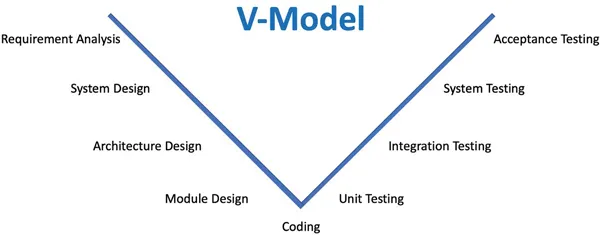
Software engineering proposed the V-Model (Figure 1.1) as an extension of the waterfall model. It is currently used by most industrial companies worldwide, not only in software engineering, but in any kind of engineering. It provides a graphical “picture” of a development life cycle of a system. The left side of the “V” shows the sequence of processes going from requirement analysis, to system design, architecture design, module design, and coding of the parts (i.e., manufacturing in the general case). The right side of the “V” shows integration of parts, through unit testing, integration testing, system testing, and finally acceptance testing (certification).
Figure 1.1 V-Model.
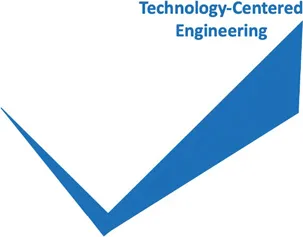
We observe that most difficulties encountered in the validation phase come from requirements that were not enough human-centered or organization-centered. In fact, we pay high price in the end on lack of sometime-small requirements flaws. We end up with a “V,” directed by technology-centered engineering (TCE), that looks like a check mark (Figure 1.2), that is, we spend extra amount of time and pay a lot of money to be ready before delivery (when it is not too late to still fix design flaws). Obviously, TCE is currently combined with human factors and ergonomics (HFE) considering that HFE is mobilized at the end of the V-Model for acceptance testing.
Figure 1.2 The V-Model when not enough attention is brought to human-centered requirements (the “qualitative thickness” of the line expresses the amount of effort and costs).
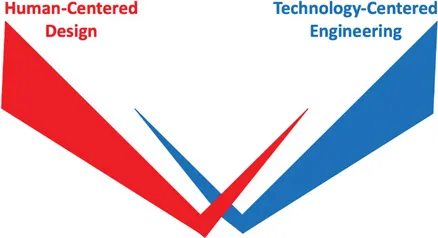
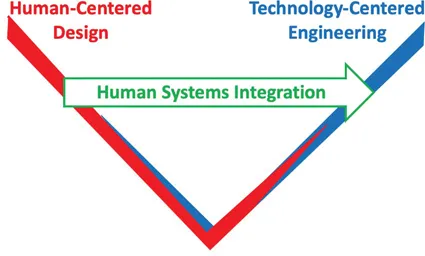
However, requirements need to be validated first against the higher-level requirements or user needs (i.e., defining human-centered requirements). This is when modeling and simulation (M&S) comes in, and an HCD contribution can be developed. As a matter of fact, HCD can be symbolically represented as an exact symmetric shape of TCE check-mark V-Model (Figure 1.3). Note that if HCD obviously includes HFE for the design parts, TCE also includes HFE for the testing parts.
Figure 1.3 Combining HCD and TCE.
We already claimed that combining HCD and TCE leads to Human–Systems Integration (HSI). In addition, the amount of effort required without HCD can be reduced carrying out HCD processes. Finally, the more we get experience carrying out HCD processes, the more the amount of effort required for TCE will decrease (Figure 1.4).
Figure 1.4 Combining HCD and TCE to develop HSI.
We will describe later in the book how HFE testing procedures and criteria should be adapted by considering tangibility metrics.
Impact of virtual HCD on the life cycle of a system
It is important at this point to explain what we mean by HCD, and more precisely VHCD. I already provided a description of HCD (Boy, 2013a), which includes six components: cognitive engineering, complexity analysis, M&S, advanced interaction media, organization design and management, and life-critical systems. M&S enables building virtual prototypes that are key HCD digital resources based on artificial intelligence (AI), human–computer interaction, and data science. It is now possible to immerse, very early in the design process, potential users, human operators, and simply people in the loop with simulated systems prefiguring targeted systems to be developed.
We will take NASA’s life cycle phase model (Table 1.1) to illustrate what M&S, and therefore VHCD, can provide to improve the life cycle of a system. This model is obviously specific to space systems, but it can be applied analogously to life cycle development of other complex systems. We are using it to better understand some useful concepts such as design flexibility, resource commitments, and system knowledge evolutions with respect to life cycle phases.
Phase B, Preliminary Design and Technology Completion
Mockups, study results, specifications, interfaces, prototypes
Phase C, Final Design and Fabrication
Detailed designs, fabrication, software development
Phase D, System Assembly, Integration and Test, Launch
Operation-ready system with related enabling products
Phases E and F
Operations and sustainment, closeout
Considering a TCE approach, we want to know what “it” will look like. We can show pieces going together and develop an architecture. However, if there is a change, what could we do; we have no design flexibility and usually a limited amount of funding.
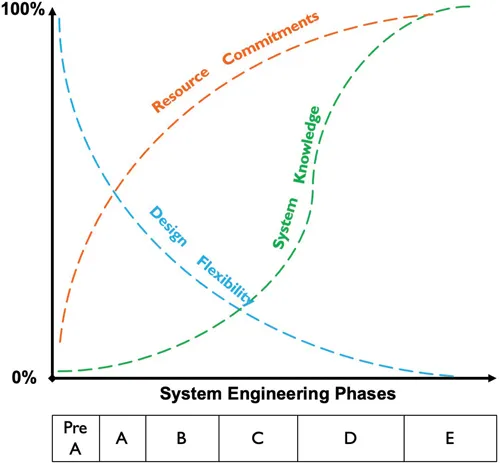
Figure 1.51 shows how design flexibility decreases rapidly during the first phases to end up being close to zero during the last phases. In the same way, resource commitments increase rapidly during the first phases to end up on a saturation during the last phases (i.e., we will not have enough resources and money to finish the project correctly, except if we add more resources that were not anticipated in the initial budget – 0% resource commitments mean that we still have 100% of the budget, and 100% means that all the potential is consumed).
Figure 1.5 Design flexibility, resource commitments, and system knowledge evolutions (Conroy, 2016) with respect to life cycle phases (e.g., NASA’s phases) using conventional TCE.
Interestingly, system knowledge (i.e., what we know about the system under development and its potential usages) slowly increases in the beginning and grows faster toward the end of the development life cycle. In other words, we need to wait almost until the end of the development life cycle to know the system and its usages well.
Now, if we take an HCD approach supported by M&S, and more specifically HITLS, we could end up having a big change on these evolutions (Figure 1.6). Assuming that we know system’s purpose, when people ask, “What will the system look like and how it could be used?”, we could show them a simulation and even get them involved into the simulation. Most interesting is that system knowledge is increasing much faster in the beginning because M&S enables to observe various kinds of activity as well as emerging behaviors and properties. In addition, M&S helps the design team in finding out alternative design solutions; we keep design flexibility for a longer time during the design life cycle of the project. Resource commitments start to grow slower with M&S support, and we have more time to make “final” design decisions. At this point, resource commitments are higher in the beginning due...
Table of contents
Cover
Half Title
Title Page
Copyright Page
Table of Contents
Preface
Author
Chapter 0 Introduction
Chapter 1 Human-centered design of industrial complex systems
Chapter 2 Tangibility problems and potential solutions
Chapter 3 Technology, organizations, and people
Chapter 4 Formalizing Human–Systems Integration
Chapter 5 From rigid automation to flexible autonomy
Chapter 6 Orchestrating Human–Systems Integration
Chapter 7 Design for flexibility in an increasingly complex world
Chapter 8 Activity, creativity, storytelling, and tangibility: The right mix
Chapter 9 Evaluation processes and metrics
Conclusion
References
Index
Trusted by 375,005 students
Access to over 1.5 million titles for a fair monthly price.
Study more efficiently using our study tools.
Frequently asked questions
Yes, you can cancel anytime from the Subscription tab in your account settings on the Perlego website. Your subscription will stay active until the end of your current billing period. Learn how to cancel your subscription
No, books cannot be downloaded as external files, such as PDFs, for use outside of Perlego. However, you can download books within the Perlego app for offline reading on mobile or tablet. Learn how to download books offline
Perlego offers two plans: Essential and Complete
Essential is ideal for learners and professionals who enjoy exploring a wide range of subjects. Access the Essential Library with 800,000+ trusted titles and best-sellers across business, personal growth, and the humanities. Includes unlimited reading time and Standard Read Aloud voice.
Complete: Perfect for advanced learners and researchers needing full, unrestricted access. Unlock 1.5M+ books across hundreds of subjects, including academic and specialized titles. The Complete Plan also includes advanced features like Premium Read Aloud and Research Assistant.
Both plans are available with monthly, semester, or annual billing cycles.
We are an online textbook subscription service, where you can get access to an entire online library for less than the price of a single book per month. With over 1.5 million books across 990+ topics, we’ve got you covered! Learn about our mission
Look out for the read-aloud symbol on your next book to see if you can listen to it. The read-aloud tool reads text aloud for you, highlighting the text as it is being read. You can pause it, speed it up and slow it down. Learn more about Read Aloud
Yes! You can use the Perlego app on both iOS and Android devices to read anytime, anywhere — even offline. Perfect for commutes or when you’re on the go. Please note we cannot support devices running on iOS 13 and Android 7 or earlier. Learn more about using the app
Yes, you can access Human–Systems Integration by Guy André Boy in PDF and/or ePUB format, as well as other popular books in Computer Science & Human-Computer Interaction. We have over 1.5 million books available in our catalogue for you to explore.