eBook - ePub
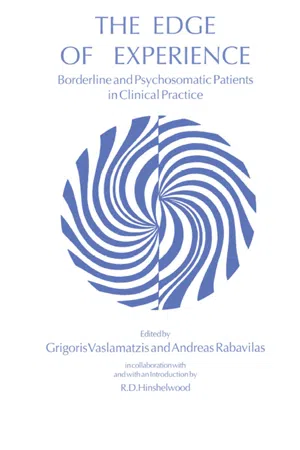
The Edge of Experience
Borderline and Psychosomatic Patients in Clinical Practice
- 120 pages
- English
- ePUB (mobile friendly)
- Available on iOS & Android
eBook - ePub
The Edge of Experience
Borderline and Psychosomatic Patients in Clinical Practice
About this book
This book deals with problems related to the analysis and treatment of borderline and psychosomatic patients. It demonstrates how psychoanalytic practice has had to accomodate the range of "borderline syndromes" and produce new models of theory and treatment.
Information
CHAPTER ONE
Psychoanalytic treatment with psychosomatic patients
The question of the psyche–soma is one that has been raised throughout the history of Western thought. Reflecting on thought processes has been one of the fundamental philosophical issues, from Plato to Descartes and on to Heidegger—thought processes that proceed from the body and end with the death of the body.
Various philosophical and theological theories all tend to circumvent the idea that thought is mortal and dependent on the body, assuming instead immortality of the soul, the soul being the centre from which thought is supposed to spring and which is irreducible to the vicissitudes of the body. In this chapter, I offer some semantic considerations and call to mind that, in Ancient Greece, “soma”—the body—did not take on the current meaning of “living organism” until after the fifth century B.C. and Hippocrates. Before the Corpus Hippocraticum became known, the term “soma” referred to the inanimate body, the corpse. Similarly, “psyche” originally meant “breath”, and by extension the breath of life and, subsequently, the soul. It is interesting to note that these etymological shifts took place at the time when Hippocrates established medicine as a scientific discipline based on the clinic and on semiology.
Depending on whether the two terms—psyche and soma—are joined or separate, different explanatory systems of man and the world, of life and death, are construed. In a strictly Freudian view, thinking began with the sight of a dead body, a body that was both loved and hated and therefore aroused the double wish: “May he disappear—I want to keep him as he is.” This first conflict and its traces convey a part of immortality to thought by giving rise to speculation—which endures longer than the life of a generation—about life and death.
The question of psyche-soma is not a psychoanalytic one: psychoanalysis treats the question and brings a unique and original answer to it. Indeed, in displacing the psyche-soma dualism onto the dualism of the drives, psychoanalysis originates thought processes in this initial conflict. The very definition of drive—psychic treatment of a sexual somatic excitation—confirms, in both drives theories, the psychophysical parallelism that Freud had underscored already in 1891.
The human being is “psychosomatic”, and if a thought is also an “act of the flesh”, as Tertullianus wrote in the third century A.D., pain and pleasure are also psychic acts. The Freudian description of hallucinatory wish-fulfilment as an expectation and as a distance necessary to the birth of desire testifies to this. Freud does not deal with the field that is today commonly called the psychosomatic clinic—that is, the psychosomatic approach to patients with somatic disorders—but he has laid the bases for it.
In Beyond the Pleasure Principle (1920g), in which he introduces the second drive dualism and thus the second topography, Freud distinguishes “pure” traumatisms from those that include organic lesions, and he then notes how the existence of a circumscribed lesion seems to protect the subject against the breaking out of a traumatic neurosis. He also considers the drastic effect of a painful somatic illness on the distribution and modalities of the libido.
The violence of mechanical trauma frees a quantum of excitation that is all the more disorganizing because the subject has not been prepared by anxiety. On the other hand, the occurrence of a physical lesion may bind excess excitation, because it calls for a “narcissistic over-investment of the affected organ”. Freud further notes that the pathognomonic mental symptoms of melancholy or of chronic senile dementia may disappear temporarily in the course of an intercurrent organic illness.
These few concepts from Freud laid, I think, the groundwork for our own psychosomatic approach.
From its beginnings, the history of psychoanalysis itself has made it obsolete to retain a restrictive meaning of the two terms of psyche and soma. Passages from mind to biological body are not what distinguishes the psychic from the somatic. However, by opposing sexual drives to instincts of self-preservation—and, later on, erotic libido to the death instinct—both dualisms put conflictual investments of the two kinds of drives into dialectical contradiction.
The Paris Psychosomatic School: a logical consequence of psychoanalysis
While Hippocratic medicine has laid the foundations for a psychosomatic approach—that is, for an understanding of health in terms of a somato-psychic equilibrium—the movement embodied in the Paris Psychosomatic School could only have sprung from the discovery of the psychoanalytic method. I shall not go into the history of the various successive psychosomatic theories, but I would like to emphasize that our psychosomatic practice is fundamentally part of, and results from, psychoanalysis—in fact, in certain ways, it is its acme, its necessary completion.
Freud’s remarkable answer to the enigma of the psychesoma is that there are not a body and its desires on one side confronting the psyche and its reasons on the other, but contradictory forces opposing each other in the same somatic field. In “The Psycho-Analytic View of Psychogenic Disturbance of Vision” (1910i), he describes an organ forced to serve two masters at the same time, and he thus gives meaning to the organic symptom. It is interesting to note that, the research model of the time being that of neurosis, and Freud having written very little in terms of psychogenesis, this text has a particular status. In hysterical conversion, the body becomes a language, the symptoms tell an unconscious story, and all mental activity takes its source in the erotic libido. The question of psychogenesis versus organogenesis does, therefore, not seem to be a truly psychoanalytic question. Moreover, to my mind, a strictly aetiological point of view is always reductive. When Freud was confronted with the clinical picture of hysteria, and disregarded the taboo that prevented consideration of the psychic component of certain disorders, he did it in such a way as to illustrate essentially the importance of the sexual in the constitution of the psyche—that is, the body.
Dreams, the via regia of the psychoanalytic science, are conceivable only in terms of the clinical aspects of sleep concerning a sleeping subject. Indeed, dreams integrate endogenous and exogenous somatic excitations in an elaborative psychic effort whose first aim is the success of a physiological function: the preservation of sleep. Psychoanalysis is particularly interested in dreams, thus indicating that it takes account of the constant presence of the physical dimension in psychic work. The psychoanalytic treatment of patients suffering from psychosomatic illness constitutes, therefore, a return to the very sources of psychoanalytic thought.
Technical implications of the theoretical model
I shall only briefly mention the theoretical model developed by the Paris Psychosomatic School since 1950. Issues 3 and 4 in 1991 of the Revue française de psychanalyse and Pierre Marty’s (1980) work serve as reference in the matter. The basic assumption of the human somato-psychic unity allows us to understand psychic as well as physical phenomena as the sum of dynamic interactions that depend on processes of organization and disorganization. Unless they have a symbolic meaning, somatic disorders are part of a general economy of which the psyche bears witness and which it coordinates.
The great complexity of the psychosomatic clinic is due to the difficulties in assessing, on the basis of psychoanalytic theory, disorders that, as it were, do not correspond to a strictly mental semiology. However, the absence of such disorders is precisely a function of psychic activity. The psychoanalyst–psychosomatician is often confronted with deficient mental organizations, either because this is part of the subject’s history or because mental functions are momentarily inhibited as a result of the illness itself and he or she is forced, therefore, to resort to a semiology of absence. In doing so, he or she tries to distinguish the habitual factors from the current ones and, for example, to differentiate between absence of conflict linked to deficiencies of the preconscious on the one hand, and a traumatic state, or the use of denial, on the other. Paradoxically, theoretical research cannot in any way adapt to the deficiencies uncovered by clinical investigation, and metapsychological formulations are called for all the more.
This heuristic aspect of the psychosomatic clinic appears to strengthen the interactive links between the theoretical model and practice. We perceive things as a result of our thinkings, yet it is the clinic that inflects our theories and enriches them. A theoretical framework should not be a grid, but a guideline to support elaboration. This point seems fundamental to me in rethinking a strictly psychoanalytic technique. Precisely in order for it to remain that, it requires particular adjustments and parameters, which I have called here the technical implications of theory.
Clinical–theoretical parameters in the treatment of somatic patients
The currently practised extension of psychoanalytic treatments to patients generally thought of as “difficult cases” allows us all, whether we are psychosomaticians or not, to assert today that we have become familiar with psychic organizations where the original psychoanalytic treatment model proves to be inapplicable as such. Modifying the analytical setting and technique of interpretation to suit the specificity of certain cases does not mean forgoing the rigour of the frame nor the psychoanalytic goal, which is the emergence of transference.
The question is one of choice of method: psychoanalysis, psychoanalytic psychotherapy, psychoanalytic psychodrama, or even psychoanalytic relaxation conducted by a psychoanalyst also trained in relaxation techniques. I shall not expand upon the idea that one needs to be very much a psychoanalyst in order to know when it is necessary to refrain from being one. The practice of psychotherapy requires an extended experience of the practice of classical psychoanalysis. Taking technical liberties implies rigorous reference to the well-internalized model. The wealth of existing literature about this subject speaks to its importance.
However, there are specific problems that one encounters in the psychoanalytic clinic with somatic patients and which I should like to underscore. These are not general factors. Somatic disorders may occur in any given individual, including in persons with highly mentalized neuroses. The psychosomatician is frequently confronted with physical suffering that is neither denied nor particularly invested and may go hand in hand with what seems to be a passive, aconflictual acceptance of treatment. To my mind, these cases are among the most disturbing, and they show the limits of the field of application of psycho-analysis.
I shall come back to the technical implications of the psycho-therapeutic treatment of these cases. My first question is: what therapeutic ideal would induce us to propose psychoanalysis to these patients? I do not think that this is a purely ethical question. Symptomatic improvement is a first requirement in psychosomatics, but it cannot be the only goal of our endeavour. It has to be part of a theoretical body based on the founding conviction of man’s psyche-soma unity. Our most pragmatic therapeutic choices are based on the assumption of psyche–soma monism and drive dualism, the latter being the source of the essentially conflictual nature of the living—that is, organic—psyche.
Setting up psychotherapeutic treatment presupposes that we adhere to a theory according to which illness and pain are an integral part of a person’s mental organization. We propose a course of therapy on the basis of this theoretical conviction, and this implies that we exclude any behaviour that would suggest that the psyche is not a matter of course—that is, that there could be human functions from which the psyche could be absent. Thus, the therapeutic ideal becomes something that one could call a “metapsychological passion”, and its very name indicates the psychoanalyst’s goal: to awaken a patient’s interest in his or her own psychic functioning.
This being said and in order to meet the patient on his or her own grounds—that is, “where he is” at a given moment—a few parameters become necessary that seem to differ from classical psychoanalytic technique. “What cannot be reached flying, must be reached limping”, as Freud notes on the last page of Beyond the Pleasure Principle, quoting the poet Friedrich Rückert.
In our context, “limping” might be taken as a metaphor meaning the acceptance of a certain adaptive flexibility regarding the patient’s affective processes. We must accompany the patient while remaining attentive at all times to the qualitative variations of his or her functioning. This enables us to adjust our attitude. In these cases of extreme narcissistic fragility and frequent lack of interest in the treatment—which is felt to be “endured” passively—interpretations are difficult. Reiterated invitations to associate, however, may foster the emergence of a variety of themes, allowing for the establishment of conversation. I am using this word purposely, because I think that in every psychoanalytic psychotherapy there is this kind of approach, which one might call “an art of conversation”. In order to get the patient interested in thought processes, one must think out loud and solicit him or her. I would not hesitate to speak of a certain kind of seduction that aims at making the patient conscious of the fact that there isn’t anybody in the world who has nothing to say, that there is no life without a history, richness, and sufferings, and that there are no stories without words. Apparently aconflictual themes—literature, films, news, and so on—remain intermediaries at first, but they allow us to detect regressive processes and to assess tolerance of excitation and disorganizing effects. Interpretations that I have elsewhere called psychodramatic (Aisenstein, 1991) may sometimes introduce opportunities for identification, while protecting the patients’ narcissism. Everything is mobilized to reanimate and sustain preconscious work and to induce the patient to discover and share pleasure in psychic functioning.
I shall quote two brief cases as examples of this long itinerary, including a fragment of a session which has raised questions about the role of interpretation in psychotherapies with somatic patients.
Claire
“Claire”, a 32-year-old a chemist, works as a civil servant doing high-level research. Slim and graceful, with regular features and fair hair, she could be attractive but appears somewhat insipid. She dresses plainly; although not really drab, she is, one might say, without radiance. Her muddy, hazy image made me think of an early Odilon Redon painting. She was referred to me by her current cardiologist, who, like his numerous predecessors, was discouraged by the ineffectiveness of the treatment of her apparently uncontrollable, labile arterial hypertension. When she presented herself to me, composed and discreet, I imagined her capable of behaving in a less attractive way, arousing character outbursts in her doctors that the mere unsuccessfulness of the treatment would not explain. There is, indeed, not a hint of querulousness in her discourse. Claire tells her story without sorrow and without humour. She seems not to understand why I should think that she is hurting. She accepts without conviction the proposal of psychotherapy, because although she would like to have a third child, for medical reasons her doctors advise against another pregnancy. Life seems “empty” to her; she masters her profession but is not proud of her career. Her parents had suggested to her what she should study; she obtained a degree in pharmacy and, later, the agrégation in chemistry, without difficulty but also without passion.
Claire tells me the story of an exemplary existence. She was an only and much-wanted child of an important, well-known couple and went to a private confessional school. Her father was a professor of German studies; her mother had devoted herself to the upbringing of her daughter. Claire’s childhood had been a provincial one, with no friends, no going out; her parents had her read, play the piano, go to museums. Spare time and vacations were spent with intensive cultural activities of which Claire seems to have retained nothing, since she is not interested in books or in the arts. Her husband too is a scientist, with a degree from the École Polytechnique. They married young, and two sons were born early on. The boys have developed well. Her parents died five and seven years ago, respectively.
Her hypertension was detected by a school physician when she was 13 years old. Claire has few memories of that morose time, but she recalls having been worried because of pains and tumefactions in her breast. Her mother took her to the family physician, a retired colonel, who seemed most astonished about having to explain to mother and daughter that the latter was beginning her puberty. Claire recounted this episode without amusement and without any criticism of her mother, but she remarked on the disconcerted expression of the doctor. I have often noted her astonishment about people’s facial expressions in reaction to her: she is aware of them and worries, but she does not decode them. In my opinion, this indicates an alarming inability to identify with others, and it helps us better to understand Claire’s relational difficulties and setbacks. Indeed, her professional/social level and the quality of her vocabulary form a contrast with the preconscious deficiencies that make her prone to projection. To quote an example: at a dinner party, while the discussion was going on about political news, one of her colleagues asked her where she lived; Claire calmly gave her address, and she was believed to be making fun of the person.
This “alexithymia” of self and others, according to the description by Sifneos (1974), is accompanied by a constant waryness and hurt that s...
Table of contents
- Cover
- Half Title
- Title Page
- Copyright Page
- Table of Contents
- EDITORS AND CONTRIBUTORS
- PREFACE
- INTRODUCTION
- CHAPTER ONE Psychoanalytic treatment with psychosomatic patients
- CHAPTER TWO Sounds of the soma
- CHAPTER THREE Day hospital treatment of borderline personality disorder and the containment of enactment
- CHAPTER FOUR On the therapist’s reverie and containing function
- CHAPTER FIVE Psychodynamic therapy of severe personality disorders
- CHAPTER SIX Self-envy and intrapsychic interpretation in borderline states
- CHAPTER SEVEN Lust for love
- REFERENCES
- INDEX
Trusted by 375,005 students
Access to over 1.5 million titles for a fair monthly price.
Study more efficiently using our study tools.
Frequently asked questions
Yes, you can cancel anytime from the Subscription tab in your account settings on the Perlego website. Your subscription will stay active until the end of your current billing period. Learn how to cancel your subscription
No, books cannot be downloaded as external files, such as PDFs, for use outside of Perlego. However, you can download books within the Perlego app for offline reading on mobile or tablet. Learn how to download books offline
Perlego offers two plans: Essential and Complete
- Essential is ideal for learners and professionals who enjoy exploring a wide range of subjects. Access the Essential Library with 800,000+ trusted titles and best-sellers across business, personal growth, and the humanities. Includes unlimited reading time and Standard Read Aloud voice.
- Complete: Perfect for advanced learners and researchers needing full, unrestricted access. Unlock 1.5M+ books across hundreds of subjects, including academic and specialized titles. The Complete Plan also includes advanced features like Premium Read Aloud and Research Assistant.
We are an online textbook subscription service, where you can get access to an entire online library for less than the price of a single book per month. With over 1.5 million books across 990+ topics, we’ve got you covered! Learn about our mission
Look out for the read-aloud symbol on your next book to see if you can listen to it. The read-aloud tool reads text aloud for you, highlighting the text as it is being read. You can pause it, speed it up and slow it down. Learn more about Read Aloud
Yes! You can use the Perlego app on both iOS and Android devices to read anytime, anywhere — even offline. Perfect for commutes or when you’re on the go.
Please note we cannot support devices running on iOS 13 and Android 7 or earlier. Learn more about using the app
Please note we cannot support devices running on iOS 13 and Android 7 or earlier. Learn more about using the app
Yes, you can access The Edge of Experience by Andreas Rabavilas, Grigoris Vaslamatzis, Andreas Rabavilas,Grigoris Vaslamatzis in PDF and/or ePUB format, as well as other popular books in Psychology & Abnormal Psychology. We have over 1.5 million books available in our catalogue for you to explore.