This book is a psychoanalytic discussion of the effects of trauma and torture on children, with a specific focus on how professionals can use an approach focused on resiliency rather than vulnerability to help the child reach wellbeing.Aida Alayarian argues that in a world where the torture, maltreatment, and neglect of children shamefully persist, it is incumbent upon all of us to intervene appropriately to put a stop to it. Whether in conference rooms developing a more comprehensive policy to hold perpetrators accountable, or working in clinics where traumatised children and their families seek help, the question of how we act to improve the opportunity for recovery in children and young people subjected to such inhumane treatment should be our primary concern. Handbook of Working with Children, Trauma, and Resilience discusses this salient issue, drawing on psychoanalytic perspectives of the effects of trauma on children, and looking specifically at the case of refugee children and families. Understanding challenging behaviour in traumatised children and the effects of refugee experience on families can help all concerned to offer more appropriate and effective support.
eBook - ePub
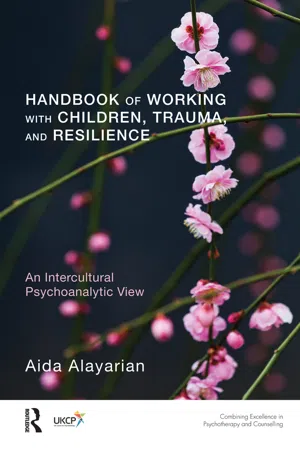
Handbook of Working with Children, Trauma, and Resilience
An Intercultural Psychoanalytic View
- 222 pages
- English
- ePUB (mobile friendly)
- Available on iOS & Android
eBook - ePub
Handbook of Working with Children, Trauma, and Resilience
An Intercultural Psychoanalytic View
About this book
Information
Chapter One
Overview
Examining theoretical approaches to working with children of refugees and unaccompanied minors, I will map several useful psychoanalytic concepts for working interculturally with children therapeutically. The discussion aims to present several key concepts that underpin the development of effective psychotherapeutic treatment: an understanding of the self and others in the context of mourning; prior experience and capacity of resilience, dissociation (healthy and unhealthy), and repression (Freud, 1915d); the concept of the True and the False Self (Winnicott, 1965a), dissociation, and the development of resilience (Alayarian, 2011).
In this chapter and throughout the book, clinical vignettes and case studies are presented and discussed. These invigorate and stir the diversity of the experiences of unaccompanied minors and children of refugees while also demonstrating the impact of appropriate therapeutic intervention. They further explore a resilience-focused approach to working with children of refugees or unaccompanied minors.
Torture and other adversities inflicted on children around the world are critical factors in the development of psychopathology. The aim of this book, therefore, is to specifically look at and seriously contemplate the torture of children, with specific focus on its psychological impact, but also looking at the legality of the situation and international conventions, and regulations for prevention and protection. The discussion around this socially and politically urgent situation will be through the lens of psychoanalysis with a view toward furthering human rights and will seek to develop a much-needed agenda for future lines of research to clarify the relationship between exposure to torture and human rights violations on children and young people, and the impact on development of psychopathology in future generations.
I use the word “torture” to refer to a severe form of ill-treatment of children. Torture in children is a worldwide problem, but there are as yet no official or reliable independent statistics for measuring the scale of the problem. The definition of torture in the Convention against Torture and Other Cruel, Inhuman or Degrading Treatment or Punishment of course applies also to children. But torture of children usually happens during political violence and military conflict. The high-risk children are frequently those impoverished children living in the street, children deprived of parental care, children in conflict with the law and in detention. During political aggression and war the high-risk children are the children detained during party-political violence, child soldiers, children internally displaced in refugee camps, and so on.
Torturing children, or adults, cannot be justified as a means to protect public safety or prevent emergencies. Neither can it be justified by orders from superior officers and public officials. The prohibition of torture applies to all territories under a party’s effective jurisdiction and protects all people under its effective control, regardless of citizenship or how that control is exercised. Since the convention’s entry came into force, this absolute prohibition has become accepted as a principle of customary international law.
Children of refugees and unaccompanied minors
There has been an increase in the number of people seeking asylum each year in the UK, of whom approximately a quarter are children. The stressors to which refugees are exposed are described in three stages: those experienced first while in their country of origin; second during their flight to safety; and third when having to settle in a new environment.
Prior to arrival in a country of resettlement, unaccompanied minors or children of refugees are exposed to a range of experiences that could be extremely traumatic, impacting not only on an individuals’ psychological health but their physical health as well. To illustrate and discuss the extreme level of violence and brutality experienced by such children, here, I will present the vignette of a young girl I shall call “Emely”.
Emely
Emely was referred for an assessment and possible therapy with a history indicating that she was only twelve years old when she was tortured by the authorities due to her parents’ involvement in a peaceful protest. In our first meeting she told me:
They came to our home and took me and my sister who was two years older than me. She was fourteen. They covered our heads and brought me to an interrogation room separate from my sister. This was the second time they had arrested my sister but was the first time for me—I was very scared. They beat me with a belt. It was painful and scary. I didn’t say a word. The angry policeman pulled out a gun and pressed it against my forehead and said: [If you don’t tell me who your parents meet and how they organise people for demonstration, I will kill you and your sister immediately]. I was really scared. I didn’t know what to do. I went silent. He shouted something. Some man brought my sister. I looked at her and she looked at me in silence for few seconds. He put his gun on my sister’s head and shot her and he sat in his chair […] I was screaming and I fainted […] I do not remember what happened next […].
The immediate reaction to the brutalities that Emely experienced at such a young age pained me as well as making me angry, but I was aware that I needed to focus on supporting her here and now. As a mother it pains me to think that children as young as twelve years old experience such violence and torment. Although I was very aware that Emely’s experience, tragically, was not unique. I am still devastated every time when I hear that these atrocities are inflicted on children. Working in the field that I have for three decades, I am aware that torture is an everyday reality in many countries around the world. It is used as a weapon against opposition by authorities to persecute and intimidate adults, young people and, indeed, children who are campaigning for human rights. We cannot continue to look at the tragedy of such abominable and atrocious treatment with mere sympathy and regret. It is vital that as local, national, and international communities we develop robust systems of accountability for those who perpetrate violence against children. Equally, we must advocate more appropriate, accessible intervention and rehabilitation services that can help the recovery process for those who have endured such extreme and traumatic abuse. As clinicians, we are faced with the need to understand and recognise the complexity of the individual situations of children subjected to unimaginable abuse while also refining our practice through recognising what effective and containing treatment can do and how it can be implemented.
Physical health of children of refugees
In my experience as a clinician and as a human rights campaigner, I have found evidence that the children of refugees are not only exposed to traumatic experiences but that their physical health is often also at risk. They suffer from overcrowded living situations, and are often subject to poor nutrition, poor hygiene, as well as a lack of access to clean water, immunisations, and other primary health care services. As a result of these factors, children of refugees under the age of five have an extraordinarily high mortality rate, especially in some developing countries.
During the settlement period in a new country, some children are under pressure as the main link between their parents and the new society. Due to substantial cultural differences for many refugees, including Turkish, Kurdish, some Middle-Eastern, African, and Asian ones, the process of settlement can be challenging. Adjusting to new environments can be difficult and people’s cultural differences may be very great and can therefore create resistance to Western culture. Therefore, the process of adaptation, integration, and acculturalisation can be lengthy and at times undesirable. Children of refugees from families that are unfamiliar with the West and do not speak English can consequently experience a role reversal, becoming in a sense parents for their parents, and can also find themselves juggling the demands of two very different cultures at home and in society. In the process, for that reason, they may become insecure about their identity and, in many cases, completely lose the experience of childhood.
Although there is a scarcity of research on the impact of multiple traumas on children of refugees, my clinical experience evidently implies that there are severe physical and psychological problems that require specialist therapeutic interventions.
There are many consequences of trauma for children, some with long-term pathogenic effects, while other consequences can be less severe due to provision of a reasonably caring and containing environment by carers or parents. Having said that, it is important to recognise that children are more vulnerable than adults, and their future relationships may be threatened if there is no appropriate intervention and treatment is made available to them in a timely manner. There can be many psychological scars, and below I will discuss some symptoms that my colleagues and I have identified in children who have been tortured or endured other forms of traumatic violations.
I intend to examine the emotional impact of the experiences that children of refugees and young people face as they flee from their home countries and settle in the UK. The following should be considered in identifying factors detrimental to the emotional well-being of children and in devising strategies for appropriate care provision and support:
- The experiences of children and young people
- The psychological impact of trauma and loss
- Risk and protective factors
- Problems children and young people may encounter in the host country
- The importance of appropriate support and access to education
- Cultural backgrounds, early development, and coping mechanisms.
Reaching to adult age and homelessness
For young refugees reaching the age of adulthood, usually eighteen, living independently brings many challenges. Amongst them is homelessness, which can affect anyone at any time, and young refugees are no exception. So the knowledge and confidence to help a young person feel empowered when handling difficult scenarios and cases of homelessness is important. This includes some understanding of:
- What is considered as homelessness?
- Eligibility criteria
- Who is in priority need?
- Intentionality and local connection for refugees
- Section 184 homeless decision letters and right to request a review of the §184 decision
- Homelessness flow chart and who provides housing
- Single non-priority and the private rented sector
- Non-priority cases
- Tenants’ rights and obligations.
Indeed, looking at the interface with the asylum and immigration system in relation to the protection of children of refugees, a range of issues affecting young refugees who are in need of protection should be continually addressed:
- The current UK legislation and court processes in child protection
- The roles of different agencies in the child protection system
- Identification and referral systems
- The impact of the asylum system on separated refugee children and their families.
It is important for clinicians to be aware of children and young people’s welfare entitlement, but the frequent changes to asylum and immigration legislation and other policies make this difficult. It is also challenging for other professionals involved to keep up to date, and to ensure that they are offering the most effective advice and practice. One of the main issues is that many families of migrants and people granted refugee status, humanitarian protection or discretionary leave are often not aware of their rights and entitlements and so may not get access to the support networks they need. Consequently, young people reaching the age of eighteen and over are more likely to end up homeless and without appropriate support, as they are not aware of the legislative framework and routes to access housing and other services available to those granted asylum (refugee status, humanitarian protection, and discretionary leave) and other migrants.
Chapter Two
Traumatic experiences of children of refugees
It is not uncommon for children of refugees to experience the violent death of one or both parents. Some witness the massacre or casualties of friends and close relatives and members in their communities. They go through the experience of forced separation and displacement. Some suffer extreme poverty, starvation, physical injuries, and disabilities, as well as sexual, physical, and emotional abuse. Often children are exposed to direct combat; they may be kidnapped, arrested, imprisoned, tortured, sexually abused or forced to participate in violent acts. Some children are born or conceived in prison as a result of their mothers’ involvement in opposition parties or human rights activities. In our clinical work we have the evidence from children’s narratives of young children being raped or massacred and of other children being made to witness these horrific events.
In some cases, specifically in African countries, children are forced to join the army and become child soldiers to participate actively in armed conflicts. They are often given extremely dangerous tasks, for instance: mine detection, spying, messengering, or taking valuables from corpses in conflicted and military areas.
The therapeutic and legal framework for children in host countries requires attention. In the health and social care intervention of caring for, and protecting the child, there often exists a lack of understanding between professionals involved and care and protection can therefore be challenging. There is a need to gain insight into the issues affecting child soldiers, and indeed, need to value specialist therapeutic interventions and use of experts to better understand the difficulties that such children face. It helps both the children and professionals involved to facilitate constructive professional links between these often disparate perspectives of the legal and therapeutic worlds.
War experiences and post-war environments are associated with psychological difficulties that can lead to poor mental health. The child soldiers are commonly subjected to some unimaginable traumas which are due to the contexts of what is going on in their community (i.e., it being a post-war environment or one which allows child soldiers in the first place). Although there are some studies linked to depression, anxiety, and post-traumatic stress (PTS), the long-term effects on psychological health within the psychosocial trajectory that influence children’s mental health and the precise causes of stressors are not yet researched appropriately. The relationship between the war experiences of children who endure trauma with depression, anxiety, and PTS has been documented, but the data available is as yet insufficient to fully establish a direct causal link. Interventions to reduce long-term problems should therefore address both stressors in the short term, by psychosocial intervention, and in the long term, by specialised therapeutic intervention, and should also consider both models of intervention as complementary to each other.
Many males in the family are imprisoned or forced to participate in combat in which they may die. Consequently, many refugee families lose the male head of their family. This results in children of refugees, particularly boys, losing their childhood prematurely as they have to take up the responsibilities of their fathers. They become the breadwinners, protectors of their younger siblings and are actively involved in finding food or shelter for their remaining family.
Regression can be exhibited by the loss of previous skills, pathological dependency towards parents and siblings, clinging behaviour, thumb sucking, baby talking, temper tantrums, bed wetting, and separation anxiety (often seen in school-going children), amongst others.
Depressive syndrome presentations can take the form of loss of appetite, lack of energy, severe apathy, feeling sad all the time, loss of interest, an increased either passive or aggressive behaviour, social withdrawal, lack of confidence, survivor guilt (especially amongst older children), suicidal ideation or attempt, refusal to attend school or declining school performances or a change in attitude toward school. Psychosomatic problems such as stomach-aches, headaches, and constipation are also reported in the literature from several cases (e.g., Cunningham, 1991; Richman 1993; Pynoos et al., 1996). It is also suggested that children have sometimes been found to express their traumatic experiences by mimicking the symptoms of their parents (Raphael, 1986).
As the primary focus of this book, I will explore the traumatic experiences of children and the psychological effects common to these experiences. Within this context, I will discuss the role of parents, professionals, and particularly clinicians who intervene to support the lives of young adult refugees and children. Drawing on more than thirty years’ experi...
Table of contents
- Cover
- Half Title
- Title
- Copyright
- Contents
- ACKNOWLEDGEMENTS
- ABOUT THE AUTHOR
- UKCP SERIES PREFACE
- INTRODUCTION
- CHAPTER ONE Overview
- CHAPTER TWO Traumatic experiences of children of refugees
- CHAPTER THREE Anxiety, depression, post-traumatic stress, and dissociation
- CHAPTER FOUR Rationale for development of new measures
- CHAPTER FIVE Assessment
- CHAPTER SIX Resilience
- CHAPTER SEVEN Working with unaccompanied minors, trafficked children, and child soldiers
- CHAPTER EIGHT Working with family
- REFERENCES
- INDEX
Trusted by 375,005 students
Access to over 1.5 million titles for a fair monthly price.
Study more efficiently using our study tools.
Frequently asked questions
Yes, you can cancel anytime from the Subscription tab in your account settings on the Perlego website. Your subscription will stay active until the end of your current billing period. Learn how to cancel your subscription
No, books cannot be downloaded as external files, such as PDFs, for use outside of Perlego. However, you can download books within the Perlego app for offline reading on mobile or tablet. Learn how to download books offline
We are an online textbook subscription service, where you can get access to an entire online library for less than the price of a single book per month. With over 1.5 million books across 990+ topics, we’ve got you covered! Learn about our mission
Look out for the read-aloud symbol on your next book to see if you can listen to it. The read-aloud tool reads text aloud for you, highlighting the text as it is being read. You can pause it, speed it up and slow it down. Learn more about Read Aloud
Yes! You can use the Perlego app on both iOS and Android devices to read anytime, anywhere — even offline. Perfect for commutes or when you’re on the go.
Please note we cannot support devices running on iOS 13 and Android 7 or earlier. Learn more about using the app
Please note we cannot support devices running on iOS 13 and Android 7 or earlier. Learn more about using the app
Yes, you can access Handbook of Working with Children, Trauma, and Resilience by Aida Alayarian in PDF and/or ePUB format, as well as other popular books in Psychology & History & Theory in Psychology. We have over 1.5 million books available in our catalogue for you to explore.