The past decade has seen more and more clinicians involved in the assessment and treatment of abused and traumatized children. They have contributed to an impressively large body of literature on the impact of abuse and trauma at all ages, the focus of which has been the short and long-term sequelae apparent in the child's behavior, emotional experience, and social interaction. But there have been few efforts to investigate the ways in which abuse and trauma damage the intrapsychic systems and structures that often guide, direct, and inform the child's manifest adjustment and functioning. The need to redress the balance was the major impetus for this book.
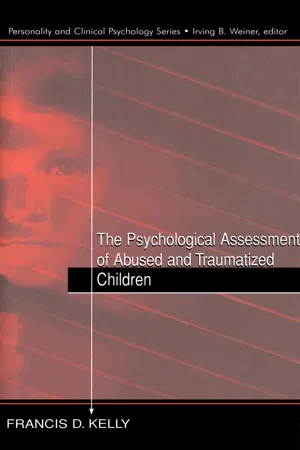
Kelly offers a clinical paradigm for the personality assessment of abused or traumatized children via projective instruments--the TAT and Rorschach--and shows how various projective measures and indices can be utilized as sensitive barometers of changes in self, object, and ego functioning following therapeutic interventions and other corrective experiences. But further, integrating the tenets of trauma theory and those of psychoanalytic theory, he sets this clinical paradigm in a meaningful theoretical context, and draws on both theory and clinical experience to develop a comprehensive psychological composite of the child who has been maltreated.
Part I provides an overview of theoretical models relevant to the assessment and diagnosis of the maltreated child. Contemporary psychoanalytic theory serves as one frame and is discussed first, with particular emphasis on object relations and ego functions. Equal attention is devoted to developmental psychology as another frame.
Part II reviews relevant research. The Mutality of Autonomy Scale (MOA) and the Social Cognition and Object Relations Scale (SCORS) are introduced as examples of reliable and valid instruments readily employed to assess the impact of abuse or trauma on a child's object relations functioning. Additional Rorschach indices--boundary disturbance measures, thought disorder indices, trauma markers, and defensive functions measures--are discussed as measures of the impact on different facets of ego functioning. These various projective measures can be utilized as sensitive barometers of changes in self, object, and ego functioning following therapeutic interventions and other corrective experiences.
Part III includes a variety of extended clinical illustrations.
Seven cases of boys and girls subjected to varying degrees of abuse and trauma are presented to demonstrate the clinical utility of projective material for assessment, diagnosis, and treatment planning. For the clinician who takes the idiographical-phenomenological approach, appropriate given the uniqueness of each situation of abuse or trauma and the frequent brevity and barrenness of the protocol, such material can open a window onto a rich vista of the child's psychological terrain. The resulting map can point the way to wise decisions about type, timing, and level of therapeutic intervention, the resolution of such process issues as transference and countertransference, plus additional questions.
Two cases of adult women who were abused as children and find themselves continuing to struggle with enduring unresolved issues vis a vis their own children are also presented. These cases underscore the value of TAT and Rorschach material, and object relations measures, in assessing and understanding the abusive and potentially abusive parent.
- English
- ePUB (mobile friendly)
- Available on iOS & Android
eBook - ePub
The Psychological Assessment of Abused and Traumatized Children
About this book
Information
II
THE PSYCHOLOGICAL REPRESENTATION OF ABUSE AND TRAUMA
3
Object Representation Assessment of Children: TAT and Rorschach Research in Relation to the Abused and Traumatized Child
Object relations theory concerns itself with articulating how the interpersonal interactions with others are processed, internalized, and ascribed personal meaning, gradually evolving in an ontological, dialectical manner and constantly being transformed into complex cognitive schemata providing definition for the self and for others. This process continues and reveals, in the normal course of events, increasingly differentiated and modified representations of self and others, proceeding from birth onward and continuing well into adulthood (Westen, 1991b).
Greenberg and Mitchell’s (1983), widely accepted definition of object relations functioning postulates internal as well as external transactions with self and others, “the term refers to individual’s interactions with external and internal (real and imagined) other people and to the relationship between their internal and external object worlds” (pp. 13–14). Another term that is sometimes synonymously used to define the domain of an individual’s real or imagined definition to self and others involves the concept of object representation. Although the term object representation is sometimes used interchangeably with object relations, its more useful and appropriate place belongs to the inner domain because this is a psychological construct referring to a complex multidimensional inner mental map, schemata or template that provides graphic psychological definitions of self and others.
SELF-REPRESENTATION
Blatt (1974), expanding on earlier writings (Beres & Joseph, 1970; Sandler & Rosenblatt, 1962), offered a succinct definition of how self-representations develop and evolve: “There is a constant and reciprocal interaction between past and present interpersonal relationships and the development of object representations, and these developing representations, in turn, provide a revised organization for experiencing new, more complex facets of interpersonal relationships” (p. 123). These mental schemata are first transmitted to the child within the context of a dyadic interpersonal relationship involving the child and the person or persons primarily entrusted with care of the child. Thus, object representations are mental constructs or models that develop first from the initial relationship via the process of internalization (Schafer, 1968). They subsequently serve to organize and integrate perceptions and experiences of self systems as well as the complex matrix of information involving significant others. This eventually insures that the individual, at any given point in time, has at his or her disposal an array of ideas and feelings about self and others that subsequently inform, direct, and guide real or imagined interactions and relatedness—providing some sense of clarity, consistency, and organization in this arena of personality functioning.
In considering the constructs of self and object representations, it is helpful to consider additional definitions that provide a relevant theoretical and clinical perspective. Regarding self-representations, Schafer’s (1968) writings provide a comprehensive and useful definition:
As used here, self representation refers to certain contents of subjective experience. It may be defined as an idea that the subject has about his own person. Terming it as an idea is not meant to discount the primarily somatic, affective, and diffuse experiential origins and referents of many self representations. (p. 25)
Similarly, Kissen (1986) drawing on earlier work (Horner, 1979; Jacobson, 1964; Mayman, 1976), provided a succinct definition, observing that self-representations refer to:
The various physiognomic modes by which the individual symbolizes an experiential image of the self and it’s associated affects. The individual may utilize verbal or non-verbal means for expressing these internalized units of self-perception. Although these self-perceptions may be experienced at relatively conscious, pre-conscious, or even unconscious levels, they are most likely to be consciously available (p. 11).
OBJECT REPRESENTATIONS
Just as the child gradually develops and builds up a cognitive-affective schemata, defining aspects and dimensions of the self-representative system, he or she is also developing an equally important, parallel, intrapsychic model that involves the conceptualization and articulation of others. Object representations refer to mental structures involving memories, perceptions, feelings and ideas about others—those in the present, those from the past, those loved, and those loathed. The vast array of conscious, unconscious, and preconscious information is organized into schemata that serve to guide and inform the direction of current and future transactions and relatedness. More precisely, as Schafer (1968) observed, “The so-called object is an aggregate of more or less organized representations of another person (or things or creatures) and its details and degree of organization vary over time and between levels within one subject; they also vary at any one time from one subject to the next” (p. 29).
The relation between the development of self and object representations involves a complex, reciprocal, oscillating, and ongoing process that sees continued mutual interaction in the course of development, whether this involves the infant, an adolescent, or the adult. Sandler (1992) provided a very comprehensive account of how self and object systems interface, coexist, and continuously influence one another:
From the concept of self representation…it is not a difficult step to make the further extension to representations which correspond to all the non-self components of the child’s world. As the child gradually creates a self representation, so he builds up representations of others, in particular, of his important love and hate objects. In the beginning, the representations which he constructs are those linked to need satisfaction, but he gradually creates schema of many other things, activities and relationships. He does all of this as a consequence of the successive experiences of his own internal needs and their interaction with his external environment. He gradually learns to distinguish between “inner” and “outer,” a distinction which he cannot make in the earliest weeks and months of life, where the main differentiation between experiences must be based on whether they provide pleasure or pain. (p. 397)
Thus, it is certainly possible to see that contemporary psychoanalytic theory and research have, in large part, moved to a higher level of conceptualization, one that attempts to arrive at a better understanding of how and why an individual interacts in a certain manner with his or her object world and environment. The newest psychoanalytic lens may or may not incorporate more traditional theoretical models emphasizing drive theory and ego psychology, but the resultant paradigms largely reveal a perspective in which the focus involves the investigation of various levels of cognitive-affective structures that define and organize an individual’s object representations and relatedness. It is equally possible to observe that over the course of the past 10 years, parallel developments in psychological test theory have also emphasized an increasing focus and concern with the systematic assessment of self- and object representations embodied in projective test material.
The impetus for the pioneering and ensuing major developments in the psychological assessment of object representations have reflected the seminal and prolific efforts of two main research centers and two principle architects. In the first case, Blatt and his colleagues at Yale (Blatt, Brenneis, Schimer & Glick, 1976; Blatt, Chevron, Quinlin, & Wein, 1975; Blatt, Ford, Berman, Cook, & Mayer, 1988; Blatt & H.D.Lerner, 1983a; Blatt & H.D. Lerner, 1983b; Blatt & Ritzler, 1974; Blatt & Shickman, 1983; Blatt, Tuber & Auerbach, 1990) have relied on an assessment approach that incorporates tenets of developmental psychoanalysis (Freud, 1965; Jacobson, 1964; Mahler et al., 1975) and cognitive developmental psychology (Klein, 1976; Piaget, 1954; Werner, 1948; Werner & Kaplan, 1963). This model has emphasized definition and understanding of cognitive parameters and the structural aspects of object representations integrating facets of cognitive psychology, contemporary object relations theory, developmental psychoanalysis, and ego psychology.
Equally important and impressive have been the contributions and research generated by Mayman and his group at Michigan (Krohn, 1972; Krohn & Mayman, 1974; Mayman, 1963, 1967, 1968, 1977; Mayman & Krohn, 1975; Mayman & Ryan, 1972; Ryan, 1973; Urist, 1977). In contrast to the previously mentioned efforts that are more weighted toward investigation and definition of structural aspects of the self and others, this approach has tended to stress the concept of ego state (Federn, 1952) as a central theoretical organizing principle along with the theory of psychosexual development. Anchored in ego psychological theories, Mayman’s efforts have also been influenced by developmental psychoanalysis and reflect both Mahler’s (Mahler, 1963, 1968; Mahler et a...
Table of contents
- The LEA Series in Personality and Clinical Psychology
- Contents
- Preface
- Introduction
- I YOUNG CHILDREN AND THE EXPERIENCE OF TRAUMA AND ABUSE
- II THE PSYCHOLOGICAL REPRESENTATION OF ABUSE AND TRAUMA
- Concluding Remarks
- References
- Author Index
- Subject Index
Trusted by 375,005 students
Access to over 1.5 million titles for a fair monthly price.
Study more efficiently using our study tools.
Frequently asked questions
Yes, you can cancel anytime from the Subscription tab in your account settings on the Perlego website. Your subscription will stay active until the end of your current billing period. Learn how to cancel your subscription
No, books cannot be downloaded as external files, such as PDFs, for use outside of Perlego. However, you can download books within the Perlego app for offline reading on mobile or tablet. Learn how to download books offline
Perlego offers two plans: Essential and Complete
- Essential is ideal for learners and professionals who enjoy exploring a wide range of subjects. Access the Essential Library with 800,000+ trusted titles and best-sellers across business, personal growth, and the humanities. Includes unlimited reading time and Standard Read Aloud voice.
- Complete: Perfect for advanced learners and researchers needing full, unrestricted access. Unlock 1.5M+ books across hundreds of subjects, including academic and specialized titles. The Complete Plan also includes advanced features like Premium Read Aloud and Research Assistant.
We are an online textbook subscription service, where you can get access to an entire online library for less than the price of a single book per month. With over 1.5 million books across 990+ topics, we’ve got you covered! Learn about our mission
Look out for the read-aloud symbol on your next book to see if you can listen to it. The read-aloud tool reads text aloud for you, highlighting the text as it is being read. You can pause it, speed it up and slow it down. Learn more about Read Aloud
Yes! You can use the Perlego app on both iOS and Android devices to read anytime, anywhere — even offline. Perfect for commutes or when you’re on the go.
Please note we cannot support devices running on iOS 13 and Android 7 or earlier. Learn more about using the app
Please note we cannot support devices running on iOS 13 and Android 7 or earlier. Learn more about using the app
Yes, you can access The Psychological Assessment of Abused and Traumatized Children by Francis D. Kelly in PDF and/or ePUB format, as well as other popular books in Psychology & Clinical Psychology. We have over 1.5 million books available in our catalogue for you to explore.