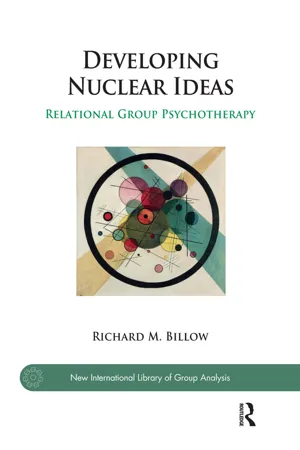
Building and expanding on concepts presented in his previous volumes (Relational Group Psychotherapy: From Basic Assumptions to Passion, and Resistance, Rebellion and Refusal in Groups: The 3Rs), Richard M. Billow presents a coherent and innovative model of group psychotherapy. Developing Nuclear Ideas: Relational Group Psychotherapy offers, in experiential terms and with vivid examples, a theoretical and technical approach to understand and organise dynamic group process and drive it towards satisfying the goal of all therapy, the hunger for emotional truth. By developing nuclear ideas, the therapist and the group itself go about the task of containing and making sense of the perceptions, conceptions, affects, and enactments present in all groups. The volume also addresses the impact of thought-limiting, action-orientated polemic ideas. Integrating contemporary theory with cutting edge technique, the author focuses on the personal nature of the intersubjective process, locating the therapist's experience in the centre of the transformational intensity of group life.
- 288 pages
- English
- ePUB (mobile friendly)
- Available on iOS & Android
eBook - ePub
About this book
Information
Part I
The Nuclear Idea: Concept and Technique
Chapter One
Developing nuclear ideas
In the course of leading a group, ideas flow in and out of my consciousness. Some seem to originate from within me, although many emerge from the verbalisations and behaviours of others. Even if the group appears to move on, several ideas linger and begin to impinge. They are now asserting influence on me; unavoidably they affect group process. So, I think about why the ideas or set of ideas has captured my attention: what they have to do with the clinical situation—present and past—and with my psychology, to the extent to which I understand it.
I consider how these ideas relate to what others are saying and doing, linking together, if I am able, unfolding intrapsychic, interpersonal, and whole group themes and processes. It is at this point of connection that a nuclear idea begins to coalesce, but it must be examined. I try to see if the idea has relevance to others, and is applicable to smaller or larger milieus, or both. This places the idea in intellectual and symbolic contexts, which also have cultural and historical dimensions.
The idea has to feel vital. I can put it aside but not forget about it. Emotional reverberations energise my thoughts, and realisations sometimes occur that surprise me. If I wish to communicate, I must test whether the idea is comprehensible to other group members. Even if they are not having similar experiences, or are having them but do not see things my way, they need still to understand what I am referring to.
This progression, as I reflect, parallels Bion’s (1963) notion of the psychoanalytic object. Bion left the concept unsaturated, to be built upon, although only a few others have written about it, and briefly (Grotstein, 2007, more extensively). I have found the concept helpful in achieving essential therapeutic goals of containment, cohesion, and coherence. As we shall see, developing nuclear ideas provides a way of thinking and working: shifting interest and discussion from “surface” contents to non-conscious or unexplored psychic processes in the individual and whole group, and, thus, to draw attention to multiple meanings—to the metapsychology of our interactions.
Bion’s theoretical formulations tend to mystify and obscure their broad clinical utility, and also, tend to exalt the analyst or group therapist as the “seer” or “exceptional individual” (his terms). Bion (1962) conceptualised the psychoanalytic object as emerging from the “dis course and behaviour of the patient” (Britton, 1998, p. 817) and brought to meaning solely by the analyst, who uses observation, theory, his or her own emotional experience, and intuition. The analyst had to maximise the conditions so as to capture the patient’s attention, establish a shared focus, invite symbolic thinking, and eventually, integrate the psychoanalytic object within an interpretation. In thinking about his ideas in terms of my own experience as group leader, member, and observer, I have chosen user-friendly words, and those that I believe more closely approximate what takes place in the group situation.
I shall be describing an approach to group that has remained undeveloped in the literature, although it is likely that it is as common in your practice as it is in mine. Evolving from the verbalisations and enactments through which the group symbolises and becomes known, a nuclear idea takes shape. The therapist now has an option to test the idea provisionally: to focus attention and redirect group process towards its personal, group, and even societal reverberations.
I conceive of nuclear ideas as emerging from the nucleus of the group process: from intersubjective forces and locations that cannot be fully specified, yet might be possible to observe, name, and utilise clinically. They arise from the indeterminacy of the network of communications and interactions, that is, from within the complexity (Schermer, 2012) of the dynamic matrix (Foulkes, 1964) or “culture” (Whitaker & Lieberman, 1964) of the group, co-created by the therapist’s participation and influence, and expressed in the group’s “idiom” (Bollas, 1989) and “discourse” (Schlapobersky, 1994), its particular language, symbolisation, and enaction.
While Bion provided a starting point, my application is group relational (Billow, 2003a; 2010a). As concept and technique, the nuclear idea—with its emphasis on meaning and the development of meaning as transformational (Bion, 1970; Bollas, 1987)—integrates the whole group, interpersonal, and intrapsychic foci, and so provides a unified basis for leader interventions.
Key qualities of the nuclear idea
A nuclear idea may evolve from any mental phenomenon that captures attention in the group, and, thus, may be felt, fantasised, and thought about on conscious and non-conscious levels. It might emerge—singularly or in combination—from a member’s verbalisations (including the leader’s), a group interchange or series of interchanges and enactments, or from the therapist’s reverie, which become clarified in language. The idea might articulate an observation, a feeling, belief, or memory that takes place in group, and which might be about the group or any group, or a personality, such as a group member or leader.
A nuclear idea entails a process of thinking and developing thoughts. This process may begin and be abandoned early on, developed somewhat or by some individuals, or elaborated more fully. Still, as Schermer (2012) has emphasised, group participants carry out multiple and complex communications simultaneously, and significant information remains non-conscious and undisclosed. Thinking is never complete, and revealed truths are never absolute, but always subject to the revisions of time, circumstance, and human limitations in tolerating frustration and mental pain.
A nuclear idea possesses experiential, symbolic, affective, and metapsychological resonance. The experiential dimension provides empirical and communicable reference. The leader needs to determine if, and to what extent, its members are hearing, seeing, and talking about a similar or (different) experience. The symbolic dimension refers to levels of embedded meaning, conveyed in speech (metaphor, verbal imagery, etc.), enactions, and the group’s sociopolitical culture. The nuclear idea represents and stirs strong feelings: the affective dimension ensures that the idea carries here-and-now emotionally significant weight. Last, metapsychological significance emerges when thoughts extend to general principles of self, group, and societal organisations. People come to think about how they think (and do not think), and, perhaps, when and why.
However, a nuclear idea does not have to become an immediate or even explicit focus of group activity. It can be partially and publically identified, or exist in the shared but unverbalised empathic space of the group. As long as it has resonance in the four dimensions, it operates as a tacit organiser.
Anything that takes place in group has the potential to inspire and develop into a nuclear idea. Something has transpired—an existential and intersubjective moment or sequence of moments becomes partially articulated in words or behaviour. The therapist may take the opportunity to link the idea thematically, to conceptualise further and negotiate meaning with the co-participation of other group members. Let us see how nuclear ideas are introduced and function in the life of four, insight-orientated groups of different types and durations.
Four clinical vignettes
Two groups
A veterans’ hospital outpatient psychotherapy group changed leaders, as one psychologist, Lewis, replaced another, Rebecca, who had left the geographical area. The members missed Rebecca, of whom they spoke reverently. Yet, the group took to Lewis immediately, perhaps because Rebecca pushed the group to tolerate the painful termination process, which also included praise for her successor.
Lewis supported the members reviewing Rebecca’s person and leadership. This continued long after the group evolved with newcomers. Even after several years, the old-timers would reminisce about “Rebecca’s group”, and how it differed from “Lewis’s group”. Recounting the dangerous behaviours they had eliminated or modified, this subgroup of self-described “rough guys” (including several females) declared that Rebecca had “saved our lives”. Rebecca had put up with “no crap” and was not afraid of them. “We had to clean up our act, watch what we said and how we said it.” “Very strict about rules and following them.”
Lewis also queried the group about his leadership, which the senior members described as “more hang-back”, “relaxed”, “not such a rule stickler”. “Rebecca locked the door, while you [Lewis] allow us to come in late.” Still, “you can be a ball buster”. “If you think someone has an issue that they don’t want to talk about, you make us come back to it.” “Rebecca did a lot of digging, now we do your fucking work.”
One outcome of these discussions surprised the members: they had become and remained “well behaved”, even though the style and gender of leadership changed.
Discussion
The core members of Rebecca’s group had been through, and shared, a violent period of adjustment—they were old hands at dealing with their own chaos and that of the new members. Perhaps because of Lewis’s inviting and non-authoritarian style, it became easier for the members to become his investigative allies. And also, perhaps, they did not need “tough love”—a phrase used repeatedly in describing Rebecca—not because what Rebecca did was unnecessary, but because the old members were more mature, and modelled (and perhaps enforced) maturity for the new ones.
In terms of enaction and symbolic influence, the two leaders—most probably unintentionally—took on parental roles related to earlier and later developmental phases of socialisation. Rebecca was a “toilet training” parent. A clear set of behavioural rules and expectations—a reinforced “yes” and a firm “no”—provided a basis for what the members had called “cleaning up our act”, a process that was apparently absent or traumatically damaged in these veterans.
Lewis established or reinforced latency ideals of mutuality and co-operation. In doing “his fucking work”, the seniors verbally and enactively transmitted behavioural norms and expectations—now internalised—to the new members. While not abrogating authority, and enforcing it when necessary, Lewis democratically shared investigative leadership, and it was the group members themselves who initiated the nuclear idea of the “two groups”. Most probably, he encouraged its clarification and elaboration without forethought or conscious awareness. He was both leader and led, augmenting and creatively surrendering (Ghent, 1990) to the force of the idea of the “two groups”.
To emphasise this point, Lewis did not make the old group, the ongoing group, or the comparisons between them an explicit nuclear idea. Here, the leader’s role was to recognise and enjoy—allowing the members to think for themselves. The members’ pungent language captured key qualities of the groups and its impact on the veterans’ thinking and behaviour.
The nuclear idea of the “two groups” functioned as an unnamed “root metaphor” (Srivastva & Barrett, 1988, p. 37), linked experientially to the sensory–affective features of the therapists but stimulated by, and based on, their leadership behaviours, both symbolic and real. It operated as a material entity and as a complex “relational image” (Migliorati, 1989, p. 198), utilised in affectively intense exchanges that referenced the group and also extended to extra-group psychological functioning. “Two groups”, thus, possessed the essential features of a well-developed nuclear idea: experiential, symbolic, affective, and metapsychological, bearing on and energising the here-and-now therapeutic process.
The “uncomfortable role” of being in group
I had the unusual opportunity to lead a demonstration group via Skype. The group conference took place in a city outside the USA. In an introductory exchange, the attendees expressed interest in hearing about “truth”, “love and hate”, “rebellion”, and “connection”, and I said I would try to address these concepts either in the small group or debriefing.
The room had been set up in preparation for the telecast: I faced a row of participants, with their backs to the large audience of observers. I suggested rearranging the chairs, so that the group of eight was rearranged in a semi-circle. While this improved the observers’ sight-lines, my view of several of the members became eclipsed. Further, while I could be clearly seen in close up, the group members, at some distance from the camera lens, were blurry on my computer screen. Since nothing else could be done with the technical arrangements, we began, with fifty minutes allotted.
Not obscured by the electronic compress of our several thousand-mile distance was a familiar jolt of start-up apprehension, which I took as my own magnified by the group’s. A woman remarked, “I feel uncomfortable, I can’t explain why.” Not waiting too long, I asked her if she could try. She repeated herself, and then asked if others could talk. I encouraged her once again to continue. She again appealed to the group, saying indistinctly, “I’m finding it hard to stay in role.” Some mumbling among the group members followed, which I could not understand. Then, a man (his back to me) confessed, “We were assigned roles.” Another member: “It’s difficult not to be yourself.”
I responded, “Me too. I was assigned a role and I want to be myself, and I’m uncomfortable too.” The room resounded with laughter. “We’re all in the same boat,” I emphasised. The man tentatively suggested dropping role assignments, which met with exclamations of relief with no dissenters. I referred to the process as a constructive rebellion: modifying the rules of engagement seemed appropriate for the brief time we had together and could make it more likely that we could reach some emotional truths.
A woman addressed the group:
“I don’t like the new arrangement.”
“But you went along,” another woman responded.
“Yes, that’s what I do, I go along, then withdraw and sulk until I can’t stand it, then protest.”
The group seemed to enjoy her honesty and began to enquire further about this aspect of her psychology, about which she claimed to know nothing further.
The protesting woman was in my full view, and I said that she seemed to be angry, and with whom?
“I don’t know… I guess you.”
Although we were talking about anger, our exchange was amiable and she seemed pleased to be addressed directly. Another woman turned to her:
“You could be scary...
Table of contents
- Cover
- Half Title
- Title
- Copyright
- CONTENTS
- ACKNOWLEDGEMENTS
- Dedication
- ABOUT THE AUTHOR
- NEW INTERNATIONAL LIBRARY OF GROUP ANALYSIS FOREWORD
- INTRODUCTION: Relational group psychotherapy and the nuclear idea
- PART I THE NUCLEAR IDEA: CONCEPT AND TECHNIQUE
- PART II THE INFLUENCE OF POLEMIC IDEAS
- PART III IT’S ALL ABOUT “ME”
- NOTES
- REFERENCES
- INDEX
Trusted by 375,005 students
Access to over 1.5 million titles for a fair monthly price.
Study more efficiently using our study tools.
Frequently asked questions
Yes, you can cancel anytime from the Subscription tab in your account settings on the Perlego website. Your subscription will stay active until the end of your current billing period. Learn how to cancel your subscription
No, books cannot be downloaded as external files, such as PDFs, for use outside of Perlego. However, you can download books within the Perlego app for offline reading on mobile or tablet. Learn how to download books offline
Perlego offers two plans: Essential and Complete
- Essential is ideal for learners and professionals who enjoy exploring a wide range of subjects. Access the Essential Library with 800,000+ trusted titles and best-sellers across business, personal growth, and the humanities. Includes unlimited reading time and Standard Read Aloud voice.
- Complete: Perfect for advanced learners and researchers needing full, unrestricted access. Unlock 1.5M+ books across hundreds of subjects, including academic and specialized titles. The Complete Plan also includes advanced features like Premium Read Aloud and Research Assistant.
We are an online textbook subscription service, where you can get access to an entire online library for less than the price of a single book per month. With over 1.5 million books across 990+ topics, we’ve got you covered! Learn about our mission
Look out for the read-aloud symbol on your next book to see if you can listen to it. The read-aloud tool reads text aloud for you, highlighting the text as it is being read. You can pause it, speed it up and slow it down. Learn more about Read Aloud
Yes! You can use the Perlego app on both iOS and Android devices to read anytime, anywhere — even offline. Perfect for commutes or when you’re on the go.
Please note we cannot support devices running on iOS 13 and Android 7 or earlier. Learn more about using the app
Please note we cannot support devices running on iOS 13 and Android 7 or earlier. Learn more about using the app
Yes, you can access Developing Nuclear Ideas by Richard M. Billow in PDF and/or ePUB format, as well as other popular books in Psychology & History & Theory in Psychology. We have over 1.5 million books available in our catalogue for you to explore.