- 318 pages
- English
- ePUB (mobile friendly)
- Available on iOS & Android
eBook - ePub
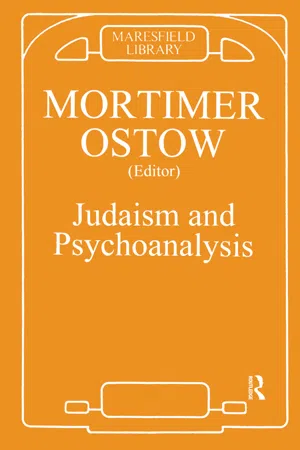
Judaism and Psychoanalysis
About this book
Is psychoanalysis a "Jewish science"? Ten essays contributed by the editor and distinguished scholars explore the Jewishness of psychoanalysis, its origins in the Jewish situation of late nineteenth century Europe, Freud's Jewishness and the Jewishness of his early colleagues. They also exemplify what the psychoanalytic approach can contribute to the study of Judaism. Clinical studies illuminate the issue of Jewish identity and psychological significance of the bar mitzvah experience. Theoretical essays throw light on Jewish history, Jewish social and communal behavior, Jewish myths and legends, religious ideas and thoughts.What are the major determinants of Jewish identity? What is the role of Jewish education in establishing and maintaining Jewish identity? What does the Midrash tell us about the meaning of anxiety to the traditional Jew, and how does Judaism attempt to deal with anxiety? What strategies have Jews used to survive an anti-Jewish world? Under what circumstances has the compliant posture of Johanen ben Zakkai been celebrated, and under what circumstances the defiance of the martyrs of Massada?
Information
Psychoanalytic Exegesis
The Consecration of the Prophet
EDITOR’S COMMENT
This paper is reprinted from The Psychoanalytic Quarterly, Vol. 23, pages 374–397, 1951. It is an excellent example of the kind of understanding that classical psychoanalysis can contribute to the study of Scriptural text. Arlow is not only one of the leading theoreticians and clinicians in contemporary psychoanalysis, but, as the essay indicates, he is familiar, in the original Hebrew, with the material that he discusses, with its historical background and with its social and religious significance.Unlike the early analysts, Arlow does not attempt to construct a virtual pseudohistory from a text. He has selected examples of one of the few types of subjective psychic experience that one finds in the Jewish Bible, and he discusses its psychodynamic meaning. The psychodynamic hypotheses he suggests are based upon classical psychoanalytic “exegetic” technic. He examines the words and phrases of a Biblical text exactly as the analyst examines the words and phrases of the text of a dream presented by a patient. Using symbolic equivalents, inference by association of words and ideas, and inference from indirect allusions, the author extracts meanings from the text that are not conveyed explicitly. The reader familiar with classical religious exegesis of the Biblical text will see the resemblance.The essay tells us something about the state of mind of those who became the classical prophets of Israel. Arlow also begins to consider, in this essay, the nature of the relation between the prophet and his followers, and the prophet’s role in providing group ideals and common purposes.Reading this essay thirty years after it was written, I believe that one can go somewhat further in the analysis of the material.The experience that Arlow describes is typical not only of what he calls the consecration of the prophet, but of the hysterical trance state in general. Vivid hallucinatory experiences of this kind are encountered in the literature of many religions, and they encourage the subject to believe that he has had the privilege of receiving the special favor of his god, of having been granted a new and direct revelation, and of having been elected for a special destiny. (Interestingly, the mysticism of post-Biblical Judaism focuses not so much on the subjective trance state as on religious fantasies and on altering one’s view of daily life so that one sees in the most mundane acts, spiritual significance not visible to others.) Not every trance state leads to a career of prophecy, but many people who have become religious leaders describe such experiences of initiation. (See, for example, Evelyn Underhill’s The Mystics of the Church [New York: Schocken, 1964].)Arlow describes the sense of invigoration, narcissistic grandiosity, and the confidence in one’s leadership that issues from such mystical revelations, and he compares the post-revelation state to a hypomanic state. In another essay I suggest that Nathan of Gaza might have been functioning as a hypomanic personality. He was known as the “prophet” of Shabbatai Zevi. Scholem (in Sabbatai Sevi, the Mystical Messiah, translated by R. J. Z. Werblowsky [Princeton: Princeton University Press, 1973, Bollingen Series XCIII]) notes that Nathan’s prophetic awakening began with mystical visions of God (pp. 204 f). Trance states, however, arc characteristic of no one mental illness or personality type, though in modern terminology, we should consider them a hysterical type of phenomenon. The subject feels that the trance—which he experienced as personal revelation—created in him a state of illumination and the readiness to prophesy. The psychoanalyst might interpret the mystical experience as a manifestation of an inner change rather than its cause.We should also take note of the prophet’s withdrawal from emotional involvement with his community that Arlow describes. The prophet usually sets himself against the community, criticizes and threatens it, and points to his revelation as authority to do so. Jonah clearly regrets the remission of the sentence he had pronounced on Nineveh. Similarly, the community that the prophet threatens, resents him and often seeks to destroy him. Although Arlow says that the prophet speaks to the needs of the people, in most instances his prophecy comes to be valued only years or generations later, when people feel the need to be reunited with God by accepting rebuke and criticism. It is unusual for him to be appreciated by his contemporaries.The prophet withdraws his love from his community and redirects it to God. By submitting to God in love, as Arlow suggests, he acquires God’s authority to set himself over his fellow men, to criticize, to scold, to threaten and condemn them. The situation will be seen somewhat differently depending upon whether one believes that the prophet was responding to an external divine influence or that his contact with divinity was an illusion. In the former instance the initiative is God’s. The prophet obeys God and carries the message to the people. In the latter instance, the illusory submission to and identification with God are explained as defensive responses to the rejection of human society. The prophet’s need to reject society derives from some conflict between them, and this conflict starts the process in motion.Finally, I should like to make a point about the ego state of the subject of the trance. Arlow notes the recurrent imagery of fire and brilliance, and he offers symbolic interpretations. I agree with his interpretations, but it is important also to note that mystical trances, as well as trances associated with pathology, such as the trances of acute schizophrenia or hysteria, those associated with certain forms of epilepsy, and those induced by hallucinogenic drugs, usually make reference to a fairly constant collection of sensory experiences: brightness or cloudiness, noisiness or silence, awareness of bodily functions, synaesthesias, hallucinations of scintillation and shimmering (often interpreted as water, mist, or jewels), feelings of strangeness and weirdness, familiarity and unfamiliarity, illusions of largeness or smallness, a sense of literal or figurative elevation, and the impression of “seeing a light” literally or figuratively (see Mysticism: Spiritual Quest or Psychic Disorder?, Group for the Advancement of Psychiatry, Vol. IX, Publication No. 97 [New York, 1976], Chapter 8). While each of these components of the trance state may have personal symbolic meaning to the subject, they are all characteristics of the state itself, and, I believe, reflect specifically the function of the temporal lobe of the brain, which becomes especially active at that moment (see Ostow, “Antinomianism, Mysticism and Psychosis,” in Psychodelic Drugs, edited by R. E. Hicks and P. J. Fink [New York: Grune & Stratton, 1969]).
Recorded in the Old Testament are several passages of vivid imagery and terrifying magnificence portraying the consecration1 of the prophets. The occasion is usually an intensely dramatic experience, signalized by supernatural portents, accompanied by auditory and visual hallucinations; a commingling of passive abnegation with ecstatic grandeur in which the prophet, having humiliated himself and proclaimed his unworthiness, accepts, as it were, the awful burden of prophecy. Revelations of this nature are most striking in the instances of Moses, Samuel, Isaiah, Jeremiah, and Ezekiel.2
Since it represents a special psychological experience in exceptional types of individuals whose influence upon the moral history of Western civilization is paramount, the consecration of the prophet would in any event excite the interest of psychoanalysts. Variations of such experiences in attenuated or distorted forms, moreover, have been known in every age. Prophetic experience is an important element in the heritage of civilization.3
Freud’s study of Moses4 approached the problem from an interest in demonstrating the historical recurrence of certain unconscious forces, persistently vital in the mythology of a race and representing, he felt, a prehistoric truth whose effects linger to this very day. The intrapsychic struggles of the individual prophet and the manner in which the prophetic calling represented a solution of these conflicts he did not discuss.
Because of the methodological difficulties inherent in such a study it is essential that its scope and nature be clearly defined.5 In certain instances, as of Moses and Ezekiel, grave doubts have been cast as to whether these prophets ever existed. Almost everything we know about the prophets is derived from their writings or from books about them or ascribed to them. These documents have been demonstrated by critical scholarship to be quite frequently of composite authorship. Fortunately, the records of the consecrations of Samuel, Isaiah, Jeremiah, and Ezekiel are fairly well-integrated literary units and appear to have suffered relatively less from contradictory distortions and additions than do other sections of the Old Testament; however, no unequivocal stand can be maintained concerning their textual accuracy.
Whether or not the prophets ever existed as historical persons, and whether or not the documents connected with them are authentic, it cannot be disputed that the prophets and their teachings exerted a profound influence upon the imagination and the moral development of the Hebrew people, who enshrined them as their heroes, canonized their writings, and accepted their words as revelations of God’s will. The prophet served as a model of consummate devotion to and identification with the cause of righteousness experienced by the prophet as the will or the voice of God.
Not a psychoanalytic study of individual prophets, this is the study of a composite, a type of person motivated chiefly by the conviction that his spoken words were the words of God. This is clearly the Hebrew version of prophecy. The Hebrew word for prophet, nabi, is of obscure origin but it does not carry the implication of prediction. This element, according to many authorities, was introduced as a result of a misunderstanding of the term used to translate the word nabi from the Hebrew into Greek.6 The central ...
Table of contents
- Cover
- Half Title
- Title Page
- Copyright Page
- Table of Contents
- Preface
- Contributors
- Introduction
- Psychoanalytic Exegesis
- Freud and Jewish Marginality
- Clinical Psychoanalytic Studies
- Applied Psychoanalytic Studies
Trusted by 375,005 students
Access to over 1.5 million titles for a fair monthly price.
Study more efficiently using our study tools.
Frequently asked questions
Yes, you can cancel anytime from the Subscription tab in your account settings on the Perlego website. Your subscription will stay active until the end of your current billing period. Learn how to cancel your subscription
No, books cannot be downloaded as external files, such as PDFs, for use outside of Perlego. However, you can download books within the Perlego app for offline reading on mobile or tablet. Learn how to download books offline
Perlego offers two plans: Essential and Complete
- Essential is ideal for learners and professionals who enjoy exploring a wide range of subjects. Access the Essential Library with 800,000+ trusted titles and best-sellers across business, personal growth, and the humanities. Includes unlimited reading time and Standard Read Aloud voice.
- Complete: Perfect for advanced learners and researchers needing full, unrestricted access. Unlock 1.5M+ books across hundreds of subjects, including academic and specialized titles. The Complete Plan also includes advanced features like Premium Read Aloud and Research Assistant.
We are an online textbook subscription service, where you can get access to an entire online library for less than the price of a single book per month. With over 1.5 million books across 990+ topics, we’ve got you covered! Learn about our mission
Look out for the read-aloud symbol on your next book to see if you can listen to it. The read-aloud tool reads text aloud for you, highlighting the text as it is being read. You can pause it, speed it up and slow it down. Learn more about Read Aloud
Yes! You can use the Perlego app on both iOS and Android devices to read anytime, anywhere — even offline. Perfect for commutes or when you’re on the go.
Please note we cannot support devices running on iOS 13 and Android 7 or earlier. Learn more about using the app
Please note we cannot support devices running on iOS 13 and Android 7 or earlier. Learn more about using the app
Yes, you can access Judaism and Psychoanalysis by Mortimer Ostow in PDF and/or ePUB format, as well as other popular books in Psychology & History & Theory in Psychology. We have over 1.5 million books available in our catalogue for you to explore.