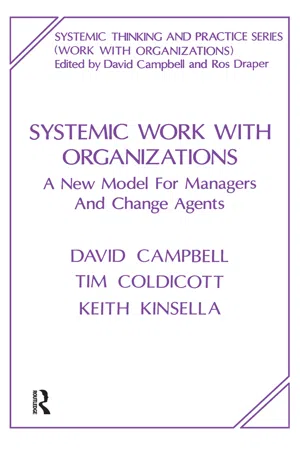
Systemic Work with Organizations explores a powerful new perspective on the challenges faced by managers and consultants who work in large organizations. Building on principles and methods originally developed in the family arena, the authors show how an emphasis on connection, context and communication can help managers and others involved in change, deal with issues of identity, leadership, and learning faced by staff in today's complex work environment.The main thesis is that one way cause and effect thinking and a central focus on the role of the individual, is no longer sufficient. Managers and change agents now need to make use of the insights and interventions offered by a systemic perspective that highlights the roles played by circularity and reflexivity in how people construct shared meaning in human systems.
eBook - ePub
Systemic Work with Organizations
A New Model for Managers and Change Agents
- 216 pages
- English
- ePUB (mobile friendly)
- Available on iOS & Android
eBook - ePub
Systemic Work with Organizations
A New Model for Managers and Change Agents
Introduction
This book is written for managers, consultants, or people aspiring to become consultants—for those, such as human resources staff, with responsibility for managing change within their own organization, or those who have reached a position of long experience in their own field and are now changing their role to consult to others.
The authors' experience spans the public and private sectors. The ideas in this book have been useful in the fields of health, education, and local authority government, as well as in commerce and industry. We have found among our public sector clients growing acceptance of the need today to import ideas from the private sector, but at the same time a concern among these managers that they do not have a context that gives meaning to the imported ideas. The counterflow into the private sector of ideas about collaboration, governance, ethics, and support for community has presented similar problems. It is this difficulty of helping clients translate and fit knowledge and practice from one sphere of action to another that has provided a central challenge to the authors as they have developed their model of systemic working.
To grapple more effectively with a world of work in which there is an increasing fragmentation of traditional structures and values, the authors put forward two central ideas:
- when people think systemically, they are able to understand better the effects of connectedness in organizations, and account more effectively for the dilemmas and tensions that arise during change;
- when people understand and accept how they collectively create and maintain mental pictures of the organization and its problems, they are able to alter and renegotiate these understandings and find new ways of solving their problems.
Although many consultancy techniques are presented here, this is not just a book of techniques. The authors describe a way of thinking, a way of being, as a systemic consultant that is akin to developing a new identity. From this new position, a consultant negotiates the work with clients and creates techniques to address the demands of a consultation process in a way that is different from and, we believe, more productive than traditional consultancy services.
We are convinced that one does not become a systemic thinker or a constructionist consultant by reading. This book is not a manual telling the reader "how to do it". Rather, it is an introduction to the ideas and practices that the authors have found successful and compelling; readers will have to go much further before applying these ideas to their own practice. We have found the best way to progress is to work with other people who share an interest in developing systemic ideas.
The work in this volume will be described with a particular terminology which may be new for some readers, and for this reason a comprehensive glossary is included at the end of the book. However, two terms in particular should be clarified at the outset:
- Systemic refers to the broad field of ideas derived from General Systems Theory and expanded in several directions since the 1960s. These ideas will become clear and familiar as the reader proceeds through the book.
- Constructionist refers to some aspects of systemic thinking that focus on the construction of problems in organizations and the attention a consultant pays to addressing that construction and to facilitating the client towards new constructions. Although based on systemic thinking, we have coined the term constructionist consulting to distinguish this type of consultancy from more traditional expert or process models.
Many readers will be aware of the new meaning of the word "systemic": for decades it has been a central concept describing integrated operational systems in the computing and engineering fields, and those of you who are avid gardeners feed your roses with "systemic" fertilizers. However, there is a new generation of systemic ideas which has been introduced to organizational thinking primarily through a different route—human systems. Historically, these ideas from the computer revolution of the 1950s and 1960s were first applied to human systems by practitioners who were working with whole families. The idea of seeing the family as an interrelated system that creates a collective meaning for individual behaviours has proved profoundly helpful to those who are trying to understand complex problems such as mental illness, alcoholism, or marital breakdown. As a result, an approach to human problems based on "systemic thinking" emerged in the 1960s and has continuously expanded and been applied to a wide range of behaviours that require new solutions. Readers interested in the historical roots of this approach will enjoy some of the seminal texts, such as Watzlawick, Beavin, and Jackson (1967), Bateson (1973), and Watzlawick, Weakland, and Fisch (1974). For many of these practitioners, it was then only a small step to think of the organization as an interconnected system, and to incorporate these ideas into their work as consultants.
The book divides into three sections.
Part I, consisting of Chapters 1 and 2, clarifies the conceptual tools that underpin this new approach to consultancy:
- Chapter 1 explains the main concepts adapted from General Systems Theory and developed into the broader framework known as systemic thinking. Each of the concepts forms the basis for some aspect of the consultancy work elaborated throughout the book.
- Chapter 2 is about the way we apply the systemic concepts to the daily practice of consultancy. Familiar topics such as leadership, communication, and change management are discussed and reframed using systemic thinking.
Part II provides three examples of the way systemic ideas have been fashioned into the practice of what the authors call "constructionist consulting":
- Chapter 3 describes how systemic principles were used to design a one-day consultation to a new hospital Trust Board. The focus is on defining the problem and planning a structured consultation to make an impact within a brief period of time.
- Chapter 4 describes a consultation lasting over a four-month period. Here the emphasis is on developing new hypotheses and interventions as the consultant learns more about the organization with each ensuing visit.
- Chapter 5 addresses the implementation of a change programme in a large commercial organization. This study goes beyond planning and strategic thinking to examine new ways to ensure that change works its way through a whole organization.
In each of these real-life cases, the names, locations, and other particular facts have been altered to ensure that the participating organizations cannot be identified.
Part III consolidates the ideas and the practices that have come before and presents ideas for creating a method of work, becoming a constructionist practitioner, and finding work:
- Chapter 6 presents the methodology for using the constructionist model of consultancy as it has emerged from the interplay of concepts and the practice described in the case studies. It is intended as a guide to putting theory into practice and outlines a consulting stance and methodology that we have found successful.
- Chapter 7 describes the process of becoming a constructionist practitioner and creating a distinctive working relationship with clients. We have found ways of renegotiating a consulting role that supports the way we want to work, but also respects the relationship the client expects to have with a consultant.
- Chapter 8 contains descriptions of the personal journeys the authors have taken to arrive at this position of using the constructionist model, the aim being to encourage readers to reflect on their own process of development and perhaps discover ways in which they can also try out some of these ideas.
Although the parts are interconnected, readers who like to begin by knowing who the authors are and how they work as consultants may well begin at the end—with Part III. Others who want to get a practical feel of what the work is like may choose to start with the cases in Part II; whereas those who prefer to establish their conceptual framework before moving on might start at the beginning.
Since the book is written by three authors, we faced the inevitable problem of continuity of ideas and writing styles. However, systemic thinking purports—if nothing else—that we must consider "reality" to be made up of many realities; therefore it seems more consistent with the message of the book not to homogenize the writing, but to allow each author to express himself in his own style. The reader will see how systemic ideas can be expressed in many different ways.
The tone of the book may seem different to many other volumes on the subject of consultancy. Most consultants are paid to be experts, and this is usually reflected in their writing. Our approach is somewhat different. We do not claim to have the "right" answer or even the "best" answer; our expertise lies in an ability to facilitate others to come to a new understanding of the way problems are constructed and maintained in organizations. This leads to client-based solutions. We are constantly exploring and probing in order to stimulate thinking in others that will help both us and them see things differently—and more clearly. We hope our writing reflects our interest in stimulating thoughts in the readers' minds rather than convincing them of our brilliance.
Finally, we acknowledge that there is an inevitable gender bias due to the fact that the three authors are male. We are aware that we talk of "he" where it could be either "he" or "she" but in the interests of readability decided against repeatedly saying "s/he" instead. We hope that male and female readers equally find the book approachable and relevant to their own work.
Part I
Approach—Adapting Theory to a New Context
"It is the theory which decides what we can observe."
Albert Einstein
"There's nothing so practical as a good theory . . ."
Anon.
Chapter 1
Key concepts of systemic thinking
The first chapter provides an understanding of the origin and the conceptual framework of systemic thinking. The book as a whole applies these ideas in many different ways, and ultimately they form the basis for a new approach to consultancy. However, because the field has expanded considerably in the last few years, borrowing and co-opting ideas from fields such as linguistics and philosophy, systems thinking has become a large umbrella under which many ideas have come to reside. This chapter aims to distinguish those ideas which are central to our understanding and application of systems theory, and to define the concepts clearly enough so that the reader will feel well-armed with the conceptual tools necessary to proceed through the rest of the book.
The founder of General Systems Theory, von Bertalanffy (1956), was a biologist who found that traditional mechanistic models did not explain the behaviour of complex living organisms. He eventually made a distinction between physical laws and closed systems that do not interact with their environment, and dynamically interacting processes that affect living growing organisms. He was the first to emphasize that systems were "sets of elements standing in interrelation". Katz and Kahn (1966) defined systems theory as being "basically concerned with problems of relationships, of structure, and of interdependence, rather than with the constant attributes of objects". Systems theory has come to be known as the study of "wholeness" and "interdependence".
The world has moved on from General Systems Theory. The broader term, "systemic thinking", now incorporates some of the original concepts as well as new ideas developed since the 1960s. We have chosen to describe those concepts of systemic thinking which have proven to be helpful tools in our work as consultants, and not to present a comprehensive review of General Systems Theory or systems thinking. For a general discussion, readers should refer to Beishon and Peters (1972), Emery (1969), von Bertalanffy (1956), and Ashby (1958a, 1958b).
Systemic thinking is not an explanatory theory. It does not explain why organizations behave as they do. Rather, it is a framework for observing and understanding the world in terms of the connections amongst its many parts. It breaks the world into smaller units such as organizations, families, or communities and conceptualizes them as systems consisting of inter-connected parts. It is, of course, the type of thinking that many people apply to organizational problems—this is not new; but from the emergence of General Systems Theory in the 1950s to the present day, a growing number of thinkers and practitioners have teased-out the elements of this approach, analysed them in action, and applied them to many different fields. We now have a recognized body of knowledge known loosely as systemic thinking, and it is being applied increasingly to the worlds of organization and business. Because systemic thinking is a loose body of ideas and techniques, each practitioner will give his or her own version of which concepts are most important in using this approach. We have developed our own ideas from years of teaching and consulting within this model.
Creating “Punctuation”
If you read the letters "attendance" as one word, it becomes "attendance". However, by introducing a capital letter and some punctuation, one can create an entirely new meaning from the same letters: "At ten, dance!"
The same letters but grouped and punctuated differently produce a new "system" of words.
A similar case can be applied to systemic thinking. One can argue that the universe is the only system (provided that there is an Observer to see it as a unified whole, but that's another story . . .), and anything less than the universe which we choose to call a system—such as a family, a town, an organization—is merely the product of the observer breaking up the world into his or her chosen parts. A furniture salesman and a molecular physicist may have completely different descriptions of the object we call "chair".
We, as observers, are continually "punctuating" or making distinctions about the world in which we live. We choose to see certain groupings as an organization because it is helpful for us to do so.
From Cause and Effect to Systemic Thinking
When we are strongly and directly affected by events going on around us, we tend to narrow our perspective and view these events in relation to ourselves, in relation to what has immediately triggered our response. We look for the people or objects or events "responsible" for triggering our response. It seems like a survival mechanism to find something to identify as a "cause" which we can then fight against in our own defence.
Take, for example, the difference we feel between a vague, worrying physical symptom and a diagnosis that defines the cause of the pain and prescribes a course of action. The process of finding and identifying causes offers a meaning for what is happening and a course of action to change the situation; and in many situations such simple cause-and-effect thinking is sufficient to change things and it is a comfort. For example, in an organization, the effect of poor communication may be "caused" by poor circulation of information, and the solution might simply be to distribute minutes of meetings to all the staff. However, our personal view of "what causes what" rarely reflects the reality of a complex organization. For an organization consisting of 10 or 100 or 1,000 employees, there will be individual reasons, departmental policies, and company cultures that affect the process of communication and make the meaning and understanding that much more complex.
The more narrow, cause-and-effect thinking is often referred to as linear (see Glossary) when it suggests a uni-directional relationship between the cause and the effect: 'If I don't submit my report in time, the boss will be angry." This is often contrasted with the wider, more divergent systemic think...
Table of contents
- Cover
- Title
- Copyright
- Contents
- EDITORS' FOREWORD
- Introduction
- Postscript Next steps
- GLOSSARY
- REFERENCES
- INDEX
Trusted by 375,005 students
Access to over 1.5 million titles for a fair monthly price.
Study more efficiently using our study tools.
Frequently asked questions
Yes, you can cancel anytime from the Subscription tab in your account settings on the Perlego website. Your subscription will stay active until the end of your current billing period. Learn how to cancel your subscription
No, books cannot be downloaded as external files, such as PDFs, for use outside of Perlego. However, you can download books within the Perlego app for offline reading on mobile or tablet. Learn how to download books offline
Perlego offers two plans: Essential and Complete
- Essential is ideal for learners and professionals who enjoy exploring a wide range of subjects. Access the Essential Library with 800,000+ trusted titles and best-sellers across business, personal growth, and the humanities. Includes unlimited reading time and Standard Read Aloud voice.
- Complete: Perfect for advanced learners and researchers needing full, unrestricted access. Unlock 1.5M+ books across hundreds of subjects, including academic and specialized titles. The Complete Plan also includes advanced features like Premium Read Aloud and Research Assistant.
We are an online textbook subscription service, where you can get access to an entire online library for less than the price of a single book per month. With over 1.5 million books across 990+ topics, we’ve got you covered! Learn about our mission
Look out for the read-aloud symbol on your next book to see if you can listen to it. The read-aloud tool reads text aloud for you, highlighting the text as it is being read. You can pause it, speed it up and slow it down. Learn more about Read Aloud
Yes! You can use the Perlego app on both iOS and Android devices to read anytime, anywhere — even offline. Perfect for commutes or when you’re on the go.
Please note we cannot support devices running on iOS 13 and Android 7 or earlier. Learn more about using the app
Please note we cannot support devices running on iOS 13 and Android 7 or earlier. Learn more about using the app
Yes, you can access Systemic Work with Organizations by David Campbell,Tim Coldicott,Keith Kinsella in PDF and/or ePUB format, as well as other popular books in Business & Consulting. We have over 1.5 million books available in our catalogue for you to explore.