@text:A concise, jargon-free guide that covers the main practices and theories that constitute human resource management (HRM). The entries, defined and discussed by a range of international contributors, are drawn from following areas: Developing employees @text:Fully cross-referenced, with suggestions for further reading throughout, this book is a valuable reference for students and professionals seeking to understanding more about the what, why and how of HRM.
- 286 pages
- English
- ePUB (mobile friendly)
- Available on iOS & Android
eBook - ePub
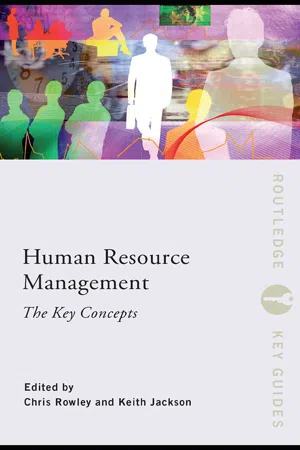
Human Resource Management: The Key Concepts
About this book
HUMAN RESOURCE MANAGEMENT
The Key Concepts
ASSESSMENT
It is as well to begin a series of discussions highlighting key concepts in HRM with one that emphasises performance. Performance becomes vivid and measurable as an aspect of assessment otherwise referred to in terms such as (performance) ‘evaluation’, ‘appraisal’, or ‘review’. As discussed elsewhere in this book, performance can be measured and improved at various levels of HRM activity: organisational, team-level, and individual. Assessment appears as a specialist and outsource-able activity, e.g. the ‘assessment centres’ that specialise in recruiting and selecting the staff that organisations need. Thus, assessment is an important part of management including management of performance, discussed elsewhere in this book under specific concept headings such as performance management and performance and rewards. From an HRM perspective, the ‘bottom line’ remains that performance at any level which becomes manifest and thereby (potentially) manageable and improvable in as far as it can be assessed. This holds true regardless of national, organisational or regional context; and regardless of whether we are talking about HRM in ‘for profit’ or in ‘not-for-profit’ organisations, in family businesses or venture start-ups, in established small and medium-sized enterprises (SMEs), and in globally influential multi-national enterprises or corporations (MNEs/MNCs).
Assessment as a core HRM intervention
In the experience of many employees, formal performance assessment is a once a year activity. However, from an employer perspective assessment is something that all supervisors and senior managers might undertake regularly, and both formally and informally. Clearly, the continuous micro-management of employee performance within the organisation can be disruptive; as one HRM intervention too many. Worse, applying systems of assessment might add little to performance if carried out with little regard to employee motivation, capability and productivity. Nonetheless, from a combined business and HRM perspective, performance assessment remains an essential part of managing an organisation and the people within it. The crucial parts of the assessment process are to provide accurate feedback of assessment and to link assessment to jobs and organisational objectives. Here we discuss assessment as a core activity in the context of resourcing and retention – processes given separate and detailed discussion elsewhere in this book.
Assessment of employees has to have clear links back to the business plan and HR plans so that employees have objectives and resources connected to these plans. The assessment process is not an HRM function exercise to have supervisors and supervisees tick boxes in 10 minutes once a year. Assessment is a regular and ongoing activity of the line manager and subordinate and should be undertaken informally whenever there is a performance issue to be attended to (for example if it is noticed that the employee seems distracted or unmotivated or if mistakes are made or if the employee is producing particularly good results which should be commended). More formal reviews are best undertaken each three months (or at appropriate intervals for the job and industry).
Actively assessing performance
The employee’s performance is assessed in a structured way based upon the job description, i.e. as one outcome of a process discussed elsewhere in this book under job planning. But the job description, while being important, is not the only factor as the employee’s potential in terms of succession planning and career path planning is also being assessed. An employee who is being moderately stretched in the job is more likely to be retained than one who is underachieving and bored. But the key is being ‘moderately’ stretched. If the person feels that they are having a greater workload or more work stress than they can handle or a greater stretch than their colleagues they may feel victimised or taken for granted. This is especially likely to be the feeling of the employee if they are not given resources (in terms of management support, sufficient financial or material resources, enough time during normal working hours or necessary training) to be successful in the undertaking. It is a regular practice of some managers (and co-workers) to put newcomers under pressure and then have them fail. Even those who do not fail will start to look for a new opportunity where their performance is supported with resources and assessed in terms of their contribution to the organisation and not assessed in terms of them being old, or female, or from a different ethnic group or just being a new recruit (cf. CEBC, 2004).
Even when the employee is assessed as not being at the required standard there must be a system of performance recovery to have the employee come up to the required standard before a decision is taken to dispense with their services. The organisation has spent time and money in the recruitment of the employee so to throw them out without trying to improve performance and without trying to understand why the recruit has not performed is a waste of those resources.
The organisation, this means mainly (but not solely) the HRM function, has to understand what factors led to high and low performance and feed this information back into the human resource planning, recruitment and selection systems, discussed elsewhere in this book under these headings. More of the candidates with the attributes leading to high performance should be targeted, for recruitment and promotion, and fewer of those with the low performance attributes should be selected – while making sure that the attributes do not mean that some groups within the potential workforce are not being discriminated against on the basis of non-work related factors.
Most employees want to perform well and want to stay with the employer’s organisation for a while. They want to develop their skills and capabilities while earning a fair reward package (cf. Lewis et. al., 2003), if given clear guidance and appropriate objectives related to the job and future career. To help judge the appropriateness of the objectives it is useful to remember the acronym SMART (specific, measurable, achievable, relevant and time-based). In fast changing organisations it may not be possible to set SMART objectives but at least a deviation from SMART should be thought out and still be appropriate.
Some organisations use peer review and 360-degree assessment to ensure that it is not just the bosses who assess employees but these styles of assessment are not valid in all cultures and as the peers, customers, co-workers and others making the assessment may not be fully aware of the job description or business plan it is not always appropriate to rely on these people’s opinion as they are likely to be more subjective and personality based than job based.
No matter what systems are used to assess employees to retain staff, the focus has to be less on the techniques and more on the outcomes. These outcomes are related at a macro-level to the business and HR plans and at a micro-level at the job description and potential for career development of the employee. The aim of the assessment is to keep the employee in service, and performing well, while their abilities and contributions are needed.
WH & KJ
See also: best practice; employment relations; human resource planning; job planning; information systems; outsourcing; performance management; performance and rewards; strategic HRM; valuing work
Suggested further reading
Burke & Cooper (2008): HRM assessment made relevant to organisation-level performance.
Fletcher (2007): A systematic assessment differentiated with reference to processes of performance appraisal, feedback, and employee development.
Purcell et al. (2008): A practical and comprehensive guide towards connecting people (employees) and performance.
Varma et al. (2008): A wide-ranging scholarly review of systems for the management of organisational and employee performance across national, international and business contexts.
BEST PRACTICE
Since the 1990s there has been a considerable degree of interest in the notion of best practice in HRM. Sometimes this is part of the areas of high-performance work systems (Appplebaum et al., 2000; Berg, 1999), ‘high-commitment HRM’ (Guest, 2001; Walton, 1985) or ‘high-involvement’ (Wood, 1999b). Whatever the terminology and lexicon, the idea is that a particular set (or number) of HR practices can have the potential to bring about improved organisational performance for all organisations.
What are best practices?
This idea can be traced back over some time. The dominant schools within classical management thought assume that efficiency imperatives press for a ‘one best way’ in management, irrespective of cultural or national context (Smith & Meiskins, 1995). Taylor, Barnard and Mayo as well as Mouton and Blake stand as examples of management theorists who sought to develop management principles that could be universally employed as single best practices.
In the 1990s, the notion of best practice in HRM was inspired, at least in part, by the work of Pfeffer via two of his popular books, Competitive Advantage through People (1994) and The Human Equation: Building Profits by Putting People First (1998). Pfeffer argues that a particular set of HR practices can increase company profits, that the impact is more pronounced when complementary groups (or ‘bundles’) of HR practices are used together and that this conclusion holds good for all organisations and industries irrespective of their context. A best practice list of HRM outlined by Pfeffer (1998) can be seen in Table 3.
Table 3 Best practices in HRM. Source: adapted from Pfeffer (1998)
Universal application of best practices
One of the key features of Pfeffer’s (1998) argument is that best practice may be used in any organisation, irrespective of product market situation, industry or workforce. This is evidenced by a range of industries and studies which he claims demonstrated the case for ‘putting people first’.
This work has been complemented by many other US studies (Arthur, 1994; Delancy & Huselid, 1996; Delery & Doty, 1996; Huselid, 1995; Huselid & Bechker, 1996; Ichniowski et al., 1996; MacDuffie, 1995; Youndt et al., 1996), by some in the UK (Guest & Conway, 1998; Guest et al., 2000a; Guest et al., 2000b; Patter-son et al., 1997; Wood, 1995, 1999a; Wood & Albanses, 1995; Wood & de Menezes, 1998) and by some in Asia (Bjorkman & Xiucheng, 2002; Rowley et al., 2004; Takeuchi e...
Table of contents
- ALSO AVAILABLE FROM ROUTLEDGE
- CONTENTS
- KEY CONCEPTS
- CONTRIBUTORS
- ABBREVIATIONS
- INTRODUCTION
- HOW TO USE THIS BOOK
- HUMAN RESOURCE MANAGEMENT
- BIBLIOGRAPHY
- RESOURCES
- INDEX
Trusted by 375,005 students
Access to over 1.5 million titles for a fair monthly price.
Study more efficiently using our study tools.
Frequently asked questions
Yes, you can cancel anytime from the Subscription tab in your account settings on the Perlego website. Your subscription will stay active until the end of your current billing period. Learn how to cancel your subscription
No, books cannot be downloaded as external files, such as PDFs, for use outside of Perlego. However, you can download books within the Perlego app for offline reading on mobile or tablet. Learn how to download books offline
Perlego offers two plans: Essential and Complete
- Essential is ideal for learners and professionals who enjoy exploring a wide range of subjects. Access the Essential Library with 800,000+ trusted titles and best-sellers across business, personal growth, and the humanities. Includes unlimited reading time and Standard Read Aloud voice.
- Complete: Perfect for advanced learners and researchers needing full, unrestricted access. Unlock 1.5M+ books across hundreds of subjects, including academic and specialized titles. The Complete Plan also includes advanced features like Premium Read Aloud and Research Assistant.
We are an online textbook subscription service, where you can get access to an entire online library for less than the price of a single book per month. With over 1.5 million books across 990+ topics, we’ve got you covered! Learn about our mission
Look out for the read-aloud symbol on your next book to see if you can listen to it. The read-aloud tool reads text aloud for you, highlighting the text as it is being read. You can pause it, speed it up and slow it down. Learn more about Read Aloud
Yes! You can use the Perlego app on both iOS and Android devices to read anytime, anywhere — even offline. Perfect for commutes or when you’re on the go.
Please note we cannot support devices running on iOS 13 and Android 7 or earlier. Learn more about using the app
Please note we cannot support devices running on iOS 13 and Android 7 or earlier. Learn more about using the app
Yes, you can access Human Resource Management: The Key Concepts by Chris Rowley,Keith Jackson in PDF and/or ePUB format, as well as other popular books in Business & Business generale. We have over 1.5 million books available in our catalogue for you to explore.