eBook - ePub
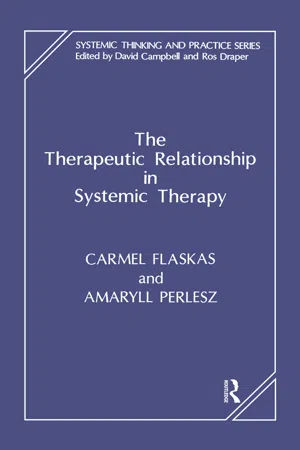
The Therapeutic Relationship in Systemic Therapy
- 256 pages
- English
- ePUB (mobile friendly)
- Available on iOS & Android
eBook - ePub
The Therapeutic Relationship in Systemic Therapy
About this book
Anyone following the recent developments of systemic thinking will be aware that activity has not been restricted to Europe and America. Systemic therapists and writers from both Australia and New Zealand are now making a major impact on the field, particularly in the way they explore therapy as an exchange between "real" people; with gender and with ethical values; and embedded within specific cultural experiences. These people are challenging the traditional way we see clients and the context of therapy. Over the years, systemic? therapists have theorized extensively about the client family as a system and have more recently addressed the use of self in therapy, but there has been very little attention paid to the therapeutic relationship between the two.
Information
Part I
New Explorations—Mainly Theory
Chapter 1
Leaving well alone: a systemic perspective on the therapeutic relationship
Introduction
In recent years there has been widespread contention that systemic therapists have under-theorized the therapist-family relationship—especially in its emotional aspects. This lack is often attributed to what Smith, Osman, and Goding (1990) call the “dominance of ‘male stream’ thought in family therapy” (p. 143). This dominance, they argue, has led to a privileging of reason over emotion and objectivity over subjectivity, which has remained unshaken by the emergence of second-order cybernetic theory. Interest has also been shown in the idea of exploring the relevance and possible value of psychoanalytic ideas for filling what is seen as a theoretical vacuum surrounding the therapeutic relationship in family therapy (cf. Flaskas, 1989, 1993, 1994).
I agree that the therapeutic relationship has been ignored for misguided reasons1, and I also think that psychoanalytic ideas are valuable for some of the things family therapists do. In this chapter, I begin with the simple point, which appears to have been overlooked, that systemic therapists play a more marginal role in the natural groups they join, whereas the one-to-one psychoanalytic therapist-client relationship demands more intense involvement. Thus it is appropriate for the former to focus more on the process in the natural group and for the latter to analyse the therapist-client relationship in depth.
I then make a distinction between the “relational” and “autonomous” aspects of a system or a “self “in order to conceptualize the way problematic patterns range from those that can change relatively easily with a change in relational context, to those that survive contradiction, changes in context, and efforts by therapists to change them. A consideration of the different kinds of therapy that seem appropriate to different kinds of situation suggests that some situations demand an emphasis on theory and technique, whilst others require special attention to feelings and intuitions.
I conclude that an intense personal relationship between therapist and client is not something that should be pursued as a general value. Rather, therapist and client should intrude on each other’s lives no more than is necessary to achieve what they will both accept as the therapeutic objective.
The Contexts of Change in Systemic and Psychoanalytic Therapies
Perhaps the central idea of family therapy is that healing takes place through the therapist convening what Sutherlin et. al. (1980) call a “family-wide encounter”, a dialogue between family members, which includes an outsider therapist whose role is to create a context that leads them to change their perspectives on each other. For example, with a couple complaining about their differences, the therapist might help to create a perspective in which each party sees the other as a resource for realizing their aspirations for growth. Systemic therapists’ focus on “natural groups” is such that they sometimes forget their presence in the system. Thus Boszormenyi-Nagy and Ulrich (1981) speak of family therapists offering “assistance within the participants’ original relational context” (p. 162; my italics).
In contrast, the psychoanalytic therapist works in a “substitutive relational context” (Boszormenyi-Nagy & Ulrich, 1981, p. 161). At the outset, the client only knows that he is not happy, and he suspects that the problem lies with him.2 The ambiguous situation allows the client unconsciously to act out his part in significant relationships transferred from elsewhere in the present or the past. The therapist slowly gains understanding by involving herself in these relationships (Mattinson, 1975, p. 24). Thus therapist and client slowly discover, in Karl Menninger’s words:
that this or that aspect of his feelings and attitudes, this or that technique of behaviour, this or that role in which he casts other people, is of a pattern … like the footprint of a bear which has lost certain toes in a trap, [which] originated long ago and stamps itself on every step of his life’s journey. [Menninger, 1964, pp. 147–148]
This pattern is present in his everyday relationships, and in the analytic relationship, but originated “for a reason which was valid at the time, and persisted despite changes in some of the circumstances which originally determined it” (Menninger, 1964, p. 148), and it now contains elements that are problematic for both the patient and his cohorts. The work of the analytic therapist is to help the client identify this pattern and free himself from it.
The therapeutic relationship is central to the analytic process and is more marginal to the systemic process. The systemic therapist is always part of the system, but, unlike her analytic counterpart, she may not be as influential as some family members.3
The Relational Self and the Autonomous Self
The psychoanalytic family therapist Jurg Willi (1987) contends that systems therapists tend to believe that different relational frameworks shape different “personalities”, whereas psychoanalysts are primarily interested in “personality” structure that remains “stable over time and in different situations” (pp. 430, 431).4 In this section I build on the “bare bones” ideas of Gregory Bateson and of Humberto Maturana to explore this idea.
According to Mathews (1991), a “self” or a living thing is distinguished not by its boundaries, but by two contrasting elements—autonomy and relatedness. Most obvious is the appearance of autonomy; it is not directly shaped by events, but acts or behaves in accordance with its own organization. On the other hand, it maintains this form or organization by means of its interconnectedness with the environment. The “autonomous” side has been represented in family therapy by the followers of Maturana and Valera (1988), such as Efran and Lukens (1985) and Dell (1982), who emphasize the way clients and their families do not resist change, they just go on being themselves.5 Bateson (1973) and his followers have emphasized the “relational” side. The autonomous organization of a living thing depends for its existence on its connectedness with information circuits that pass “through” organs such as the brain, and elements in the wider context in which the self is embedded. These circuits generally occupy a much larger space than that bounded by the skin, and they often include other selves.6
A brief excursion into Bateson’s notorious discussion of a man-axe-tree system will help to clarify the relationship between the autonomous and relational sides of the self. He claims that the total self corrective unit which “’thinks’ and ‘acts’ and ‘decides’” (Bateson, 1973, p. 289) is the “tree-eyes-brain-muscles-axe-stroke-tree” system (Bateson, 1973, p. 288). What happens depends on all the elements in the system. The size and shape of the tree will determine what the man does, and the changing shape of the cut in the tree will in turn shape the movements of his arms, which will be different if the axe is blunt or a muscle is sore, and so on. There is a sense in which all the elements in the system determine what happens, but, says Bateson, this is not how “the average Occidental” sees it. “He says, ‘I cut down the tree’ and he even believes that there is a delimited agent, the ‘self’, which performed a delimited ‘purposive’ action upon a delimited object” (Bateson, 1973, p. 288). At this point Bateson forgets the autonomous side. The “average Occidental” is right in the sense that the intention to cut down the tree resides only in him. Being there does not constitute an invitation to him from the tree.
The man’s intention is part of the autonomous side of his structure, which has its source, not in the immediate context, but in earlier complementary relationships, in his “learning the contexts of life” (Bateson, 1979, p. 132). The disposition to fell trees has its roots in the man’s prior relational learning about what is expected in a social context of trees, axes, timber milling, and so on. He would be unlikely to think of cutting the tree if his life were embedded in a culture in which trees were sacred. This learning is embedded in his structure, but, as Bateson insists, “the relationship comes first; it precedes” (Bateson, 1979, p. 133).
The behaviour of the “relational” self is shaped by all the elements in the system in which it is presently involved. While the relational self is continuously initiating and accommodating, the “autonomous” self may or may not stay the same. The autonomous self carries into the present a dense inscription of prior relational experience in the forms of language, discourse, tradition, and culture. People do not continuously learn, but normally they learn new practices, or develop their autonomous selves, as they meet new circumstances or developmental pressures in the ordinary course of life. The distinction between the relational and the autonomous is much the same as that between “process” and “structure”, and “first-” and “second-”order change.7
This distinction provides a basis for a discussion of a range of therapeutic domains, ranging from least to most in terms of intrusiveness, time commitment, intensity, therapist’s use of self and emotional involvement, and most to least in terms of reliance on theory and technique. The middle of the range demands the greatest investment of authority in the therapist, the most therapist power, and the most prescription for ideological change on the part of the therapist.
On Leaving the Autonomous Self Well Alone
The sort of therapy I discuss in this section is a matter of “expediting the currents of change already seething in the person and the family” (Erikson, in Waldwick, Weakland, & Fish, 1974, p. ix). It relies on the fact that people busy themselves with “realization of the imagined” (Kovel, 1991, p. 458). In this process they seek information from friends, radio, television, books, courses, travel, expert advisors, and so on. They visit therapists when they reach an impasse in this process.8
Brief systemic therapy is distinctively unintrusive in the way it uses the relational side of the system to suggest positions from which family members can see for themselves the way forward. It thus engages directly with the relational self and only indirectly with the autonomous self—clients are not directly taught what to do. It does not involve pointing out where the clients have gone wrong, but builds on the resources that are there. As an illustration, consider a couple where the more seriously the woman tried to address their sexual problem, the more the man avoided it. The man felt sexy in a context of play, so the therapist suggested that they give up on sex for a while and seek out occasions for play.9
This work is a matter of attuning oneself to, and then aligning with, the “language”, aspirations, values, and attitudes of family members without depending too much on feedback and correction. Because it does not involve confrontation, it requires a minimal exercise of power by the therapist. Sales persons have minimal authority, yet they get by with these skills. Clients vest far more authority in therapists than the therapists need for this kind of work. Thus the M.R.I. brief therapists (Waldwick et al., 1974) strategically adopted a “one-down” stance with their clients to minimize the possibility of clients “taking on the expert”.
This therapy appears “clever” because it depends greatly on a knowledge of theory and technique and on an ability to think clearly about what to do “on the spot” with the family. Therapy with the sexual problem above depended on a knowledge of deviation-amplifying processes, paradoxical injunctions, and solution-focused techniques. The possibility of contributing “news” to existing structures is greatly enhanced when the therapist carries an awareness of “control hierarchies” (Broderick & Smith, 1979). Individuals and families not only monitor their performances, but they monitor their monitorings and sometimes monitor these monitorings. Clients change when they see what they are doing in the light of overriding or “higher-level” considerations (cf. Paterson, 1985, pp. 444, 445). For example, parents may rethink the need to resolve conflict in their relationship when they see how distressed their children are about it. Here, the changes are “second-order”, but in the “lower-order” rules of the system, and once again it is the clients who choose to bring their practices into line with their own values. Sometimes particular experiences of relationships at “lower-order” levels create a “strange loop” (Hofstadter, 1979), which changes general attitudes, values, and principles.10 This awareness of levels in systems has led to some very detailed work on how to use the therapeutic relationship to provoke “reflexivity” (cf. Pearce & Cronen, 1980; Tommy, 1987, 1988).
It is not possible to cover all the ways in which brief therapists work. Rather, I am concerned to illustrate the unintrusive nature of this sort of work and the way in which it demands theoretical understanding rather than an ability to recognize emotional significance and hidden meanings. The parents of a young boy presented because their fighting over how to bring him up had brought them to the brink of separation. In the course of the first interview the therapist established that each appreciated the other’s strength, and neither could contemplate living with a “wimp” she or he could dominate. However, they fought about nearly everything, including how to “come home” from work. He liked to be silent when they got home and to get all the tasks of the evening over before sitting down to talk over a coffee and a port. She liked to “unload” all the worry and frustration of the day from the moment they were together. As a first exercise, the therapist suggested that he should accommodate to her way of coming home from work on even days of the month, and she should accommodate to his way on odd days. They phoned three weeks later to say that they had “got the idea” and did not need to return. The therapist followed the rule that symmetry is reduced by introducing complementarity, but exactly equally, so that it remains within the dominant symmetrical frame of the system (cf. Bateson, 1973, pp. 294–295). The therapist needed a degree of authority for the couple to accept this prescription of a change to a “lower-order” practice, but again she fitted with the way she saw that the system was.
When systemic therapists name what they see, or ask “embedded suggestion questions” (Tommy, 1987, p. 177), or reframe, it would often satisfy the therapist if the clients saw that a situat...
Table of contents
- Cover
- Half Title
- Title
- Copyright
- CONTENTS
- ABOUT THE CONTRIBUTORS
- EDITORS’ FOREWORD
- FOREWORD
- Introduction The return of the therapeutic relationship in systemic therapy
- PART I New explorations—mainly theory
- PART II New explorations—mainly practice
- INDEX
Trusted by 375,005 students
Access to over 1.5 million titles for a fair monthly price.
Study more efficiently using our study tools.
Frequently asked questions
Yes, you can cancel anytime from the Subscription tab in your account settings on the Perlego website. Your subscription will stay active until the end of your current billing period. Learn how to cancel your subscription
No, books cannot be downloaded as external files, such as PDFs, for use outside of Perlego. However, you can download books within the Perlego app for offline reading on mobile or tablet. Learn how to download books offline
Perlego offers two plans: Essential and Complete
- Essential is ideal for learners and professionals who enjoy exploring a wide range of subjects. Access the Essential Library with 800,000+ trusted titles and best-sellers across business, personal growth, and the humanities. Includes unlimited reading time and Standard Read Aloud voice.
- Complete: Perfect for advanced learners and researchers needing full, unrestricted access. Unlock 1.5M+ books across hundreds of subjects, including academic and specialized titles. The Complete Plan also includes advanced features like Premium Read Aloud and Research Assistant.
We are an online textbook subscription service, where you can get access to an entire online library for less than the price of a single book per month. With over 1.5 million books across 990+ topics, we’ve got you covered! Learn about our mission
Look out for the read-aloud symbol on your next book to see if you can listen to it. The read-aloud tool reads text aloud for you, highlighting the text as it is being read. You can pause it, speed it up and slow it down. Learn more about Read Aloud
Yes! You can use the Perlego app on both iOS and Android devices to read anytime, anywhere — even offline. Perfect for commutes or when you’re on the go.
Please note we cannot support devices running on iOS 13 and Android 7 or earlier. Learn more about using the app
Please note we cannot support devices running on iOS 13 and Android 7 or earlier. Learn more about using the app
Yes, you can access The Therapeutic Relationship in Systemic Therapy by Carmel Flaskas, Amaryll Perlesz, Carmel Flaskas,Amaryll Perlesz in PDF and/or ePUB format, as well as other popular books in Psychology & History & Theory in Psychology. We have over 1.5 million books available in our catalogue for you to explore.