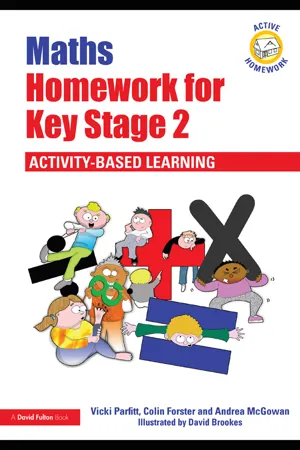
Maths Homework for Key Stage 2 is a unique resource for busy teachers – a selection of 'pencil-free', hands-on activities that teachers can use as extension activities or give to pupils as homework to do with members of their family or friends. Each of the activities encourages the pupils to learn through discussion and through practical activities utilising everyday resources.
Each activity is quick and easy for pupils and teachers to manage, and includes:
a learning aim
full, clear instructions and discussion points
tasks to develop collaboration and partnership between pupils, parents and teachers
photocopiable resources.
A refreshing approach for teachers and pupils, these activities will foster enthusiasm for learning and inspire pupils' interest in Maths.

Frequently asked questions
Yes, you can cancel anytime from the Subscription tab in your account settings on the Perlego website. Your subscription will stay active until the end of your current billing period. Learn how to cancel your subscription.
At the moment all of our mobile-responsive ePub books are available to download via the app. Most of our PDFs are also available to download and we're working on making the final remaining ones downloadable now. Learn more here.
Perlego offers two plans: Essential and Complete
Essential is ideal for learners and professionals who enjoy exploring a wide range of subjects. Access the Essential Library with 800,000+ trusted titles and best-sellers across business, personal growth, and the humanities. Includes unlimited reading time and Standard Read Aloud voice.
Complete: Perfect for advanced learners and researchers needing full, unrestricted access. Unlock 1.4M+ books across hundreds of subjects, including academic and specialized titles. The Complete Plan also includes advanced features like Premium Read Aloud and Research Assistant.
Both plans are available with monthly, semester, or annual billing cycles.
We are an online textbook subscription service, where you can get access to an entire online library for less than the price of a single book per month. With over 1 million books across 1000+ topics, we’ve got you covered! Learn more here.
Look out for the read-aloud symbol on your next book to see if you can listen to it. The read-aloud tool reads text aloud for you, highlighting the text as it is being read. You can pause it, speed it up and slow it down. Learn more here.
Yes! You can use the Perlego app on both iOS or Android devices to read anytime, anywhere — even offline. Perfect for commutes or when you’re on the go. Please note we cannot support devices running on iOS 13 and Android 7 or earlier. Learn more about using the app.
Yes, you can access Maths Homework for Key Stage 2 by Vicki Parfitt,David Brookes,Colin Forster,Andrea McGowan in PDF and/or ePUB format, as well as other popular books in Education & Education General. We have over one million books available in our catalogue for you to explore.
YEARS FIVE AND SIX Counting and understanding numbers
Finding the difference between positive and negative numbers
Aim
• To find the difference between positive and negative numbers.
Think of five pairs of negative numbers with a difference of 16, such as –220 and –44. Ask someone to check your answers and tell them what methods you used to think up the pairs of numbers.
Think about and discuss
The table below shows average temperatures in Celsius for the base camp of Mount Everest and its summit. Use the data to create three questions to ask someone and check to see if they answered correctly.
See Table
Here are some examples:
• What is the difference in temperature between the base camp and the summit of Everest in April?
• Which month has the greatest difference in temperature between the base camp and the summit?
Now ask your helper to make up three questions to ask you. Tell them what methods you used to work out the answers.
Extra challenge: what is the difference between 7 and –77? Make up some positive and negative number pairs to calculate the difference.
Counting in whole numbers and decimal steps, extending into negative numbers
Aim
• To count from any given number in whole numbers and decimal steps, extending beyond zero when counting backwards.
Count forwards or backwards in a sequence of your choice, missing out one of the numbers. Ask someone to spot the missing number.
Here are some examples:
• 0.7, 0.9, 1.1, 1.5, 1.7, 1.9 missing number =1.3
• 20, 15, 10, 5, –5, –10 missing number =0
• 1.2, 1.7, 2.7, 3.2, 3.7, 4.2 missing number =2.2
• 2.5, 2.25, 1.75, 1.5, 1.25 missing number =2.0
Can they explain the mistake and correct your number sequence?
Swap around so that you get a turn at spotting the mistake.
Move on to sequences of up to eight numbers to make this harder. Try making sequences that include negative numbers.
Think about and discuss
Which sequences do you find most difficult and why?
Use knowledge and understanding of numbers
Aim
• To use knowledge and understanding of nu...
Table of contents
Contents
Guidance for the teacher: how to use this ‘pencil-free’ homework book
YEARS THREE AND FOUR Using and applying maths
YEARS THREE AND FOUR Counting and understanding numbers
YEARS THREE AND FOUR Knowing and using number facts
YEARS THREE AND FOUR Calculations
YEARS THREE AND FOUR Understanding shape
YEARS THREE AND FOUR Measuring
YEARS THREE AND FOUR Handling data
YEARS FIVE AND SIX Counting and understanding numbers