- 496 pages
- English
- ePUB (mobile friendly)
- Available on iOS & Android
eBook - ePub
About this book
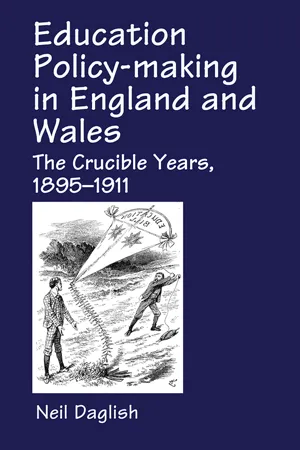
The lack of educational provision for the majority towards the and of the 19th century attracted the attention of education policy-makers who wished to remedy the situation. This overview draws on unpublished sources to describe and analyse the crucible years for 20th-century English education.
Information
Topic
EducationSubtopic
Comparative Education1
Education, politics and policy-makers
… from our Educational Minister we look for naught paltry, partial, peddling. Faltering and piecemeal reform will make confusion worse confounded, and arouse that discontent which it should be the means of pacifying.1
The collapse of Lord Rosebery’s Liberal government in the summer of 1895 had been anticipated for many months by observers of the British political scene. Beatrice Webb had noted a month before the government’s resignation, ‘the Haves thoroughly frightened’ (partly because of the death duties which had been introduced the previous November), ‘the Have-nots unsatisfied’ (by the lack of significant social reform).2 The dissatisfaction with the lack of progress in social reform came as no surprise to Webb for soon after the Liberals had come to power in 1892 under Gladstone she had observed that although the younger Cabinet members, including Asquith and Arthur Acland, were busy introducing administrative reforms there remained a tangible query as to whether the ‘old gang will not dictate a policy of evasion to all legislative proposals’.3 A year later her prognosis appeared to be correct when Acland, the radical Vice President of the Committee of Council on Education, privately vented his frustrations over the Cabinet’s preoccupation with Ireland and the correspondingly slow progress in initiating social reform. ‘Were the government’, he asked the Liberal Chief Whip, Tom Ellis, ‘straining ourselves and spending so much time to any real purpose? It is a miserably poor way to spend our lives unless we are really working for something which is real … ’4 Lord Rosebery’s succession as Premier after Gladstone retired in 1894 did little to boost the Cabinet’s morale, and by the beginning of 1895 Webb observed that with the exception of Acland ‘none of the Ministers are doing any work’. One Liberal, R.B. Haldane, believed the Cabinet were unable to free themselves from their lassitude and problems: the ‘Rot has set in … there is no hope now but to be beaten and then to reconstruct a new party’.5 The government lurched on for another six months until defeat over the supply of cordite for the army provided an excuse for resignation.
The change of government that followed their resignation, and was confirmed by victory in the subsequent General Election held in July, was accompanied by the usual critical appraisal in the press of the new Ministers and their future roles. Apart from having established a royal commission to investigate the administration of secondary education, the legacy of educational reform from Arthur Acland to his Conservative successor, Sir John Gorst, was small owing to the reasons cited. This meant that there was a danger that the education system would continue to trundle on into the future along well-worn grooves and impervious to the changing nature and needs of society. Thus much of the first debate on education in the new Parliament, one marked by an unusual degree of consensus, was spent in identifying key topics requiring urgent administrative or legislative resolution. The consensus view which emerged was matched by those being published in articles written by educationists and the list was substantial. The financial state of many elementary schools, the conditions of employment of their teachers, the plight of half-time pupils, the content and administration of secondary education as well as the nature of teacher training college facilities comprised the core problems.6 The need for substantial reforms was heightened by a growing awareness in parts of society that education was becoming a critical factor in the nation’s ability to survive the increasing economic competition with both Europe and the USA. This concern was intensified by a perception that the current system was not meeting the nation’s needs:
It was no longer possible to pass over the fact that a young Englishman on leaving school was intellectually two years behind a German of the same age with the consoling reflection that he made up in character what he lacked in information, and that, if more ignorant, he was better equipped for practical life. … A nation of amateurs was being forced to recognise that they could not compete with a nation of professionals.7
Much was thus expected from Gorst and the Duke of Devonshire, the Lord President, for the crucial questions they faced were: just how legitimate were these perceptions of the state of the nation’s education system and were the problems identified by the House and in the press the only serious ones afflicting it?
Surveying the development of the elementary education system over the 80 years since its inception, on a mass scale, in the first decade of the nineteenth century, one education administrator acknowledged that the system had been more of a growth, rather than having been created. It was, he believed,
the resultant of the action, not always harmonious, of various forces originating in the very depths of our national existence the outcome of which is a system differing in some of its most prominent features from any which is to be found elsewhere.8
One of the most active of these forces had been class and one invidious consequence had been that the provision of education for the majority of children, that is, those of the working classes, was both minimal and in accordance with the prevailing view of being for the poor. The absence of any government intervention, financial or otherwise, before 1833 meant that the provision of elementary education had been virtually the prerogative of voluntary agencies. The State’s general lassitude as far as education was concerned prevailed until the mid-century when it became more interventionist, as demonstrated by Robert Lowe’s Revised Code of 1862. The effects of this pattern of growth coupled with the consequences of the 1870 Education Act, whereby an alternative to the voluntary schools was created in the form of board schools, meant that for the final quarter of the century the system was characterised by certain features. The first was that the State’s supervisory role was based primarily upon its financial contribution to the system, rather than ‘any inherent right … to regulate the education of its future citizens’. Secondly, although the system was ostensibly a secular one, in reality it possessed a quite marked religious character, this being a distinctly denominational one in the majority of schools. And, finally, although there was a dual system of school management in existence after 1870 at least two-thirds of the elementary schools were controlled by private managers.9 Consequently, by the summer of 1895, while the provision of elementary education was no longer quite so minimalist in approach or content as it had been, it still carried the stigma of being essentially for the poor working classes.
The voluntary schools were in the main the educational offspring of religious bodies and had been, and still were, the main providers of elementary education. They were funded by a mixture of voluntary subscriptions and parliamentary grants, the major force among them being the Church of England (via the National Society) with some 1,850,545 children on average in its schools in 1895. The children present in other voluntary schools run by the British and Foreign School Society and other undenominational bodies (235,151), the Roman Catholic (230,392) and Wesleyan (129,724) authorities brought the total attending this type of school to 2,445,812. Virtually the sole providers of organised elementary education until 1870, the majority of voluntary schools had found it difficult to accept the competition provided in the subsequent 25 years by the board schools.
The growing impact of technological advances upon manufacturing processes which had previously relied on the use of child labour had, by the mid-nineteenth century, resulted in the loss of employment opportunities for many children. This phenomenon, when combined with the overall increase in numbers of school-age children as a result of the continued growth of the birth rate nationally, necessitated an increase in school places. At the same time, there was concern in some quarters of society not only about the dominance of the voluntary school organisations in the provision of elementary education and the quality of education they were providing but also about the poor attendance statistics. The need to address these problems fell to Gladstone’s first government, with W.E. Forster as Minister of Education. The solution, contained in the 1870 Education Act, had been to establish ad hoc school boards in either boroughs or civil parishes after the voluntary agencies had been given time to remove the deficit in places. Originally intended to fill the gaps left in the voluntary school system, the board schools had not taken long to become the competitors of, rather than complementary to, the voluntary schools, especially in many urban areas. In 1883 the board schools were educating 1,028,904 pupils as against the 2,098,310 attending voluntary schools and by 1895 the gap had diminished so that 5,316 board schools contained 1,879,218 children compared with the 2,445,812 in 14,484 voluntary schools.10 This phenomenal growth rate of 14.5 per cent per annum since 1872 was the consequence of a combination of funding, curricular emphasis and demography.
Like the voluntary schools, the board schools were eligible for parliamentary grants based upon the numbers of children in average attendance each year plus, until 1895, the pupils’ academic achievements in annual examinations administered under the payment by results scheme introduced in 1862 into the Education Department’s Annual Code by the Vice President, Robert Lowe. But where the voluntary schools had to make up the shortfall between their expenditure and the parliamentary grant by voluntary subscriptions, the school boards had recourse to rate funding. By 1895 the board schools were receiving an income of 19s 8d per child in average attendance from the rates while the average income per child in the voluntary schools from subscriptions was 6s 9d. As the board schools’ growth rate had continued on its undiminishing path since 1872, especially in the urban areas, epithets such as ‘omnivorous’, ‘extravagant’ or even ‘palatial’ had been used by their opponents to describe both their expenditure and schools. But such generalisations were misleading for the rural school boards tended to be small and suffered, like their voluntary counterparts, from financial problems. This situation reflected the critical fact that a school board’s rate was totally dependent upon the rating of the district in which it was located. Thus while London and Liverpool could raise £140,000 and £13,200 respectively from a penny rate, the corresponding sums for Clayhanger (Devon) and Ashen (Essex) were £714s and £63s. Differentials in government funding compounded this problem; whereas London needed to raise only £1 9s from rate aid for each pound from the Exchequer to complete its school board’s financial needs, Great Bentley in Essex had to find £14 on the same basis.11 The rate demands arising from these rural school boards’ educational activities were such that if, as one HMI reported from Cheshire, the average farmer was forced to choose between the Colorado Beetle and a School Board ‘he wouldn’t know which way to go’.
The majority of school boards were small – out of a total of 2470 boards in 1895 some 2,293 were parish boards, and of these 1,696 had only five members each and 469 seven members each but, none the less, the majority of board school pupils lived in urban areas.12 It was not surprising therefore, given their financial circumstances, that the creation and growth of a new type of secondary school, the higher grade school, offering a more vocational and modern type of secondary education than that of the traditional secondary schools, should have been almost entirely the preserve of the urban school boards. But at the same time, and following the rationalisation of local government authorities which had been instituted by the Local Government Act of 1888, both the composition and attitudes of some of the school boards had become a source of concern in some parts of society. The substantial rate demands of many boards, the increasing unwillingness of some to be publicly accountable for their expenditure and demands, the absence of any special qualifications needed by candidates for board elections, triennial elections and the use of the cumulative vote had reinforced the increasing division in society between those in favour of collectivisation and those wishing to maintain ad hoc bodies in local government. This was reinforced by the London School Board election of 1894 in which an acrimonious dispute over the religious instruction provided in the Board’s schools dominated. The responses of the factions involved, including the teachers, the Anglicans and the Nonconformists, had revealed some of the tension that existed about the elementary school curriculum and the place of re...
Table of contents
- Cover
- Half Title
- Title Page
- Copyright Page
- Table of Contents
- Preface
- Acknowledgements
- List of Illustrations
- Abbreviations
- 1. Education, politics and policy-makers
- 2. Tory democracy and education
- 3. A Swiss model for England?
- 4. Administrative pincers
- 5. The 1902 Education Act – stage one
- 6. The 1902 Act – stage two
- 7. New broom at the Board
- 8. Some little local difficulties
- 9. The voice of the people?
- 10. New lamps for old
- 11. And what of the children?
- 12. An indissoluble partnership? The State, the child and health
- 13. The end of the beginning
- Epilogue
- Select Bibliography
- Index
Trusted by 375,005 students
Access to over 1.5 million titles for a fair monthly price.
Study more efficiently using our study tools.
Frequently asked questions
Yes, you can cancel anytime from the Subscription tab in your account settings on the Perlego website. Your subscription will stay active until the end of your current billing period. Learn how to cancel your subscription
No, books cannot be downloaded as external files, such as PDFs, for use outside of Perlego. However, you can download books within the Perlego app for offline reading on mobile or tablet. Learn how to download books offline
Perlego offers two plans: Essential and Complete
- Essential is ideal for learners and professionals who enjoy exploring a wide range of subjects. Access the Essential Library with 800,000+ trusted titles and best-sellers across business, personal growth, and the humanities. Includes unlimited reading time and Standard Read Aloud voice.
- Complete: Perfect for advanced learners and researchers needing full, unrestricted access. Unlock 1.5M+ books across hundreds of subjects, including academic and specialized titles. The Complete Plan also includes advanced features like Premium Read Aloud and Research Assistant.
We are an online textbook subscription service, where you can get access to an entire online library for less than the price of a single book per month. With over 1.5 million books across 990+ topics, we’ve got you covered! Learn about our mission
Look out for the read-aloud symbol on your next book to see if you can listen to it. The read-aloud tool reads text aloud for you, highlighting the text as it is being read. You can pause it, speed it up and slow it down. Learn more about Read Aloud
Yes! You can use the Perlego app on both iOS and Android devices to read anytime, anywhere — even offline. Perfect for commutes or when you’re on the go.
Please note we cannot support devices running on iOS 13 and Android 7 or earlier. Learn more about using the app
Please note we cannot support devices running on iOS 13 and Android 7 or earlier. Learn more about using the app
Yes, you can access Education Policy Making in England and Wales by Neil Daglish in PDF and/or ePUB format, as well as other popular books in Education & Comparative Education. We have over 1.5 million books available in our catalogue for you to explore.