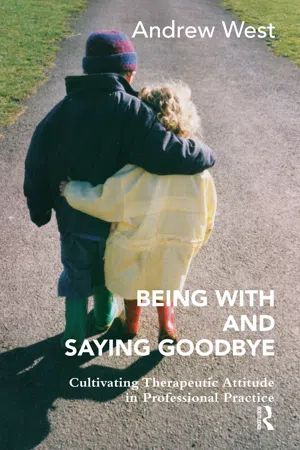
At a time of increasing financial pressure on families - as well as the services that support them - children are doubly disadvantaged. The economical mass-provision of proven approaches appears to be an unquestionable strategy. In this frank and revealing book, written by an experienced child and adolescent psychiatrist of eclectic and questioning persuasion, the argument is made that we are travelling in the wrong direction. A blinkered pursuit of empirical evidence and uniform delivery is leading us away from any sensitive and reciprocal relationship between caring professionals and the young individuals whose interests they are there to serve. Drawing on attachment and psychodynamic approaches, as well as systemic, values-based and mindful practice, Being With and Saying Goodbye describes an attitude that should be the prerequisite and medium of all child and adolescent work that has therapeutic intention. Unacknowledged, even reviled, this ghost in the machine is threatened with extinction.
eBook - ePub
Being With and Saying Goodbye
Cultivating Therapeutic Attitude in Professional Practice
- 208 pages
- English
- ePUB (mobile friendly)
- Available on iOS & Android
eBook - ePub
About this book
Information
Chapter One
Being and being with
In the chapters that follow I shall describe what I believe the attitude of being with might look like throughout the patient’s journey but, first, I must try to explain what I mean by being with someone. When Szczeklik tells us that, “Being there is the doctor’s ultimate duty,” he is probably referring to the end stages of illness, but he is clear that the challenge to the doctor is most acute when there is no way to remove suffering (2005, p. 86). At these times, compassionate human presence is invaluable. Yet simply being there can be the biggest challenge of all. Not being able to help (much) is commoner than we would like to admit. We prefer to identify something in the patient’s experience that we can change, than to admit that what she is suffering from is something that we cannot significantly alter.
I met many patients before I developed the ability to be myself in their presence, let alone the ability to be with them in the sense that I hope to explain. The latter, in particular, demanded of me the capacity to be more or less comfortable with my own feelings, thoughts, and reactions, and to manage them appropriately.
Meeting patients no doubt threw me off centre somewhat, but being pushed off centre is an important part of finding an equilibrium. My encounters with others have probably served rhythmically to draw my attention to the value of re-establishing my ability to be. In the last ten years or so I have found that patients and their families present less of a challenge in this regard, than do other elements of my work as a consultant psychiatrist, such as committee meetings, actuarial demands, service development, and suchlike. This is probably because I find the agenda relatively clear in the clinical encounter, with one party asking the other for help, and because the presence of the child is conducive to play.
There is no doubt that any confusion in the account that follows reflects a degree of confusion in my thinking. I excuse myself from hammering this out with ruthless precision and am inclined to the view that more would be lost than gained through elaborating in a technical or highfalutin way, or attempting to pin down the concepts to any greater degree. Words can be used to synchronise experience between people up to a point, but from that point on, further details result in the drawing of distinctions and the redevelopment of distance. Instead I shall consider this confusion to be an example of “potential space” and I shall value it as an opportunity to play (Winnicott, 1971a, pp. 126–129).
This potential space is uncertain, even in so far as it exists. It is there, yet is not there, or it might be. It is potential in this sense of potentially existing, as well as being a potent space, and one in which a person’s potential begins to be realised. In this elusive space we play—and grow. If the potential space is too successfully defined, it ceases to be potential. In becoming actual it ceases to be.
So you are there, trying to understand. And here am I, trying to be understood. Between us something is developing. It has not yet taken shape and it does not yet bridge the gap between us. You may be already impatient or bored, but I am suggesting that we play in or with this space.
Perhaps it is the challenge of being with others that stimulates the development of our ability to be ourselves, and being with ourselves might be the training ground for both. Let us leave it there and move on. Hopefully the sections that follow will form stepping-stones in this primal confusion.
Having and doing
Erich Fromm made the argument for a less acquisitive approach to life: being in contrast to having (Fromm, 1976). This contrast and argument will seem familiar to most of us now though we have almost certainly become even more materially acquisitive than we were when he set the distinction out so eloquently. I shall take it for granted that you, the reader, agree that there are more important things to human existence than the acquisition of material wealth, though we should acknowledge that for many this may not be a self-evident truth.
There is not only having. We need to think about the distinction between having, doing, and being. In a sense, they are all ways of being. I shall also briefly explore being, being oneself, being with oneself, and being with another, in order to be able to continue, hopefully with the idea of being with in a clinical setting, which is the purpose of the exercise.
Making these distinctions is fraught with danger. I had a clear sense of what I meant by being with and did not think about it very much until I came to write this book. The problem is that, in putting it into the necessary words, it is easy to become distracted by the semantics and then get confused. I shall take these distinctions in turn and do what I can with them as briefly as possible.
Having and doing are of obvious importance when it comes to the ability to meet relatively basic needs. If one needs water one can walk to find it or one can pay someone to provide it. The same applies to shelter, warmth, and food. The ability for either wealth or activity to secure the meeting of needs of a less tangible nature is more tenuous and complex. We are familiar with the adage “money can’t buy you love”, and most of us are aware of the pitfall of slavishly performing to secure the admiration of another, though we often struggle to avoid it.
Having, once it exceeds the necessary modicum, may be rather like an addiction; acquisition satisfying a superficial need in the short term but leaving more profound and less understood needs unmet. Often it leaves us with an additional sense of having sullied ourselves in some way.
I suspect that, a little like a phobia of the dark that began through biological preparedness derived in a context where it was functional, a functional drive to obtain some degree of security in an insecure environment becomes exaggerated and compulsive. Excessive having and excessive doing are probably to do with some sort of insecurity.
Very often, in attempting to live a more virtuous and less acquisitive life, we launch ourselves into a life of doing, perhaps accumulating virtue or achievement credits instead of material wealth. Having and doing are not the same, but there are some parallels.
Being and doing
I am not convinced that there is a distinction between being and doing, the classification of to be as a verb suggesting that we cannot be without doing something, but I do think that it is useful to behave as though these two things are different, and in order to make sense of this book it will be essential to do so. I shall muddy the water first, and then let it settle.
When Winnicott said that the individual has “to reach being before doing” (1971a, p. 152), the emphasis might just as well have been on the word “individual”. He went on to say that unless “I am” precedes “I do”, the latter has no meaning. He acknowledges, though, the pre-separation, merged state of the baby-plus-mother or baby-plus-world and, in purely objective, mechanical terms we would probably all agree that the baby is doing things, such as crying, defecating, feeding, etc., before it has any sense of itself as a subject doing those things. I shall suggest that, for the objective baby to do anything, it has to exist. On the other hand, coming into existence could be regarded as the first thing that it does. Then, before it can be a subject in its own experience and action, it has to develop a sense of “I”. It does this by an iterative process of being and doing, gradually accruing subjectivity along the way.
But in this book I am talking about clinicians who are hopefully at a much later stage of development. We have to assume a subjective state of “I”-ness, and in this world I find it useful to draw some sort of distinction between being and doing. An illustration may help to move us on.
My mother was not in the least materialistic, but she worked very hard as a single-handed rural general practitioner and then, after her retirement, worked very hard at a great number of other things. It seemed that it was only old age that gave her permission to simply be and, even then, she found it hard.
Anthony Storr wrote a short article in the Oxford Medical School Gazette in the 1980s entitled Don’t just do something, listen! He made the point that it can often be very important, though difficult, to not do something, particularly when we are in the presence of hardship or worry and have cast ourselves in the role of helper. We do things to neutralise discomfort. If someone comes to us in discomfort a tension is created which it is our tendency to attempt to reduce.
Being, though, is not about not doing anything, which is probably impossible, but about being aware of what we are doing and then taking ownership, wherever possible and appropriate, of the choice to do or to not do. Our experience and action in the here and now become the focus of our open-minded and non-judgemental attention. Nor is it about abolishing automatic action, because there will be automatic actions that rightly remain so. Breathing would be one. It is sufficient that we become aware that some of the things we do are automatic and should probably remain so. Other activities, though, may have become automatic in a less helpful sense, and we should identify them as outcomes of choice and therefore amenable to choosing.
An ability to discern the shift from being to doing is a good way of protecting oneself from compulsive action.
Before leaving the doing mode of existence, there is the matter of how many things we try to do. I once attended a presentation by a practitioner of the Alexander technique. She spoke whilst juggling three ripe plums and told us that she was doing this partly so that we would remember her own talk over the others (I have remembered it, so far, for about thirty years), but also so that we would understand that it is easy to do two things at once, provided it is only two. If there is something that we really want or need to do, it is likely that we will do it better if we are not simultaneously and compulsively doing a large number of other things. Being able to reduce what we do in the moment is a way, not only of choosing what we do, but also of doing things properly.
Ways of being
Being is something I cannot help doing (sic.). I believe I have a level of being that is the same as that of an animal, a stone, or the weather. Whether or not I think, I am. I can think as much as I like about my existence, but doing so does not make my existence any more real.
So much for being. I cannot avoid it, whatever I am doing, or whatever mode I am in. I shall return to being mode in a moment, but shall for the time being say that it is a state in which striving (after truth, action, attainment, etc.) is minimised. The Zen tradition has handed down the instruction “just sit”. I suggest that the instruction for being mode is “just be”. Because it doesn’t come very naturally to us, it requires practice, and this contains a paradox that I shall come back to.
One can consider what it is to be oneself and to be with another. I shall slip past “being oneself” and suggest that there is some striving therein and that it is, therefore, not the same as “just being”. If I can be anything other than myself (which the idea of being myself suggests) then the idea must involve things like sense of identity, image, expression, consistency, motivation, etc., and these are all judgements, actions, and concepts. In other words, they are about doing and thinking.
Incidentally, being a psychiatrist, like being anything else that contributes to our self-perception, quickly becomes more an example of clinging-on than of being. Being a specific thing is more like doing or having because it requires temporal stability.
We have left behind, then, both “being” and “being myself”. Now for being with: I do not simply mean “existing in proximity to” because, like “being” this is of little interest to me in the current context. It is either inevitable, or its definition rests on physical measures of distance. Also I want to be able, if only briefly, to think about being with myself, and this would be meaningless unless it included more than simple physical proximity. When I talk about “being with” I am referring to being in being mode in the company of another. I shall return to this after a brief detour through two influential areas derived from Eastern spiritual philosophy and practice.
Mindfulness, the Tao, and a fresh breeze from the east
It is probably necessary for there to be a taboo on overt religion in a uniformly delivered health service, simply because of the power of words to divide people when adhered to with fervour. Alain de Botton has described rather elegantly how useful religious values could be if only the extrapolated fine print could be passed over or taken more lightly (de Botton, 2012). It is essential that the team pulls together for the sake of the patient population and if talking about a particular topic were to split or distract the team, then it would be better for it to be avoided. This is slightly ironic, as the religions, when they are not set against one another, share a number of values, perhaps most notably variations on a theme of altruism, which are particularly well suited to serving a culture of healthcare.
Mindfulness has made an interesting and welcome breakthrough, however. It can be described as the practice of a non-judgemental awareness of what you are doing from moment to moment, whether that be breathing, hearing, remembering, worrying, planning, etc. Despite its spiritual or religious connotations (it is broadly derived from Buddhist meditation), a predominantly scientific mental health community has adopted it, no doubt because it has been shown by methods that pass scientific muster to have outcomes of utilitarian value (Williams, Teasdale, Segal & Kabat-Zinn, 2007). The paradox is that the practice itself eschews the utilitarian motive. Mindfulness has been described as maintaining oneself in the being mode (Kabat-Zinn, 1991, p. 20). If one practices mindfulness in order to achieve some end, then one is thinking, trying, and future-oriented; one is neither non-judgemental, nor in the here-and-now. There are some things that you are more likely to have, the less effort you put into getting them.
The other “Eastern” influence that has impressed me and provided me with a tool is Taoism. Tao is “the way”, not in the sense of a code of practice, but in the sense of inevitability, sometimes called the “water-course way” (Watts, 1975). I am inclined to equate it with “god-or-nature” (Spinoza, 1994). The Taoist approach helps us in our attempts to understand something that seems essential and yet is elusive, and it does so by pointing out that efforts to capture the essence of running water in a bucket result in failure and disappointment. The opening words of the Tao Te Ching are usually translated along the lines of, “The Tao that is described is not the true (or eternal) Tao” (Mears, 1922, p. 22; Watts, 1975, p. 38–39). Time and again, I shall argue that our attempts to define, measure, and reproduce in specific terms what it is that we do have drawn us away from its most important and human aspect; in defining what we do we miss the point of what we do. Perhaps this is nothing more than a stating of the observer effect which applies from the cosmic to the human: if you observe or measure something, then you are likely to alter its nature.
Of these two ideas, both of which appeal to my thinking, it is mindfulness that I practice. I shall not attempt to teach it in this text, but can recommend it with few reservations. Its emphasis on the suspension of judgement has resonance elsewhere in mental health, for example, the curiosity and non-expert positions of systemic practice (Jones, 1993), and can, I think, usefully be expressed as “beginner’s mind” (Suzuki, 1970).
Being with
I have described being with as being in the company of another. This other can be an idea as well as a person, and it can be helpful to think of that including oneself. One can meditate, or one can meditate on something. That something could be an idea or it could be a person. They may be in the room with me but, more importantly, they are within the realm of my mindful attention. I have them in mind.
The possibility of being with oneself is important in the therapeutic setting because we are all human, with failings that it would be hubristic to believe we could simply leave outside of the room. Being aware of one’s self, with it’s needs, fears, etc., is necessary, in my view, even if only to enable us to let those things be.
If one is to be with a number of things (including, for example, a patient) at the same time, it goes without saying that this will include conflicting viewpoints and interests. Valuing these without bei...
Table of contents
- Cover
- Half Title
- Title
- Copyright
- Contents
- ACKNOWLEDGEMENTS
- ABOUT THE AUTHOR
- INTRODUCTION
- CHAPTER ONE Being and being with
- CHAPTER TWO The intrusion of reality
- CHAPTER THREE The nature of evidence
- CHAPTER FOUR Uncertainty, the mother (or father) of hope
- CHAPTER FIVE Thinking
- CHAPTER SIX Greeting and engagement
- CHAPTER SEVEN Assessment and diagnosis
- CHAPTER EIGHT Treatment
- CHAPTER NINE Saying goodbye
- EPILOGUE
- A TWO-PAGE PRESCRIPTION FOR BEING WITH AND SAYING GOODBYE IN CHILD AND ADOLESCENT MENTAL HEALTH SERVICES
- REFERENCES
- INDEX
Trusted by 375,005 students
Access to over 1.5 million titles for a fair monthly price.
Study more efficiently using our study tools.
Frequently asked questions
Yes, you can cancel anytime from the Subscription tab in your account settings on the Perlego website. Your subscription will stay active until the end of your current billing period. Learn how to cancel your subscription
No, books cannot be downloaded as external files, such as PDFs, for use outside of Perlego. However, you can download books within the Perlego app for offline reading on mobile or tablet. Learn how to download books offline
Perlego offers two plans: Essential and Complete
- Essential is ideal for learners and professionals who enjoy exploring a wide range of subjects. Access the Essential Library with 800,000+ trusted titles and best-sellers across business, personal growth, and the humanities. Includes unlimited reading time and Standard Read Aloud voice.
- Complete: Perfect for advanced learners and researchers needing full, unrestricted access. Unlock 1.5M+ books across hundreds of subjects, including academic and specialized titles. The Complete Plan also includes advanced features like Premium Read Aloud and Research Assistant.
We are an online textbook subscription service, where you can get access to an entire online library for less than the price of a single book per month. With over 1.5 million books across 990+ topics, we’ve got you covered! Learn about our mission
Look out for the read-aloud symbol on your next book to see if you can listen to it. The read-aloud tool reads text aloud for you, highlighting the text as it is being read. You can pause it, speed it up and slow it down. Learn more about Read Aloud
Yes! You can use the Perlego app on both iOS and Android devices to read anytime, anywhere — even offline. Perfect for commutes or when you’re on the go.
Please note we cannot support devices running on iOS 13 and Android 7 or earlier. Learn more about using the app
Please note we cannot support devices running on iOS 13 and Android 7 or earlier. Learn more about using the app
Yes, you can access Being With and Saying Goodbye by Andrew West in PDF and/or ePUB format, as well as other popular books in Psychology & Developmental Psychology. We have over 1.5 million books available in our catalogue for you to explore.