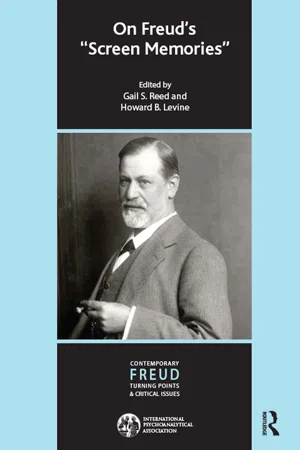
The concept of "screen memories" was introduced by Freud for the first time in his 1899 paper, reprinted here in its entirety. Although the clinical interest in "screen memories" has perhaps diminished in recent analytic discussion, there is much to be gained from revisiting and re-examining both the phenomenon and Freud's original paper within a contemporary context. To this end, the authors have invited contributions from eight leading psychoanalysts on the current meaning and value to them of the screen memory concept. These comments come from contemporary psychoanalysts practicing in Italy, Francophone Switzerland, Argentina, Israel, and the United States of America, each of whom has been trained in one or another of a variety of psychoanalytic traditions, among which are ego psychology, a French version of Freud, an American version of Lacan and at least two variants of Kleinian thought - one British and one Latin American.
- 224 pages
- English
- ePUB (mobile friendly)
- Available on iOS & Android
eBook - ePub
On Freud's Screen Memories
About this book
Information
PART I
“Screen memories” (1899a)
EDITOR’S NOTE
ÜBER DEGKERINNERUNGEN
(a) GERMAN EDITIONS:
1899 | Mschr. Psychiat, Neurol., 6 (3), 215–30. (September.) |
1925 | G.S., 1, 465–88. |
1952 | G.W., 1, 531–54. |
(b) ENGLISH TRANSLATION:
’Screen Memories’ | |
1950 | C.P., 5, 47–69. (Tr. James Strachey.) |
The present translation is a slightly revised reprint of that published in 1950.
An unpublished letter of Freud’s to Fliess of May 25, 1899, tells him that on that date this paper was sent in to the editor of the periodical in which it appeared later in the year. He adds that he was immensely pleased by it during its production, which he takes as a bad omen for its future fate.
The concept of ‘screen memories’ was here introduced by Freud for the first time. It was no doubt brought into focus by his consideration of the particular instance which occupies the major part of the paper and which had been alluded to in a letter to Fliess of January 3, 1899 (Letter 101). Nevertheless the topic was closely related to several others which had been occupying his mind for many months previously—in fact ever since he had embarked on his self-analysis in the summer of 1897—problems concerning the operation of memory and its distortions, the importance and raison d’être of phantasies, the amnesia covering our early years, and, behind all this, infantile sexuality. Readers of the Fliess letters will find many approaches to the present discussion. See, for instance, the remarks on phantasies in Draft M of May 25, 1897 and in Letter 66 of July 7, 1897. The screen memories analysed by Freud at the end of Chapter IV of the 1907 edition of The Psychopathology of Everyday Life (1901b) go back to this same summer of 1897.
It is a curious thing that the type of screen memory mainly considered in the present paper—one in which an early memory is used as a screen for a later event—almost disappears from later literature. What has since come to be regarded as the regular type—one in which an early event is screened by a later memory—is only barely alluded to here, though it was already the one almost exclusively dealt with by Freud only two years later, in the chapter of The Psychopathology of Everyday Life just mentioned. (See also footnote, p. 322.)
The intrinsic interest of this paper has been rather undeservedly overshadowed by an extraneous fact. It was not difficult to guess that the incident described in it was in fact an autobiographical one, and this became a certainty after the appearance of the Fliess correspondence. Many of the details, however, can be traced in Freud’s published writings. Thus the children in the screen memory were in fact his nephew John and his niece Pauline, who appear at several points in The Interpretation of Dreams (1900a). (Cf, for instance, Standard Ed., 5, 424–5, 483 and 486.) These were the children of his much older halfbrother, who is mentioned in Chapter X of The Psychopathology of Everyday Life (1901b), ibid., 6, 227. This brother, after the break-up of the family at Freiberg when Freud was three, had settled in Manchester, where Freud visited him at the age of nineteen—not twenty, as is implied here (p. 314)—a visit alluded to in the same passage in The Psychopathology of Everyday Life and also in The Interpretation of Dreams (ibid., 5, 519). His age at the time of his first return to Freiberg was also a year less than is represented here. He was sixteen, as he tells us in ‘Letter to the Burgomaster of Příbor’ (1931e), ibid., 21, 259. We learn from this source too that the family with whom he stayed was named Fluss, and it was one of the daughters of this family, Gisela, who was the central figure of the present anecdote. The episode is fully described in the first volume of Ernest Jones’s biography (1953, 27–9 and 35–7).1
SCREEN MEMORIES
IN the course of my psycho-analytic treatment of cases of hysteria, obsessional neurosis, etc., I have often had to deal with fragmentary recollections which have remained in the patient’s memory from the earliest years of his childhood. As I have shown elsewhere,1 great pathogenic importance must be attributed to the impressions of that time of life. But the subject of childhood memories is in any case bound to be of psychological interest, for they bring into striking relief a fundamental difference between the psychical functioning of children and of adults. No one calls in question the fact that the experiences of the earliest years of our childhood leave ineradicable traces in the depths of our minds. If, however, we seek in our memories to ascertain what were the impressions that were destined to influence us to the end of our lives, the outcome is either nothing at all or a relatively small number of isolated recollections which are often of dubious or enigmatic importance. It is only from the sixth or seventh year onwards—in many cases only after the tenth year—that our lives can be reproduced in memory as a connected chain of events. From that time on, however, there is also a direct relation between the psychical significance of an experience and its retention in the memory. Whatever seems important on account of its immediate or directly subsequent effects is recollected; whatever is judged to be inessential is forgotten. If I can remember an event for a long time after its occurrence, I regard the fact of having retained it in my memory as evidence of its having made a deep impression on me at the time. I feel surprised at forgetting something important; and I feel even more surprised, perhaps, at remembering something apparently indifferent.
It is only in certain pathological mental conditions that the relation holding in normal adults between the psychical significance of an event and its retention in memory once more ceases to apply. For instance, a hysteric habitually shows amnesia for some or all of the experiences which led to the onset of his illness and which from that very fact have become important to him and, apart from that fact, may have been important on their own account. The analogy between pathological amnesia of this kind and the normal amnesia affecting our early years seems to me to give a valuable hint at the intimate connection that exists between the psychical content of neuroses and our infantile life.
We are so much accustomed to this lack of memory of the impressions of childhood that we are apt to overlook the problem underlying it and are inclined to explain it as a self-evident consequence of the rudimentary character of the mental activities of children. Actually, however, a normally developed child of three or four already exhibits an enormous amount of highly organized mental functioning in the comparisons and inferences which he makes and in the expression of his feelings; and there is no obvious reason why amnesia should overtake these psychical acts, which carry no less weight than those of a later age.
Before dealing with the psychological problems attaching to the earliest memories of childhood, it would of course be essential to make a collection of material by circularizing a fairly large number of normal adults and discovering what kind of recollections they are able to produce from these early years. A first step in this direction was taken in 1895 by V, and C. Henri, who sent round a paper of questions drawn up by them. The highly suggestive results of their questionnaire, which brought in replies from 123 persons, were published by the two authors in 1897. I have no intention at present of discussing the subject as a whole, and I shall therefore content myself with emphasizing the few points which will enable me to introduce the notion of what I have termed ‘screen memories’.
The age to which the content of the earliest memories of childhood is usually referred back is the period between the ages of two and four. (This is the case with 88 persons in the series observed by the Henris.) There are some, however, whose memory reaches back further—even to the time before the completion of their first year; and, on the other hand, there are some whose earliest recollections go back only to their sixth, seventh, or even eighth year. There is nothing at the moment to show what else is related to these individual differences; but it is to be noticed, say the Henris, that a person whose earliest recollection goes back to a very tender age—to the first year of his life, perhaps—will also have at his disposal further detached memories from the following years, and that he will be able to reproduce his experiences as a continuous chain from an earlier point of time—from about his fifth year—than is possible for other people, whose first recollection dates from a later time. Thus not only the date of the appearance of the first recollection but the whole function of memory may, in the case of some people, be advanced or retarded.
Quite special interest attaches to the question of what is the usual content of these earliest memories of childhood. The psychology of adults would necessarily lead us to expect that those experiences would be selected as worth remembering which had aroused some powerful emotion or which, owing to their consequences, had been recognized as important soon after their occurrence. And some indeed of the observations collected by the Henris appear to fulfil this expectation. They report that the most frequent content of the first memories of childhood are on the one hand occasions of fear, shame, physical pain, etc., and on the other hand important events such as illnesses, deaths, fires, births of brothers and sisters, etc. We might therefore be inclined to assume that the principle governing the choice of memories is the same in the case of children as in that of adults. It is intelligible—though the fact deserves to be explicitly mentioned—that the memories retained from childhood should necessarily show evidence of the difference between what attracts the interest of a child and of an adult. This easily explains why, for instance, one woman reports that she remembers a number of accidents that occurred to her dolls when she was two years old but has no recollection of the serious and tragic events she might have observed at the same period.
Now, however, we are met by a fact that is diametrically opposed to our expectations and cannot fail to astonish us. We hear that there are some people whose earliest recollections of childhood are concerned with everyday and indifferent events which could not produce any emotional effect even in children, but which are recollected (too clearly, one is inclined to say)1 in every detail, while approximately contemporary events, even if, on the evidence of their parents, they moved them intensely at the time, have not been retained in their memory. Thus the Henris mention a professor of philology whose earliest memory, dating back to between the ages of three and four, showed him a table laid for a meal and on it a basin of ice. At the same period there occurred the death of his grandmother which, according to his parents, was a severe blow to the child. But the professor of philology, as he now is, has no recollection of this bereavement; all that he remembers of those days is the basin of ice. Another man reports that his earliest memory is an episode upon a walk in which he broke off a branch from a tree. He thinks he can still identify the spot where this happened. There were several other people present, and one of them helped him.
The Henris describe such cases as rare. In my experience, based for the most part, it is true, on neurotics, they are quite frequent. One of the subjects of the Henris’ investigation made an attempt at explaining the occurrence of these mnemic images, whose innocence makes them so mysterious, and his explanation seems to me very much to the point. He thinks that in such cases the relevant scene may perhaps have been only incompletely retained in the memory, and that that may be why it seems so unenlightening: the parts that have been forgotten probably contained everything that made the experience noteworthy. I am able to confirm the truth of this view, though I should prefer to speak of these elements of the experience being omitted rather than forgotten. I have often succeeded, by means of psycho-analytic treatment, in uncovering the missing portions of a childhood experience and in thus proving that when the impression, of which no more than a torso was retained in the memory, had been restored to completeness, it did in fact agree with the presumption that it is the most important things that are recollected. This, however, provides no explanation of the remarkable choice which memory has made among the elements of the experience. We must first enquire why it should be that precisely what is important is suppressed and what is indifferent retained; and we shall not find an explanation of this until we have investigated the mechanism of these processes more deeply. We shall then form a notion that two psychical forces are concerned in bringing about memories of this sort. One of these forces takes the importance of the experience as a motive for seeking to remember it, while the other—a resistance—tries to prevent any such preference from being shown. These two opposing forces do not cancel each other out, nor does one of them (whether with or without loss to itself) overpower the other. Instead, a compromise is brought about, somewhat on the analogy of the resultant in a parallelogram of forces. And the compromise is this. What is recorded as a mnemic image is not the relevant experience itself—in this respect the resistance gets its way; what is recorded is another psychical element closely associated with the objectionable one—and in this respect the first principle shows its strength, the principle which endeavours to fix important impressions by establishing reproducible mnemic images. The result of the conflict is therefore that, instead of the mnemic image which would have been justified by the original event, another is produced which has been to some degree associatively displaced from the former one. And since the elements of the experience which aroused objection were precisely the important ones, the substituted memory will necessarily lack those important elements and will in consequence most probably strike us as trivial. It will seem incomprehensible to us because we are inclined to look for the reason for its retention in its own content, whereas in fact that retention is due to the relation holding between its own content and a different one which has been suppressed. There is a common saying among us about shams, that they are not made of gold themselves but have lain beside something that is made of gold.1 The same simile might well be applied to some of the experiences of childhood which have been retained in the memory.
There are numerous possible types of case in which one psychical content is substituted for another, and these come about in a variety of psychological constellations. One of the simplest of these cases is obviously that occurring in the childhood memories with which we are here concerned—the case, that is, where the essential elements of an experience are represented in memory by the inessential elements of the same experience. It is a case of displacement on to something associated by continuity; or, looking at the process as a whole, a case of repression accompanied by the substitution of something in the neighbourhood (whether in space or time), I have elsewhere1 had occasion to describe a very similar instance of substitution which occurred in the analysis of a patient suffering from paranoia. The woman in question hallucinated voices, which used to repeat long passages from Otto Ludwig’s novel Die Heiterethei to her. But the passages they chose were the most trifling and irrelevant in the book. The analysis showed, however, that there were other passages in the same work which had stirred up the most distressing thoughts in the patient. The distressing affect was a motive for putting up a defence against them, but the motives in favour of pursuing them further were not to be suppressed. The result was a compromise by which the innocent passages emerged in the patient’s memory with pathological strength and clarity. The process which we here see at work—conflict, repression, substitution involving a compromise—returns in all psychoneurotic symptoms and gives us...
Table of contents
- Cover
- Half Title
- Title Page
- Copyright Page
- Table of Contents
- CONTEMPORARY FREUD
- ACKNOWLEDGEMENTS
- EDITORS AND CONTRIBUTORS
- PART I “Screen memories” (1899a)
- PART II Discussion of “Screen memories”
- REFERENCES
- INDEX
Trusted by 375,005 students
Access to over 1.5 million titles for a fair monthly price.
Study more efficiently using our study tools.
Frequently asked questions
Yes, you can cancel anytime from the Subscription tab in your account settings on the Perlego website. Your subscription will stay active until the end of your current billing period. Learn how to cancel your subscription
No, books cannot be downloaded as external files, such as PDFs, for use outside of Perlego. However, you can download books within the Perlego app for offline reading on mobile or tablet. Learn how to download books offline
Perlego offers two plans: Essential and Complete
- Essential is ideal for learners and professionals who enjoy exploring a wide range of subjects. Access the Essential Library with 800,000+ trusted titles and best-sellers across business, personal growth, and the humanities. Includes unlimited reading time and Standard Read Aloud voice.
- Complete: Perfect for advanced learners and researchers needing full, unrestricted access. Unlock 1.5M+ books across hundreds of subjects, including academic and specialized titles. The Complete Plan also includes advanced features like Premium Read Aloud and Research Assistant.
We are an online textbook subscription service, where you can get access to an entire online library for less than the price of a single book per month. With over 1.5 million books across 990+ topics, we’ve got you covered! Learn about our mission
Look out for the read-aloud symbol on your next book to see if you can listen to it. The read-aloud tool reads text aloud for you, highlighting the text as it is being read. You can pause it, speed it up and slow it down. Learn more about Read Aloud
Yes! You can use the Perlego app on both iOS and Android devices to read anytime, anywhere — even offline. Perfect for commutes or when you’re on the go.
Please note we cannot support devices running on iOS 13 and Android 7 or earlier. Learn more about using the app
Please note we cannot support devices running on iOS 13 and Android 7 or earlier. Learn more about using the app
Yes, you can access On Freud's Screen Memories by Howard B. Levine, Gail S. Reed, Howard B. Levine,Gail S. Reed in PDF and/or ePUB format, as well as other popular books in Psychology & History & Theory in Psychology. We have over 1.5 million books available in our catalogue for you to explore.