- 256 pages
- English
- ePUB (mobile friendly)
- Available on iOS & Android
eBook - ePub
About this book
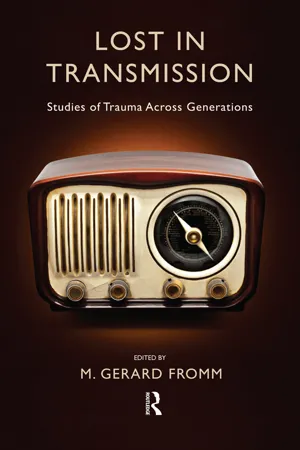
This book is about how traumatic psychological injury is passed down to the children and grandchildren of those who originally experienced it and about finding the shared humanity in families, in psychotherapy, in society, and in memories of the past that repairs the damage people do to one another.
Information
Part I
Shadows of the Holocaust
Introduction
The field of transmission studies, within the larger category of trauma studies, exploded in the 1970s with attention to the suffering and family dynamics of second-generation Holocaust survivors, those who had grown up with, and taken in psychically, the parental generation that encountered what Lacan calls the Real and Ilany Kogan calls “the cataclysmic event which changed the shape of human history forever”.
Kogan’s chapter lays out the emotional scenario for those children who identify deeply with their parents’ damage as well as those who seem to have had their parents’ images of people, events, and the world deposited forcefully within them. She asks what happens when these children face traumatic events in their current lives and illustrates her answer with two moving clinical vignettes. Powerful themes of joining with the damaged other, healing them, or assuaging the guilt for not doing so, and for surviving when they have not, come through clearly, as does the profound confusion between past and present, and inner and outer, with which such people struggle when they face present-day trauma.
Profound confusion-the sense of being completely lost-is also a theme in Vera Muller-Paisner’s chapter: confusion as a consequence of trauma to the sense of identity one has grown up with. She tells the story-many stories really-of Polish Jews who did not know they were Jewish and spent their lives growing up as Catholics, one of them even becoming a priest. The impact on their sense of themselves and the relationship dilemmas that follow are described poignantly. But side by side with the sudden shock of this deeply unsettling information is the theme of secrets and the sense that something was being held back all along. This double awareness-the simultaneous sense of knowing and not knowing-is another aspect of the experience of trauma transmission.
Dori Laub’s chapter returns us to the impact of past trauma on current events, but this time in the coincidence of trauma, within the clinical setting, for patient, analyst, and supervisor. Building especially on Green’s work, he offers a rich description, both theoretical and clinical, of the way in which trauma destroys the capacity to cognize, symbolize, and remember, creating a “hole” in the psyche, which is responded to by others, particularly in the next generation. His discussion of the death instinct-a controversial and ill-defined concept within psychoanalysis-is linked compellingly to the effects of trauma in both victims and perpetrators and to the destruction of the internalized good object, what Laub tenderly calls the “inner thou”, the ongoing dialogue with whom is the wellspring of our functioning and humanity.
Peter Loewenberg closes this section of the book by returning us to Freud’s original description of psychic trauma, a discovery made in the face of the emotional casualties of the First World War. In experience-near terms, Loewenberg lists several clinical characteristics, which specify the suffering, but also the adaptation, of the next generation, and shows us how the unspeakable of history erupts as pure anxiety. He then takes us to the story of his own family, bringing both empathy and wisdom to these reminiscences. His reflections warn us strongly about the terrible irony in the transmission of trauma: that the victimized often reverse their traumatic helplessness by becoming victimizers, thus continuing the cycle of trauma. But he also holds out hope for the breaking of the cycle, as one generation could get hold of the legacy it has received, translate that transmission into narrative, grieve its effects, and open a reparative future.
Chapter One
The second generation in the shadow of terror
Introduction
In his book Persistent Shadows of the Holocaust: the Meaning to Those Not Directly Affected, Moses (1993) describes the Holocaust as an unprecedented, systematic attempt to achieve “racial purity” through the extermination of innocent people. Reduced in the eyes of their persecutors to the lowest form of life, entire peoples-as well as homosexuals and the physically and mentally deformed-were regarded as a threat to the “Aryan race”; as invaders of the “Aryan body,” they were to be totally and completely annihilated in order to purge the German genetic pool of their taint. Thus, the Nazi’s “Final Solution” represented an utter and total debasement and dehumanization of some groups of people by another group, a cataclysmic event which changed the shape of human history forever.
The trauma of the Holocaust is often transmitted to, and absorbed by, the children of survivors. The psychoanalytic literature on the offspring of Holocaust survivors states that the Holocaust is transmitted to them through early, unconscious identifications which carry in their wake the parents’ perception of an everlasting, life-threatening inner and outer reality (Axelrod, Schnipper, & Rau, 1978; Barocas & Barocas, 1973; Kestenberg, 1972; Klein, 1971; Laufer, 1973; Lipkowitz, 1973; Rakoff, 1966; Sonnenberg, 1974). These children, whose minds have been impregnated with mental representations of the atrocities of the Holocaust deposited by their parents, carry within themselves powerful feelings of loss and humiliation, guilt and aggression. They often feel compelled to enact the parents’ suppressed traumas, thereby echoing their parents’ inner world (Auerhahn & Laub, 1984).
“Enactment”, putting into action, is a non-verbal behaviour, which reflects what occurs between patient and therapist in the analytic situation, with the emphasis on the way the analyst participates in the process. This might be compared to “acting out” and “acting in”. “Acting out” is the attempt to avoid painful knowledge in treatment by means of acting instead of remembering and communicating. “Acting in” is defined as acting in the transference; it might be the only way available to the patient to relive an experience and to convey it to the therapist.
In the context of the Holocaust, I view “enactment” as a general term that includes some of the attributes of both “acting out” and “acting in”. In this sense, “enactment” can serve the purpose of avoiding painful knowledge and memory (similar to the objective of “acting out”) while, at the same time, it is the only way available to the patient to relive an inner experience (as in the process of “acting in”). This use of “enactment” differs from that of analysts who primarily stress its interactive aspects. These analysts believe that enactment (or “actualization,” as it is termed by Sandler and Sandler, 1978) reflects what occurs in the relationship between patient and analyst and the analyst’s part in the process (Chused, 1991; Jacobs, 1986, 2000; McLaughlin, 1992; Renik, 1993; Schafer, 1982). I define “enactment” as the compulsion of Holocaust survivors’ offspring to recreate their parents’ experiences in their own lives through concrete acts. Thus, “enactment” is the externalization of traumatic themes from the past, and not what occurs in the relationship between patient and analyst in the analytic situation (Kogan, 2002).
I will describe in brief the two mechanisms by which the transgenerational transmission of historical trauma occurs: “primitive identification” (Freyberg, 1980; Grubrich-Simitis, 1984a, b; Kogan, 1995, 1998, 2002, 2007a, b; Kogan & Schneider, 2002) and “deposited representation” (Volkan, 1987a, p. 73). “Primitive identification” refers to the child’s unconscious introjection and assimilation of the damaged parent’s self-images through interactions with that parent. This process is an attempt to heal the parent and help him recover. This identification leads to a loss of the child’s separate sense of self and to an inability to differentiate between the self and the damaged parent. (I find this phenomenon similar to the identification which takes place in pathological mourning, which Freud (1917e) describes as a process whereby the mourner attempts to possess the object by becoming the object itself, rather than bearing a resemblance to it. This occurs when the mourner renounces the object, at the same time preserving it in a cannibalistic manner (Green, 1986; Grinberg & Grinberg, 1974). It is this type of identification that is at the core of the offspring’s inability to achieve self-differentiation and build a life of his or her own.)
“Deposited representation” is a concept that emphasizes the role of the parent, who unconsciously, and sometimes even consciously, forces aspects of himself on to the child. By doing so, the parent affects the child’s sense of identity and gives the child certain specific tasks to perform. In these cases, the children become the reservoirs for deposited images connected to the trauma, which often initiate unconscious fantasies linked to it. The children are compelled to deal with the shame, rage, helplessness, and guilt that the parents have been unable to work through for themselves (Volkan, 2002).
The question I wish to address here is what happens when children whose Holocaust-survivor parents have undergone victimization, actual abuse, and humiliation encounter traumatic reality in the present? What is the impact of this external reality on their inner life, their perception of reality and their defences?
Life-threatening reality does not reactivate only a simple recollection of traumatic events, but it also reactivates in the children the mental representation of the Holocaust that they share with their parents. These include real events of a traumatic nature, conscious and unconscious fantasies regarding these events, intense feelings of mourning and guilt, and defences against unacceptable feelings such as shame, guilt, or aggression (Kogan, 2003; Moses, 1993; Roth, 1993).
I will now present clinical vignettes from two cases in which the life-threatening situation of the Intifada in Israel reactivated mental representations of the Holocaust and had an impact on their perception of reality, reinforcing their manic defences.
The case of Daphna
Daphna, a forty-six-year-old high-school teacher, married and the mother of a sixteen-year-old boy, was a member of a small group of extreme leftists who strongly advocated the pro-Palestinian position. Not only did she participate in the big peace demonstrations organized by Israel’s left-wing parties, but she also stood at crossroads together with several other women, holding up signs that promoted their pro-Palestinian views. These signs often evoked furious reactions from passersby, many of whom responded by shouting angrily at the demonstrators. These angry reactions never deterred Daphna from what she was doing. On the contrary, they increased her emotional excitement and the importance of these demonstrations for her.
Daphna was the daughter of a Holocaust survivor father and a mother who arrived in Israel with her parents before the Second World War. Her father’s parents and siblings were taken to Auschwitz, where they were gassed and their bodies cremated in the ovens. Daphna’s mother had suffered from depression throughout her life, which worsened with age. Her psychic situation deteriorated after the birth of Daphna, the younger of two children.
Daphna remembered her mother as a sad, passive, very silent woman, who had difficulties in coping with the simple chores of life. “I grew up with a shadow,” said Daphna about her mother. Daphna’s parents lived in a little village. From the time she was a baby, Daphna lived in a children’s home, together with the other children. She was told that after her birth her mother had become so depressed that she would sometimes forget to feed her. When this was discovered, other women took charge of her.
When Daphna was nine years old, the family moved to the USA for a period of three years. Her mother had a very bad reaction to leaving Israel, where she had led a sheltered life and where her children had been cared for. Daphna remembered that during this period her mother would lie in bed for days on end, unable to buy food or cook for her family, never responding to teachers’ requests to discuss the problems the child was having in school. Father took care of these matters, and Daphna learned to live with a depressed, psychically dead mother.
Upon their return to Israel, Daphna was placed in a boarding school, where she began to thrive. She was a good student, had many friends, and led the life of a normal adolescent.
When Daphna was thirteen, her mother committed suicide. Father was the one who found her burnt corpse near the oven, and an empty bottle of pills which she had apparently swallowed before putting her head inside the oven (it was an old-fashioned gas oven with an open flame). It was never clear whether the mother had died from gas inhalation or from the flames that consumed her body after she had poured gasoline over herself. Daphna was shocked and horrified by this terrible event.
Nobody talked with Daphna about what happened; her father never mourned his wife. Daphna knew that the shocking death of her mother must have reminded him of his lost relatives who died in the gas chambers. After about two years, he was hospitalized because of a psychotic depression. Daphna visited him regularly in the hospital and was terribly ashamed of the way he looked and behaved.
After the initial shock, Daphna made a conscious decision to get on with her life. She studied and worked, and married a man she did not love, out of fear that she would remain an old maid. She gave birth to her first child, a boy. Throughout her life, Daphna was plagued by terrible headaches and periodic depressions. She encountered great difficulties in raising her son, and, in spite of giving him love and care, she sometimes lost her temper and became violent, a fact which tormented her deeply and aroused feelings of guilt. Daphna was in therapy for a period of ten years, at the end of which her therapist developed a terminal illness.
Daphna sought analysis two years ago, when her older brother, at the age of fifty-one, became ill and was hospitalized in a mental institution because of a mental breakdown. Concerned that she, like her older brother, might suffer a psychotic breakdown at the fatal age of fifty-one (the age at which her mother had committed suicide), Daphna decided to seek analytic treatment.
I will not describe our painful analytic journey over the last three years. Instead, I will examine Daphna’s reaction to the life-threatening situation in Israel over the last few years as revealed in analysis. I will illustrate this with a vignette from one of our sessions:
D (Daphna): There are so many terrorist attacks. I am so angry about it. I feel like another Holocaust is descending on us.
We were silent for some moments.
D(continuing):There is a story about a frog. A frog is insensitive to differences in temperature. So, if you slowly warm up water to boil the frog, it will not jump out of it, because it does not feel the danger. This happened to the Jewish people in the past. Those who did not run away from the Holocaust, look what happened to them, they all got cooked in the oven. It’s the same with us now. We don’t pay attention to what’s going on until the situation gets really bad.
I was frightened by Daphna’s words. Perhaps she is right, I thought to myself. Nobody knows what the future will bring upon us. Then, my thoughts turned to Daphna’s tragic mother, who had put her head in an oven, possibly choosing to concretely follow the fate of her relatives who had been gassed and cremated in Auschwitz. Was the mother the “frog who was insensitive to pain”, I asked myself, or was her psychic pain so overwhelming that she destroyed herself in order to get rid of it?
Further on, we delved into Daphna’s fantasies regarding the political demonstrations that she participated in at crossroads. We discovered that Daphna was not reacting to external reality only out of political conviction and striving for peace, but she was also reacting to an internal world full of fear and feelings of guilt.
D: You know, yesterday I was demonstrating together with other women against the occupation of the territories. When I took part in these demonstrations in the past, people threw tomatoes at us or cursed us. I heard that women who demonstrated were beaten and needed hospitalization. I thought, with the level of violence being so high, there are people who might sh...
Table of contents
- Cover
- Half Title
- Title
- Copyright
- CONTENTS
- Dedication
- ACKNOWLEDGEMENTS AND PERMISSIONS
- ABOUT THE EDITOR AND CONTRIBUTORS
- INTRODUCTION
- PART I: SHADOWS OF THE HOLOCAUST
- PART II: INSIDE THE CONSULTING ROOM
- PART III: CONTEMPORARY AMERICA
- INDEX
Trusted by 375,005 students
Access to over 1.5 million titles for a fair monthly price.
Study more efficiently using our study tools.
Frequently asked questions
Yes, you can cancel anytime from the Subscription tab in your account settings on the Perlego website. Your subscription will stay active until the end of your current billing period. Learn how to cancel your subscription
No, books cannot be downloaded as external files, such as PDFs, for use outside of Perlego. However, you can download books within the Perlego app for offline reading on mobile or tablet. Learn how to download books offline
Perlego offers two plans: Essential and Complete
- Essential is ideal for learners and professionals who enjoy exploring a wide range of subjects. Access the Essential Library with 800,000+ trusted titles and best-sellers across business, personal growth, and the humanities. Includes unlimited reading time and Standard Read Aloud voice.
- Complete: Perfect for advanced learners and researchers needing full, unrestricted access. Unlock 1.5M+ books across hundreds of subjects, including academic and specialized titles. The Complete Plan also includes advanced features like Premium Read Aloud and Research Assistant.
We are an online textbook subscription service, where you can get access to an entire online library for less than the price of a single book per month. With over 1.5 million books across 990+ topics, we’ve got you covered! Learn about our mission
Look out for the read-aloud symbol on your next book to see if you can listen to it. The read-aloud tool reads text aloud for you, highlighting the text as it is being read. You can pause it, speed it up and slow it down. Learn more about Read Aloud
Yes! You can use the Perlego app on both iOS and Android devices to read anytime, anywhere — even offline. Perfect for commutes or when you’re on the go.
Please note we cannot support devices running on iOS 13 and Android 7 or earlier. Learn more about using the app
Please note we cannot support devices running on iOS 13 and Android 7 or earlier. Learn more about using the app
Yes, you can access Lost in Transmission by M. Gerard Fromm in PDF and/or ePUB format, as well as other popular books in Psychology & History & Theory in Psychology. We have over 1.5 million books available in our catalogue for you to explore.