- 112 pages
- English
- ePUB (mobile friendly)
- Available on iOS & Android
eBook - ePub
About this book
This work provides a concise and up-to-date account of endocrine therapy for breast cancer. It covers historical development, basic physiology of female sex hormones, role of hormones in breast cancer aetiology, selective oestrogen receptor modules, ovarian ablation and chemoprevention. The book aims to provide a concise and up-to-date medical guide to medical and surgical oncologist working in the field of breast cancer and reflects recent advances in molecular biology of the oestrogen receptor including descriptions of ongoing trials involving hormonal manipulation.
Information
Section 1
Children and choice
The first three introductory chapters look at some of the basic principles of how children choose things for themselves and what motivates them to join in and take part. It outlines a healthy eating plan for all the family and describes how to check up on a child’s growth. These principles and ideas are used throughout the book to show how small changes to current lifestyles can make a big difference to a child’s health.
Chapter 1
Children, choices and The Balance of Good Health
Who is in charge of how children eat?
This question has many answers ranging from the government, the food industry, supermarket managers, corner shop assistants and even dinner ladies. As for parents and children themselves, how much control do they really have over meals and snacks when they are manipulated by supermarkets into buying whatever is on offer and when advertisements tell children what to like? This book shows how families can step in to take control over how they eat and put health and fitness successfully onto the family priority list.
It is a traditional view that in order for children to do what is good for them, they must be told what to do. In many circumstances this is true, and in some food settings this will work. Children do not automatically like things that are good for them and have to develop a taste for different foods but, as many parents will readily testify, telling a child to eat his greens is a thankless and often fruitless endeavour. Indeed, forcing disliked foods may simply harden the child’s resolve to avoid what is being pushed altogether. This is the ‘catch- 22’ situation: how can children be persuaded to keep trying new things that take some getting used to and to eat less of the tasty foods that are not so good for them?
There are many avenues to help children make happy, healthy choices for themselves. Childhood is a time for experimenting with choice, when adults are around to guide the process. The more people understand how children make choices the greater the chance of helping them continue to make good choices when parents are not around.
Children learn about making choices from the following factors:
- copying parents and other role models
- the choice worked last time, i.e. they are choosing something familiar
- the choice might annoy parents, and that can be fun
- the choice was relevant to them, i.e. they sensed it was good for them
- they could not think of a good alternative, i.e. that’s how the family do things
- the choice was easy, rather than an effort
- they had some control over the choice, even if that meant getting it wrong, i.e. it was a choice.
It is worrying that so many of today’s children are making poor choices about how they eat. Despite having a wider choice of foods than ever before, children do not seem to be getting the balance right. Newspapers are full of headlines about the ‘obesity epidemic’ that is sweeping the western world. Even children who are of normal weight for their height may not be eating enough fresh produce to ensure good health, which may put them at higher risk of developing illnesses as they get older.
Whilst parents may have a reasonable idea as to what they would like their kids to eat, getting them to eat it is an entirely different matter. Happily there is plenty of good advice to follow with helpful healthy eating guidelines produced by many governments in different countries. This book uses United Kingdom (UK) nutritional guidelines and gives helpful ideas on how to fit these guidelines into daily family life.
Some examples are the Department of Health’s ‘Take Five’ or ‘Five-A-Day’ campaign that encourages everyone to eat at least five portions of fruit and vegetables each day. Another is the Food Standards Agency’s The Balance of Good Health food guide, which is used throughout this book and which is taught to children in schools as part of personal, social and health education. Because the book explores how children make up their minds and the things that influence choice, parents will discover not only which guidelines to follow but also how to make them work.
Start with establishing healthy basics
The key to a healthy diet is getting the balance right. Many eating surveys have shown that high-fat diets are strongly linked to becoming overweight. Ahigh-fat diet tends to contain a small amount of fruit and vegetables whereas people eating lower-fat diets tend to eat far more fruit and vegetables. If families focus on eating more fruit and vegetables then the overall diet will become better balanced without having to fuss especially over the fat content. It is a case of getting the basics right so that other details will not be so significant.
Whilst this sounds simple, many parents struggle because their children are reluctant to choose plain healthy foods when there is a ready supply of tastier and more satisfying options. In order to help children choose healthily we need to understand what sways their choices. This has been extensively studied by the Department of Nutrition at Pennsylvania State University in the United States, and its approaches have now been incorporated into the most up-to-date guidelines on healthy eating for children. In particular it has shed light on how children make choices and why they might like something or not. Afundamental finding -which might appear almost too obvious to mention – is that children will eat what they like and leave the rest.
Children who eat fruit and vegetables like fruit and vegetables! This is a hugely crucial factor that will help a child to develop good eating habits – the focus should be on teaching children to like healthy foods, rather than worrying about banning unhealthy things or labelling items as ‘bad’.
Children do not miss things if they have not been expected
Ideally, children should grow up being able to eat anything they fancy without having to worry about weight. Indeed there are many people who do just that, tucking into platefuls of food whilst shuddering at the thought of exercise. The simple reason they do not become overweight is that they naturally enjoy a lower-calorie diet without any sense of being deprived. For everyone else, however – those who live for chocolate, would die for a doughnut and pine for pizzas – they either apply restraint against overeating or else suffer the penalty of becoming overweight.
Could a child deprived of cheesecake or chocolate fudge brownies really be happy and fulfilled? Yes! It all depends on expectations. If a person is expecting frequent rich treats then there will be disappointment when they are missing, but if they are not expected then they will not be missed. In the same way most people are not devastated each week when they fail to get the winning numbers in the lottery – they do not really expect to win.
Parents have a big influence on the type, quantity and frequency of family foods, and can improve a child’s acceptance of a healthy diet by working on expectations. Achild who is used to a healthy diet with only occasional treat items will think that diet is normal – not great, not bad, just normal. But the bonus is that treats will seem far more special than they will to a child who has treats at every meal and in between.
Food does not need to be the centre of life. Despite the attractions of exotic designer menus and the constant supply of tempting new foods, there are plenty of inedible amusements that can fill the ‘entertainment gap’. Of course rich foods are there to be enjoyed from time to time, but it is important to get the balance right. In the same way that varying the diet will ensure it is well balanced, varying the way people entertain themselves will help to keep minds and bodies well balanced, by enjoying a mixture of friends, sports, music, films and hobbies, all in addition to good food.
On the other hand, if children are taught the ‘entertainment diet’ – where food is used for comfort, reward and relief of boredom – then they will be at risk of obesity and all the problems that it brings. The principles in this book can help parents to nurture healthy children who enjoy a wide range of foods (both rich and plain), will tolerate feeling hungry now and again, and who thoroughly enjoy treats and special occasion foods when they are appropriate. Hopefully this will reawaken the novelty and excitement of ‘a rare treat’.
Introducing The Balance of Good Health: the perfect diet for children
The Balance of Good Health is a simple system that guides the proportions of the five different food groups within a healthy diet. This guide is suitable for children over the age of five, whereas the under-fives may need to eat more fatty or energydense foods because of smaller appetites. This is discussed further in Section 2 ‘Pre-school children’.
Obviously there is no single meal plan that would suit every child, but certain principles apply:
- the diet should be well balanced, and that means varied
- a child’s individual needs should be taken into account, as explained in the section below on functional meals
- the diet should be practical, bearing in mind the rest of the family.
What is meant by a ‘well-balanced’ diet? Too much of some things is just as bad as not enough of others. Without having to read labels or calculate recommended daily allowances (RDAs), it is possible to give a child a well-balanced diet by encouraging as wide a variety of foods as possible. This way the child will get a hotchpotch of all the necessary ingredients whilst avoiding dietary deficiencies that a fussy eater may be susceptible to.
How to use the guide
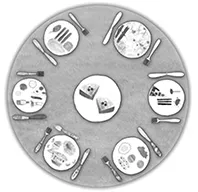
Figure 1.1 shows what proportions of the five different food groups should appear in the diet over an average day. Roughly a third of mouthfuls (not calories) should come from fruit and vegetables; another third should come from bread, potatoes and cereals, especially wholegrain. The remaining third of the diet should be made up of protein-containing foods, such as meat and fish; dairy products and milk plus a small amount of fatty and sugary foods.
- This balance does not need to be achieved at each meal, but should guide eating throughout the day. So, for example, breakfast consisting of cereals and milk is fine if fruit and vegetables feature in meals and snacks later in the day.
- The guide does not require any calorie counting, but guides what sort of portions should appear on the plate.
- Portion sizes for a particular person tend to be fairly constant – a person who usually has two potatoes is unlikely to suddenly choose five, and so it doesn’t matter that the guide does not specify exactly what a portion size is. Details of suitable fruit and vegetable portion sizes for children are described in Chapter 12.
- By getting these proportions roughly right throughout each day, there is no need to worry about individual foods because the overall balance will be good. Eating fatty and sugary foods too frequently will upset the balance, and may mean that healthier parts of the diet are ‘pushed off the plate’.
- For foods made up of several ingredients, such as pies, looking at the main listed ingredient will indicate which group it fits best. This will be the first item listed in the ingredients on the packaging. Some foods will fit into two food groups, such as cheesy potato bake. Chapter 13 ‘The Food Frequency Framework’ looks into this in more depth.
- No foods are banned in the guide; if the existing diet contains too much fatty or sugary food, then it can be improved by making those portion sizes smaller or less frequent whilst increasing the number of portions of healthier items.
- The diet will be healthier if there is variety within each food group. For example, eating five portions of carrots each day might provide plenty of vitamin A, but will not supply the full variety of vitamins that a mixture of fruit and vegetables will.
- Although cooking methods are not specified in the guide, it is recommended to use low-fat methods such as grilling rather than frying and to choose lower-fat meat and dairy products on the whole.
- Fruit and vegetables can be fresh, frozen, chilled, canned, dried or served as juice – all will provide an array of vitamins, minerals and fibre.
- Where possible, choosing wholegrain cereals and breads will maximise the amount of micronutrients and fibre in the diet.
- For celebrations, put The Balance of Good Health to one side and enjoy whatever is on offer...
Table of contents
- Cover
- Title Page
- Copyright Page
- Contents
- Forewords
- Preface
- About the author
- Acknowledgements
- Dedication Page
- Section 1: Children and choice
- Section 2: Pre-school children
- Section 3: Junior children from five to 12
- Section 4: Nutrition and health problems
- Appendix 1: Height and weight charts showing normal growth
- Appendix 2: Useful resources
- Index
Trusted by 375,005 students
Access to over 1.5 million titles for a fair monthly price.
Study more efficiently using our study tools.
Frequently asked questions
Yes, you can cancel anytime from the Subscription tab in your account settings on the Perlego website. Your subscription will stay active until the end of your current billing period. Learn how to cancel your subscription
No, books cannot be downloaded as external files, such as PDFs, for use outside of Perlego. However, you can download books within the Perlego app for offline reading on mobile or tablet. Learn how to download books offline
Perlego offers two plans: Essential and Complete
- Essential is ideal for learners and professionals who enjoy exploring a wide range of subjects. Access the Essential Library with 800,000+ trusted titles and best-sellers across business, personal growth, and the humanities. Includes unlimited reading time and Standard Read Aloud voice.
- Complete: Perfect for advanced learners and researchers needing full, unrestricted access. Unlock 1.5M+ books across hundreds of subjects, including academic and specialized titles. The Complete Plan also includes advanced features like Premium Read Aloud and Research Assistant.
We are an online textbook subscription service, where you can get access to an entire online library for less than the price of a single book per month. With over 1.5 million books across 990+ topics, we’ve got you covered! Learn about our mission
Look out for the read-aloud symbol on your next book to see if you can listen to it. The read-aloud tool reads text aloud for you, highlighting the text as it is being read. You can pause it, speed it up and slow it down. Learn more about Read Aloud
Yes! You can use the Perlego app on both iOS and Android devices to read anytime, anywhere — even offline. Perfect for commutes or when you’re on the go.
Please note we cannot support devices running on iOS 13 and Android 7 or earlier. Learn more about using the app
Please note we cannot support devices running on iOS 13 and Android 7 or earlier. Learn more about using the app
Yes, you can access Weight Matters for Children by Rachel Pryke in PDF and/or ePUB format, as well as other popular books in Medicine & Medical Theory, Practice & Reference. We have over 1.5 million books available in our catalogue for you to explore.