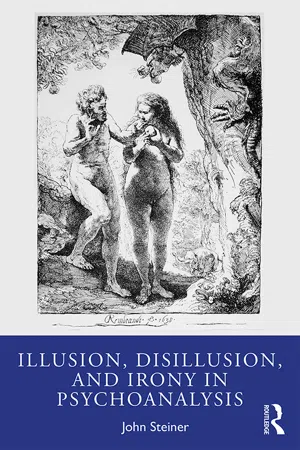
The Garden of Eden Illusion
In many of these idyllic phantasies we can discern a reference to a Paradise that was once enjoyed and then tragically lost. The phantasies then emerge as attempts to undo or reverse the loss and to recreate the ideal state that is yearned for. The romantic scenarios can then be linked to the original romantic love affair of the baby with the mother and her breast, which is idealised as a blissful time of mutual admiration and exclusive love. The loss of perfection may then be experienced as a forcible expulsion often associated with humiliation which may then play a critical role in defensive responses.
Even those who recognise the idealisation as an illusion frequently retain an unconscious belief in the reality of a personal Paradise. Others believe that the ideal is a reality that they once enjoyed, often up to a particular moment when it all went wrong. These turning points are linked to the experience of weening but often identified with an event such as the birth of a sibling, a move of house, or the mother returning to work. It is especially in these cases of concrete belief that disillusion may be traumatic and give rise to powerful defences which can seriously disturb development. In an important paper anticipating this type of idealisation Akhtar (1996) described what he called “if-only” and “someday” phantasies in which nostalgia for the past and magical hopes for the future sustain the belief that the ideal state can be restored. They imply a failure of disillusionment which keeps a phantasy of an idealised state alive as one that might still be possessed, “if-only …” the disillusion had not happened. They are often accompanied by the phantasy that “someday” it will all be magically put right and Paradise regained.
The phantasies may then function as idealised psychic retreats in which the patient becomes stuck to the detriment of development and growth. Even more disturbing are phantasies in which grievance turns to revenge and the good object is attacked for failing to deliver the desired perfection. A sense of entitlement can lead to a passionate striving for the promised ideal which is sometimes ruthlessly pursued and which may lead to political or religious fundamentalism in pursuit of utopian dreams.
The Garden of Eden in mythology
Individual Garden of Eden phantasies have their counterpart in the mythological history of our culture where every age seems to have its Paradise. Indeed, the German poet Schiller argued that all cultures have a Paradise in their history and that this corresponds to the Paradise that every individual remembers (Schiller, 1759–1805).
While the biblical story of the Garden of Eden is perhaps the best-known myth, many others refer to an ideal time once enjoyed and eventually lost. In Greek mythology the Golden Age of Hesiod describes how
Men lived like gods without sorrow of heart, remote and free from toil and grief: miserable age rested not on them; but with legs and arms never failing they made merry with feasting beyond the reach of all devils. When they died, it was as though they were overcome with sleep, and they had all good things; for the fruitful earth unforced bare them fruit abundantly and without stint. They dwelt in ease and peace.
(Hesiod, 7 century BCE)
Closely related is the version of Paradise referred to as Arcadia, an area in the Peloponnese of pastoral harmony where Pan enjoyed an unrestricted reign. The romantic images of beautiful nymphs frolicking in lush forests is presented as the spontaneous result of life lived naturally, uncorrupted by civilisation. Don Quixote’s version of the Golden Age which is discussed in Chapter 10 is an ironic elaboration of the perfection of a time before the unlimited abundance of Paradise was challenged by the existence of Oedipal rivals.
Milton’s Garden of Eden
In this chapter I am going to use extracts from Milton’s Paradise Lost as well as some quotations from Keats together with Freud’s paper “On Transience”, to discuss these idealised states as they appear in our personal history,2 I will suggest that their appearance in the phantasy life of the individual has similar features to those found in the myths and that in both the idealisation depends on a denial of the passage of time.
Milton’s description of the Garden of Eden allows us to see that the ideal is particularly concerned with the abundance of food and the absence of delays and frustrations.
A happy rural seat of various view;
Groves whose rich Trees wept odorous Gumms and Balme,
Others whose fruit burnisht with Golden Rinde
Hung amiable, …
Flours of all hue, and without Thorn the Rose:
.… umbrageous Grots and Caves
Of coole recess, o’re which the mantling vine
Layes forth her purple Grape, and gently creeps
Luxuriant …
(Book Four, 260)
All kinds of animals abound in peaceful harmony and among all this perfection Adam and Eve stand out as most perfect of all:
Of living Creatures new to sight and strange:
Two of far nobler shape erect and tall,
Godlike erect, with native Honour clad
In naked Majestie seemd Lords of all …
(Book Four, 290)
Work was not necessary and Adam and Eve did only so much labour as would whet their appetite.
More grateful, to thir Supper Fruits they fell,
Nectarine Fruits which the compliant boughes
Yielded them, side-long as they sat recline
On the soft downie Bank damaskt with flours:
The savourie pulp they chew, and in the rinde
Still as they thirsted scoop the brimming stream …
(Book Four, 336)
Around them the peaceful world in which the animals played meant that there was no violence, no strife, and no death.
About them frisking playd
All Beasts of th’ Earth, since wilde, and of all chase
In Wood or Wilderness, Forrest or Den;
Sporting the Lion rampd, and in his paw
Dandl’d the Kid; Bears, Tygers, Ounces, Pards
Gambold before them, th’ unwieldy Elephant
To make them mirth us’d all his might, and wreathd
His Lithe Proboscis;
(Book Four, 347)
Perhaps most enviable was the idyllic relationship between Adam and Eve as they lay “imparadised” in one another’s arms. This is Eve speaking:
with that thy gentle hand
Seisd mine, I yielded, and from that time see
How beauty is excelld by manly grace
And wisdom, which alone is truly fair.
So spake our general Mother, and with eyes
Of conjugal attraction unreprov’d,
And meek surrender, half imbracing leand
On our first Father, half her swelling Breast Naked met his under the flowing Gold
Of her loose tresses hid: he in delight
Both of her Beauty and submissive Charms
Smil’d with superior Love, as Jupiter
On Juno smiles, when he impregns the Clouds That shed May Flowers; and press’d her Matron lip
With kisses pure: …
(Book Four, 500)
Of course, emphasising the woman’s submissive charms is a male view of Paradise but one that is derived from infantile longings for a submissive mother. This is part of the infantile Garden of Eden Illusion of a blissful time when unlimited access to the breast was enjoyed without interference from siblings or fathers. Of course from the point of view of an analytic observer such phantasies are illusions and we recognise that, except for brief moments, no infantile situation is actually ideal.