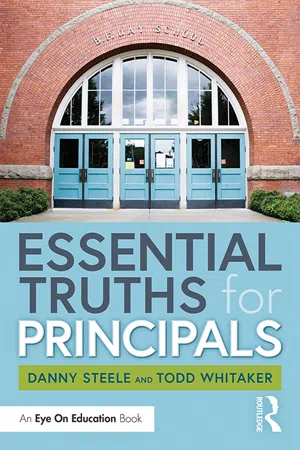
School principals are constantly being pulled in different directions. How do you focus on the things that matter most? In this inspiring book from Danny Steele, creator of the popular Steele Thoughts blog, and Todd Whitaker, bestselling author and speaker, you'll learn how to center your leadership on your core values and the practices that have the biggest impact. The authors reveal essential truths that will make you a more effective principal in areas such as school culture, appreciating teachers, and empowering your staff. The strategies are presented in digestible chunks, perfect for book studies, professional development sessions, and other learning formats. With the inspiring anecdotes and insights in this book, you'll be reminded of your greater purpose – making a difference in students' lives.
- 84 pages
- English
- ePUB (mobile friendly)
- Available on iOS & Android
eBook - ePub
Essential Truths for Principals
About this book
Information
Essential Truths
Continue the Conversation
Which truths and anecdotes resonated with you the most? Share your thoughts and join the conversation with Danny Steele (@steelethoughts) and Todd Whitaker (@toddwhitaker) on Twitter using the hashtag #essentialtruths.

1
Instructional Leadership Is Not About Improving Teachers; It Is About Creating the Conditions Where Teachers Can Improve Themselves.
Being the “instructional leader” of the school is probably at the top of every principal’s job description. It is a nebulous concept, but it suggests to many administrators that they need to be experts on curriculum development, pedagogy, professional development, the integration of technology, and the research-based best practices that pour out of the literature and out of the workshops. That is a lot of pressure on any school leader.
Instructional leadership is not about being an expert, though; it is about cultivating the expertise in your building. It is about creating a culture of collaboration where teachers learn from one another and inspire one another. It is not about having all the answers; it is about asking some really good questions. It is about empowering teachers to pursue solutions to instructional problems. It is about removing barriers in the classroom. (And your teachers will let you know what those barriers are!) It is about providing resources that teachers need to be more effective. It is about providing a consistent focus in the building – a focus that reminds teachers why they come to work each day. It is a focus that motivates teachers to pursue excellence in the classroom. Teaching is hard work, and when it is done right can be absolutely draining. It is imperative that school leaders provide support and encouragement all year long. A principal’s instructional leadership is only as strong as their commitment to supporting teachers.
“It is not about having all the answers; it is about asking some really good questions.”
2
If You Want to Evaluate a School’s Culture Do Not Read the Mission Statement on the Wall, Listen to the Teachers Talk in the Hallway.
You can learn a lot about a school simply by listening to the teachers talk. Are they complaining to each other about the students’ behavior or are they sharing accomplishments of their classes? Are they griping about the students who are not turning in their homework, or are they collaborating about instructional strategies? Are they counting down the days until the next break or are they smiling, laughing, and having fun with each other? The interactions of the adults in the building provide a great gauge of the culture of the building. And if you want to see a teacher’s rapport with students, watch them interact with the students in the hallway. Those interactions speak volumes! Every school has basically the same mission: “Preparing kids for their future.” What matters is not the quality of words in a frame, but the quality of relationships in the building.
3
Administrators Want Their Teachers to Be Sensitive to the Home Life of Students. And Administrators Need to Be Sensitive to the Home Life of Their Teachers.
There are teachers who are going through divorce. There are teachers who are battling depression. There are teachers who are coping with family illness. Teachers deal with the same stresses that affect everyone else. Teachers are professionals, and they try to be strong for their students. They continue to do their jobs with excellence. But these stresses have an impact. Teachers are human. It is imperative that school leaders recognize the reality of the stress that many of their teachers are under. Maslow’s Hierarchy of Needs does not just apply to students; it applies to teachers as well. They are in the pyramid too. Principals and other administrators are more effective when they are mindful of that reality. The sensitivity, patience, and compassion of principals can go a long way to maintaining the morale and energy of these teachers. And it helps to create the sort of culture that all employees appreciate.
4
No Program in the School Will Ever Exceed the Passion of the Adults Implementing It.
I remember when our school started “Homework Cafe.” We intended this to be a place for students to complete their homework during lunch if they had not finished it for their class. We knew that assigning zeros was not constructive, and we did not want students to leave their assignment unfinished. We knew that this initiative would only be successful if we recruited the right staff member to supervise it. When discussing this with my assistant principal, we knew that we needed someone who would connect well with the students in the Cafe. We needed a teacher who was patient and compassionate. We needed a teacher who would be invested in the success of Homework Cafe.
Several years ago, our school launched co-curricular clubs for our students. Every student was allowed to pick a club that they were interested in, and we developed a schedule where students would meet in their clubs once or twice a month during the school day. The most important part of this process was when we asked teachers to choose a club that they would lead. I asked teachers to think of a club that they could be passionate about – a club that they would be excited about leading. Our clubs have been successful for a few years now, and we continually remind our teachers that they are the reason for the success. Their enthusiasm, dedication, and preparation are the reasons these clubs are meaningful for the students.
It does not matter what programs are going on in your school. The success of these programs will depend on the adults who are leading them. Ultimately, schools do not thrive because of programs; they thrive because of the passionate educators in the building. The adults are always the most important variable in the success of any endeavor.
“Schools do not thrive because of programs; they thrive because of the passionate educators in the building.”
5
School Culture Is Made in the Little Moments. And We All Have Those Little Moments Where We Can Make a Difference – Every Day.
Principals shape school culture … as do custodians, secretaries, counselors, teachers, bookkeepers, librarians, paraprofessionals, maintenance technicians, resource officers, nurses, registrars, and cafeteria workers. If you work in a school, you make a difference for that school. Everyone contributes to building a strong school culture. And good culture does not result from clever programs; it is created by the adults who care about the students and the schools. It is not created through big initiatives; it is created with personal connections. It is created through taking advantage of the little opportunities to create moments of awesomeness. And if you are alert you will discover that there are opportunities to be awesome all around you – opportunities to make someone’s day – opportunities to make a difference for students, and celebrate colleagues. Building strong school culture is nothing more than making the most of all those small moments.
Not long ago, I remember telling our school custodian some knock-knock jokes. She laughed … and that made me feel good – although she may have been laughing more at my silliness than the actual humor of the jokes. But we both had fun with it that day; we both enjoyed the interaction.
I remember a day when a student stopped me as I was walking around, and said, “Hey Dr. Steele … do you have time for a magic trick?” What principal has time for magic tricks? But I stopped … and was thoroughly impressed with his sleight of hand.
Every morning, I am in our cafeteria, helping to supervise students eating breakfast. We have an amazing Child Nutrition Program (CNP) staff, and one of their special talents is making cinnamon rolls. I’m glad to see the lunch ladies every morning, and they seem glad to see me. Several years ago, I made a point to talk to them about how good their cinnamon rolls were. I didn’t think much of the conversation at the time, but I did want them to know that I appreciated them … and their baking talents. The next time they served cinnamon rolls, there was a treat packaged up for me in the window between the kitchen and the serving lines: My very own cinnamon roll, set aside in a container. The sticky note read, “Enjoy, Dr. Steele!” For the last several years, on days when cinnamon rolls are being served, there is a special one waiting for me in the window. If I don’t see it, they will call my attention to it. What a tasty tradition!
So what do knock-knock jokes, magic tricks, and cinnamon rolls have to do with instructional leadership? What do they have to do with raising student achievement? Nothing, I suppose.
But they have everything to do with culture. They have everything to do with relationships. They have everything to do with building the type of school where students enjoy learning and adults enjoy working. And this is the kind of school where kids and staff members thrive. School culture is not about the big things; it’s about the little things. It’s about the thoughtful gestures … the high-fives, the co...
Table of contents
- Cover
- Half Title
- Title Page
- Copyright Page
- Dedication
- Table of Contents
- Meet the Authors
- Preface
- How to Use This Book
- Essential Truths
Trusted by 375,005 students
Access to over 1.5 million titles for a fair monthly price.
Study more efficiently using our study tools.
Frequently asked questions
Yes, you can cancel anytime from the Subscription tab in your account settings on the Perlego website. Your subscription will stay active until the end of your current billing period. Learn how to cancel your subscription
No, books cannot be downloaded as external files, such as PDFs, for use outside of Perlego. However, you can download books within the Perlego app for offline reading on mobile or tablet. Learn how to download books offline
Perlego offers two plans: Essential and Complete
- Essential is ideal for learners and professionals who enjoy exploring a wide range of subjects. Access the Essential Library with 800,000+ trusted titles and best-sellers across business, personal growth, and the humanities. Includes unlimited reading time and Standard Read Aloud voice.
- Complete: Perfect for advanced learners and researchers needing full, unrestricted access. Unlock 1.5M+ books across hundreds of subjects, including academic and specialized titles. The Complete Plan also includes advanced features like Premium Read Aloud and Research Assistant.
We are an online textbook subscription service, where you can get access to an entire online library for less than the price of a single book per month. With over 1.5 million books across 990+ topics, we’ve got you covered! Learn about our mission
Look out for the read-aloud symbol on your next book to see if you can listen to it. The read-aloud tool reads text aloud for you, highlighting the text as it is being read. You can pause it, speed it up and slow it down. Learn more about Read Aloud
Yes! You can use the Perlego app on both iOS and Android devices to read anytime, anywhere — even offline. Perfect for commutes or when you’re on the go.
Please note we cannot support devices running on iOS 13 and Android 7 or earlier. Learn more about using the app
Please note we cannot support devices running on iOS 13 and Android 7 or earlier. Learn more about using the app
Yes, you can access Essential Truths for Principals by Danny Steele,Todd Whitaker in PDF and/or ePUB format, as well as other popular books in Education & Education General. We have over 1.5 million books available in our catalogue for you to explore.