eBook - ePub
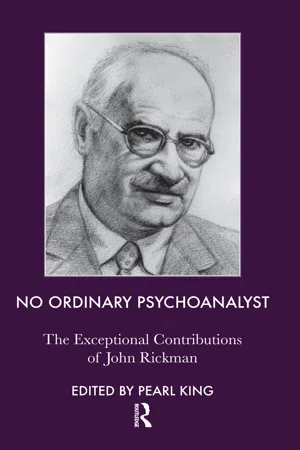
No Ordinary Psychoanalyst
The Exceptional Contributions of John Rickman
- 382 pages
- English
- ePUB (mobile friendly)
- Available on iOS & Android
eBook - ePub
About this book
The author had a deep impact on psychoanalysis, combining a deep knowledge thereof with an avid interest in social psychology, to the benefit of both. He was a fresh thinker, always innovative, with an extensive range of interests. This is an affectionate, incisive, intelligent paean to one of the greats of psychoanalysis.
Information
Part I
Observations on Psychoanalytic Theory and Technique
Chapter 1
Developments in psychoanalysis, 1896-1947
(1947)
Introduction and definition
Psychoanalysis is the name given to a method of research and therapy discovered by Freud (1896c) based on a study of "free associations" in the "transference situation" and to the body of data and theories about the unconscious mind and its relation to behaviour which that method of research and therapy discloses. A psychoanalyst is a person who uses that method of research or therapy; but speaking professionally he is a person who has been trained and registered as suitable for practice in that method in one of the Psychoanalytical Institutes recognised by the International Psychoanalytical Association (Rickman, 1951b).
Psychoanalysis deals with a part only of the field of psychology, but it contributes a part—dealing with what has been called "depth-psychology"—which cannot be clearly discerned without the use of that method of research and therapy. Just as certain classes of natural phenomena cannot be scrutinised minutely without the aid of special instruments, e.g. a microscope for small objects, a telescope for distant ones, an electroscope for electrical phenomena, so with certain mental phenomena a special "instrument" is required.
Briefly, the transference situation is such art "instrument". It is a social relationship (most clearly seen in the case of two persons) which permits the spontaneous appearance of repressed unconscious phantasies of the person analysed (the analysand) to crystallise in reference to the person (and his environment) who is analysing that individual's personality and social relationships (transference neurosis). The skill of the analyst lies in his capacity without any impatience (it is often a slow business), and without interference (it is usually tantalizing to the beginner), to let the analysand's ideas about this social and emotional relationship emerge clearly, convincingly, and undisturbed.
It is this that requires the years of training; it is this that makes the analysis of the patient himself so time consuming—400 sessions, i.e. five times a week for about two years, reckoning holidays (intercurrent illness during the analysis is unusual), is a common figure. Psychoanalysis is therefore time consuming both for research and therapy, but, as has been said, no substitute has yet been found to accomplish the same work that it does whether for the body of theory or in the interests of the particular patient.
Throughout this introductory monograph, research and therapy have been coupled. In no other branch of psychology is this inevitable; and in this, psychoanalysis is unique. Also, and importantly, it deals with mental pain, and strives to go to the sources of mental pain in the development of the personality of the individual analysed. It provides a setting for the struggle, in which deep-seated causes of guilt, anxiety, grief and libidinal conflict are reawakened and worked through. Permanent relief is usually found and the cramping effect of inhibitions, self distrust, and suspicion of others is removed. Only with the prospect of relief from pain does the sufferer disclose (or perhaps can the sufferer disclose), the depths of his mind and the hidden sources of his pain. Hence research and therapy into this field of mental science at least (and how far this is also true and inevitable for the social sciences time will show) are always coupled.
Though the practitioner must in his work keep in mind the general development of the personality of his patient, it is important to note that the scientific data (which alone are convincing to the patient, strange though that may sound in reference to the notoriously suggestible neurotic) are essentially a-historical, i.e. as in science generally the essential data are present and discernible at the time of observation. Though no other aspect of psychology has thrown so much light on man's development from babyhood to childhood through adolescence to adult life, or shown so clearly how one phase influences another, yet psychoanalysis is all based on experiences in the present. The realization of past and incompletely worked-through experiences in the present is the basis of this transference situation. The particular device that the psychoanalyst uses for dealing with the data afforded by the transference situation is free associations; and they are pieced together by means of a set of theoretical devices, extremely simple to apply in theory but taking years to acquire in practice, which were discovered by Freud and published in his The Interpretation of Dreams (Freud, 1900a). This is the sole theoretical instrument as the transference situation is the sole social instrument of psychoanalytic research and therapy.
Origins of psychoanalysis
Dr Josef Breuer, a Viennese physician, had as a patient from 1880-82, a girl who suffered from numerous neurotic symptoms which came on after she had nursed her father during his last illness (Breuer & Freud, 1893-95). She had periods of dreamy confusion in which her mind was far removed from present reality and she was compulsively preoccupied with her own thoughts. It was possible to hypnotize her and get her to talk without such confusion; her mind then kept on going back to ideas and impulses which she had to suppress while nursing her father, and her numerous symptoms were related to these suppressed thoughts. When the patient recalled these thoughts and "re-lived" in imagination these scenes, she was for a time relieved of her symptoms, but soon relapsed, so that the process had to be repeated over and over again. In the repetition the scenes dwelt on shifted further and further back in her life; eventually all of the symptoms were removed. The cure seemed to result from the reliving of the emotional experiences, which for various reasons she had avoided facing in the first place: the theory of the cure was that when the accumulated emotion which maintained the symptom found an outlet, i.e. a catharsis, in the treatment-room of the physician, through being brought to consciousness, the patient got better. Freud developed this technique further by abandoning hypnosis and getting the patient to talk freely. He would ask the patient to say whatever came into the mind, holding nothing back because the patient might feel it to be irrelevant or distressing. This free association rule (Freud, 1904a) is the foundation on which psychoanalysis rests and it makes its demand on the analyst too, for if the patient must not consider anything irrelevant, neither must the analyst, and he has the added duty of making sense of it and also of communicating its meaning to the patient.
In the course of this kind of treatment two things are invariably met with. The first is resistance. The patient's mind seems incapable of taking an objective view of the procedure, forgets the free association rule, or pleads that certain ideas should be made exceptions to it, and becomes preoccupied with what the analyst must be thinking about the thoughts disclosed or about to be disclosed. In the hypnotic treatment the patient was urged to remember, and the amount of effort expended to enable the recall of painful ideas and experiences gave a measure of the resistance to their content. In the free association treatment there is no urging but attention is directed to the reason for this tardiness of the mind to master its own content. It becomes apparent (to both parties eventually) that something has begun to happen in this social relationship of two people (physician and patient): the patient cannot recollect directly— the resistances are too strong—and he is "transferring" onto the analytic situation some of the undischarged emotion which he could not deal with in the critical phases of his development. This is the second of the things invariably met with. The therapeutic co-operation between two adults has superimposed on it all kinds of emotional cross-currents from the past of which the patient was consciously quite unaware, and of a strength and intensity which he could not believe possible. This past situation transferred to time present and dominating the physician-patient co-operation is the transference situation (Freud, 1912b). The treatment consists in disclosing to the patient the operation of these early and buried impulses and seeing them in their past and present setting; the art of the treatment lies in the maintenance of a quiet, interested, objective personal relationship throughout the storms and confusions of these transference phenomena; the science of the treatment, so to speak, lies in the employment of the simplest possible technical (theoretical) aids to the understanding of what is going on.
The data provided by following the free association rule and the transference phenomena are given some sort of order if it is assumed, and this is a basic assumption, that when any two ideas come together in temporal association there must be some common link or links of meaning. The patient's resistance frequently challenges this assumption; it is usually, if not invariably, a counter-attack to cover a sore spot. Out of the clinical application of this rule and this simple hypothesis, Freud was enabled to construct a theory which gave meaning to neurotic symptoms, to hallucinations and even to dreams.
Dreams
First it is necessary to distinguish between the manifest content of the dream and another, latent or hidden, content (Freud, 1901a). The former is what the dreamer remembers of his dream—it is in his consciousness; of the latter we will assume that it has sense if we can but find it. Free associations to elements of the remembered or manifest dream reveal a focal point in a complex train of thought, i.e. the dreamer has made a condensation of a number of thoughts ail of which are represented in a single dream element. Another feature of the dream-work is the tendency to shift the accent from an important theme onto a trivial one, i.e. there is a displacement of the emotion. Another peculiar feature of the dream-work is that a thing may be represented by its opposite, i.e. it seems as if there is a part of the mind which can tolerate contradictions; and finally there seems at times to be a process at work which makes the jumble look sensible and coherent. The importance of this study of dreams lay in the fact that by these simple devices of interpretation, i.e. of undoing the disguises employed in the dreamwork, light was thrown on the processes going on in the unconscious mind, or more strictly we were helped to make inferences about the interplay between different parts of the mind. The manifest dream is that part of the total dream process which is accessible directly to the conscious mind, but by employing the basic principle of free association to the dream elements and the devices of interpretation above mentioned, thoughts are disclosed, and their relation to the manifest content is recognised by the dreamer, which seem to belong to another part of the mind and personality—to the unconscious. Something like a force seems to be keeping the two apart; the urging to remember painful episodes in the hypnotic treatment and the inability to associate freely, justify the use of some such concept as resistance and censorship.
Transference
When the urgings of the hypnotist were abandoned in favour of a neutral observation by the analyst of just whatever the patient liked to say or to impute to the analyst, or of how he tried to manipulate the relationship between them, the focus of attention of the analyst is turned to the forces in the patient's mind as the immediately significant data and these data in strangely large proportion seem apparently irrelevant to the immediate situation. The analyst is pictured by the patient to be playing all manner of roles; and it soon becomes obvious that these roles have relevance to periods and episodes of frustration and stress in the patient's past life and early childhood.
When sufficient care is given to the detail of material and the phenomena of transference are not blurred through the impatient interference by the analyst—how difficult that task is, as beginners only gradually discover!—a new sort of mental functioning becomes apparent, which is primitive, infantile and unconscious. One of its important features is the part which bodily impulses of the most elementary kind play in the personal relationship which the patient's phantasy elaborates, It is not a simple falling in love, but a complicated mixture of love and hate, tenderness and aggression that "is both attraction and repulsion, ambivalently mixed; it is a mode of relationship which is strange to adult ways of thought.
The free associations in the transference situation disclosed two things. The first was the way in which bodily centred impulses of instinctual origin find representation in our imagination and outlet in our action, and the way they become transformed into the bonds which tie us in love and in hate to those nearest and dearest to us, and by displacement to our kind and our environment generally. This latter throws light on our cultural life and may provide a clue to that great gap which separates us from the animals. We are not only more intelligent than the beasts, but we have also a more flexible emotional life; if we are frustrated in our love, we displace our longing to another and seek satisfaction from a new source. Animals pine for a lost companion: man uses his frustrations, for the most part, to build, under the pressure of painful loss, an inner world—a private zone of culture—where he can work through his privation, however long and devious the path, to a solution of his longing. The richness of that inner world, which animals seem to lack, is the result of overcoming mental pain; we seem to differ from the animals too in being able to share with others the benefits we gain from our private zone of culture.
The second thing that was disclosed in the transference situation was that though there are in fact only two people in the treatment situation, the analysand frequently behaves as if there were three or more, i.e. the analysand takes the analyst as the object of his impulses and also feels a constraint, as if a third person's rights and feelings had to be taken into account at the same time. It seems as if from an early age of personal, mental development, the individual cannot easily deal with two people at a time, and if the third party is not actually present, the mind unconsciously imagines him or her to be there. The character of the behaviour and indeed the mood of the individual and his confidence or diffidence in life generally, as well as his capacity to co-operate with his fellows, is greatly influenced by his relation to this third part}'. The obscurity of these last statements may be perhaps diminished in a later consideration of this important topic. With a perhaps aphoristic inexactitude we may say that the barrier between human psychology and sociology is broken down when account is taken of the unconscious influence of "the third party" in the relation between two people. As this touches on society it may be one of the most momentous discoveries in human history.
Four periods of psychaoanalytic theory to date
First period, 1896-1914
As has been said, one of the things disclosed by the free associations in the transference situation is the strange un-adult nature of the impulses which the unconscious harbours. They are primitive and erotic and the conscious mind repudiates them; indeed much of the above-mentioned "resistance" is a manifestation of this repudiation. Man appears to be unique in having two types of sexuality, an infantile type, which persists in the unconscious, and an adult type, which "crystallizes" at puberty. It is the persisting influence of the infantile kind which leads to abnormalities of a sexual nature in the adult and largely accounts for unhappiness in married life, and it is also one of the elements in the causation of social maladjustments, including neuroses.
The sexuality of the infant, that is, the libidinal desire for another person or part of that person, is in the early days characterised by a mouth-to-nipple relationship (Freud, 1905d). The infant is predominantly a "mouth-animal"; what it does with its mouth is exciting to it and has greater emotional value than have other activities. In phantasy the mouth activities give it control over the object of its desire and thus minister to its sense of power; they also give that feeling of access of pleasure, even ecstasy, which is characteristically erotic. Later in infantile development defecation and urination (unlike the early oral- and the later genital-activities) do not necessarily involve physical contact with another person, but in the infant's phantasy they provide a means of doing something to people. A personal and bodily substance is held in control at an orifice arid then is expelled, not into a void—the child's mind peoples every cranny of its world—but towards those on whom its thoughts rest. A bodily substance and a bodily action, which biologically have nothing to do with sexuality, are used by the imagination as the medium of erotic play and personal relationships. In the course of development the genitals achieve the primacy. These organs above all others have the power to discharge the sexual tensions of the body and at the same time to bring the individual psychically into relation with another person. The increasing urge to sexual mastery and possession of the desired object, in imagination as well as in the act, brings with it a new, or rather an enhanced, source of danger—that of rivalry with another person of the same sex, typically a parent figure in the unconscious. There is rivalry in the earlier ("pregenital") activities also, but the unification of erotic activity and the differentiation of sexual objects and aims, which reach a climax with the primacy of the genital organ, increases its influence in personal and interpersonal relationships. The Oedipus complex, i.e. sexual attraction to the parent of the opposite sex and hostility to the one of the same sex, is the earliest social relationship which the individual experiences. This difficult period of development is reached and usually in good part solved by the age of five. These stresses are veiled from adult recollection by an involuntary and active forgetting; they can reappear when the effort of urging under hypnosis overcomes the resistance, and, as has been said, spontaneously and with less distortion in the transference analysis.
In the course of his work Freud found that his neurotic patients often presented scenes of seduction in infancy, in a detailed and precise way; these scenes fitted into the picture of the symptoms; but on trying to get objective verification Freud found no substantiating evidence. This...
Table of contents
- Cover
- Half Title
- Title
- Copyright
- Contents
- ACKNOWLEDGEMENTS
- FOREWORD
- Introduction The rediscovery of John Rickman and his work
- PART I Observations on psychoanalytic theory and technique
- PART II The interpersonal and intra-psychic dynamics of the interview situation
- PART III Disruptive forces in group relations
- PART IV On the nature of religious and moral beliefs
- APPENDIX 1 Memorandum on training criteria
- APPENDIX 2 A note on the concept of "dynamic structure" and "field theory"
- APPENDIX 3 Quotations researched by Lucy Rickman Baruch
- REFERENCES
- INDEX
Trusted by 375,005 students
Access to over 1.5 million titles for a fair monthly price.
Study more efficiently using our study tools.
Frequently asked questions
Yes, you can cancel anytime from the Subscription tab in your account settings on the Perlego website. Your subscription will stay active until the end of your current billing period. Learn how to cancel your subscription
No, books cannot be downloaded as external files, such as PDFs, for use outside of Perlego. However, you can download books within the Perlego app for offline reading on mobile or tablet. Learn how to download books offline
Perlego offers two plans: Essential and Complete
- Essential is ideal for learners and professionals who enjoy exploring a wide range of subjects. Access the Essential Library with 800,000+ trusted titles and best-sellers across business, personal growth, and the humanities. Includes unlimited reading time and Standard Read Aloud voice.
- Complete: Perfect for advanced learners and researchers needing full, unrestricted access. Unlock 1.5M+ books across hundreds of subjects, including academic and specialized titles. The Complete Plan also includes advanced features like Premium Read Aloud and Research Assistant.
We are an online textbook subscription service, where you can get access to an entire online library for less than the price of a single book per month. With over 1.5 million books across 990+ topics, we’ve got you covered! Learn about our mission
Look out for the read-aloud symbol on your next book to see if you can listen to it. The read-aloud tool reads text aloud for you, highlighting the text as it is being read. You can pause it, speed it up and slow it down. Learn more about Read Aloud
Yes! You can use the Perlego app on both iOS and Android devices to read anytime, anywhere — even offline. Perfect for commutes or when you’re on the go.
Please note we cannot support devices running on iOS 13 and Android 7 or earlier. Learn more about using the app
Please note we cannot support devices running on iOS 13 and Android 7 or earlier. Learn more about using the app
Yes, you can access No Ordinary Psychoanalyst by John Rickman, Pearl King in PDF and/or ePUB format, as well as other popular books in Psychology & History & Theory in Psychology. We have over 1.5 million books available in our catalogue for you to explore.