eBook - ePub
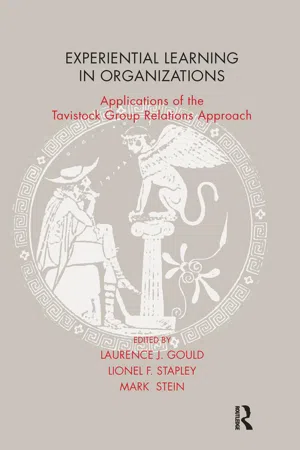
Experiential Learning in Organizations
Applications of the Tavistock Group Relations Approach
- 208 pages
- English
- ePUB (mobile friendly)
- Available on iOS & Android
eBook - ePub
Experiential Learning in Organizations
Applications of the Tavistock Group Relations Approach
About this book
This book shows the ways in which the boundaries of the basic group relations training conference model of experiential learning have been extended to provide creative, conceptual, and applied links to both management and group and organizational education, training, and consultancy practice.
CHAPTER ONE
“The ‘Leicester’ model” revisited
Eric J. Miller
The “Leicester conference” is an intensive two-week residential event devoted to experiential learning about group and organizational behaviour. Its purpose is educational. The first conference in 1957 was a collaborative venture of the Tavistock Institute and Leicester University, where it had strong support from the professors of adult education and sociology. That joint sponsorship continued for several years, until their retirement. Since that beginning, the conference has been held once and sometimes twice a year, and with two or three early exceptions it has always been at Leicester—hence the label.
In the first conference (Trist & Sofer, 1959) the only experiential event was the “study group” of about 12 members with a consultant; the rest of the programme was made up of lectures, seminars, and visits to organizations. The year 1959 brought the addition of an intergroup exercise (Higgin & Bridger, 1964), in which I was a rather bewildered consultant attending my first conference. This was followed in the early 1960s by the large group and a second version of this inter-group which involved the “here-and-now” study of relations between the membership and staff (Rice, 1965). Lectures were phased out; apart from review and application groups, all events were experiential. By the end of the 1960s the “Leicester model” of today was becoming crystallized; innovations since have been minor or temporary. By then, too, the model was being disseminated, particularly in the United States. These were shorter conferences—typically a week, or even just a weekend. Leicester itself remained (and remains) the only two-week conference, bringing together an increasingly international membership of, usually, 50-70 people drawn from a wide range of occupations, with a similarly diverse group of around 12 staff.
In the late 1980s, when Eric Trist (who had a key role in creating the first Leicester conference) and Hugh Murray were assembling the first volume of their trilogy on The Social Engagement of Social Science: A Tavistock Anthology, they asked me for a contribution on the Leicester model, covering history, theory, and methodology in one chapter and dissemination and application in a second (Miller, 1990a, 1990b). They also willingly agreed to a slightly expanded version being published separately as a Tavistock Institute occasional paper—which in fact came out before the book (Miller, 1989).
Re-reading this paper after some eight years, I find little that I would want or need to revise for a 1998 edition. The Leicester conferences themselves have continued as an annual event—the 50th was held in 1996—latterly being jointly sponsored by the Tavistock Institute’s Group Relations Programme (GRP) and the Tavistock Clinic Foundation. For a long time directorship of the conference alternated between myself, as director of GRP, and Anton Obholzer, who was associate director of the programme in addition to being head of the Clinic. One positive change was the appointment of external advisers to the programme. These have expanded the pool of Leicester directors, and the 1995 conference was the first to be directed by a woman (Olya Khaleelee). However, the design has not changed. There are some who argue that it should, on the grounds that organizations have changed and so has the psychological contract of those who work for them; and many conference members are nowadays self-employed. Yet for much of the present decade the conferences have been fully subscribed, sometimes with a waiting list, and the great majority of ex-members seem to value their learning. So while there is a strong case for revisiting the conceptual framework and methodology to generate new models of educational events, it is more appropriate at present to see them as complementing rather than replacing the existing Leicester model. I shall come back to this.
Dissemination of the model also continues. The Israel Association for the Study of Group and Organizational Processes (OFEK), which the Tavistock Institute helped to establish, is now a thriving institution with a growing programme of educational and consultancy activities, in addition to an annual international conference jointly sponsored by the Institute from 1988 onwards. In South Africa, formation of the Institute for the Study of Leadership and Authority (ISLA) was, like OFEK, initially supported by subsidized places at Leicester conferences. It now operates through three regional groups with a multiracial membership. Its contribution to the current massive process of national transformation was brought home to me during visits in 1996 and 1997 to direct conferences and other events, including a development programme for consultants.
Alongside conferences based on what has become the traditional model, there have been innovative re-combinations of elements of the conceptual framework and methodology. As I have noted in the past, the design of the conferences that evolved in the 1960s was explicitly for the task of studying authority and was thus centred in the transference and countertransference between members and staff. Consequently, it is usually inappropriate to use the model indiscriminately for other learning objectives: different tasks require different designs. This issue came up in a practical way when I received a challenging invitation to direct a conference for German and Israeli psychoanalysts on the theme of “the past in the present”. Those who invited me had valued the insights they had gained for themselves about the meanings of that “past” through their experiences as members and in some cases as staff at Leicester conferences and/or the one-week conferences in Israel (which some Germans had attended). They wanted me to adopt the same model for the German-Israeli event. This I strongly resisted. My task, as I saw it, was to design an encounter between the two national groups in a way that would help members to get in touch with their underlying mutual projections. Each needed the other to evoke those projections. Thus it was to be an intergroup conference, with staff as a third party. But it would not be a neutral third party, because I planned that the staff group should include equal numbers of Germans, Israelis, and those like myself, who were neither. The transference onto staff, as individuals and collectively, would be an inevitable part of the process, but their interpretations needed to relate to the overall task of the conference. The resultant design involved members moving back and forth between groupings of the same nationality—for example, in review and application groups and in the opening phase of a version of an institutional event—and of mixed nationalities—for example, small study groups and plenaries. Despite echoes of Leicester in the titles of some events, the work being done in them reflected the different task. For example, an Israeli consultant to a mixed study group needed to be alert all the time to when and why her Jewish identity was being mobilized or denied. The two conferences held in Israel in 1994 and 1996 using this design were seen as being rich learning experiences by the great majority of participants.
Another example of recombination is the Tavistock Institute’s programme in Advanced Organizational Consultation (AOC) launched in 1993. The 14-15 participants (who come from many different countries) are involved in seven residential modules spread over 18 months, interspersed with regional application days. In this programme the psychodynamic perspective is integrated with organizational theory and consultancy methods in a combination of conceptual and experiential learning.
This programme also goes some way towards dispelling a mythical “Tavistock Model” of organizational consultancy that has some currency among past conference members. I may have partly contributed to this myth through being insufficiently explicit in my paper on the Leicester model (Miller, 1989), where I stated that
the conceptual framework that Rice and I developed for the study of organisation... was appropriate for an action research/consultancy relationship in which we were collaborating with clients as actors in understanding and perhaps modifying their roles in the organisation.... Indeed, the basic framework of the Leicester model is identical to the framework underlying much of the Institute’s organisational consultancy: in both cases the consultant’s method involves proposing working hypotheses that may be tested by the client [p. 9]
Although the paper goes on to refer to the techno-economic as well as the psycho-social dimensions of organizations (p. 11) and to the use of the heuristic concept of “primary task” to construct and compare different organizational models of an enterprise based on different task definitions (p. 12), there is a persisting belief that the “working hypotheses” offered to the client are devoted to unconscious processes in the organization. The implication is that interpretation of these processes will lead to positive organizational change. I am certainly alert to such underlying dynamics in the client system and also to how I am being used in my role—the transference and countertransference—and I find these insights important in shaping my interventions. Only rarely, however, would I use them directly. An exception might be a therapeutic community in which the language of psychoanalysis is already familiar or a long-standing client system that I have gradually “educated” into the psychodynamic perspective; but even there I am just as likely, if not more so, to be addressing technological, structural, and economic factors or political processes. By itself, interpretation of underlying dynamics, while it may explain what sustains the status quo, is seldom enough to produce an organizational change.
Recently Jaques (1995) has generated a flurry among students of organizational psychodynamics by recanting his original proposition that social systems provide defences against persecutory and depressive anxiety (Jaques, 1955). He now argues that “it is badly organised social systems that arouse psychotic anxieties and lead to their disturbing acting out and expression in working relationships” (1995, p. 343) and he “doubts whether ... understanding of unconscious processes can contribute to the study and understanding of social systems” (p. 363). While I agree with other critics of this view (e.g. Amado, 1995, Ridgeway, 1997) that a psychoanalytic perspective can help to illuminate the processes of organizational life—we never leave the unconscious at home when we go to work—I have always recognized (Miller & Rice, 1967) that appropriate organizational design—for example alignment of organizational boundaries with process boundaries—can reduce conflict and stress and their dysfunctional effects. Consequently it is this kind of issue that is likely to be the subject of my working hypotheses rather than unconscious dynamics. A recently published case study of organizational consultancy makes that plain (Miller, 1997a). This related to water supply for Mexico City, which was under the administration of the Federal District. My immediate client was the director general of a new agency resulting from the merger of previously separate divisions for construction and operation, each with its own identity and culture. The presenting problem was to form an integrated organization. Socio-technical analysis generated a possible model. However, there were two more fundamental issues: low tariffs for water and drainage meant that the agency was heavily subsidized; and key functions, including billing, collection, and financial control, were retained by the Federal District administration. I therefore proposed conversion of the agency into a much more autonomous enterprise—a quasiutility company—which would include all these functions, and progressively become self-financing. My understanding of the political climate indicated—correctly, as it turned out—that this radical alteration might be acceptable. I thus designed a process of planning and implementation that had the effect of creating a new common identity and submerging the differences.
The Jaques recantation is in fact a useful reminder that theory does not stand still. For example, although Melanie Klein’s theory of infant development continues to provide a useful framework, I would be disappointed if other more recent psychoanalytic theories did not find a relevant place within the “system psychodynamics” framework. Thus, I see Kleinian theory as paying too little attention to the infant’s biogenetic inheritance and to the experience in utero. Bowlby tended to be marginalized by other analysts for drawing on ethological studies to support the instinctiveness of attachment behaviour. Bion originally postulated that “groupishness” was instinctive but then backed off, probably under the influence of Klein, who was his training analyst. I have suggested (Miller, 1997b) that if one starts from the proposition that the infant is equipped both with instinctive survival drives (pleasure seeking, pain avoidance) and with instinctive groupishness, then human maturation involves a dual process of individuation: from attachment towards separation and autonomy in relation to the motherinfant dyad and from homogenization towards differentiation in relation to the group. I have often heard people with many years of analysis and psychoanalysts themselves report that a Leicester conference has brought them in touch with previously unrecognized parts of their inner world. It seems possible that whereas the dynamics of the former process can be worked at effectively in the analytic pair, only a vehicle such as a Leicester conference can address the vicissitudes of the homogenization-differentiation processes, and hence the individual’s relatedness to groups and institutions.
Changes in the characteristics of today’s work organizations also call for modifications to the original system psychodynamics framework. For example, information technology makes previously clear system boundaries both less clear and more permeable. Thirty years ago, when the idea of semi-autonomous work groups based on the socio-technical system model was being disseminated widely and being seen as a panacea, Rice and I made ourselves unpopular in some circles for questioning their appropriateness in enterprises facing rapid technological change (Miller & Rice, 1967). Since then the rate of change has escalated. Consequently various writers are reformulating the original conceptualization. Thus Heller (1997) adds the ecological dimension to the techno-economic and psychosocial, while Holti (1997) identifies four levels of organizational life: the political and economic, the logical and cognitive, the cultural or interpretative, and the psychodynamic.
Continuing conceptual developments of this kind, which build on and extend our framework for understanding system psychodynamics, offer scope for innovation in the design of educational events and also in organizational interventions, as is amply demonstrated in this volume. However, I see them as supplementing rather than supplanting the Leicester model. It is a model that has proved to be extraordinarily robust during a period of major social change from the 1960s onwards. Perhaps we should not be surprised at this when we recall that the basic framework of the psychoanalytic dyad with its transference-countertransference methodology has survived for a much longer period and yet remains relevant. The Leicester model can be seen as a macro-version of that framework and methodology for individuals to explore their unconscious involvement in group processes and to work at the very fundamental issues of differentiation and the exercise of their own authority. I therefore see no immediate signs of it becoming obsolete.
CHAPTER TWO
Theories of experiential learning and the unconscious
Mark Stein
In an age preoccupied by outcomes, the processes of learning are often seen to be of subsidiary interest. As a result, a theory of experiential learning, which focuses principally on processes rather than on outcomes, runs against the current tide of fascination for competence, performance, and anything that can be tightly linked to the products of learning. Prior to the current tide, however, one finds a long history of interest in the idea of experiential learning. The purpose of this chapter, therefore, is to examine a variety of approaches to experiential learning and to locate the group relations or systems psychodynamic approach within it. It begins with an examination of some of the most influential ideas associated with the concept of experiential learning, suggesting a line of intellectual development from one of its earliest incarnations in the writings of Aristotle. Subsequently, a veritable renaissance of interest has occurred since the end of the nineteenth century. This includes William James’s notion of knowledge of acquaintance, Dewey’s work in education, Lewin’s work on organization and community development, Schon’s work on the professions, and Kolb’s idea of the learning cycle, which may all be seen to fall under the aegis of the development of our understanding of experiential learning or practical wisdom.
We then turn to the group relations or systems psychodynamic approach, and the pivotal role played in this perspective by the concept of the unconscious. While the other approaches provide fundamental and valuable bases for the understanding of experiential learning, it is argued here that an invaluable addition to our understanding may be made when we refer to the unconscious. Drawing on the work of Freud, Klein and Bion, the concept of unconscious phenomena and its relation to experiential learning is then explored: in particular, the concept of projective identification (Klein, 1946,) and the associated idea of beta-elements and alphafunction (Bion, 1962) are looked at. A case example from an educational setting is then offered by way of illustration. The chapter ends with an examination of some of the implications of these ideas.
Theories of experiential learning
A theory of experiential learning is one that suggests that a uniquely valuable source for learning—especially in the realm of human behaviour on the individual and group level—lies in the experience of everyday life and the conceptualization and reflection on it. It implies that academic or book learning—on its own— cannot be a substitute for learning from experience and may only play a supplementary role by recording or otherwise elaborating on some of the learning phenomena derived from experience. This view of experiential learning is neither new nor confined to a specific school of thought. Perhaps one of the earliest explorations of the link between experience and learning occurs in Aristotle’s Nicomachean Ethics (in Aristotle, 1976). Here he argues that one who is young (either in age or in character) cannot comprehend political science because he is not versed in the practical business of life from which politics draws its premises and subject matter (1976; p. 56). Of all types of knowledge, experience has a particular place in phronesis or practical wisdom, and this Aristotle contrasts with scientific knowledge [episteme] and technical knowledge [techne]. The distinctive character of phronesis is that it involves the specific capacity to deliberate and make intelligent judgements about courses of action, without being corrupted by pleasure or pain.
In more recent times theories of experiential learning have emerged from a wide range of sources. One of these derives from William James (1890), who drew a distinction that echoed one drawn by Aristotle. James argued that there is a fundamental difference between knowing about, the product of reflection and abstract thought, and knowledge of acquaintance, which derives from the direct experience of situations.
In the education field, Dewey—probably the most influential educationalist in the twentieth century—has argued strongly that learning and experience are profoundly interconnected. Consequently, he suggested that education should be shaped by the organic connection between education and personal experience (Dewey, 1963, p. 25). Education should therefore focus as much on how people learn as on what it is that they learn.
In the field of organization and community development, Lewin (1952) developed an approach to experiential learning that was to have a major influence. Lewin’s team at the Massachu...
Table of contents
- Cover
- Half Title
- Title Page
- Copyright Page
- Dedication Page
- Contents
- Editors and Contributors
- Abbreviations and Acronyms
- Introduction
- 1 “The ‘Leicester’ Model” Revisited
- 2 Theories of Experiential Learning and The Unconscious
- 3 Fraternal Disciplines: Group Relations Training and Systems Psychodynamic Organizational Consultation
- 4 Diversity and Authority Conferences as a Social Defence
- 5 Working in Retreats: Learning from the Group Relations Tradition
- 6 Building an Institution for Experiential Learning
- 7 Experiencing, Understanding, and Dealing with Intergroup and Institutional Conflict
- References
- Index
Trusted by 375,005 students
Access to over 1.5 million titles for a fair monthly price.
Study more efficiently using our study tools.
Frequently asked questions
Yes, you can cancel anytime from the Subscription tab in your account settings on the Perlego website. Your subscription will stay active until the end of your current billing period. Learn how to cancel your subscription
No, books cannot be downloaded as external files, such as PDFs, for use outside of Perlego. However, you can download books within the Perlego app for offline reading on mobile or tablet. Learn how to download books offline
Perlego offers two plans: Essential and Complete
- Essential is ideal for learners and professionals who enjoy exploring a wide range of subjects. Access the Essential Library with 800,000+ trusted titles and best-sellers across business, personal growth, and the humanities. Includes unlimited reading time and Standard Read Aloud voice.
- Complete: Perfect for advanced learners and researchers needing full, unrestricted access. Unlock 1.5M+ books across hundreds of subjects, including academic and specialized titles. The Complete Plan also includes advanced features like Premium Read Aloud and Research Assistant.
We are an online textbook subscription service, where you can get access to an entire online library for less than the price of a single book per month. With over 1.5 million books across 990+ topics, we’ve got you covered! Learn about our mission
Look out for the read-aloud symbol on your next book to see if you can listen to it. The read-aloud tool reads text aloud for you, highlighting the text as it is being read. You can pause it, speed it up and slow it down. Learn more about Read Aloud
Yes! You can use the Perlego app on both iOS and Android devices to read anytime, anywhere — even offline. Perfect for commutes or when you’re on the go.
Please note we cannot support devices running on iOS 13 and Android 7 or earlier. Learn more about using the app
Please note we cannot support devices running on iOS 13 and Android 7 or earlier. Learn more about using the app
Yes, you can access Experiential Learning in Organizations by Laurence J. Gould in PDF and/or ePUB format, as well as other popular books in Business & Consulting. We have over 1.5 million books available in our catalogue for you to explore.