- 294 pages
- English
- ePUB (mobile friendly)
- Available on iOS & Android
eBook - ePub
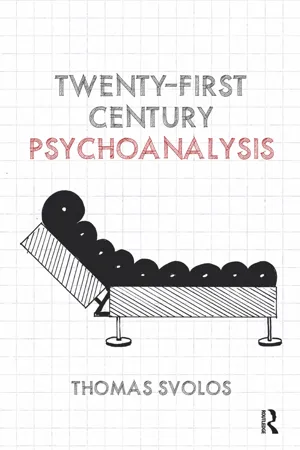
Twenty-First Century Psychoanalysis
About this book
This book articulates a possible future for Lacan and psychoanalysis, through an exploration of the historical trajectory of psychoanalysis and a survey of the ways Lacanian psychoanalysis offers a unique response to the pressing clinical demands.
Information
PART I
INTRODUCTION
CHAPTER ONE
Twenty-first century psychoanalysis*
What is the future of psychoanalysis? What psychoanalysis might we have in the twenty-first century?
I would like to start my remarks with a reference to a way in which Lacan defined psychoanalysis in Seminar 17, as a discourse or a social bond that might exist between speaking beings. This definition places psychoanalysis within the realm of speech and language. And indeed it is with words that we practice.
This definition transforms a whole series of debates about the “identity” of the psychoanalyst. For example, I supervise residents in a psychiatric clinic. When they talk about their clinical work, from time to time, clearly the words spoken between patient and the resident psychiatrist can be described as something happening within the discourse of psychoanalysis. The psychoanalytic discourse can exist without either of those participating being aware of it, and, as discourse, it existed before Freud, who described it for the first time.
On the flip side of that, just because a person has been named as psychoanalyst is no guarantee that the speech that that individual engages in with his or her patients should be understood as psychoanalysis. I can look in the mirror and think to myself, “I am an analyst,” but as we learn from the first lessons of Lacan regarding the Imaginary, such recognition always carries within itself the potential for misrecognition. The attribution of identity is a separate matter from spoken discourse.
This basic approach to psychoanalysis has implications for the institutional questions that are often posed about psychoanalysis. In some psychoanalytic groups, it is Imaginary rules that define the process by which a person is named a psychoanalyst—numbers of sessions or supervisions, being present in a class (even one about neuroscience!), and so forth. The Schools of the World Association of Psychoanalysis, however, acknowledge Lacan’s famous statement that the analyst authorizes himself or herself. Any two people may engage in spoken discourse that could be structured as psychoanalysis. But, while the speech of any two people may fall within the discourse of psychoanalysis, it is an ethical responsibility of the analyst to conduct himself or herself with those who come for help in such a way that is consistent with psychoanalytic discourse. The best that we can do as a School of psychoanalysts is listen to those who wish to join our School and determine if we can offer a guarantee, of course never certain, that we believe the potential member is able to sustain that responsibility.
And, further, in contrast to some groups who award their highest honor to the training or supervising analyst, which is largely a function of age and scholarly activity and clinical experience, in our Schools the greatest honor is awarded to those analysts of the School who are able to put something of their experience of psychoanalysis into words, to say something new about psychoanalysis, to extract something from their experience that can be transmitted to colleagues through their Testimonies and thus move our practice forward.
While we describe the practice of psychoanalysis itself as something we do as analysts with the spoken word, we must on the other hand recognize the significance of those developments in the last work of Lacan that reframe the practice as one of reading—a shift from listening to words to the reading of the text of the analysand, a reading of the unconscious, a reading of the symptom. The genius of Freud was to recognize that those seemingly meaningless phenomena of the patients that he saw—dreams, slips, symptoms, and so forth, are, in fact, a kind of text that is to be read by the analyst.
Freud, we must say, had a very particular way of reading these texts. They are always read through the perspective of the Oedipus complex. It is hard for us in our current moment to recognize the shock that this reading of Freud had on his patients and on society. Freud’s formulations relating to sexuality, infantile sexuality, and the ways in which he believed this was structured through the Oedipal complex—some of which are accepted now as fact in many disciplines—were difficult for the society around Freud to accept.
From a clinical perspective, though, many of the first people who came in to see an analyst felt a dramatic relief, a significant diminution in the suffering of their symptoms as these symptoms were deciphered through Freud’s reading. To me, there are two different issues in play here with Freud’s work. First, there is the hypothesis that Freud introduces regarding the unconscious (and hypothesis is what it remains). In Lacan’s classic formulation, the unconscious is that set of signifiers—the “treasure trove of signifiers,” (2006a, p. 682) as he put it—that form the backdrop against which the unconscious formations such as dreams, symptoms, and slips may be decoded. In the work of Lacan of the 1950s, the truth to the unconscious formations is found in the unconscious (Let me add parenthetically, that in the later work of Lacan, more relevant today in practice, as further developed by Jacques-Alain Miller, in addition to this aspect of the unconscious as signifier—the transferential unconscious—there is also a Real unconscious, what we might describe as the libidinal dimension of the unconscious). The second issue with Freud relates to the Oedipal complex. It seems to me that Freud used this concept to master the unconscious, to organize it, to structure it. It was, we might say, his law of the unconscious, and in the first decades of psychoanalysis it was powerful in the elucidation of meaning and in its therapeutic efficacy as an interpretive key.
This did not last long however, and by the 1920s, Freud and his colleagues were already lamenting the loss of therapeutic efficacy of psychoanalysis and the persistence of symptoms in the patients of that era who came in for psychoanalysis, even after long periods of psychoanalysis. The Oedipal interpretations were no longer working. Where before, Oedipal interpretations were able to reduce or eliminate the symptom, now analysts struggled more and more with the fact of the resistance of symptoms to interpretation. The hermeneutic aspect of psychoanalysis lost its power; indeed, psychoanalysis is not a hermeneutics (or, better said, hermeneutics is only one facet of psychoanalysis).
We should note that the moment when patients begin to come into their sessions no longer complaining of meaningless symptoms or troubling dreams, but rather come in complaining of unresolved Oedipal wishes, is the moment where the Oedipal reading will, without a doubt, fail. The analyst must read otherwise. When the symptoms were meaningless, an Oedipal meaning was an Other reading. But, when the Oedipal hypothesis becomes part of the world (as a result of the very success of psychoanalysis itself), an analyst may no longer use it to read Otherwise, for it is already incorporated into the unconscious. The unconscious is not a stable phenomenon, the Jungian position, but articulates with the society in which people live. And society itself absorbed the first Freudian lessons.
We must fast forward all the way to the Lacan of the late 1960s and 1970s to reach a point where the residual repetitive effects of symptoms are no longer sign of the failure of psychoanalysis, but become the grounds for the basis of another way for psychoanalysis to work.
It is the moment of the 1960s and the advent of what we now call postmodernity that puts psychoanalysts in a situation where they are confronted with a different society and a change in the unconscious. Authority—paternal authority and the Name of the Father, a key concept for the Lacan of the 1950s—no longer organizes society—the “master narratives” in postmodernity are no longer trusted, as Lyotard described it (1984). As for postmodernity, I will add that Fred Jameson’s work in this area (see especially Jameson 1991, 2015) is presupposed throughout.
I would characterize three responses of psychoanalysts to the 1960s. On the one hand, in the face of a clear decline in paternal authority, a weakening of authoritarian structures in many forms, there are movements in psychoanalysis that seek to reassert the power of the father, of Oedipus. This is what we might term a conservative, or, perhaps better yet, a fundamentalist response from psychoanalysis. In the face of a social change with regard to authority, there is a reaction to prop it back up.
There is a second response, which is that which celebrates the unconscious and the overthrow of authority. Rather than using Oedipus to tame the unconscious, the unconscious, in the form of the drive object, is placed at what Jacques-Alain Miller refers to as the zenith of society (Miller, 2005). Society is no longer organized around the Ideal, previously derived from the father, but by the drive object. This argument from psychoanalysis aligns well with Fred Jameson’s comment regarding the colonization of the unconscious by capitalism in postmodernity, as these drives are often linked no longer to the old Freudian part objects, but rather ready made drive objects created by society, consumer objects. The drives are something to be identified with, and to pursue without any restriction, thus the development of addiction as the paradigmatic psychic state of our current moment. It is the proposal of Deleuze and Guattari against Oedipus and in praise of schizophrenia that is the most clearly articulated intellectual version of this response (1983).
Lacan’s response marks the third response. Lacan responded to this moment of the 1960s in a way that remains relevant today. The act of reading the symptoms will no longer make the symptoms go away as it did a century ago. However, we must not simply celebrate the symptom, for it is certainly a source of pain and suffering and, to go back to the Freudian formulation, is linked to the death drive. I would say that the task is not to enjoy the symptom (as, say, with the Deleuze, or with the addictive push so present in our society today), as much as find a way to live with the symptom. How might we help our patients find a way to live with the symptom, with their particular symptom, their unique symptom, their partner, in a world where the old rules no longer hold sway?
Instead of Oedipus rex, a single Oedipal formulation that rules over all of psychic reality for everyone, I would state that we are now in a world of A-topos rex. There is no longer a general Aristotelian Topos or rule or argument for all, but a kind of lack of rule in which all must try to find their way.
The consequences of this in the clinic are immense. It is clear, for example, that a century ago, Freud did not know what to do with psychosis. He placed that psychiatric category outside the realm of psychoanalysis. Psychoanalysis has been grappling with that ever since. Lacan’s first response to the question of psychosis in the 1950s was to apply his linguistic formulations of the time in such a way to define psychosis as what we might refer to as a refusal of Oedipus—foreclosure (1993; 2006a, pp. 445–488). However, in the 1970s, with his study of Joyce, we have a novel, and what will become quite useful, formulation of psychosis (2005). Namely, Lacan tackled the question of how James Joyce used his very particular symptom, writing itself, as a way to prevent him from falling into psychosis, from an acute psychotic episode. The hypothesis is that Joyce used his symptom as a way to evade or avoid psychosis. At this moment we move from the symptom as only a source of suffering to the symptom as something that may provide the possibility of stabilization, of finding a place in the world.
In our current moment, with so many debates and discussions in the psychiatric clinic regarding the seemingly impossible task of diagnosis—debates over bipolar disorder, autism, and so forth are so common in the psychiatric world today as psychiatrists face a proliferating variety of clinical presentations—the psychoanalytic reformulation of these questions in terms of the particularity of the psychic structure for each patient offers a clinical path that meets the demands of the time.
Let me add that if, in the old Freudian world, it was only within the erogenous zones that one would find the drive or libido or jouissance, we must note that in the case of psychosis, language does not have the same mortifying effect on the body. Speaking beings in the world of psychosis experience drive or jouissance outside the paths as specified by Freud. And, in the final work of Lacan, we find a redefinition of the relationship of speech and language such that signifiers are identified as having both a significatory and also a libidinal value (Lacan, 1998a). Thus, even words, in particular words of love, have an aspect of the drive or jouissance.
And, it was not only psychosis that baffled Freud. Freud also struggled with the desire of women or the question of what Lacan refers to as sexuation. Freud’s formulations on this matter are not completely without value, but seem so convoluted—the negative Oedipus complex and so forth. For Freud, the key to sexuation, to the difference between the male and female, was a matter of biology, of nature, of a difference in the genitals. For Lacan, the question here is not one of nature. For the speaking being, sexual identity, or gender identity, is a function of language or even logic, and not biology. Man and woman are signifiers. This is not to deny biological sexuality or genetics, but rather to point out that the fundamental fact of sexual identity for the speaking being is not a function of nature. We see this very clearly in transsexuality.
But, even further, there is nothing natural about sexuality itself for the speaking being. What is an instinct with an animal, in the encounter with language and society, becomes the drive for the speaking being. The drive is a function of the impact of language on the body. We see this the most in the case of trauma, which has nothing to do with terrible events as such, though these may have traumatic impacts of their own, but with the way in which language leaves a mark on the speaking being.
And, when it comes to the issue of sexuality as a relation to an other, to one’s intimate partner, we find Lacan’s most famous formulation on the matter, il n’y a pas de rapport sexuel, which we might translate as “there is no sexual relationship” or “there is no sexual harmony” or “there is no sexual ratio,” indicates that for every speaking being, sexuality is something that is struggled with in one way or another. Thus, there is no natural or harmonious relation between two speaking beings with regards to sexuality. There is no sexual utopia. Speaking beings will often act as if there is (why not?), but that is only a fantasy. Note, however, that we also have love—what seems to me now one of the most fragile things in today’s world—that allows us a way of bringing another speaking being into our lives. As analysts, we must assist those who come to us to find a way to struggle through the challenges of sexuality in the world today without rules.
In this brief survey, I’ve tried to point out the ways in which we see an unconscious that changes. It is even one that changes in response to psychoanalysis itself. Though it is not the unconscious of old, in the Lacanian world we still believe in the unconscious in whatever new forms it may take. Some analysts, however, have lost their faith, have lost this belief in the unconscious. They feel a need to turn to science to find the unconscious in the brain, in different parts of the brain or different neuronal structures. That side of the neuropsychoanalytic project, where analysts look to science for proof of their discipline, is a departure from psychoanalysis itself, as the unconscious does not exist as such. That is not to say, however, that scientists may not want to make use of psychoanalytic formulations. There is a lawless quality to science, and it will mine psychoanalytic texts for hypotheses that it may try to use in the advancement of scientific knowledge. But, that is a different matter.
I want to close with a very brief vignette that may elucidate something about interpretation in this post Oedipal psychoanalysis, where it is not our goal to put meaning to the analysand’s words, to give an example of an analyst at work in this new world, to give an example of interpretation in a post-hermeneutic era. This is a story recounted in a documentary that includes an interview with Suzanne Hommel, who was in analysis with Lacan in 1974 (Miller, G., 2011). One piece of background to the story is vital, namely that Suzanne was a young girl when her country was occupied by the Nazis. In this documentary, she spoke of a session with Lacan when she was talking about a dream. She said to Lacan that she woke up every morning at five o’clock, adding that Gestapo came to get the Jews from their homes at five o’clock in the morning. She states that at that moment Lacan jumped up from his chair, walked over and gave her an extremely gentle caress on her cheek. She immediately understood this as the way in which Lacan had changed Gestapo to geste à peau, which in French means a gesture on the skin. She described it as tender, as an appeal to humanity. It did not take away her pain, but turned it into something different, something she could live with, and had an effect she remembers. She talks about how she can still feel the caress on her skin forty years later.
_______________
* “Twenty-first century psychoanalysis” was presented at the University of Chicago on May 19, 2013, at “Which way forward for psychoanalysis?”—a Conference sponsored by the Society for Psychoanalytic Inquiry.
PART II
ON THE LEGACY OF JACQUES LACAN IN THE UNITED STATES
CHAPTER TWO
Jacques Lacan, reader*
Like most Americans and most people of my generation, or those younger than me, I never met Lacan, never saw him, never heard him speak. When we talk about Lacan’s Legacy, I think there is a gulf between the notion of a legacy among those who knew Lacan, who heard him, who went into analysis with him; and those without that personal connection. If, like me, you have no personal experience of the man, I think you will have missed something important about him, something associated with his corporeal existence. In Commandatuba, Jacques-Alain Miller (...
Table of contents
- Cover
- Half Title
- Title Page
- Copyright Page
- Dedication
- Table of Contents
- Acknowledgements
- About the Author
- Preface
- Part I: Introduction
- Part II: On the Legacy of Jacques Lacan in the United States
- Part III: Lacanian Explications
- Part IV: Addiction
- Part V: Psychosis
- Part VI: Encore, Encore: Conceptual Extracts from Seminar 20
- Part VII: Remarks on Psychoanalysis
- Part VIII: Remarks on the Mental Health Field
- References
- Index
Trusted by 375,005 students
Access to over 1.5 million titles for a fair monthly price.
Study more efficiently using our study tools.
Frequently asked questions
Yes, you can cancel anytime from the Subscription tab in your account settings on the Perlego website. Your subscription will stay active until the end of your current billing period. Learn how to cancel your subscription
No, books cannot be downloaded as external files, such as PDFs, for use outside of Perlego. However, you can download books within the Perlego app for offline reading on mobile or tablet. Learn how to download books offline
Perlego offers two plans: Essential and Complete
- Essential is ideal for learners and professionals who enjoy exploring a wide range of subjects. Access the Essential Library with 800,000+ trusted titles and best-sellers across business, personal growth, and the humanities. Includes unlimited reading time and Standard Read Aloud voice.
- Complete: Perfect for advanced learners and researchers needing full, unrestricted access. Unlock 1.5M+ books across hundreds of subjects, including academic and specialized titles. The Complete Plan also includes advanced features like Premium Read Aloud and Research Assistant.
We are an online textbook subscription service, where you can get access to an entire online library for less than the price of a single book per month. With over 1.5 million books across 990+ topics, we’ve got you covered! Learn about our mission
Look out for the read-aloud symbol on your next book to see if you can listen to it. The read-aloud tool reads text aloud for you, highlighting the text as it is being read. You can pause it, speed it up and slow it down. Learn more about Read Aloud
Yes! You can use the Perlego app on both iOS and Android devices to read anytime, anywhere — even offline. Perfect for commutes or when you’re on the go.
Please note we cannot support devices running on iOS 13 and Android 7 or earlier. Learn more about using the app
Please note we cannot support devices running on iOS 13 and Android 7 or earlier. Learn more about using the app
Yes, you can access Twenty-First Century Psychoanalysis by Thomas Svolos in PDF and/or ePUB format, as well as other popular books in Psychology & History & Theory in Psychology. We have over 1.5 million books available in our catalogue for you to explore.