- 240 pages
- English
- ePUB (mobile friendly)
- Available on iOS & Android
eBook - ePub
Consultations in Dynamic Psychotherapy
About this book
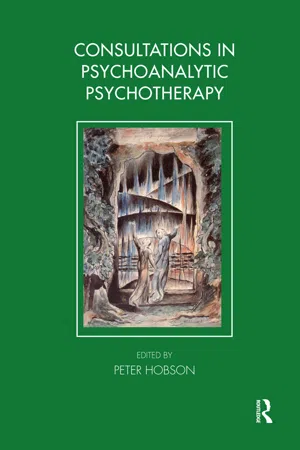
This book illustrates clinical, psychoanalytic approaches to understanding people in depth, even when breadth of understanding is severely constricted by the brevity of a consultation. It considers the changing times in which psychoanalytic psychotherapists carry on consulting.
Information
Part I
Introduction
I begin by offering an overview of the book and then discuss the aims and rationale of consultations in psychoanalytic psychotherapy. For those unfamiliar with psychoanalytic concepts, I conclude with a brief explanation of terms that will crop up in the ensuing chapters.
Chapter 1
Overview
Psychotherapy practice within the National Health Service presents few more exacting clinical tasks than to conduct a psychoanalytic consultation interview. In the case of consulting with an adult individual—and it is with this kind of interview, rather than meetings with children, couples, or families, that the present book is concerned—a principal aim is to discern the nature of and basis for someone’s emotional difficulties and assess the person’s potential to benefit from one or another kind of psychotherapy. Yet beneath this seemingly simple description there lie formidable complexities.
Consider how the meeting between two people, initially strangers to one another, is convened. Sometimes the therapist who encounters a person for the first time is forewarned and forearmed by a referral letter penned by a time-starved family doctor. Sometimes the therapist also has the benefit of the patient’s own best efforts to respond (or not) to a personal if straight-laced questionnaire. On other occasions, the therapist has almost nothing to which he or she can cling as the moment of interview approaches. In any case, whether clear-etched or shadowy, fulsome or sparse, background information affords little to the therapist by way of protection or foresight. The only real preparation is to anticipate being unprepared. The consultation will yield what it will. Anything could happen.
What is so alarming and remarkable about all this is that in the space of 90 minutes, deep and serious intimacies may be achieved or steadfastly avoided, profound griefs or resentments articulated or denied, sorrows and losses pinpointed or evaded, lifelong traumata revived or reviewed, and the most personal of relationships recounted or relived. Whatever does happen is hugely significant for the two people involved. This book illustrates as much.
If all this is so, then wherein lies the challenge of conducting assessment consultations? It sounds like falling off a log—into a turbulent river, perhaps, but falling nevertheless. Yet beyond the need to keep one’s head above water, one has the job of charting often unstable currents of emotion in the patient’s relationships, including emotions towards the patient’s own self, in order to achieve an adequate grasp of the problems and envisage the prospects for psychotherapy. And as we shall see, appraising what is important for a person’s difficulties and distress is just one dimension of a multifaceted therapeutic endeavour that has the aims not only of understanding the patient, but also (and partly through this) of embarking on the task of promoting the patient’s development through disorder and distress to more fruitful functioning.
This book emerged from discussions that took place in 2008–9 within a clinical unit (chaired by Cyril Couve and subsequently Julian Lousada) in the Adult Department of the Tavistock Clinic. We found that when different clinicians presented distilled accounts of assessment consultations, we learnt a great deal not only about therapists’ professional endeavours and patients’ emotional and relationship difficulties, but also about the various processes through which “assessment” may be accomplished. The clinicians involved were psychodynamic psychotherapists, all of whom believed in the value of tracing how a patient’s conflicts become manifest in the relationship with the therapist in the transference. Again and again this proved to be an important avenue to achieving depth in understanding. Yet each clinician was distinctive in how he or she began the interview, steadied proceedings or prompted the patient–therapist exchanges to move forward, and conceptualized the prime focus and goal of the meeting.
At the outset, I had hoped to chart some of these differences in therapeutic orientation and practice through diverse chapters written by an assortment of therapists who would then compare and contrast their respective approaches. For a variety of reasons, this hope was not fulfilled. I mention this because it is important to appreciate that there is no single correct way to conduct psychodynamic consultations. It is neither helpful nor justified to prescribe in detail how a therapist should behave. Provided that care is taken to respect a patient’s needs for confidentiality and interpersonal boundaries are maintained, there may be many ways to proceed. What is most appropriate and helpful for one therapist in relation to one patient may be inappropriate and unhelpful for another therapist with another patient. We do not have agreed criteria for what is to count as effective when it comes to psychoanalytic consultations. Even if we did, still we lack adequate research to justify claims that such criteria are met by one approach and not another.
In the event, then, this book represents not so much diversity in therapeutic attitude and technique as, rather, the working-over of ideas pertaining to a more restricted, and perhaps distinctive, style of assessment consultation. However, what the book lacks in variety, it may compensate for through relative consistency. Yet this is only one take on its contents, because contrasts in approach are also in evidence. Even to the degree that there is consensus on the purpose and some of the techniques of consultation, both the aims and the application of techniques need to be modified in keeping with the different settings in which consultations take place.
Another feature of the book is that it comprises chapters that differ in style as well as content. Readers should be prepared for some choppy transitions from one chapter to the next. Consultations are being considered from distinct vantage-points, and each contributor has written in a style that suits his or her communicative purpose. This chapter provides a point of orientation. At the beginning of Part II, Ruth Berkowitz gives an academically rich account of the historical background to our theme, and readers wishing to consult the literature will find in her chapter prominent works summarized and signposted (for which one might also consult books edited by Cooper & Alfillé, 1998, and by Mace, 1995). Jane Milton follows in chapter 3 with a deeply thoughtful discussion on the conduct and rationale of psychoanalytic consultations. The authors of Parts III and IV—respectively, myself and then Joanne Stubley, Dave Bell, and Birgit Kleeberg—mostly draw on first-hand clinical experience, albeit with respectful reference to inspirational thinkers, rather than discuss and critique the ideas of others. We trust readers will appreciate that although there are many other works that are not mentioned, this in no way signifies that the contributions of others are undervalued, nor that we are seeking to appropriate the original ideas and clinical accounts on which much of our thinking has been founded. Finally, Part V starts with a chapter by colleagues and myself, on research reflections. Here we do not attempt to review such scant evidence as exists on the predictive validity of assessment interviews. Instead, and in keeping with what has gone before, we describe illustrative research studies to complement the clinical experience of psychotherapists and to inform interested parties within and beyond psychiatry and clinical psychology. Antony Garelick rounds things off in his chapter by considering the changing times in which psychoanalytic psychotherapists carry on consulting.
We have taken pains to secure patients’ permission to present disguised clinical material. In rare instances, identities have been reconfigured by mixing together clinical material from two or more individuals. In every case, we have tried to capture what happened in the process of consultation.
The book’s primary aim, then, is to illustrate clinical, psychoanalytic approaches to understanding people in depth, even when breadth of understanding is severely constricted by the brevity of a consultation. If the book is successful in this aim, then it will also reveal the limitations of much that passes under the rubric of “psychological therapies” in contemporary NHS practice—which is not at all to diminish the potential value of such treatments. In-depth understanding is neither necessary nor sufficient to promote a person’s mental health, and here there is no claim (nor even discussion of the claim) that the psychodynamic approach is superior to non-psychodynamic assessments or interventions in diagnosing or resolving emotional distress. It is not superior—but it does have the power to reach parts of a person’s mind that other approaches only sense.
The what and why of assessment consultations
There is a fuzzy boundary between assessment consultations and the kinds of session that take place in brief or even longer term psychoanalytic psychotherapy. To be sure, there are a number of contrasts that could be highlighted, not least because the therapeutic engagement between an assessing psychotherapist and a patient is brief in nature. For example, my standard practice for such consultations is to have a preliminary meeting that lasts 90 minutes and one or two follow-up meetings, each lasting about 40 minutes. Of course, the assessment will need to accomplish things—from introducing a person to the experience of psychotherapy to excluding biological forms of psychiatric disorder—that do not feature in routine psychotherapy. Having said this, I want to bring out potential similarities between brief and lengthier psychotherapeutic encounters.
I take the view that even one-off assessment consultations are comparable to longer periods of psychotherapy in having a beginning, a middle, and an end; they can draw upon techniques that are much the same as those involved in a more extended psychotherapeutic relationship; and they serve therapeutic aims. If the term “assessment” implies that the therapist is the one assessing, then it captures only part of the truth. Consultations are also for the patient to assess the therapist’s qualities, the nature and potential relevance of psychoanalytic therapy, and what the demands and implications of psychotherapy might be. Last but not least, they allow the patient to discover whether or not he or she wishes to engage in this form of treatment.
Some patients seek the kinds of self-exploration and discovery that psychotherapy makes possible, others do not. It is a central task of assessment consultations to confront this issue. It is also important that potential benefits and risks of entering or not entering treatment are addressed in an explicit manner. At the end of the day, patients need to be in a position to decide whether, if treatment is offered, they accept or decline the offer.
Not infrequently at the beginning of a consultation, a patient will ask what psychotherapy is. I tend to reply that this is an important question that, of course, the patient has a right to ask, and perhaps we can return to it later. In such cases, I make a point of coming back to the question near the conclusion of the interview. When I do so, I express doubt whether it would be helpful for me to give a worked-out description of what psychotherapy is. I say I believe that in the course of our meeting, the patient has had first-hand experience of what it involves. I also say that this kind of experience is what should enable the patient to tell how dynamic psychotherapy may or may not be relevant for his or her difficulties.
It remains the responsibility of the therapist to make a judgement whether, in the balance of probabilities, psychotherapeutic treatment of a particular kind—whether individual or group or family therapy, whether conducted by a novice or an experienced therapist, whether brief or lengthy, whether NHS or private, whether psychodynamic or non-dynamic, whether set up as a stand-alone venture or coordinated with other (e.g., psychiatric) services—will serve the patient’s best interests. Will such treatment be acceptable to the patient, is it likely that the patient will work through difficult times and stay the course, and will the therapy promote development and thereby change the person’s emotional life? On the other side of the equation, is there a significant danger that treatment will make things worse? These questions will resur-face in ensuing parts of the book.
Very often, it is helpful to arrange one or more follow-up interviews, to see how the initial consultation has taken. What emerges then will inform a therapist’s conclusions over the critical question: does this person have the wish and ability to partake in, and benefit from, treatment of the kind offered, and does he or she know what this may entail? It also gives the patient an opportunity to review what has happened, and to communicate his or her feelings, negative as well as positive, to the person of the therapist. Sometimes I have said to patients that I am sorry that they found parts of the first consultation stressful or distressing, and I have meant this. By now, this communication is in the context of mutual understanding that patient and therapist needed to get hold of elusive but vitally important aspects of the person’s emotional life.
And finally, of course, the therapist has the job of accommodating his or her view of what the patient needs to the realities of what might be available. It is shorthand to think in terms of generic treatment, for the reason that much depends on the experience and skill of the therapist who is to conduct the treatment. Once patient and therapist have come to a shared view on what might be optimal, taking such realities into consideration, then the therapist does his or her best to move towards this goal, either through arranging something with the patient or giving the patient advice.
The patient–therapist relation
It is easy enough to catalogue some of the principal aims of conducting a psychodynamic assessment interview. It is less easy to accomplish them. How is one to achieve what one needs to achieve for the patient, and indeed for the system (often including the NHS) within which the patient is embedded?
Among the most important qualities a therapist brings to a consultation, two stand out. First, the therapist has a serious commitment to trying to understand the patient in a personal way. Second, the therapist has the aim of communicating this understanding as and when it is appropriate for promoting the patient’s development.
To some, this statement will seem anodyne. Yet such a therapeutic orientation and attitude may be contrasted with other approaches that stress the importance of putting a patient at ease, offering supportive comments, providing information and reassurance, taking a detailed developmental and psychiatric history, evolving a life narrative, or even achieving empathy. It is not that these modes of therapeutic contact are unimportant, and each may well have a place in any given encounter. For instance, there are times when what emerges during a consultation requires that time is set aside at the end, or in an alternative interview, for a thorough psychiatric appraisal. Yet despite this, I would put at the very top of the list what I have just described as a therapist’s commitment to understanding the patient in a personal way, aligned with the aim of fostering the patient’s development.
What, then, do such things mean? In trying to understand a patient, a therapist is after the truth. In my view, this means much more (though also, at times, much less) than creating a coherent narrative, or seeing things from a patient’s point of view. It means striving to characterize what is the case, or what is objectively true, of this person. What is true in this sense includes what is true of the patient’s emotional (psychic) reality, of course. As a therapist, one may not have the means to prove that what one concludes is true in this way—that is, to establish that anyone in a position to make an accurate judgement would agree with oneself over a particular formulation of a particular patient’s emotional difficulties. But this does not gainsay the importance of striving for an account that has truth as its raison d’être.
This orientation is one that pervades the therapeutic work. It is not just that the therapist is trying to find out what is true of the patient. It is also that much of the communication between therapist and patient is addressed to determining the truth, either directly or indirectly. So, too, much communication is addressed to analysing the facts of how the patient (and sometimes the therapist) are drawn to deflect from the truth or from truth-revealing interpersonal engagement, or imposing non-truths, in order to manage distress, conflict, and pain.
In case all this is too abstract, let me give a brief illustration. It has been said that when a therapist finds that he or she is avoiding or failing to address something that is happening in relation to a patient, then that is precisely the matter that the therapist needs to find a way of making explicit. If the therapist cannot manage to address things squarely (in an appropriate way, of course—blurting things out is not “managing”), then it is likely that neither will the patient be enabled to do so. Or, to take a less weighty example, consider the therapist who steals surreptitious glances at his or her watch to see how long before the session ends, or who finds he or she cannot raise the issue of the next break. It is not just that such attempts to conceal or evade uncomfortable or conflict-ridden elements of truth are ultimately fruitless. Far more important, they undermine the very foundations of psychodynamic psychotherapy. Psychotherapy is not only about the pursuit of truth. It is constantly and unremittingly orientated towards the truth. This is so, even when therapist and patient explore how facing the truth and reality is too difficult to bear.
Certain implications flow from this way of looking at the psychoanalytic encounter. Here I shall focus on the implications for a therapist’s attitude and technique, rather than those that pertain to the patient’s mental health.
First, a hallmark of the pursuit of truth is respect for evidence. What evidence is relevant for arriving at a potentially correct or incorrect view of a person’...
Table of contents
- Cover
- Half Title
- Series Page
- Title
- Copyright
- Dedication
- CONTENTS
- SERIES EDITOR’S PREFACE
- ABOUT THE EDITOR AND CONTRIBUTORS
- PART I Introduction
- PART II Frameworks for practice
- PART III The consultation process
- PART IV Special domains
- PART V Views from elsewhere
- REFERENCES
- INDEX
Trusted by 375,005 students
Access to over 1.5 million titles for a fair monthly price.
Study more efficiently using our study tools.
Frequently asked questions
Yes, you can cancel anytime from the Subscription tab in your account settings on the Perlego website. Your subscription will stay active until the end of your current billing period. Learn how to cancel your subscription
No, books cannot be downloaded as external files, such as PDFs, for use outside of Perlego. However, you can download books within the Perlego app for offline reading on mobile or tablet. Learn how to download books offline
Perlego offers two plans: Essential and Complete
- Essential is ideal for learners and professionals who enjoy exploring a wide range of subjects. Access the Essential Library with 800,000+ trusted titles and best-sellers across business, personal growth, and the humanities. Includes unlimited reading time and Standard Read Aloud voice.
- Complete: Perfect for advanced learners and researchers needing full, unrestricted access. Unlock 1.5M+ books across hundreds of subjects, including academic and specialized titles. The Complete Plan also includes advanced features like Premium Read Aloud and Research Assistant.
We are an online textbook subscription service, where you can get access to an entire online library for less than the price of a single book per month. With over 1.5 million books across 990+ topics, we’ve got you covered! Learn about our mission
Look out for the read-aloud symbol on your next book to see if you can listen to it. The read-aloud tool reads text aloud for you, highlighting the text as it is being read. You can pause it, speed it up and slow it down. Learn more about Read Aloud
Yes! You can use the Perlego app on both iOS and Android devices to read anytime, anywhere — even offline. Perfect for commutes or when you’re on the go.
Please note we cannot support devices running on iOS 13 and Android 7 or earlier. Learn more about using the app
Please note we cannot support devices running on iOS 13 and Android 7 or earlier. Learn more about using the app
Yes, you can access Consultations in Dynamic Psychotherapy by Peter Hobson in PDF and/or ePUB format, as well as other popular books in Psychology & History & Theory in Psychology. We have over 1.5 million books available in our catalogue for you to explore.