With growing numbers of children with autism spectrum disorder (ASD) being diagnosed in the early years, it is becoming increasingly important for education and health professionals to understand ASD and to implement supportive strategies as part of the everyday curriculum and routine. This book serves as an essential tool kit for anyone working with young children with ASD and speech, language, and communication needs (SLCN). Filled with practical and up-to-date tips, advice, and guidance, it shifts the responsibility of change from the child onto the caregiver, asking the question: what can we do to support the child?
Key features of this book include the following:
An introduction to ASD
Detailed case studies illustrating the varied impacts ASD can have on the life of a child
Practical activities and resources, including planning sheets and activity suggestions
Easy-to-follow chapters focusing on the classroom environment, communication, social interaction, play, and behaviour
Comprehensive, practical, and evidence based, this manual is essential reading for anyone working with children experiencing social communication difficulties and ASD in an early years setting.
An overview of communication development in typical children and children with ASD
A summary of joint attention
Practical case studies to illustrate the communication needs of children with ASD
Activity sheets:
(C1) – Developing joint and shared attention
(C2) – The power of pausing
(C3) – Imitation ‘copy me’!
(C4) – Making chances to communicate – offering choices
(C5) – Making chances to communicate – giving
(C6) – Making chances to communicate – a bit at a time
(C7) – Ready, steady, go games
(C8) – Stop/go games
(C9) – Making choices with a choosing board
(C10) – Asking for help
(C11) – Using songs
(C12) – Adding language
(C13) – Using action words
(C14) – Reducing repeated language
(C15) – Let’s create
(C16) – Using an about-me book
Development of communication
Communication develops even before a child is born; in the womb babies are becoming familiar with the native language spoken in their environment. From soon after birth babies develop their sociocognitive skills, receptive language (understanding), and expressive language (spoken language). Typically, children start to understand words before they are able to say them. Even before children are talking, they are developing important skills. Receptive and expressive language are self-explanatory, but what do we mean by sociocognitive skills?
Sociocognitive skills relate to basic skills in engaging and interacting with others and are important skills in the development of communication, social interaction, and play. In typically developing children these skills are innate and are crucial to the development of both language and also social communication. These skills include (amongst others) joint and shared attention and social responsiveness in addition to gesture and symbolic understanding. These skills all play a part in two-way communication. Typically children do not need to learn these skills; they just have them. Think of a baby or young child of one year old; typically when you smile at them, they smile at you, or if you look or point to an item out of sight, they are intrigued and interested to know what you are looking at. We are naturally programmed to be social, and from an early age, long before we can talk, we are learning how to use these skills.
We know that communication is so much more than words. Gestures, symbolic understanding, and joint and shared attention all play a huge part in the development of typical communication
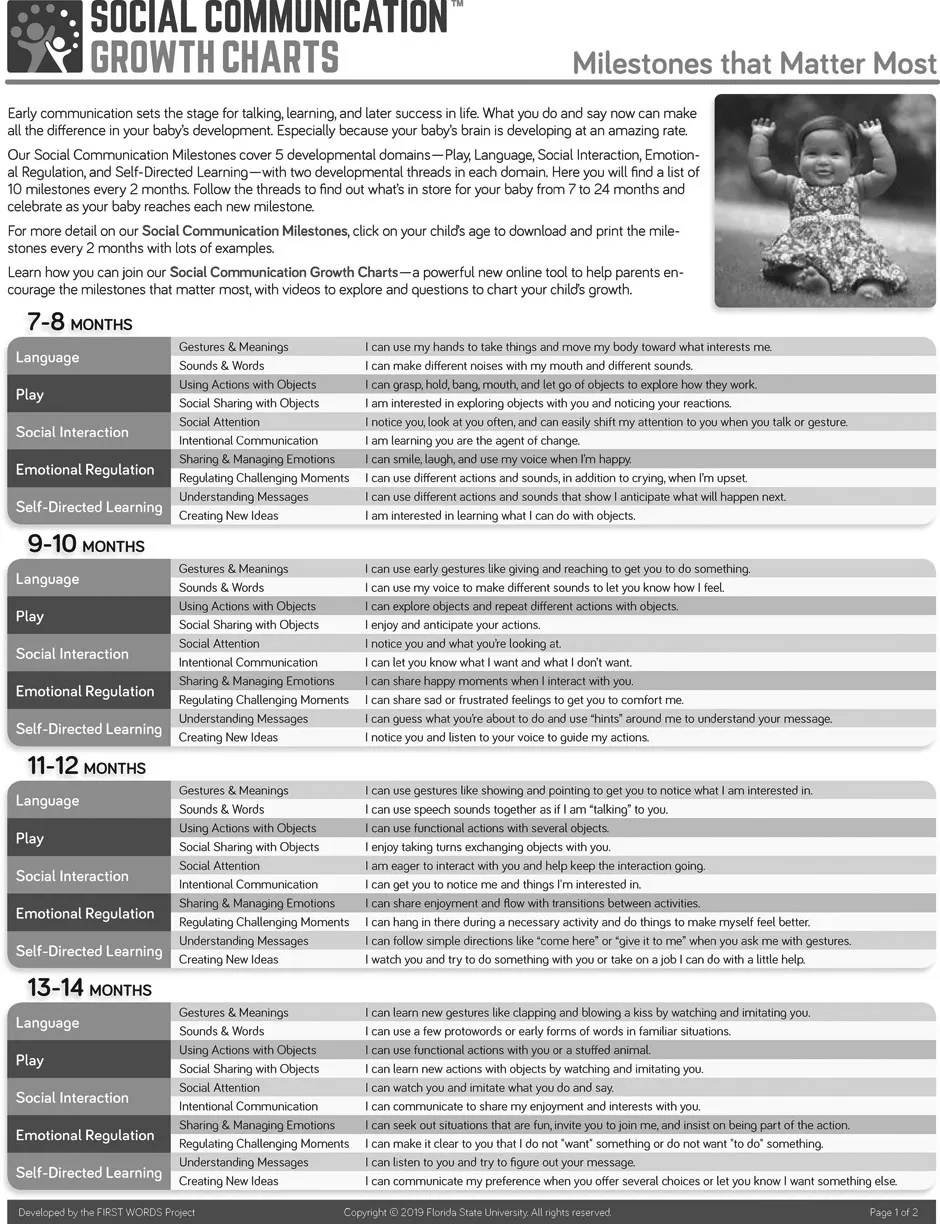
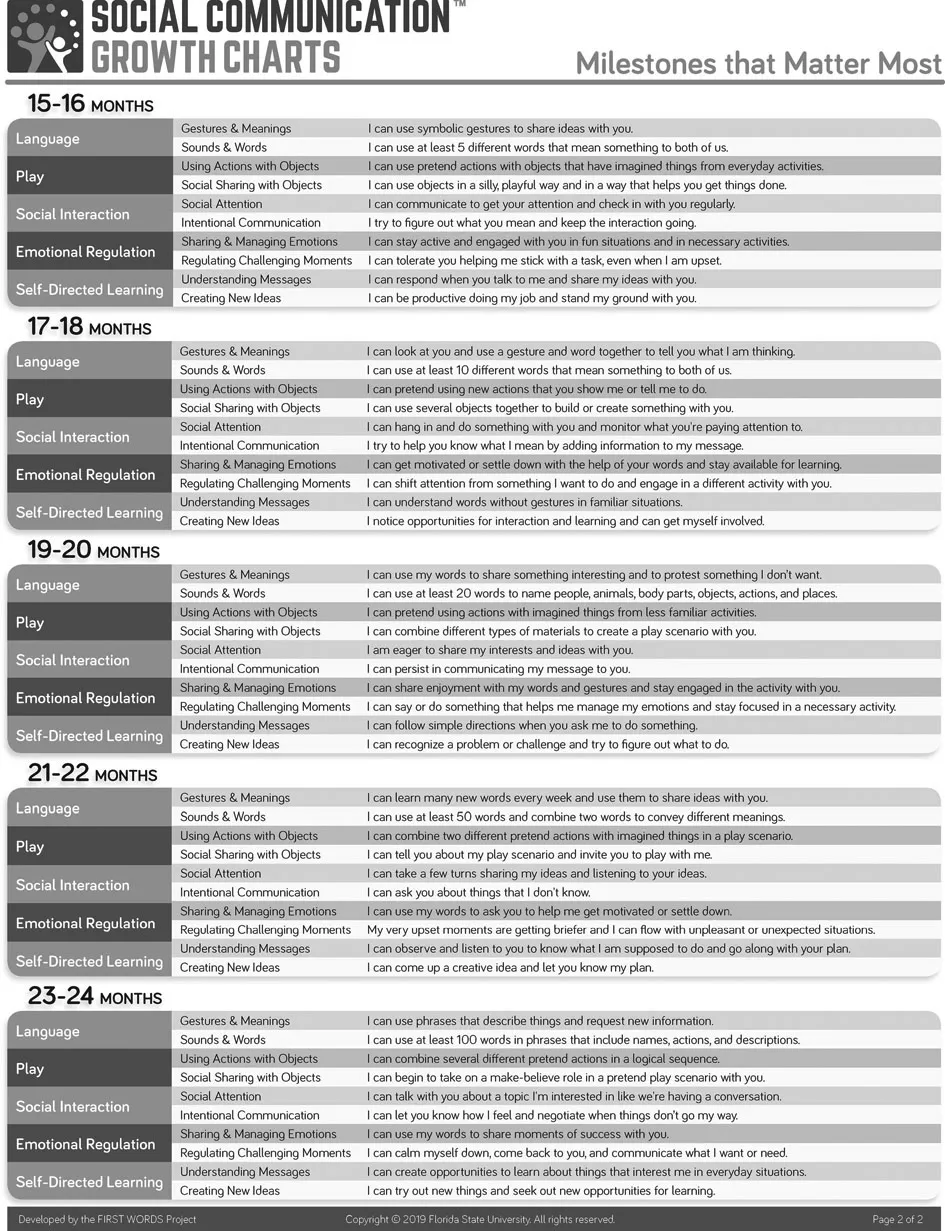
The FIRST WORDS PROJECT® is an extremely useful resource for practitioners and parents. They have kindly given permission to use a number of their checklists in this manual. These checklists provide you with a detailed insight of what to expect at different ages and stages.
Think about what may be different in a child with ASD who has a disordered pattern of communication.
Joint attention
SLTs often talk about joint attention as a key part of communication and social interaction development. You will have gained some understanding from reading the checklist and also your reading in Chapter One. We will turn now to consider joint attention and why it is important for communication and social interaction.
What is joint attention?
Joint attention relates to the ability to share a focus of attention with someone else. Typically, joint attention emerges in young children towards the end of their first year of life and involves both responding to joint attention and initiating joint attention. These skills are important for developing attention, looking and listening to activities together, learning new words, and engaging in interaction with others.
Responding to joint attention – This involves looking and focussing on where someone is looking and/or pointing, for example, when you are walking along with a child and you say, ‘Look, bus’, whilst looking and pointing towards it. Typically, children will look to where you are pointing and see the bus whilst hearing the word at the same time.
Initiating joint attention – This is being able to get someone else to focus on something of interest, for example, when a child points to an airplane and says, ‘Uh uh’, whilst looking back at you to make sure you are looking at it as well.
Why is joint attention so important?
In Chapter One we discussed theory of mind; research indicates that joint attention is an important precursor to the development of theory of mind; it is suggested that at around seven to nine months children start to understand attention and they are also beginning to understand another person’s thoughts. In other words, when a young child directs another person’s attention by pointing for example to a bus he or she has the ability to consider that another person may find what the bus that he or she is looking at interesting
Joint attention is also important for learning new words and giving meaning to objects. Think of a young, typically developing child, age eighteen months, walking in a buggy with his mother. The bus goes past, and the mother points to the bus and says, ‘Look, bus’ (whilst pointing). Because the child is able to follow her point and responds immediately to her, he is able to put the big, red, shiny object (bus) and the word ‘bus’ together. Similarly, later on in the day when walking through the park, the child sees a dog, points, and says, ‘Woof’. The mother also points and says, ‘Yes, dog’. Without joint and shared attention, it can be much harder for children to learn words in this way.
Attention and listening versus joint attention
Joint attention is quite an abstract concept and isn’t something I regularly see educators attempting to develop. Sometimes there can be confusion between attention and listening skills and joint attention.
Often when I visit nurseries, staff have concerns that a child ‘won’t pay attention’ or ‘won’t sit at a table or group time’. Naturally there is a tendency to want to develop attention and listening skills as they have such a big impact on all other areas, and this then becomes a goal as part of an individual education plan; for example, ‘Jack will sit for 10 minutes at story time’. In many cases a goal like this is asking too much in terms of what they are able to focus on. Whilst all children do need to develop their ability to pay attention to others as part of activities, it is important with children with ASD that this is done in a way that is at the child’s level. Often sitting in a circle and listening to a story is not motivating enough for a child with ASD to attend to.
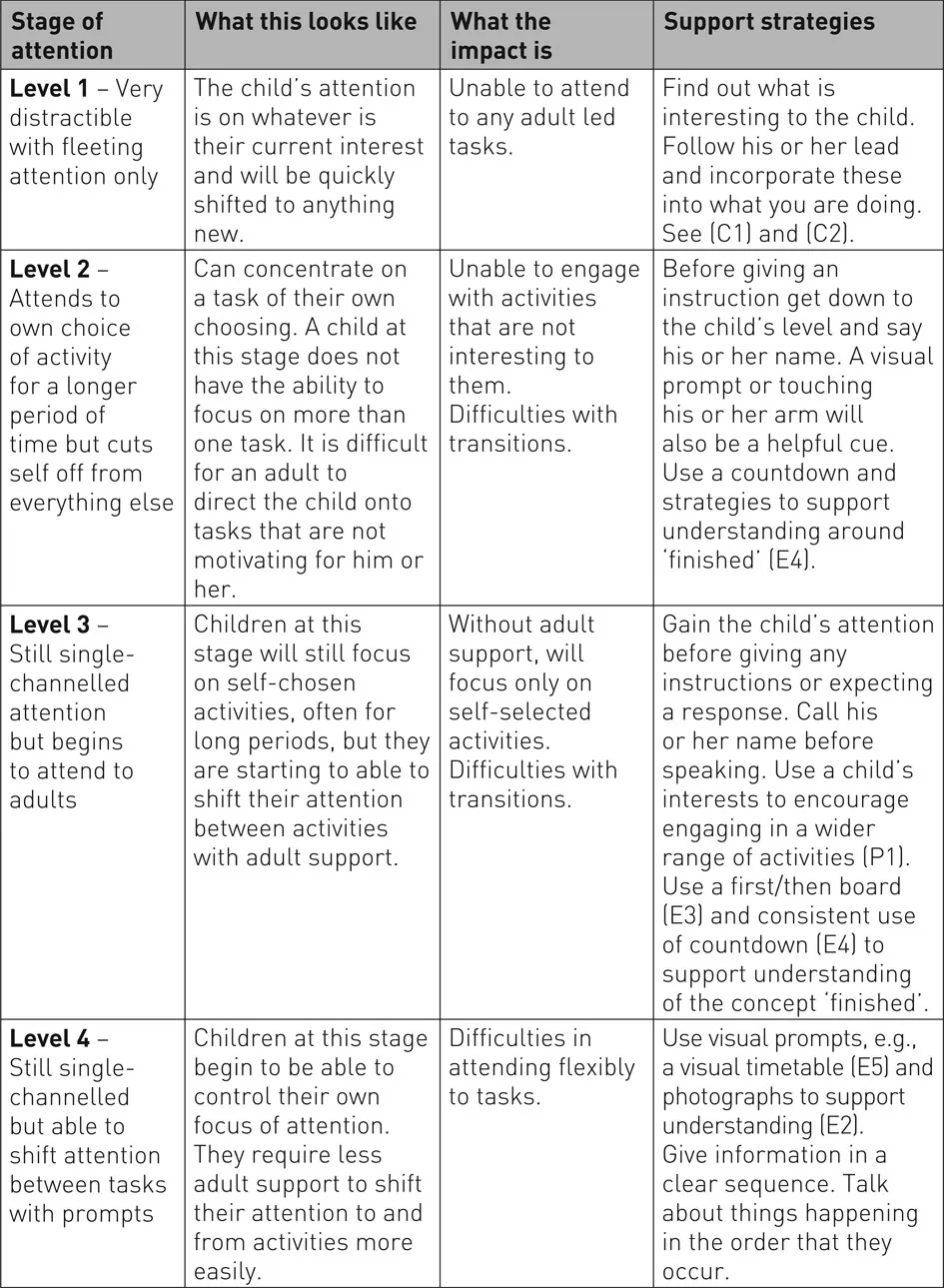
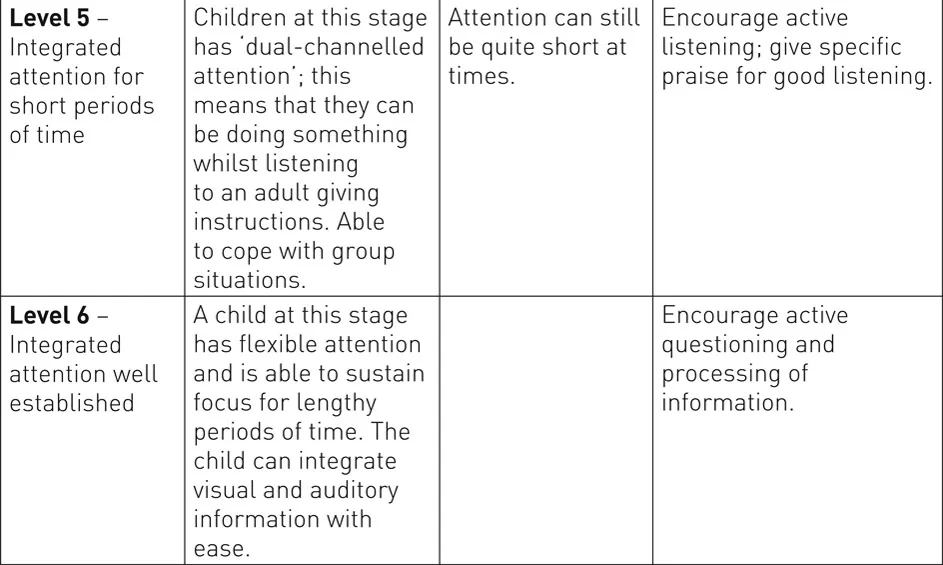
Often the activities that we expect a child to engage in within an early years education environment are at a higher level (level 5–level 6) than their skills are at (level 1–level 4). Table 3.1 outlines the stages of attention and provides some simple strategies for each level. Information regarding the levels of attention adapted from Cooper, Moodley and Reynell (1978).
Look at the stages of attention in the Skills Profile or in Table 3.1. Think about a child you work with, and think what level of attention they are at. Think about the activities they can and can’t engage with. What is the difference?
Table 3.1 Stages of attention, implications, and support strategies
Development of communication in children with ASD
Children with ASD develop communication in an atypical way; often SLTs will describe it as following a ‘disordered pattern of development’. These means that the communication skills of children with ASD aren’t behind their developmental stage and age; they are developing in an uneven way. Even amongst children with ASD of the same age, there can be a huge variability in ter...
Table of contents
Cover
Half Title
Series Page
Title
Copyright
CONTENTS
Acknowledgements
Introduction to autism spectrum disorder (ASD)
The early years environment: challenges and opportunities
Communication skills
Social interaction
Play skills in the early years
Making sense of behaviour
Next steps
Appendices
Trusted by 375,005 students
Access to over 1.5 million titles for a fair monthly price.
Study more efficiently using our study tools.
Frequently asked questions
Yes, you can cancel anytime from the Subscription tab in your account settings on the Perlego website. Your subscription will stay active until the end of your current billing period. Learn how to cancel your subscription
No, books cannot be downloaded as external files, such as PDFs, for use outside of Perlego. However, you can download books within the Perlego app for offline reading on mobile or tablet. Learn how to download books offline
Perlego offers two plans: Essential and Complete
Essential is ideal for learners and professionals who enjoy exploring a wide range of subjects. Access the Essential Library with 800,000+ trusted titles and best-sellers across business, personal growth, and the humanities. Includes unlimited reading time and Standard Read Aloud voice.
Complete: Perfect for advanced learners and researchers needing full, unrestricted access. Unlock 1.5M+ books across hundreds of subjects, including academic and specialized titles. The Complete Plan also includes advanced features like Premium Read Aloud and Research Assistant.
Both plans are available with monthly, semester, or annual billing cycles.
We are an online textbook subscription service, where you can get access to an entire online library for less than the price of a single book per month. With over 1.5 million books across 990+ topics, we’ve got you covered! Learn about our mission
Look out for the read-aloud symbol on your next book to see if you can listen to it. The read-aloud tool reads text aloud for you, highlighting the text as it is being read. You can pause it, speed it up and slow it down. Learn more about Read Aloud
Yes! You can use the Perlego app on both iOS and Android devices to read anytime, anywhere — even offline. Perfect for commutes or when you’re on the go. Please note we cannot support devices running on iOS 13 and Android 7 or earlier. Learn more about using the app
Yes, you can access Supporting SLCN in Children with ASD in the Early Years by Jennifer Warwick in PDF and/or ePUB format, as well as other popular books in Education & Early Childhood Education. We have over 1.5 million books available in our catalogue for you to explore.