eBook - ePub
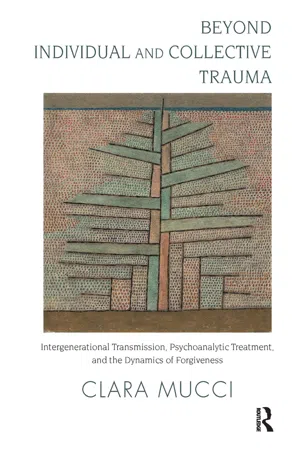
Beyond Individual and Collective Trauma
Intergenerational Transmission, Psychoanalytic Treatment, and the Dynamics of Forgiveness
- 312 pages
- English
- ePUB (mobile friendly)
- Available on iOS & Android
eBook - ePub
Beyond Individual and Collective Trauma
Intergenerational Transmission, Psychoanalytic Treatment, and the Dynamics of Forgiveness
About this book
This book represents a major effort to integrate contemporary theories and findings regarding the psychological effects of severe trauma. It explores the psychodynamic implications of aggression, sexuality and dependency, and the consequences of primitive defensive operations dealing with them.
Information
CHAPTER ONE
From early relational trauma, to abuse, to massive social trauma
The psychoanalytic concept of trauma describes it as “any excitations from outside which are powerful enough to break through the protective shield” of the “living vesicle” (Freud, 1920g, pp. 301, 298). Thus, it is a unique event characterised by the excessive intensity of the stimulus in relation to what the ego can sustain, breaking through the shield of the mind of the subject, as Freud explained in Beyond the Pleasure Principle (thinking of war trauma in particular). When we consider trauma today, reflecting on it together with this established view, we conjure up more and more a traumatic condition established over time between child and caregiver, which is usually referred to as “early relational trauma”. This concept, as we will see, is a disturbance in the attachment relationship of the child towards the parent, a concept not too distant from what Masud Khan called “cumulative trauma” (1963). In other words, we tend to think of a traumatic climate or situation perduring in time in which psychological, physical, or sexual abuse might be perpetrated even without overt dramatic features being immediately noticeable but whose potentially pathological effects can be nonetheless very serious.
Internationally renowned researchers on trauma and society such as van der Kolk, McFarlane, and Weisaeth (1996) prefer to speak of a “traumatic atmosphere”, to better define the everyday climate which can be highly destructive of the Self, in which a deeply neglected or even abused child might find herself; Lenore Terr (1994) distinguishes between Type 1 trauma, that is traumatisation due to a single event, and Type 2 trauma, taking place over a long period of time, often within the silence of a family or of society, as happens with severe neglect, abuse, violence and incest.
Antonello Correale defines a traumatic experience as “not exclusively a single experience capable of determining a destructuring of cognitive capacities according to a mechanism concentrated in time, but in a wider sense the reiterated exposition to disturbing or incomprehensible aspects of the signifying other” (2006, p. 135). Cesare Albasi (2006) writes about “traumatic attachments”, identifying, in the wake of Bowlby’s internal working models, a new category of internal working model which he terms “dissociated internal working models” (DIWM). Liotti and Farina (2011) have recently devoted a study to “traumatic developments”.
Social and collective preoccupation is also evident in the discourse on trauma; for instance Correale asks if contemporary Western society presents traumatising factors that need to be considered at a collective level as well as on the individual level, and that contribute to the sense of emptiness and precariousness so typical of our time (Correale, in Cellentani, 2008, pp. 35–36). Bohleber (2012) calls for the necessity of a social discourse framing traumatic consequences and the subsequent generations in history and defines trauma as “a brute fact that cannot be integrated into a context of meaning at the time it is experienced because it tears the fabric of the psyche” (2007, p. 335); in other words, an individual threshold has been irreparably crossed and a fundamental and irreparable breach has taken place.
French theoreticians and clinicians prefer to speak of “traumatism” in a wider medical, psychological, or socio-anthropological context (Fassin & Rechtman, 2007).
Together with this attention to the relational aspects of trauma, testified by a renewed interest in attachment theory and early relational trauma, clinical work with traumatised patients underlines the reality-based aspects of trauma, in contrast with the classic Freudian theory which, with various detours, highlighted the fantasmatic aspects of trauma, as the determining feature.
According to Laplanche and Pontalis’s Vocabulaire de la psychanalyse (1967), the internal and external world both contribute to a traumatic effect, since it would be impossible to speak of traumatic events in an absolute way, without considering the sensitivity of the subject.
Although it is undeniable that both subjective and objective elements intervene in establishing what will result in traumatisation for the subject, this individual threshold should not prevent us from thinking that trauma might also be a real event. As Paul-Claude Racamier writes in L’incest et l’incestuel, we do not need to contrast the very origin of psychoanalytic theory and practice, with the so-called “seduction theory” which Freud après coup disavowed, underlining the unconscious fantasmatic elements in its stead; but rather, we want to investigate what happens when the seduction [or the abuse: a better word] really existed (1995, p. 59).
We want to propose a kind of psychoanalytic practice capable of bearing witness to what in society is always in danger of undergoing repression and marginalisation, a psychoanalysis not only rooted in the intrapsychic but fostering a clinical and theoretical activity that includes the interpersonal, the ethical and the social, which is therefore situated on the site of testimony, active against the “resistance to know” that is at the foundation of culture (Bohleber, 2012, talks of “reluctance to know”). With Cathy Caruth, we want to emphasise a “speaking and a listening from the site of trauma” (Caruth, 1995), aware, as Dori Laub and Susanna Lee write, that “it is not the lie itself, but the continued communal acceptance of the lie, that indicates the operation of the death instinct. This constant and relentless opposition to knowing compromises the ability to see and recognise truth” (2003, p. 459). Psychoanalysis can help us understand this movement from individual to collective, and vice versa. In fact, the same dynamics that occur in the psyche also form the collective environment: “Repression, dissociation, and denial are phenomena of social as well as individual consciousness” (Herman, 1992, p. 9). Sociologist Slavoj Žižek (1989) has identified trauma as the kernel of modern societies taking the example of the extermination camps or of the Gulag as a symbol of the “real” in our civilisation, “which returns as the traumatic kernel in all social systems” (p. 50), following a Lacanian view in which trauma is identified with the real, the unsymbolised and unassimilable per excellence (see also Kirshner, 1993). Žižek has been criticised (by Judith Butler, among the others) for his “universalising” attempt at a definition of trauma, while others, Bohleber in primis, remind us of a specific historicisation of trauma. I think the two views are not incompatible. While it might be true, with Anna Freud, that with a too ample theory of trauma we are in danger of making this concept too general and therefore vague, leading to a “blurring of meaning” (A. Freud, 1967, p. 235), I don’t think we are at risk of losing the cogency of the specific historicity of trauma if we believe that trauma and the real (beyond Lacan’s frame) can be linked in some cases, especially in contemporary society. I think it is not a catastrophic view, or a post-modern, but a realistic one. As Caruth, again, writes, “In a catastrophic age, trauma itself may provide the link between cultures” (1995, p. 11); this philosophical statement is attested to by psychologists and psychopathologists, confirming that we live in an age that is constantly in danger of massive traumatisation. At the root of trauma, there is history itself: “It is indeed the truth of the traumatic experience that forms the center of its psychopathology; it is not a pathology of falsehood or displacement of meaning, but of history itself” (Caruth, 1995, p. 5). “Historical trauma” is a concept coined by Dominick LaCapra (2001), who in turn, recognising the “symptomatic dimension as well as the phantasmatic in all cultural phenomena” questions (in relation to Žižek’s influential take) “any homogenising notion of desire and would distinguish among phenomena … on the basis of the specific combination in them of symptomatic, critical, and possibly transformative processes and effects” (LaCapra, 2004, p. 9).
The link between trauma and reality might simply be psychologically and socially effective and an ethical stance to keep in mind, for a wider representation of the high levels of suffering and traumatisation belonging to our contemporary, some would say “post-modern”, societies. It is not incidental that contemporary anthropology, facing the universal tasks of accounting for what is “human” within different societies, turns to the discourse of trauma and dehumanisation more and more (Beneduce, 2010). In man-made trauma, what is human also defines what is unhuman, and trauma testifies to the extremes and limits of both.
In this work, we want first of all to investigate what happens to the individual when the event leading to the traumatisation is a real, man-made event, that is, it is not due to a natural (or so-called natural, since human responsibility often needs to be ascertained) catastrophe. Our focus is instead on a traumatic relationship, or a kind of attachment generating confusion, chaos and fear, (as in so-called disorganised attachment). We also want to investigate what happens at a neurobiological level to a child living in an abusive and violent or invalidating environment and what are, as a consequence, the implications for psychotherapy, focusing particularly on the consequences that adverse conditions in child rearing have for society at large. What happens, for example, to an individual who has undergone a potentially mortal aggression or has been a direct witness of a devastating traumatic event such as ethnic cleansing, political persecution and torture, extermination of a “race”, a nation or a social group as happened in Ruanda, in the former Yugoslavia, in South Africa, Latino-America or in the case of the Shoah, which remains unique for its proportion and level of bureaucratic organisation. We aim at investigating what happens when the violence or the abuse remains inscribed in the individual body and mind, both on a subjective and interpersonal level, and how it is transferred into the subsequent generations.
Against decades of psychoanalytic interest centred almost exclusively on fantasies, we want to focus our attention on the reality-based aspects of trauma in the awareness that, as Robert S. Wallerstein observed at the 1972 winter meetings in New York, the psychoanalytic study of reality has been “relatively neglected or taken for granted in usual psychoanalytic discourse” (1973, p. 23). More recently, Werner Bohleber noted that psychoanalysis, “originally undertaken in order to discover repressed childhood memories, is now in danger of becoming a treatment technique that actually fades out history” (2010, p. 109), if it remains fixed to the intrapsychic world and the constructions of fantasy more than attuned to real events and real relational experiences.
This traditional attitude also has a bearing on clinical practice: as Gherardo Amadei (in Lingiardi et al., 2011) argues in La svolta relazionale, an old-fashioned psychoanalyst, within the analytic session, instead of focusing on what is happening right now in the relationship and in the room, has instead been trained to catch and give meaning to the distant and unknown aspects of what is being said. The past scars will inevitably leave residues in the present, but the only possibility to really affect and redeem them is in the present relationship, both at the implicit and the explicit level (concepts we will clarify).
The interpretation of anything that takes place within the therapeutic frame has a much more complex meaning than it would have outside of that setting; but this should not lead to neglecting what is happening in the here and now of the analytic room, with the risk of re-traumatising the patient precisely on the basis of the denial of the reality on the part of an adult in the position of authority, an adult who should have been a witness to what had happened, and whose denial cost the patient so much.
Early relational trauma and the theory of attachment
In the recent volume edited by Giovanni Liotti and Benedetto Farina, Sviluppi Traumatici, we read, in the incipit: “The relationships in which those who habitually take care of a child expose her also to maltreatment, abuse, or severe emotional neglect, affect in a stable way her mental development and are considered capable of causing vulnerability to an ample variety of psychic disturbances, not only during childhood but also in the adult age” (2011, p. 3, translated for this edition).
The traumatic quality of early relationships seems to be at the root of future pathologies such as the borderline personality disorder, depression, alcohol and substance abuse. Fonagy (2001), Liotti (1999a, 1999b), van der Kolk (1987), and many other researchers have identified in attachment disorders and especially in disorganised attachment a vulnerability to future traumas and pathologies.
Disorganised attachment has been studied by Main and Solomon (1986, 1990), and by Main and Hesse (1990), and includes a variety of contradictory behaviours, ill-directed, decontextualised, out-of-control conduct by children towards their caregivers, after a period of separation. These works refer to one-year-old children studied within the protocol of the so-called strange situation and other experiments involving the presence of strangers and the absence of the caregiver for a given time (Ainsworth & Wittig, 1969; Main & Solomon, 1990; Main & Weston, 1981). This laboratory procedure was designed to examine the balance that one-year-olds have between attachment and exploratory behaviour in conditions of low and high stress. In a twenty-minute session, mother and infant are introduced into a laboratory playroom, where they are joined by a woman stranger. The stranger plays with the child, while the mother leaves shortly and then comes back. In a second separation, the child is left totally alone, then the stranger and finally the mother return.
John Bowlby, the British psychoanalyst to whom we owe these first studies on the bond (and separation) between mother and infant, noted that certain contradictory elements such as incoherent behaviour of these children indicating anger, rage, anxiety and fear towards the adult were not expressed because of fear of alienating the attachment figure. These behaviours seem to be a sign of the defences activated on one hand with the purpose of avoiding the emotional pain linked to the departure of the caregiver, on the other hand, they have the purpose of excluding (starting from late infancy) painful representations of the self and of the object. The mothers of these disorganised children seem to be unresponsive and rather insensitive towards them and show emotional distance or intrusiveness.
It is important nonetheless to stress that, although a disorganised kind of attachment might imply a vulnerability for the individual, a vulnerability which, together with a familiarity (genetic elements) and other environmental experiences, might lead to future pathology, reparatory elements might intervene. For instance, together with an unavailable mother, there might be a father or another caregiver who is on the contrary capable of providing care and comfort, therefore the connections between nature and nurture, as we will see, are highly complex and difficult to predict on the basis of a single element. Differently said, if pathogenic elements are not present and protective factors are in the environmental context, the early experience of disturbed or altered states of consciousness might not lead to pathology.
But in general, it is the study of trauma and of the pathologies connected to trauma that might lead to an appreciation, in the psychoanalytic and psychotherapeutic field, of attachment theory and its findings.
Attachment theory might have been ostracised for many years by psychoanalysts (an attitude that still persists in certain areas of this discipline) precisely because ...
Table of contents
- Cover
- Half Title
- Title Page
- Copyright Page
- Table of Contents
- Acknowledgements
- About the Author
- Preface
- Chapter One From early relational trauma, to abuse, to massive social trauma
- Chapter Two Psychoanalysis of trauma: contemporary psychoanalysis and/as testimony
- Chapter Three Generations of trauma: reflections on the transmission of trauma from the first to the second and third generation
- Chapter Four Going beyond trauma: mourning, connectedness, creativity, and the practice of forgiveness
- References
- Index
Trusted by 375,005 students
Access to over 1.5 million titles for a fair monthly price.
Study more efficiently using our study tools.
Frequently asked questions
Yes, you can cancel anytime from the Subscription tab in your account settings on the Perlego website. Your subscription will stay active until the end of your current billing period. Learn how to cancel your subscription
No, books cannot be downloaded as external files, such as PDFs, for use outside of Perlego. However, you can download books within the Perlego app for offline reading on mobile or tablet. Learn how to download books offline
Perlego offers two plans: Essential and Complete
- Essential is ideal for learners and professionals who enjoy exploring a wide range of subjects. Access the Essential Library with 800,000+ trusted titles and best-sellers across business, personal growth, and the humanities. Includes unlimited reading time and Standard Read Aloud voice.
- Complete: Perfect for advanced learners and researchers needing full, unrestricted access. Unlock 1.5M+ books across hundreds of subjects, including academic and specialized titles. The Complete Plan also includes advanced features like Premium Read Aloud and Research Assistant.
We are an online textbook subscription service, where you can get access to an entire online library for less than the price of a single book per month. With over 1.5 million books across 990+ topics, we’ve got you covered! Learn about our mission
Look out for the read-aloud symbol on your next book to see if you can listen to it. The read-aloud tool reads text aloud for you, highlighting the text as it is being read. You can pause it, speed it up and slow it down. Learn more about Read Aloud
Yes! You can use the Perlego app on both iOS and Android devices to read anytime, anywhere — even offline. Perfect for commutes or when you’re on the go.
Please note we cannot support devices running on iOS 13 and Android 7 or earlier. Learn more about using the app
Please note we cannot support devices running on iOS 13 and Android 7 or earlier. Learn more about using the app
Yes, you can access Beyond Individual and Collective Trauma by Clara Mucci in PDF and/or ePUB format, as well as other popular books in Psychology & History & Theory in Psychology. We have over 1.5 million books available in our catalogue for you to explore.