
- 452 pages
- English
- ePUB (mobile friendly)
- Available on iOS & Android
eBook - ePub
About this book
Logistics: Principles & Practice is a general introduction to the subject. This specialized field is fast moving â fulfilling orders on time is of crucial importance in the modern age of internet economy and just-in-time production.
Besides dealing with the logistics of purchasing, production and distribution, the book also examines common ground with marketing, quality and production design. This integrated approach ensures that important topics such as e-business, CRM, process design, E-procurement, enterprise resource planning and E-logistics are given prominent coverage.
This textbook can be used as core reading for all students of logistics and operations management.
Frequently asked questions
Yes, you can cancel anytime from the Subscription tab in your account settings on the Perlego website. Your subscription will stay active until the end of your current billing period. Learn how to cancel your subscription.
No, books cannot be downloaded as external files, such as PDFs, for use outside of Perlego. However, you can download books within the Perlego app for offline reading on mobile or tablet. Learn more here.
Perlego offers two plans: Essential and Complete
- Essential is ideal for learners and professionals who enjoy exploring a wide range of subjects. Access the Essential Library with 800,000+ trusted titles and best-sellers across business, personal growth, and the humanities. Includes unlimited reading time and Standard Read Aloud voice.
- Complete: Perfect for advanced learners and researchers needing full, unrestricted access. Unlock 1.4M+ books across hundreds of subjects, including academic and specialized titles. The Complete Plan also includes advanced features like Premium Read Aloud and Research Assistant.
We are an online textbook subscription service, where you can get access to an entire online library for less than the price of a single book per month. With over 1 million books across 1000+ topics, weâve got you covered! Learn more here.
Look out for the read-aloud symbol on your next book to see if you can listen to it. The read-aloud tool reads text aloud for you, highlighting the text as it is being read. You can pause it, speed it up and slow it down. Learn more here.
Yes! You can use the Perlego app on both iOS or Android devices to read anytime, anywhere â even offline. Perfect for commutes or when youâre on the go.
Please note we cannot support devices running on iOS 13 and Android 7 or earlier. Learn more about using the app.
Yes, you can access Logistics by Hessel Visser in PDF and/or ePUB format, as well as other popular books in Business & Business General. We have over one million books available in our catalogue for you to explore.
Information
1
Logistics: the start
1 Logistics subsystems
2 Logistics framework
Logistics covers a wide field of activity. Before we can get to work, we need to define and classify the discipline.
Chapter 1 starts by making the traditional distinction between production and distribution logistics. Touching on some of the related costs, we describe the logistics subsystems in both stages. We then expand the traditional division to include purchasing logistics and reverse logistics. We show that logistics applies not only to manufacturing and distribution but also to service industries such as health care, banking and airlines.
Chapter 2 provides insight into the logistics concept that establishes the âblueprintâ or standard framework of modern logistics. Using this model, organizations can investigate and if necessary adapt their logistics systems. Our discussion of the logistics concept covers four topics:
- The logistics structure. This deals with establishing the primary process, including the layout of machines on a factory floor, the required warehouse space and choice of distribution channel. All of these involve far-reaching, strategic decisions for a company.
- The logistics control system. When we know much about a particular product demand, the logistics control system is relatively simple. Unfortunately, this only applies to a few products or services. Often we need more complex control systems.
- The logistics information system. Logistics functions as a service and draws its information from the enterprise information system (ERP). We come back to this important topic several times in this book.
- The organization of logistics personnel. Tasks and responsibilities are broadening and becoming more important, especially with regard to supply chain management.
This basic concept of logistics applies equally to the logistics of purchasing, production and distribution, and reverse logistics.
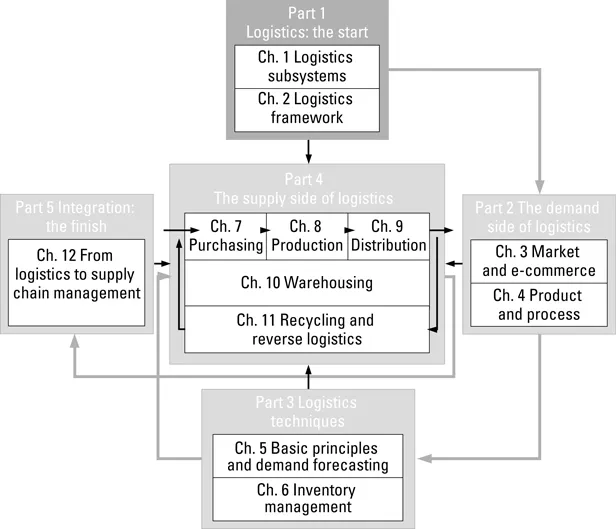
The terms and concepts given in Part 1 form a good basis for study as the following diagram clearly shows.

The thread through Logistics: principles & practice
1
Logistics subsystems
1.1 Introduction to logistics
1.2 Historical development of logistics
1.3 Logistics subsystems
1.4 Logistics in a production environment
1.5 Logistics in a distribution environment
1.6 Logistics in service industries
1.7 Logistics in other contexts
In this chapter, we briefly introduce the discipline of logistics, covering its background, current fields of application and defining some important terms on the way.
Section 1.1 presents an introduction to the field. Here the begin point is that the client always comes first. We touch on historical development in section 1.2 while in section 1.3 we examine the subsystems of modern logistics, including purchasing, production, distribution and reverse logistics.
In sections 1.3.1 to 1.3.3 we demonstrate the practical relevance of logistics with a number of examples. Section 1.4 deals with logistics in the context of production, section 1.5 treats the distribution context while section 1.6 focuses on logistics in service industries. Finally, in section 1.7 we look at how logistics works in other contexts.
Learning goals
After having studied this chapter, you will know:
- the scope and definition of the discipline of logistics
- the history of development from military logistics onwards
- the differences between military and civil logistics
- how the logistic process has broadened and changed in past years
- the role of change in consumption patterns
- the factors contributing to organizations becoming more complex
- the distinctions between different subsystems in logistics
- the decisions that can be made within logistics
- the application of logistics in different contexts.
INTRODUCTORY CASE
China might be your plan A, butâŚ
On going East and the importance of keeping your options open, some predictions are safe to make. For example, if your company is entering the global market, you are probably looking to China to play a key role in your manufacturing future. According to a paper recently co-published by APL Logistics and Drewry Shipping Consultants, China accounts for a vast amount of the worldâs production, including 75 percent of its toys, 20 percent of its steel and 18 percent of its apparel and textiles. The country has a huge supply of labor at some of the worldâs most competitive wages. Since China joined the World Trade Organization, it has demonstrated an impressive ability to attract foreign investment.
Here are two other bold predictions: you could find it difficult to complement your Chinese manufacturing with a seamless and efficient logistics service; and you could run into trouble if you rely on China as your sole manufacturing market. Letâs start with the logistical difficulties first. Unfortunately, Chinaâs logistics infrastructure and practices are in great need of improvement. The countryâs density of roadways is scant compared with Europe. Tolls on these roads are comparatively high, sometimes accounting for as much as 20 percent of the total cost of the haul. And the cross-country truck service is basically nonexistent. Chinaâs rail system also faces challenges. Some rail routes require you to book space as much as six weeks in advance. Rail terminals can rarely give an accurate read on where cargo is or when itâs available. Even inventory at rest has its problems. China has a shortage of cargo storage space and much of the capacity it does have is old which leads to cargo damage and high inventory costs.
Despite these challenges, China is still the obvious frontrunner for many companiesâ manufacturing investments â and legitimately so. In fact, it is almost every major companyâs plan A for manufacturing operations. China is certainly a significant component of my companyâs logistics portfolio and will play an important role in our development plans. But the past few years have shown that it is always important to have diversity built into your supply chain. SARS was a sobering less on in this respect, because even though it does not seem to have affected inventory, it affected China for some time and there were very real concerns that the impact would be both serious and sustained. In todayâs world, no corner of the globe is immune from situations that could affect your ability to get your goods to market in a timely manner. As a result, itâs wise to consider having an option of access to alternative sourcing.
While China is clearly a primary sourcing location for major European retailers, many of these retailers continue to maintain production in other regions â notably Eastern Europe. But the good news is that China is in the process of addressing many of its logistics challenges. It is currently working on a five-year plan that includes substantial infrastructure improvement, regulatory change and a policy more friendly toward foreign investment. Also, the influx of business from Europe and the US is raising the bar on Chinaâs logistics practices and introducing new efficiencies into its supply chain structures. And some leading third-party logistics providers are increasing their presence there. As a result, itâs safe to say that the worldâs factory floor will become an even more viable venue for your manufacturing in coming years. In the meantime, be prepared to integrate the current realities of sourcing in China into your supply chain plans.
Source: H. Hickler, Logistics Europe, February 2004, p. 6
1.1 Introduction to logistics
Organizations often face problems caused either by their suppliers, their own fault or their clients.
Due to their suppliers:
- delivering goods late
- delivering the wrong goods
- delivering a shipment to the wrong address
- providing bad service after the goods have arrived.
Due to their own fault:
- bad lay-out in the warehouse
- inventory fails to correspond with its administration
- machines kept idle because they lack raw materials.
Due to their clients:
- complaining about missing goods on delivery
- refusing to pay, because the order has been delivered incomplete.
You might recognize some of these problems from your own experience. All are related to managing the flow of goods. This wide field of activity is called âlogisticsâ. It is a very practical discipline. The purpose of this book is to arouse the readerâs interest in the discipline of logistics.
Logistics
For companies such as Tesco and Marks & Spencer, logistics has become an integral part of their business. Logistics is often identified most closely with trade and transport. In the opening case you can read how vital it is to have efficient transport f...
Table of contents
- Cover
- Half Title
- Title
- Copyright
- Preface
- Contents
- Study guide
- Part 1 Logistics: the start
- Part 2 The demand side of logistics
- Part 3 Logistics techniques
- Part 4 The supply side of logistics
- Part 5 Integration: the finish
- Answers to the intermediate questions
- Answers to the multiple-choice questions
- References
- Addresses of logistics organizations and links to websites
- About the authors
- List of abbreviations
- Index