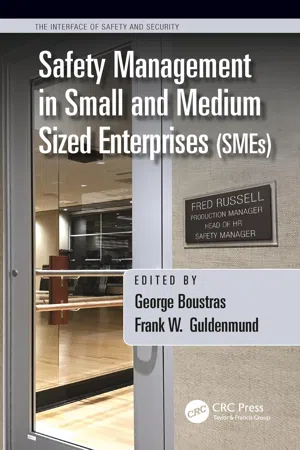
Safety is an important aspect of everyday business operations. It can have an impact on the operations of an enterprise as well as the wellbeing of the workers. Literature shows that SMEs face extra problems in this area due to limited resources and lack of knowledge. A potential accident on the premises, in many cases, has devastating consequences. SMEs make up the vast majority of private companies in the EU and beyond. Despite the importance of the issue, the information found in literature is scattered and often not aimed at SMEs. This book aims to gather the latest information and become the full reference point for designing and adopting an appropriate safety strategy for SMEs.
eBook - ePub
Safety Management in Small and Medium Sized Enterprises (SMEs)
- 222 pages
- English
- ePUB (mobile friendly)
- Available on iOS & Android
eBook - ePub
Safety Management in Small and Medium Sized Enterprises (SMEs)
About this book
Information
1
Introduction
This book aims to be the first practical guide for any small and medium sized enterprise (SME) owner or manager to establishing a safe and healthy work environment – indeed, an ‘owner’s manual’. At the same time, the book is written mostly by academics, because the intent is to provide a solid scientific basis to this aim. By including a number of case studies and case examples we try to be of practical use to the owner and/or manager.
Understandably, this has been a challenging job to coordinate, as a number of people with different backgrounds and from different countries have contributed to the book. It has taken longer than we had initially anticipated, but we hope that the end result will be worth the wait.
Occupational Safety and Health (OSH) is an important notion which can function as a particular line of defence for both employees and employers. OSH is based on a number of directives and pieces of legislation that are partly grounded in studies and documents released by the International Labour Organization (ILO). Different countries, different legal systems and different cultures may differ in parts of the legislation but all the general concepts are present. The editors and contributors of this book try to present these core issues, taking especially the legislation of the European Union (EU) as well as the United States into account.
Chapter 2 provides an in-depth, both practical as well as theoretical introduction to risk assessment. Risk assessment is the main (and sometimes the only) tool in the hands of the owner/manager in order to identify the risk profile of his/her organization. Risk, by default, possesses a degree of uncertainty and is defined by a number of parameters that are not always easy to derive. A number of guides on and examples of risk assessment(s) exist in the literature and on the Internet, but it is important to realize that only a tailor-made risk assessment that takes into account the local and organizational culture and other particularities will produce a good reference, which in turn will lead to the provision of robust and effective risk management options (RMOs).
Chapter 3 presents a framework for the management of OSH in the workplace. A basic introduction to legislation is followed by practical examples as well as a theoretical context for how to make the necessary arrangements for a safety management system. Emphasis is put on the importance of the human element in this process. Participation of employees in the safety decision-making process through the establishment of appropriate committees is a key notion in this chapter. The commitment of management as expressed through the development and adoption of a sound safety policy is the second important element.
Chapter 4 discusses the most important OSH standards applicable to SMEs. SMEs need to comply with pertinent EU legislation and small companies are often not aware of these. This chapter offers an insight into this extensive and rather complex world. Furthermore, it provides a clear overview of the practice of auditing, which is what SMEs can do to see whether they actually comply to pertinent legislation. Audits identify strong as well as weak OHS areas and will offer directions to improve the latter. SMEs can perhaps identify a few OSH indicators themselves, which they can monitor to see whether their OHS practices are up to standard. Chapter 4 provides clues for these.
Chapter 5 tackles the topic of safety climate. Safety climate refers to the perception employees have of the overall priority of safety within the organization. In essence, safety climate can provide another performance indicator for safety; a relationship has been found between measures for safety climate and, for instance, incidents and accidents. Following a thorough theoretical discussion of the concept, also the use and application of safety climate for SMEs is explained in this chapter. A short safety climate questionnaire is provided in the chapter (Table 5.1).
Chapter 6 discusses new perspectives on safety training. This chapter first describes the concept of a culture of prevention and clarifies the term competence at both an individual and organizational level. It goes on to analyze the meaning of safety competence and health competence, and discusses possible competences for a culture of prevention and the conditions for change and learning in SMEs in the future.
Chapter 7 focuses on micro-firms, a special case of SMEs. In contrast to the abundance of information with regard to, for example, risk assessment, safety performance and various other aspects of safety, there is a gap in knowledge regarding smaller firms that employ less than 10 employees. Understandably, distinct roles of employers and employees in smaller firms can be difficult to identify and differentiate. The role of the manager is that of a role model as well as that of a co-worker in many occasions. This chapter focuses on the presentation and discussion of organizational factors as well as governmental and organizational safety policies that define OSH in micro-firms. The chapter ends with a number of practical recommendations.
Chapter 8 is concerned with monitoring and the modification of a SMS. It is divided into two parts. In the first part, the investigation of incidents (or accidents) is discussed. As explained in Chapter 4, audits already provide useful information about the SMS’s functioning. However, unplanned events such as incidents or accidents also provide information about the system’s performance, for example whether some risks have been overlooked or underestimated. In the second part of the chapter, the modification of the SMS is addressed, in particular, the modification of (safe) behaviour using BBS (behaviour-based safety) programmes. Results of these and incident/accident investigations can be used to modify the SMS.
Chapter 9, the final chapter of this book, focuses upon an important, yet, on many occasions, neglected area in OSH, namely safety communication. Successful safety policies and practices often go unnoticed or are misunderstood in the workplace. The aim of this chapter is to present theoretical and practical aspects of safety communication in the workplace. The authors start by presenting basic concepts such as risk perception, awareness and communication. After that, risk communication tools are explained and practical solutions are presented.
2
Risk Assessment
Getting the ‘Big Picture’
Contents
2.1Introduction
2.2Risk Perception in SMEs
2.3Risk Assessment
2.4Hazard Identification Techniques
2.4.1Checklist
2.4.2Safety Audit
2.4.3‘What If?’ Analysis
2.4.4Preliminary Hazard Analysis (PHA)
2.4.5Hazard and Operability Study
2.5Risk Assessment Methods
2.5.1Quantitative Risk Assessment Methodologies
2.5.2Qualitative Risk Assessment Methodologies
2.5.2.1BS 8800:2004 Simple Matrix Method
2.5.3Semi-Quantitative Risk Assessment Methodologies
2.5.3.1Methodology for an Initial Risk Assessment
2.5.3.2Risk Assessment Approach for the Furniture Industrial Sector
2.6Acceptance Criteria
2.7Final Remarks
References
2.1Introduction
Over the years, several principles, theories, methods and approaches have been developed to assess and manage risks in different fields (see, e.g., Aven, 2016). One clear example of this is observed in the industries with potential for major hazards or risk of disaster, on which most of the literature has been focused and for which rigorous and sophisticated techniques and methods have been proposed. However, attention to small and medium sized enterprises (SMEs) has only been seen more recently.
Nowadays, it is widely recognized that risk assessment and control are particularly challenging for SMEs. Limited (human, economic and technological) resources, little knowledge about the enterprise’s risks by the owner (referred later in this chapter as the owner/manager) and deficiencies in organizational processes are often highlighted as insurmountable obstacles to enterprises effectively assessing and controlling their own risks (Jensen et al., 2001; Fabiano et al., 2004; Sørensen et al., 2007; Micheli and Cagno, 2008). An additional factor exacerbating the problem is the frequent mismatch between the legal framework and SMEs’ needs. ...
Table of contents
- Cover
- Halftitle Page
- Title Page
- Copyright Page
- Dedication Page
- Contents
- Acknowledgements
- Editors
- Contributors
- Chapter 1 Introduction
- Chapter 2 Risk Assessment: Getting the ‘Big Picture’
- Chapter 3 Safety Management
- Chapter 4 Safety Performance in an SME Environment
- Chapter 5 Safety Climate of Small-to-Medium Enterprises
- Chapter 6 Competences for a Culture of Prevention: Conditions for Learning and Change in SMEs
- Chapter 7 Micro-SMEs: A Special Case
- Chapter 8 Monitoring and Modifying a Safety Management System
- Chapter 9 Risk Communication in SMEs
- Index
Trusted by 375,005 students
Access to over 1.5 million titles for a fair monthly price.
Study more efficiently using our study tools.
Frequently asked questions
Yes, you can cancel anytime from the Subscription tab in your account settings on the Perlego website. Your subscription will stay active until the end of your current billing period. Learn how to cancel your subscription
No, books cannot be downloaded as external files, such as PDFs, for use outside of Perlego. However, you can download books within the Perlego app for offline reading on mobile or tablet. Learn how to download books offline
Perlego offers two plans: Essential and Complete
- Essential is ideal for learners and professionals who enjoy exploring a wide range of subjects. Access the Essential Library with 800,000+ trusted titles and best-sellers across business, personal growth, and the humanities. Includes unlimited reading time and Standard Read Aloud voice.
- Complete: Perfect for advanced learners and researchers needing full, unrestricted access. Unlock 1.5M+ books across hundreds of subjects, including academic and specialized titles. The Complete Plan also includes advanced features like Premium Read Aloud and Research Assistant.
We are an online textbook subscription service, where you can get access to an entire online library for less than the price of a single book per month. With over 1.5 million books across 990+ topics, we’ve got you covered! Learn about our mission
Look out for the read-aloud symbol on your next book to see if you can listen to it. The read-aloud tool reads text aloud for you, highlighting the text as it is being read. You can pause it, speed it up and slow it down. Learn more about Read Aloud
Yes! You can use the Perlego app on both iOS and Android devices to read anytime, anywhere — even offline. Perfect for commutes or when you’re on the go.
Please note we cannot support devices running on iOS 13 and Android 7 or earlier. Learn more about using the app
Please note we cannot support devices running on iOS 13 and Android 7 or earlier. Learn more about using the app
Yes, you can access Safety Management in Small and Medium Sized Enterprises (SMEs) by George Boustras,Frank W. Guldenmund in PDF and/or ePUB format, as well as other popular books in Technology & Engineering & Management. We have over 1.5 million books available in our catalogue for you to explore.